
Items related to Revolution at the Roots: Making Our Government Smaller,...
Synopsis
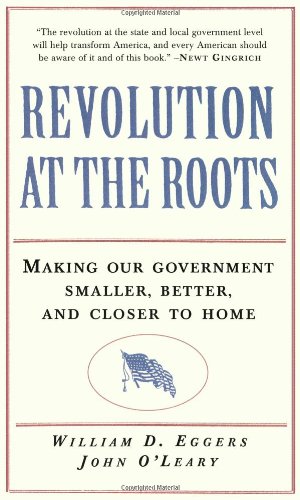
Identifying a current revolution in small government, a study examines the emergence of new, localized approaches to governance that include community policing, parental intervention, and creative neighborhood design. Tour.
"synopsis" may belong to another edition of this title.
About the Author
William D. Eggers directs the 21st Century Government Project and the Privatization Center at the Reason Foundation in Los Angeles. He has advised dozens of governments on the nuts-and-bolts of restructuring, and has written for The Wall Street Journal, The Chicago Tribune and other publications.
Reviews
Charging that our centralized federal bureaucracy is wasteful, inefficient and ill-suited to many of the tasks it now handles, the authors present a blueprint for down-sizing federal government and devolving power to states, cities and neighborhoods. Fellows of the Reason Foundation in Los Angeles, Eggers and O'Leary, who have conducted workshops with local leaders around the country, argue that federal poverty relief, job training, day care, drug abuse, arts and other programs work to undermine community and individual initiatives. Such efforts, they suggest, should be the responsibility of private-sector organizations and voluntary self-help groups. They profile governors who are streamlining state government?John Engler of Michigan, William Weld of Massachusetts, New Jersey's Christine Todd Whitman?as well as business-minded mayors such as New York City's Rudolph Giuliani, Cleveland's Michael White and Philadelphia's Edward Rendell, who are privatizing services, cutting the work force and shifting services and decision-making to the neighborhood level. In place of a welfare system, which in their view encourages dependency, they advocate letting each state choose whatever course it deems best?workfare, group homes, time limits, etc. This sure-to-be-controversial report is both a handbook for reform and a critique of big government. Author tour.
Copyright 1995 Reed Business Information, Inc.
Each of these three books presents a blueprint to achieve the goals of the current political mood?making government smaller and more accountable. Their argument is basically the same: the smaller the government, the closer it is to the people and therefore the better it is. They also tout many of the same ideas: a flat income tax, welfare reform, school choice, deregulation, and privatization. Each book, however, has its own characteristics. House Majority Leader Armey (R-Texas), one of the authors of the Republican Party's "Contract with America," argues that the 1994 election, which gave Republicans control of Congress for the first time since the 1940s, was a mandate to put the provisos of the contract into place. Armey also gives details of his own life and political ideology and spells out his proposals for a flat income tax and other initiatives. Since the Contract with America will continue to be debated by Congress, this is an important work for anyone interested in the current political climate. Eggers and O'Leary, members of the Reason Foundation, discuss initiatives taken by local and state governments to privatize and streamline bureaucracies. They provide excellent case studies of these mechanisms and present a compelling argument that, given the right personnel, government services can be improved and savings achieved. Their book is important because it provides clues as to how some local and state governments will handle the block grants currently under discussion in Washington. Pinkerton, a former aide in the Bush administration, presents a rather extreme view of the changes he claims need to be made. He believes that the current political and economic course will result in the desolate worlds described by "cyberpunks" in science fiction literature. Because government provides such shoddy service, those who can afford it will pay to have a sort of secondary government?private security guards, tutors for education, and the like?while the poor and disassociated will have access to little or no quality services. Thus, he claims, a new paradigm is needed, and he espouses many of the same ideas as Armey. His premise is somewhat questionable, but he gives a decent history of how we got where we are and delineates many of the ideas currently being debated. Pinkerton's book is recommended for academic collections, while The Freedom Revolution and Revolution at the Roots are recommended for all collections.?Patricia Hatch, Emmanuel Coll., Boston. Ma.
Copyright 1995 Reed Business Information, Inc.
"About this title" may belong to another edition of this title.
Search results for Revolution at the Roots: Making Our Government Smaller,...

Stock Image
Revolution at the Roots Making
Seller: World of Books (was SecondSale), Montgomery, IL, U.S.A.
Seller rating 5 out of 5 stars

Condition: Very Good. Item in very good condition! Textbooks may not include supplemental items i.e. CDs, access codes etc. Seller Inventory # 00102057974
Stock Image
Revolution at the Roots: Making Our Government Smaller, Better and Closer to Home
Seller: Wonder Book, Frederick, MD, U.S.A.
Seller rating 5 out of 5 stars
Condition: Good. Good condition. Very Good dust jacket. A copy that has been read but remains intact. May contain markings such as bookplates, stamps, limited notes and highlighting, or a few light stains. Seller Inventory # H13K-00104
Stock Image
Revolution at the Roots: Making Our Government Smaller, Better and Closer to Home
Seller: Book Gurus, Tallahassee, FL, U.S.A.
Seller rating 5 out of 5 stars
hardcover. Condition: Very Good. Seller Inventory # 01KX3QQH2W3ES49
Stock Image
Revolution at the Roots: Making Our Government Smaller, Better and Closer to Home
Seller: Duru Media, Tallahassee, FL, U.S.A.
Seller rating 5 out of 5 stars
hardcover. Condition: Fine. Seller Inventory # 01KVBH88XVCE83M
Stock Image
Revolution at the Roots: Making Our Government Smaller, Better and Closer to Home
Seller: HPB-Emerald, Dallas, TX, U.S.A.
Seller rating 5 out of 5 stars
hardcover. Condition: Very Good. Connecting readers with great books since 1972! Used books may not include companion materials, and may have some shelf wear or limited writing. We ship orders daily and Customer Service is our top priority! Seller Inventory # S_421289598
Stock Image
Revolution at the Roots: Making Our Government Smaller, Better and Closer to Home
Published by
Free Press (edition First Edition), 1995
ISBN 10: 0028740270
ISBN 13: 9780028740270
Used
Hardcover
First Edition
Seller: BooksRun, Philadelphia, PA, U.S.A.
Seller rating 5 out of 5 stars
Hardcover. Condition: Very Good. First Edition. With dust jacket. It's a well-cared-for item that has seen limited use. The item may show minor signs of wear. All the text is legible, with all pages included. It may have slight markings and/or highlighting. Seller Inventory # 0028740270-11-6-29
Stock Image
Revolution at the Roots: Making Our Government Smaller, Better and Closer to Home
Seller: ThriftBooks-Atlanta, AUSTELL, GA, U.S.A.
Seller rating 5 out of 5 stars
Hardcover. Condition: Good. No Jacket. Pages can have notes/highlighting. Spine may show signs of wear. ~ ThriftBooks: Read More, Spend Less. Seller Inventory # G0028740270I3N00
Stock Image
Revolution at the Roots: Making Our Government Smaller, Better and Closer to Home
Seller: ThriftBooks-Dallas, Dallas, TX, U.S.A.
Seller rating 5 out of 5 stars
Hardcover. Condition: Good. No Jacket. Pages can have notes/highlighting. Spine may show signs of wear. ~ ThriftBooks: Read More, Spend Less. Seller Inventory # G0028740270I3N00
Stock Image
Revolution at the Roots: Making Our Government Smaller, Better and Closer to Home
Seller: WeSavings LLC, MONTGOMERY, TX, U.S.A.
Seller rating 5 out of 5 stars
Hardcover. Condition: Good. No Jacket. X-Library book. Typical library markings. Ships promptly from Texas. 100% Money-Back Guarantee!!! Seller Inventory # Q4-E108-JS4I
Stock Image
Revolution at the Roots: Making Our Government Smaller, Better and Closer to Home
Seller: Wonder Book, Frederick, MD, U.S.A.
Seller rating 5 out of 5 stars
Condition: Good. Good condition. No Dust Jacket A copy that has been read but remains intact. May contain markings such as bookplates, stamps, limited notes and highlighting, or a few light stains. Seller Inventory # F13F-01941