
Items related to Fatal Decision: Anzio and the Battle for Rome
Synopsis
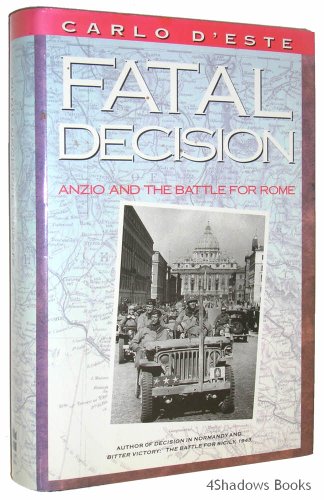
Fatal Decision is a powerful, dramatic, moving, and ultimately definitive narrative of one of the most desperate campaigns of World War II. In the winter of 1943-44, Anzio, a small Mediterranean resort and port some thirty-five miles south of Rome, played a crucial role in the fortunes of World War II as the target of an amphibious Allied landing. The Allies planned to bypass the strong German defenses along the Gustav Line and at Monte Cassino sixty miles to the southeast, which were holding up the American and British armies and preventing the liberation of Rome. By taking advantage of Allied command of the sea and air to effect complete surprise, infantry and armored forces landing at Anzio on January 22 were expected to secure the beachhead and then push inland to cut off the two main highways and railroads supplying the German forces to the south, either trapping and annihilating the German armies or forcing them to withdraw to the north, thus opening the way to Rome.
But the reality of one of the most desperate campaigns of World War II was bad management, external meddling, poorly relayed orders, and uncertain leadership. The Anzio beachhead became a death trap, with Allied troops forced to fight for their lives for four dreadful months. The eventual victory in May 1944 was muted, bitter, and overshadowed by the Allied landings in Normandy on June 6. Mixing flawless research, drama, and combat with a brilliant narrative voice, Fatal Decision is one of the best histories ever written of a World War II military campaign.
"synopsis" may belong to another edition of this title.
Reviews
A meticulous audit of Operation Shingle, the WW II campaign designed to win Rome for Allied forces at an acceptable cost. D'Este (Bitter Victory, Decision in Normandy) provides a panoramic overview of the planning, preparation, and execution of the 1944 assault on Anzio, a Mediterranean port about 30 miles south of Rome. The aim of the amphibious thrust was to bypass strong German defenses along the so-called Gustav line and at Monte Cassino, which had stalled American and well as British armies in their drive to liberate Rome. In D'Este's persuasive view, the strike failed in its objectives for lack of decisive leadership. For example, instead of issuing firm orders, General Sir Harold Alexander made gentlemanly instructions which Mark Clark (commander of the US Fifth Army) often ignored. Nor did Clark prod subordinates to seize highways and rail lines that supplied Wehrmacht forces under the able command of Field Marshal Albert Kesselring. At any rate, the Anzio beachhead became a death trap in which Allied troops fought for their lives in rain and mud for over five dreadful months. When opposition finally crumbled under air and sea pounding, Clark neglected to pursue, let alone destroy, retreating German soldiers, so great was his ambition to be the first man into Rome. In a crowning irony, the recapture of Italy's capital was almost wholly overshadowed by the D-day landings in France. In D'Este's book, blame for the botched Anzio expedition is widely shared. Among others meriting censure, he singles out a meddlesome Winston Churchill, who sowed confusion in the Allied ranks and raised unrealistic expectations. A vivid account of a campaign that attests to the high cost of miscalculation and overconfidence in matters military. (Sixteen pages of maps--not seen.) -- Copyright ©1991, Kirkus Associates, LP. All rights reserved.
In January 1944 an Allied task force landed at Anzio on Italy's west coast, its mission to draw German forces away from the Cassino bottleneck and open the way to Rome. The landing was only lightly opposed but the Germans soon counterattacked, and for five months U.S. general John Lucas's Anglo-American VI Corps fought desperately to retain its fragile beachhead. D'Este's account of this bloody struggle and the subsequent capture of Rome is well researched and vividly told. The political, strategic and tactical aspects of the campaign are carefully reviewed, as are the dynamics of leadership on both sides. D'Este ( Decision at Normandy ) sorts out the still-simmering controversy over whether Lucas missed a great opportunity by not attempting to capture Rome early in the campaign when it was presumably undefended. First-class military history. Illustrations.
Copyright 1991 Reed Business Information, Inc.
"About this title" may belong to another edition of this title.
Search results for Fatal Decision: Anzio and the Battle for Rome

Stock Image
Fatal Decision: Anzio and the Battle for Rome
Published by
HarperCollins Publishers Inc, 1991
ISBN 10: 0060158905
ISBN 13: 9780060158903
Used
Hardcover
Seller: World of Books (was SecondSale), Montgomery, IL, U.S.A.
Seller rating 5 out of 5 stars

Hardback. Condition: Fair. Fatal Decision is a powerful, dramatic, moving, and ultimately definitive narrative of one of the most desperate campaigns of World War I. In the winter of 1943-44, Anzio, a small Mediterranean resort and port some thirty-five miles south of Rome, played a crucial role in the fortunes of World War I as the target of an amphibious Allied landing. The Allies planned to bypass the strong German defenses along the Gustav Line and at Monte Cassino sixty miles to the southeast, which were holding up the American and British armies and preventing the liberation of Rome. By taking advantage of Allied command of the sea and air to effect complete surprise, infantry and armored forces landing at Anzio on January 22 were expected to secure the beachhead and then push inland to cut off the two main highways and railroads supplying the German forces to the south, either trapping and annihilating the German armies or forcing them to withdraw to the north, thus opening the way to Rome. But the reality of one of the most desperate campaigns of World War I was bad management, external meddling, poorly relayed orders, and uncertain leadership. The Anzio beachhead became a death trap, with Allied troops forced to fight for their lives for four dreadful months. The eventual victory in May 1944 was muted, bitter, and overshadowed by the Allied landings in Normandy on June 6. Mixing flawless research, drama, and combat with a brilliant narrative voice, Fatal Decision is one of the best histories ever written of a World War I military campaign. Seller Inventory # 00104376608
Stock Image
Fatal Decision: Anzio and the Battle for Rome
Seller: GoldBooks, Denver, CO, U.S.A.
Seller rating 5 out of 5 stars
Hardcover. Condition: fair. Acceptable Copy. Customer Service Guaranteed. Seller Inventory # 4J11_8_0060158905
Stock Image
Fatal Decision : Anzio and the Battle for Rome
Published by
HarperCollins Publishers, 1991
ISBN 10: 0060158905
ISBN 13: 9780060158903
Used
Hardcover
First Edition
Seller: Better World Books, Mishawaka, IN, U.S.A.
Seller rating 5 out of 5 stars
Condition: Good. First Edition. Pages intact with minimal writing/highlighting. The binding may be loose and creased. Dust jackets/supplements are not included. Stock photo provided. Product includes identifying sticker. Better World Books: Buy Books. Do Good. Seller Inventory # 6196238-6
Stock Image
Fatal Decision: Anzio and the Battle for Rome
Seller: ThriftBooks-Dallas, Dallas, TX, U.S.A.
Seller rating 5 out of 5 stars
Hardcover. Condition: Fair. No Jacket. Readable copy. Pages may have considerable notes/highlighting. ~ ThriftBooks: Read More, Spend Less. Seller Inventory # G0060158905I5N00
Stock Image
Fatal Decision: Anzio and the Battle for Rome
Seller: ThriftBooks-Atlanta, AUSTELL, GA, U.S.A.
Seller rating 5 out of 5 stars
Hardcover. Condition: Fair. No Jacket. Readable copy. Pages may have considerable notes/highlighting. ~ ThriftBooks: Read More, Spend Less. Seller Inventory # G0060158905I5N00
Stock Image
Fatal Decision: Anzio and the Battle for Rome
Seller: ThriftBooks-Phoenix, Phoenix, AZ, U.S.A.
Seller rating 5 out of 5 stars
Hardcover. Condition: Good. No Jacket. Pages can have notes/highlighting. Spine may show signs of wear. ~ ThriftBooks: Read More, Spend Less. Seller Inventory # G0060158905I3N00
Stock Image
Fatal Decision: Anzio and the Battle for Rome
Seller: ThriftBooks-Dallas, Dallas, TX, U.S.A.
Seller rating 5 out of 5 stars
Hardcover. Condition: Good. No Jacket. Pages can have notes/highlighting. Spine may show signs of wear. ~ ThriftBooks: Read More, Spend Less. Seller Inventory # G0060158905I3N00
Stock Image
Fatal Decision: Anzio and the Battle for Rome
Published by
HarperCollins Publishers Inc, 1991
ISBN 10: 0060158905
ISBN 13: 9780060158903
Used
Hardcover
Seller: World of Books Inc, Montgomery, IL, U.S.A.
Seller rating 4 out of 5 stars

Hardback. Condition: Fair. Fatal Decision is a powerful, dramatic, moving, and ultimately definitive narrative of one of the most desperate campaigns of World War I. In the winter of 1943-44, Anzio, a small Mediterranean resort and port some thirty-five miles south of Rome, played a crucial role in the fortunes of World War I as the target of an amphibious Allied landing. The Allies planned to bypass the strong German defenses along the Gustav Line and at Monte Cassino sixty miles to the southeast, which were holding up the American and British armies and preventing the liberation of Rome. By taking advantage of Allied command of the sea and air to effect complete surprise, infantry and armored forces landing at Anzio on January 22 were expected to secure the beachhead and then push inland to cut off the two main highways and railroads supplying the German forces to the south, either trapping and annihilating the German armies or forcing them to withdraw to the north, thus opening the way to Rome. But the reality of one of the most desperate campaigns of World War I was bad management, external meddling, poorly relayed orders, and uncertain leadership. The Anzio beachhead became a death trap, with Allied troops forced to fight for their lives for four dreadful months. The eventual victory in May 1944 was muted, bitter, and overshadowed by the Allied landings in Normandy on June 6. Mixing flawless research, drama, and combat with a brilliant narrative voice, Fatal Decision is one of the best histories ever written of a World War I military campaign. Seller Inventory # CIN0060158905A
Stock Image
Fatal Decision: Anzio and the Battle for Rome
Seller: HPB Inc., Dallas, TX, U.S.A.
Seller rating 5 out of 5 stars
hardcover. Condition: Very Good. Connecting readers with great books since 1972! Used books may not include companion materials, and may have some shelf wear or limited writing. We ship orders daily and Customer Service is our top priority! Seller Inventory # S_481148514
Stock Image
FATAL DECISION: Anzio and the Battle for Rome
Published by
Harpercollins, 1991, 1991
ISBN 10: 0060158905
ISBN 13: 9780060158903
Used
Hardcover
First Edition
Seller: NorthStar Books, Spokane, WA, U.S.A.
Seller rating 4 out of 5 stars
Hardcover. Condition: Fine. Dust Jacket Condition: Near Fine. 1st Edition. BOOK DESCRIPTION: 8vo, viii, 566 pgs, endpaper maps, index, notes, appendices, maps, illustrations. Black cloth with gilt titled spine. Dust Jacket as issued. CONDITION DESCRIPTION: Fine; interior is clean and tight. Unclipped DJ is near fine in mylar sleeve. CONTENTS DESCRIPTION: Seller Inventory # 0425072