
Items related to Seven Life Lessons of Chaos: Timeless Wisdom from the...
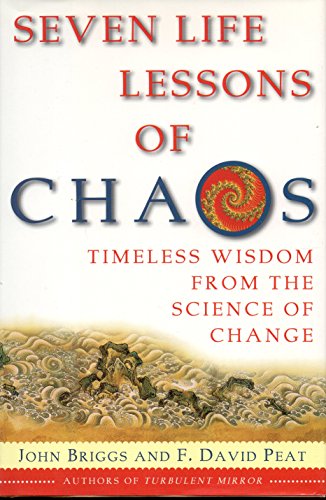
Synopsis
The predicament of all life is uncertainty.
While humans have had to deal with chaos since ancient times, only recent has science recognized it as a fundamental force in the universe.
Chaos, theory, originally used to understand the movements that create thunderstorms, raging rivers, and hurricanes, is now being applied to everything from medicine to warfare to social dynamics and theories about how organizations form and change. Chaos is evolving from a scientific theory into a cultural metaphor. As a metaphor it allows us to query some of our most cherished assumptions and encourages us to ask fresh questions about reality.
Our modern society has been obsessed with conquering and scientifically controlling the world around us. However, chaotic, nonlinear systems--such as nature, society, and our individual lives--lie beyond all our attempts to predict, manipulate, and control them. Chaos suggests that instead of resisting life's uncertainties, we should embrace the possibilities they offer.
In this groundbreaking new book, John Briggs and F. David Peat unfold seven lessons for embracing chaos in daily life:
- Be Creative: how to engage with chaos to find imaginative new solutions and live more dynamically
- Use Butterfly Power: how to let chaos grow local efforts into global results
- Go with the Flow: how to use chaos to work collectively with others
- Explore What's Between: how to discover life's rich subtleties and avoid the traps of stereotypes
- See the Art of the World: how to appreciate the beauty of life's chaos
- Live Within Time: how to utilize time's hidden depths
- Rejoin the Whole: how to realize our fractal connectedness to each other and the world
"synopsis" may belong to another edition of this title.
About the Authors
John Briggs, Ph.D., is a professor of English and the journalism coordinator at Western Connecticut State University. He lives in Danbury, Connecticut.
F. David Peat holds a Ph.D. in physics from the University of Liverpool and has written dozens of books on art, science, and spirituality. He lives in London and can be reached at www.fdavidpeat.com. They are the authors of Turbulent Mirror.
John Briggs, Ph.D., is a professor of English and the journalism coordinator at Western Connecticut State University. He lives in Danbury, Connecticut.
F. David Peat holds a Ph.D. in physics from the University of Liverpool and has written dozens of books on art, science, and spirituality. He lives in London. They are the authors of Turbulent Mirror.
From the Back Cover
The predicament of all life is uncertainty.
While humans have had to deal with chaos since ancient times, only recent has science recognized it as a fundamental force in the universe.
Chaos, theory, originally used to understand the movements that create thunderstorms, raging rivers, and hurricanes, is now being applied to everything from medicine to warfare to social dynamics and theories about how organizations form and change. Chaos is evolving from a scientific theory into a cultural metaphor. As a metaphor it allows us to query some of our most cherished assumptions and encourages us to ask fresh questions about reality.
Our modern society has been obsessed with conquering and scientifically controlling the world around us. However, chaotic, nonlinear systems--such as nature, society, and our individual lives--lie beyond all our attempts to predict, manipulate, and control them. Chaos suggests that instead of resisting life's uncertainties, we should embrace the possibilities they offer.
In this groundbreaking new book, John Briggs and F. David Peat unfold seven lessons for embracing chaos in daily life:
- Be Creative: how to engage with chaos to find imaginative new solutions and live more dynamically
- Use Butterfly Power: how to let chaos grow local efforts into global results
- Go with the Flow: how to use chaos to work collectively with others
- Explore What's Between: how to discover life's rich subtleties and avoid the traps of stereotypes
- See the Art of the World: how to appreciate the beauty of life's chaos
- Live Within Time: how to utilize time's hidden depths
- Rejoin the Whole: how to realize our fractal connectedness to each other and the world
From the Inside Flap
While humans have had to deal with chaos since ancient times, only recently has science recognized it as a fundamental force in the universe.
Chaos theory, originally used to understand the movements that create thunderstorms, raging rivers, and hurricanes, is now being applied to everything from medicine to warfare to social dynamics and theories about how organizations form and change. Chaos is evolving from a scientific theory into a cultural metaphor. As a metaphor it allows us to query some of our most cherished assumptions and encourages us to ask fresh questions about reality.
Our modern society has been obsessed with conquering and scientifically controlling the world around us. However, chaotic, nonlinear systems - such as nature, society, and our individual lives - lie beyond all our attempts to predict, manipulate, and control them. Chaos suggests that instead of resisting life's uncertainties, we should embrace the possibilities they offer.
In this groundbreaking new book, John Briggs and F. David Peat unfold seven lessons for embracing chaos in daily life:
1. Be Creative: how to engage with chaos to find imaginative new solutions and live more dynamically.
2. Use Butterfly Power: how to let chaos grow local efforts into global results
3. Go with the Flow: how to use chaos to work collectively with others
4. Explore What's Between: how to discover life's rich subtleties and avoid the traps of stereotypes
5. See the Art of the World: how to appreciate the beauty of life's chaos
6. Live Within Time: how to utilize time's hidden depths
7. Rejoin the Whole: how to realize our fractal connectedness to each other and the world.
If you have ever felt your life was out of control and headed towards chaos, science has an important message: Life is chaos, and that's a very exciting thing.
Reviews
Attempting to extract lessons for daily living from the emerging science of chaos theory, Briggs, a professor of English at Western Connecticut State University, and Peat, a British physicist, have produced an often frustrating, intermittently suggestive guide. Chaos scientists seek hidden patterns underlying apparently random events. By heeding their example, the authors maintain, ordinary folk can learn to appreciate the interconnectedness of all things, to go with the flow of events, to unlock creativity through heightened tolerance for ambiguity and ambivalence, to pay attention to subtlety, to act according to one's internal rhythms. Skipping fluidly from irrational numbers to Zen paradoxes, from Vaclav Havel's notion of "the power of the powerless" to the I Ching to the egalitarian, "self-organizing" interactions of an Ojibway Indian community and Manhattan's food distribution system, the authors use chaos as an overworked metaphor in a barrage of analogies, speculative leaps, platitudes and anecdotes. Their unconvincing manual is riddled with sentences like, "Positive butterfly power involves a recognition that each individual is an indivisible aspect of the whole and that each chaotic moment of the present is a mirror of the chaos of the future." Scores of intriguing photographs (66 b&w; eight pages color), which form an integral part of the book, reinforce points about the dynamics of change and the liberating potential of chaos with images of colliding galaxies, Ice Age cave paintings, a traffic jam, a craggy British coastline, plots of heart rhythms.
Copyright 1999 Reed Business Information, Inc.
There would have been no Jurassic Park without it. There is a perfume named after it. It is chaos, whose theory is the hottest one in science since relativity. The most powerful part of its allure is the relevance of chaos theory to human life struggles, yet no earlier book more than alluded to that connection. Briggs and Peat, whose Turbulent Mirror (1990) is one of the best popular books on the science of chaos (Briggs also wrote the lavish Fractals [1992] on chaos art), now give us a book that introduces the major ideas of chaos and shows how they can be used metaphorically. For instance, sensitive dependence upon initial conditions, or the butterfly effect, is the phenomenon of a tiny action, when amplified throughout a system, having unexpectedly disproportionate effects. (It is called butterfly after the chaos theory canard that a butterfly flapping its wings in China can cause a thunderstorm--or hurricane--in New York.) Apply this to politics, say, and apparently small initiatives can produce enormous changes. Briggs and Peat are careful to differentiate between scientific fact and metaphor, unlike some popular but often inaccurate self-help writers. The combination of factual exactitude and imaginative application makes this the best book on chaos yet. Patricia Monaghan
"About this title" may belong to another edition of this title.
Search results for Seven Life Lessons of Chaos: Timeless Wisdom from the...

Stock Image
Seven Life Lessons of Chaos: Timeless Wisdom from the Science of Change
Seller: ThriftBooks-Reno, Reno, NV, U.S.A.
Seller rating 5 out of 5 stars

Hardcover. Condition: Very Good. No Jacket. May have limited writing in cover pages. Pages are unmarked. ~ ThriftBooks: Read More, Spend Less. Seller Inventory # G0060182466I4N00
Stock Image
Seven Life Lessons of Chaos: Timeless Wisdom from the Science of Change
Seller: Orion Tech, Kingwood, TX, U.S.A.
Seller rating 5 out of 5 stars
hardcover. Condition: As New. Seller Inventory # 0060182466-1-37864404
Stock Image
Seven Life Lessons of Chaos: Timeless Wisdom from the Science of Change
Seller: ThriftBooks-Dallas, Dallas, TX, U.S.A.
Seller rating 5 out of 5 stars
Hardcover. Condition: Very Good. No Jacket. May have limited writing in cover pages. Pages are unmarked. ~ ThriftBooks: Read More, Spend Less. Seller Inventory # G0060182466I4N00
Stock Image
Seven Life Lessons of Chaos: Timeless Wisdom from the Science of Change
Seller: ThriftBooks-Atlanta, AUSTELL, GA, U.S.A.
Seller rating 5 out of 5 stars
Hardcover. Condition: Very Good. No Jacket. May have limited writing in cover pages. Pages are unmarked. ~ ThriftBooks: Read More, Spend Less. Seller Inventory # G0060182466I4N00
Stock Image
Seven Life Lessons of Chaos: Timeless Wisdom from the Science of Change
Seller: World of Books (was SecondSale), Montgomery, IL, U.S.A.
Seller rating 5 out of 5 stars
Hardback. Condition: Good. From movies likeJurassic Park and Twister to MTV's slogan -Chaos theory in action' to artists as Wu Tang Clan describing their work as -organized chaos,' chaos theory is the first new science in two generations to change the way nonspecialists view the world. Now, taking the continuous success as such books as Chaos: Making a New Science, The Turbulent Mirror, and Fractals: Patterns of Chaos to the next level, this fascinating work brings this science to the layperson, exploring its implications about life, spirituality and the nature of the universe. Clustered around the central principle of wholeness and interconnectivity, the seven lessons described here temper our scientific knowledge with mystery. With these lessons working both independently and collectively, Seven Life Lessons of Chaos promises to enlighten and empower the reader. Seller Inventory # 00102408124
Stock Image
Seven Life Lessons of Chaos : Timeless Wisdom from the Science of Change
Published by
HarperCollins Publishers, 1999
ISBN 10: 0060182466
ISBN 13: 9780060182465
Used
Hardcover
First Edition
Seller: Better World Books, Mishawaka, IN, U.S.A.
Seller rating 5 out of 5 stars
Condition: Very Good. 1st ed. Pages intact with possible writing/highlighting. Binding strong with minor wear. Dust jackets/supplements may not be included. Stock photo provided. Product includes identifying sticker. Better World Books: Buy Books. Do Good. Seller Inventory # 4187813-75
Stock Image
Seven Life Lessons of Chaos : Timeless Wisdom from the Science of Change
Published by
HarperCollins Publishers, 1999
ISBN 10: 0060182466
ISBN 13: 9780060182465
Used
Hardcover
First Edition
Seller: Better World Books, Mishawaka, IN, U.S.A.
Seller rating 5 out of 5 stars
Condition: Very Good. 1st ed. Former library copy. Pages intact with possible writing/highlighting. Binding strong with minor wear. Dust jackets/supplements may not be included. Includes library markings. Stock photo provided. Product includes identifying sticker. Better World Books: Buy Books. Do Good. Seller Inventory # 4062046-75
Stock Image
Seven Life Lessons of Chaos : Timeless Wisdom from the Science of Change
Published by
HarperCollins Publishers, 1999
ISBN 10: 0060182466
ISBN 13: 9780060182465
Used
Hardcover
First Edition
Seller: Better World Books, Mishawaka, IN, U.S.A.
Seller rating 5 out of 5 stars
Condition: Good. 1st ed. Pages intact with minimal writing/highlighting. The binding may be loose and creased. Dust jackets/supplements are not included. Stock photo provided. Product includes identifying sticker. Better World Books: Buy Books. Do Good. Seller Inventory # 4879749-6
Stock Image
Seven Life Lessons of Chaos: Timeless Wisdom from the Science of Change
Seller: World of Books Inc, Montgomery, IL, U.S.A.
Seller rating 4 out of 5 stars

Hardback. Condition: Good. From movies likeJurassic Park and Twister to MTV's slogan -Chaos theory in action' to artists as Wu Tang Clan describing their work as -organized chaos,' chaos theory is the first new science in two generations to change the way nonspecialists view the world. Now, taking the continuous success as such books as Chaos: Making a New Science, The Turbulent Mirror, and Fractals: Patterns of Chaos to the next level, this fascinating work brings this science to the layperson, exploring its implications about life, spirituality and the nature of the universe. Clustered around the central principle of wholeness and interconnectivity, the seven lessons described here temper our scientific knowledge with mystery. With these lessons working both independently and collectively, Seven Life Lessons of Chaos promises to enlighten and empower the reader. Seller Inventory # CIN0060182466G
Stock Image
Seven Life Lessons of Chaos: Timeless Wisdom from the Science of Change
Seller: HPB Inc., Dallas, TX, U.S.A.
Seller rating 5 out of 5 stars
hardcover. Condition: Very Good. Connecting readers with great books since 1972! Used books may not include companion materials, and may have some shelf wear or limited writing. We ship orders daily and Customer Service is our top priority! Seller Inventory # S_488548606