Items related to Empire: How Spain Became a World Power, 1492-1763
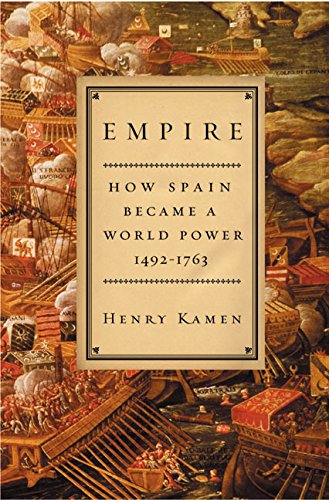

How did a barren, thinly populated country, somewhat isolated from the rest of Europe, establish itself as the world's first superpower? Henry Kamen's impressive new book offers a fresh and highly original answer.
Empire is a global survey of the two and a halt centuries (from the late fifteenth to the mid-eighteenth) in which the Spaniards established the most extensive empire the world had ever known, ranging from Naples and the Netherlands to the Philippines. Unlike previous accounts, which have presented the Empire as a direct consequence of Spanish power, this provocative work of history emphasizes the inability of Spain to run an imperial enterprise by itself The role of conquest was deceptive. Spain's rise to power was actually made possible by the collaboration of international business interests, including Italian financiers, German technicians and Dutch traders, in the task of setting up networks of contact ranging across the oceans. At the height of its apparent power, the Spanish Empire was in reality a global enterprise in which non-Spaniards -- Portuguese, Basque, Aztec, Genoese, Chinese, Flemish, West African, Incan and Neapolitan -- played an essential role. It is this vast diversity of resources and people (which included many of its greatest adventurers and soldiers) that made Spain's power so overwhelming.
There is no better account in English of this time. Henry Kamen's book provides a highly relevant analysis of the origins and nature of imperial power, and of global economic activity. Challenging, persuasive and unique in its thesis, Empire explores Spain's complex impact on world history with admirable clarity and intelligence.
"synopsis" may belong to another edition of this title.
About the Author:
From Publishers Weekly:
Henry Kamen is a fellow of the Royal Historical Society in London and an emeritus professor of the Higher Council for Scientific Research in Barcelona. He is the author of Empire: How Spain Became a Great Power, 1492-1763, as well as several other books on Spain. He divides his time between Barcelona and the United States.
Whether the term "globalization" is defined as the global imposition of a hegemonic culture or as a more creative dynamic of global interactivity, it's nothing new-it can be traced at least as far back as the Spanish Empire of the 16th and 17th centuries. Kamen (The Spanish Inquisition: A Historical Revision) depicts this golden age globalization on a suitably grand canvas, tracing the surprisingly hesitant and serendipitous spread of empire from Naples to Manila. He demonstrates to superb effect that this empire was in its very origins a truly multinational enterprise in which the Spanish element was one among many. This element, he suggests, was wholly-if understandably-distorted by contemporary propagandists. In reality, without Genoese bankers, expansionism into the Canary Islands (and Italy itself) would have been unworkable; without Muslim agency, Granada would not have fallen, nor Tenochtitlan without indigenous collaboration; there were Greeks, Netherlanders and at least two blacks in the party that conquered the Aztec capital. Like David Northrup in his recent study, Africa's Discovery of Europe, Kamen restores agency to those who have been relegated to victim status: the black people who helped forge colonial society, and the indigenous peoples of the Americas. While he recognizes that empire catalyzed Spanish patriotism, not least a regressive nostalgia among settlers in the New World, he observes that among those who cried out "Espa¤a!" at the battle of Muhlberg (1547) were crack Hungarian cavalry. While memories of empire (not quite so dead as Kamen claims) continue to shape Spanish culture, and as new forms of global imperialism develop, this sophisticated and broad-minded book could not be more timely. 16 pages of color illus., 11 b&w photos.
Copyright 2003 Reed Business Information, Inc.
Copyright 2003 Reed Business Information, Inc.
"About this title" may belong to another edition of this title.
- PublisherHarper
- Publication date2003
- ISBN 10 0060194766
- ISBN 13 9780060194765
- BindingHardcover
- Number of pages640
- Rating
Buy New
Learn more about this copy
US$ 19.00
Shipping:
FREE
Within U.S.A.
Top Search Results from the AbeBooks Marketplace
Stock Image
Empire: How Spain Became a World Power, 1492-1763
Seller:
Rating

Book Description Hardcover. Condition: New. Dust Jacket Condition: New. Seller Inventory # ABE-1709253964618
Buy New
US$ 19.00
Convert currency
Stock Image
Empire: How Spain Became a World Power, 1492-1763
Seller:
Rating

Book Description Hardcover. Condition: new. New. Fast Shipping and good customer service. Seller Inventory # Holz_New_0060194766
Buy New
US$ 21.69
Convert currency
Stock Image
Empire: How Spain Became a World Power, 1492-1763
Seller:
Rating
Book Description Hardcover. Condition: new. New Copy. Customer Service Guaranteed. Seller Inventory # think0060194766
Buy New
US$ 28.26
Convert currency
Stock Image
Empire: How Spain Became a World Power, 1492-1763
Seller:
Rating
Book Description Condition: new. Seller Inventory # FrontCover0060194766
Buy New
US$ 30.22
Convert currency
Stock Image
Empire: How Spain Became a World Power, 1492-1763
Seller:
Rating
Book Description Condition: New. Buy with confidence! Book is in new, never-used condition. Seller Inventory # bk0060194766xvz189zvxnew
Buy New
US$ 52.73
Convert currency
Stock Image
Empire: How Spain Became a World Power, 1492-1763
Published by
HarperCollins
(2003)
ISBN 10: 0060194766
ISBN 13: 9780060194765
New
Hardcover
Quantity: 1
Seller:
Rating
Book Description Hardcover. Condition: Brand New. 640 pages. 9.25x5.75x1.50 inches. In Stock. Seller Inventory # 0060194766
Buy New
US$ 40.31
Convert currency
Stock Image
Empire: How Spain Became a World Power, 1492-1763
Seller:
Rating
Book Description Hardcover. Condition: new. New. Seller Inventory # Wizard0060194766
Buy New
US$ 52.86
Convert currency
Stock Image
Empire: How Spain Became a World Power, 1492-1763
Seller:
Rating
Book Description Hardcover. Condition: new. Buy for Great customer experience. Seller Inventory # GoldenDragon0060194766
Buy New
US$ 55.69
Convert currency
Stock Image
EMPIRE: HOW SPAIN BECAME A WORLD
Seller:
Rating
Book Description Condition: New. New. In shrink wrap. Looks like an interesting title! 2.35. Seller Inventory # Q-0060194766
Buy New
US$ 60.69
Convert currency
Stock Image
Empire: How Spain Became a World Power, 1492-1763
Seller:
Rating
Book Description Condition: new. Book is in NEW condition. Satisfaction Guaranteed! Fast Customer Service!!. Seller Inventory # PSN0060194766
Buy New
US$ 39.16
Convert currency