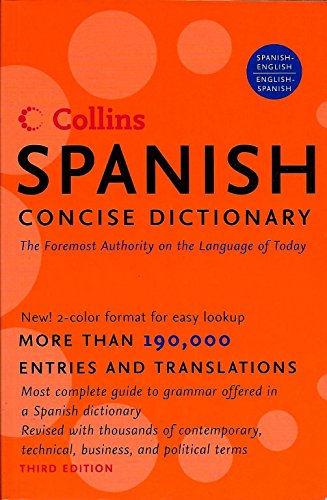
Collins Spanish Concise Dictionary, 3e (HarperCollins Concise Dictionaries) (Spanish and English Edition) - Softcover
Synopsis
Practical, user-friendly, comprehensive
- The HarperCollins Spanish Concise Dictionary, 3rd Edition offers up-to-date coverage of contemporary Spanish -- from broadband to designer baby, botellón to emoticón
- Special entries throughout highlight aspects of Spanish life and culture
- Exclusive keyword feature provides additional help with translating the most essential vocabulary
Extra help with grammar:
- Step-by-step guide to Spanish grammar includes hundreds of examples
- Extensive examples are given for grammatical constructions and idiomatic usage
"synopsis" may belong to another edition of this title.
About the Author
FAKE: ont face=arial size=2>
HarperCollins Publishers is one of the world's leading English-language publishers with headquarters in New York. The company is part of News America Publishing Group, a division of News Corporation. The house of Mark Twain, the Bronte Sisters, Thackeray, Dickens, John F. Kennedy, Martin Luther King, Jr. and Maurice Sendak, HarperCollins was founded in New York City in 1817 by the brothers James and John Harper. The worldwide book group, which was formed following News Corporation's acquisition of the British publisher William Collins in January 1990, has significant publishing interests in the U.S., Canada, the U.K. and Australia.
Excerpt. © Reprinted by permission. All rights reserved.
Collins Spanish Concise Dictionary, 3e
By Margaret HarperCollins PublishersHarperCollins Publishers, Inc.
Copyright © 2008 Margaret HarperCollins PublishersAll right reserved.
ISBN: 9780060575786
Introduction
You may be starting Spanish for the first time, or you may wish to extend your knowledge of the language. Perhaps you want to read and study Spanish books, newspapers and magazines, or perhaps simply have a conversation with Spanish speakers. Whatever the reason, whether you're a student, a tourist or want to use Spanish for business, this is the ideal book to help you understand and communicate. This modem, user-friendly dictionary gives priority to everyday vocabulary and the language of current affairs, business, computing and tourism, and, as in all Collins dictionaries, the emphasis is firmly placed on contemporary language and expressions.
How to use the dictionary
Below you will find an outline of how information is presented in your dictionary. Our aim is to give you the maximum amount of detail in the clearest and most helpful way.
Entries
A typical entry in your dictionary will be made up of the following elements:
Phonetic transcription
Phonetics appear in square brackets immediately after the headword. They are shown using the International Phonetic Alphabet (IPA), and a complete list of the symbols used in this system can be found on page x. The pronunciation given is for Castilian Spanish except where a word is solely used in Latin America, when we give the Latin American pronunciation. A further guide to the differences in types of Spanish pronunciation is given on page x.
Grammatical information
All words belong to one of the following parts of speech: noun, verb, adjective, adverb, pronoun, article, conjunction, preposition, abbreviation. Nouns can be singular or plural and, in Spanish, masculine or feminine. Verbs can be transitive, intransitive, reflexive or impersonal. Pans of speech appear in italics immediately after the phonetic spelling of the headword. The gender of the translation also appears in italics immediately following the key element of the translation, except where this is a regular masculine singular noun ending in "o", or a regular feminine singular noun ending in "a".
Often a word can have more than one part of speech. just as the English word chemical can bean adjective or a noun, the Spanish word conocido can bean adjective ("(well-) known") or a noun ("acquaintance"). In the same way the verb to walk is sometimes transitive, ie it takes an object ("to walk the dog") and sometimes intransitive, ie it doesn't take an object ("to walk to school"). To help you find the meaning you are looking for quickly and for clarity of presentation, the different part of speech categories are separated by a shaded square.
Continues...
Excerpted from Collins Spanish Concise Dictionary, 3eby Margaret HarperCollins Publishers Copyright © 2008 by Margaret HarperCollins Publishers. Excerpted by permission.
All rights reserved. No part of this excerpt may be reproduced or reprinted without permission in writing from the publisher.
Excerpts are provided by Dial-A-Book Inc. solely for the personal use of visitors to this web site.
"About this title" may belong to another edition of this title.
Other Popular Editions of the Same Title

Search results for Collins Spanish Concise Dictionary, 3e (HarperCollins...

Stock Image
Collins Spanish Concise Dictionary, 3e (HarperCollins Concise Dictionaries) (Spanish and English Edition)
Seller: World of Books (was SecondSale), Montgomery, IL, U.S.A.
Seller rating 5 out of 5 stars

Condition: Good. Item in good condition. Textbooks may not include supplemental items i.e. CDs, access codes etc. Seller Inventory # 00061110000
Stock Image
Harpercollins Spanish Dictiona
Seller: World of Books (was SecondSale), Montgomery, IL, U.S.A.
Seller rating 5 out of 5 stars
Condition: Good. Item in good condition. Textbooks may not include supplemental items i.e. CDs, access codes etc. Seller Inventory # 00058089536
Stock Image
Collins Spanish Concise Dictionary, 3e (HarperCollins Concise Dictionaries) (Spanish and English Edition)
Seller: Orion Tech, Kingwood, TX, U.S.A.
Seller rating 5 out of 5 stars
Paperback. Condition: Fair. Seller Inventory # 0060575786-4-24370153
Stock Image
Collins Spanish Concise Dictionary, 3e (HarperCollins Concise Dictionaries) (Spanish and English Edition)
Seller: Wonder Book, Frederick, MD, U.S.A.
Seller rating 5 out of 5 stars
Condition: Good. Good condition. 3rd edition. Spanish and English edition. A copy that has been read but remains intact. May contain markings such as bookplates, stamps, limited notes and highlighting, or a few light stains. Seller Inventory # Z04B-01254
Seller Image
Collins Spanish Concise Dictionary, 3e (HarperCollins Concise Dictionaries) (Spanish and English Edition)
Seller: Greenworld Books, Arlington, TX, U.S.A.
Seller rating 5 out of 5 stars
Condition: good. Fast Free Shipping â" Good condition book with a firm cover and clean, readable pages. Shows normal use, including some light wear or limited notes highlighting, yet remains a dependable copy overall. Supplemental items like CDs or access codes may not be included. Seller Inventory # GWV.0060575786.G
Stock Image
Collins Spanish Concise Dictionary, 3e (HarperCollins Concise Dictionaries) (Spanish and English Edition)
Seller: Once Upon A Time Books, Siloam Springs, AR, U.S.A.
Seller rating 4 out of 5 stars

Paperback. Condition: Good. This is a used book in good condition and may show some signs of use or wear . This is a used book in good condition and may show some signs of use or wear . Seller Inventory # mon0001337453
Stock Image
Collins Spanish Concise Dictionary
Seller: BookHolders, Towson, MD, U.S.A.
Seller rating 5 out of 5 stars
Condition: Good. [ No Hassle 30 Day Returns ][ Ships Daily ] [ Underlining/Highlighting: NONE ] [ Writing: NONE ] [ Edition: Third ] Publisher: Collins Pub Date: 7/1/2004 Binding: Paperback Pages: 1216 Third edition. Seller Inventory # 6920401
Stock Image
Collins Spanish Concise Dictionary, 3e (HarperCollins Concise Dictionaries) (Spanish and English Edition)
Seller: ThriftBooks-Dallas, Dallas, TX, U.S.A.
Seller rating 5 out of 5 stars
Paperback. Condition: Good. No Jacket. Pages can have notes/highlighting. Spine may show signs of wear. ~ ThriftBooks: Read More, Spend Less. Seller Inventory # G0060575786I3N00
Stock Image
Collins Spanish Concise Dictionary, 3e (HarperCollins Concise Dictionaries) (Spanish and English Edition)
Seller: ThriftBooks-Atlanta, AUSTELL, GA, U.S.A.
Seller rating 5 out of 5 stars
Paperback. Condition: Fair. No Jacket. Readable copy. Pages may have considerable notes/highlighting. ~ ThriftBooks: Read More, Spend Less. Seller Inventory # G0060575786I5N00
Stock Image
Collins Spanish Concise Dictionary, 3e (HarperCollins Concise Dictionaries) (Spanish and English Edition)
Seller: ThriftBooks-Dallas, Dallas, TX, U.S.A.
Seller rating 5 out of 5 stars
Paperback. Condition: As New. No Jacket. Pages are clean and are not marred by notes or folds of any kind. ~ ThriftBooks: Read More, Spend Less. Seller Inventory # G0060575786I2N00