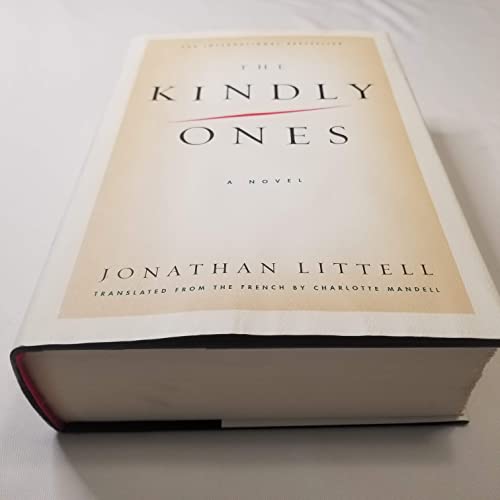
The Kindly Ones - Hardcover

Littell, Jonathan

  • 4.03 out of 5 stars
    15,141 ratings by Goodreads
 
9780061353451: The Kindly Ones

Synopsis

Named one of the "100 Best Books of the Decade" by The Times of London "Oh my human brothers, let me tell you how it happened." A former Nazi officer, Dr. Maximilien Aue has reinvented himself, many years after the war, as a middle-class family man and factory owner in France. An intellectual steeped in philosophy, literature, and classical music, he is also a cold-blooded assassin and the consummate bureaucrat. Through the eyes of this cultivated yet monstrous man we experience in disturbingly precise detail the horrors of the Second World War and the Nazi genocide of the Jews. Eichmann, Himmler, GÖring, Speer, Heydrich, HÖss—even Hitler himself—play a role in Max's story. An intense and hallucinatory historical epic, The Kindly Ones is also a morally challenging read. It holds a mirror up to humanity—and the reader cannot look away.

"synopsis" may belong to another edition of this title.

About the Author

Jonathan Littell was born in New York to American parents, and grew up in the United States and France. He lives in Barcelona, Spain.

From the Back Cover

"Oh my human brothers, let me tell you how it happened." So begins the chilling fictional memoir of Dr. Maximilien Aue, a former Nazi officer who has reinvented himself, many years after the war, as a middle-class family man and factory owner in France.

Max is an intellectual steeped in philosophy, literature, and classical music. He is also a cold-blooded assassin and the consummate bureaucrat. Through the eyes of this cultivated yet monstrous man, we experience in disturbingly precise detail the horrors of the Second World War and the Nazi genocide of the Jews. During the period from June 1941 through April 1945, Max is posted to Poland, the Ukraine, and the Caucasus; he is present at the Battle of Stalingrad and at Auschwitz; and he lives through the chaos of the final days of the Nazi regime in Berlin. Although Max is a totally imagined character, his world is peopled by real historical figures, such as Eichmann, Himmler, Göring, Speer, Heyrich, Höss, and Hitler himself.

A supreme historical epic and a haunting work of fiction, Jonathan Littell's masterpiece is intense, hallucinatory, and utterly original. Published to impressive critical acclaim in France in 2006, it went on to win the Prix Goncourt, that country's most prestigious literary award, and sparked a broad range of responses and questions from readers: How does fiction deal with the nature of human evil? How should a novel encompass the Holocaust? At what point do history and fiction come together and where do they separate?

A provocative and controversial work of literature, The Kindly Ones is a morally challenging read; it holds up a mirror to humanity—and the reader cannot look away.

Reviews

From The Washington Post's Book World/washingtonpost.com Reviewed by Melvin Jules Bukiet Hire some nice young people. Tell them to copulate. Take a picture and you're a pornographer. But add a caption and you're a documentarian. Better yet, frame the picture and voilà! you're an artist. Best of all, turn that picture into half a million words, slap on a cover and you're a writer. Jonathan Littell's expansive and repulsive first novel -- an award-winning bestseller in France, where it was originally published -- is part literature, predominantly documentary and most memorably pornography. "The Kindly Ones" begins in the present, when Maximilien Aue, a former Nazi bureaucrat who has adopted a modest new identity as the manager of a lace factory in France, decides to write his memoirs. In the opening pages, Aue sets the terms for the book. He is unapologetic about his role in the Holocaust, but neither is he rabidly anti-Semitic. Instead, he insists, perhaps correctly, that his atrocities were a function of being in the wrong place at the wrong time. Of course, the 6 million Jews murdered by the likes of Aue during the 1940s were in a worse place, yet who can say whether, if circumstances were reversed, many of them wouldn't have bowed to authority as he did? On the other hand, the Jews didn't have that choice, and there's a difference between an active, if reluctant, participant in genocide and a victim who might have been a perpetrator in an alternative universe. Littell sees through the specious arguments of the good doctor (of jurisprudence, not medicine) Aue and then allows the man to hang himself, figuratively. Aue enters the intelligence branch of the SS because it offers career opportunities. This allows him to travel and drink fine wine while observing and organizing mass murder, if never quite pulling the trigger himself. Initially, Aue is assigned to one of the mobile killing units that executed hundreds of thousands of Jews in shtetls throughout the Ukraine. Sure, he feels compunctions; it's a messy business. He disdains some of his sadistic co-workers and absurdly claims, in "all honesty . . . I had doubts about our methods." Still, he completes his tasks, rising consistently in the ranks. The pressure does, however, wreak havoc with Aue's digestive system. He vomits before he has half-digested his food, and he seems to have diarrhea for the entire second half of the war. But it's likely that some of his problems precede his stressful labors because we also hear a tale of obsession dating from childhood with his twin sister. This unresolved personal history leads, near the end of the book, to an explicit sexual fantasy before a feverish, Boschian climax in which Aue finally kills several people he actually knows. Until that finale, his work puts him in contact with nearly every major figure in the Nazi party hierarchy. He reports to Heydrich and Himmler. He negotiates with Speer for slave labor and attends musical evenings at the Eichmann household. Ultimately, he meets Hitler. "The Kindly Ones" eagerly displays vast amounts of research. We are treated to several pages on the languages of the Caucasus as well as a remarkable description of Jawizowitz, a subcamp of Auschwitz about which virtually no one who didn't survive its lethal mines would know. All of this documentation may be impressive, but the research begins to feel like an excuse for a giddy "If this is Tuesday, it must be Madjanek" itinerary as Aue hopscotches from the mass execution of Kiev's Jews in the pit at Babi Yar to the destruction of the German army at Stalingrad to several major extermination camps to the underground V-2 missile factory at Mittlebau-Dora. I couldn't help but wonder, "Will he make it to the Führer's bunker?" and, sure enough, he does. Aue is a Zelig of the Holocaust. Throughout Aue's morbidly picaresque travels, the tone is leering. A phenomenon that can only be called death porn saturates "The Kindly Ones." Despite its many, potent set pieces that vividly render the misery and insanity of war, the effect is voyeuristic as Aue, Littell and the unfortunate reader rubberneck at the innumerable bodies -- gassed, shot, hanged, strangled, burnt, bombed, eyes gouged, intestines unwound, limbs severed, brains spattered -- heaped in piles by history's roadside. Two years ago when it won France's Goncourt and Grand Prix de Littérature, "The Kindly Ones" was compared to Tolstoy's "War and Peace," presumably because of its length and scope. But it more aptly sits beside -- rather, beneath -- Christopher Browning's nonfictional examination of the Einsatzgruppen, "Ordinary Men," and William T. Vollmann's novel "Europe Central." Without a hint of the prurience of "The Kindly Ones," "Ordinary Men" makes many of the same points through hard evidence and sober restraint. In fact, Browning notes that few of the killers were as tormented as Aue claims to be. This makes one wonder whether Littell's intent is to create a mundane functionary or a monster, or both. Yet after nearly 1,000 pages, we can't quite tell because Littell fails to explore any of the moral dilemmas that compose Vollmann's multifaceted vision of real people at pivotal moments in Germany and Russia during the 1940s. Not that a reader necessarily seeks a lesson, but fiction and nonfiction ought to approach the subject as more than an opportunity to wallow in the worst humankind has to offer. In "The Kindly Ones," event follows event without any sense of individual character or dramatic motion except for that of the war itself. The book is narratively empty and intellectually incoherent. It leaves us feeling like tourists, gawking.
Copyright 2009, The Washington Post. All Rights Reserved.

Despite being hailed as a new War and Peace in its native France, The Kindly Ones did not fare as well further west, where critics decried it as "Holocaust porn." Unable to let go of any of his research, Littell strings together hundreds of pages of brutally graphic descriptions of the torture and murder of Jews, interrupted only by Aue's grotesque sexual dalliances and frequent bouts of vomiting and diarrhea. A cliched plot, graceless prose, and an awkward translation round out the novel's flaws. By making Aue a monstrous psychopath, Littell completely destroys Aue's value in exploring the moral complexities of ordinary people under the Nazi regime. The only soul-searching readers will do is to understand why they picked up the book in the first place.
Copyright 2009 Bookmarks Publishing LLC

SignatureReviewed by Jonathan SeguraWritten in French by an American, this was the hot book of Frankfurt in 2006 and won two of France's major literary awards. A couple of years and a reported million-dollar advance later, here it is in English. Is it worth the hype and money? In a word, no. Dr. Max Aue, the petulant narrator of this overlong exercise in piling-on, is a rising star in the SS. His career helped along by a slick SS benefactor, Aue watches the wholesale slaughter of Jews in the Ukraine, survives getting shot through the head in Stalingrad, researches and writes dozens of reports, tours Auschwitz and Birkenau, and finds himself in Hitler's bunker in the Reich's final days. He kills people, too, and is secretly gay—a catcher—and tormented by his love for his twin sister, Una, who now rebuffs his lusty advances. He also hates his mother and stepfather. As he claims, If you ever managed to make me cry, my tears would sear your face. But after nearly 1,000 pages, Herr Doktor Aue, for all his alleged coldness and self-hatred and self-indulgent ruminations, amounts to nothing more than a bloodless conduit for boasting the breadth of Littell's research (i.e., a nine-page digression on the history of Caucasian linguistics). The text itself is notable for its towering, imposing paragraphs that often run on for pages. Unfortunately, these paragraphs are loaded with dream sequences marked by various unpleasant bodily functions, a 14-page hallucination where a very Céline-like crackpot cameos as Dr. Sardine and dozens of numbing passages in which SS functionaries debate logistical aspects of the Jewish Question. Also, nary an anus goes by that isn't lovingly described (among the best is one surrounded by a pink halo, gaped open like a sea anemone between two white globes). Most crippling, however, is Aue's inability to narrate outside his one bulldozing, breathless register, and while it may work marvelously early on as he relates the troubles of trying to fit the maximum number of bodies into a pit, the monotone voice quickly loses its luster. In the final 200 or so pages, Berlin is burning, the Russians and Americans are making rapid advances, Hitler is nearly assassinated and SS brass are formulating their personal endgames. But, alas, this massive endeavor grinds to its conclusion on a pulp conceit: two German cops, against all odds, are in hot pursuit of Aue for a crime he may or may not have committed.Littell's strung together many tens of thousands of words, but many tens of thousands of words does not necessarily a novel make. As the French say, tant pis.Jonathan Segura is the deputy reviews editor of Publishers Weekly and the author of Occupational Hazards.
Copyright © Reed Business Information, a division of Reed Elsevier Inc. All rights reserved.

Littell opens his Second World War novel, told through the recollections of a German officer named Max Aue, with a breakdown of how many Germans, Soviets, and Jews died, minute by minute, in the conflict. As Aue travels to Stalingrad, Auschwitz, and Hungary to report on morale and efficiency, long sections of bureaucratic analysis alternate with moments of mind-numbing sadism. Aue, a caricature of moral failure (he fantasizes at length about sodomizing his twin sister), encounters a cast of unintentionally comic characters, such as an obese and flatulent proponent of the Final Solution, who surrounds himself with Teutonic beauties. The Holocaust is recast as an extended bout of office politics, with German officials quarrelling over who is responsible for prisoners� hygiene. As the novel draws to a violent close, its story seems nearly as senseless as the horrors it depicts.
Copyright ©2008 Click here to subscribe to The New Yorker

*Starred Review* “I can claim without any false modesty that I have seen more than most.” In the person of Dr. Max Aue, Littell has created a compelling witness to the extraordinary events that punctuated the Third Reich. A scarred survivor of the savage siege of Stalingrad, this remarkably protean Nazi metamorphoses into a technical consultant at Auschwitz, where he helps convert the flow of doomed Jewish prisoners into properly codified bureaucratic reports. He then ends the war in the ruins of Berlin’s zoo, surrounded by wild beasts and wearing a uniform stolen from a comrade he has just murdered. Though himself a minor actor in the terrible drama, Aue frequently shares the stage with titans, including Himmler, Eichmann, Bormann, and—finally—the führer himself, giving readers an up-close look at ugly yet fascinating personalities. Littell has assiduously researched the large events he depicts; however, it is his own creative imagination that gives substance to the narrator’s broodings on his involvement in horrific deeds. As these dark meditations probe episodes of nightmarish cruelty and tangled sexuality, they reveal much about how ordinary human weakness creates openings for diabolic evil. A nuanced translation preserves the vertiginous power that made the French original a much-acclaimed prizewinner in Europe. --Bryce Christensen

"About this title" may belong to another edition of this title.

Other Popular Editions of the Same Title