
Items related to Kansas City Lightning: The Rise and Times of Charlie...
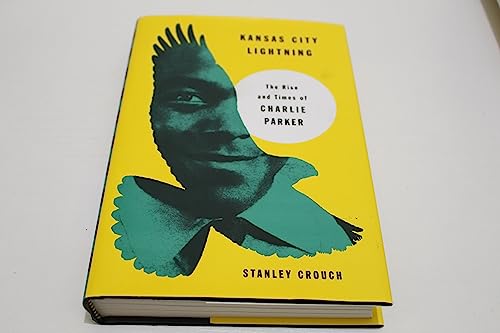
Synopsis
Kansas City Lightning: The Rise and Times of Charlie Parker is the first installment in the long-awaited portrait of one of the most talented and influential musicians of the twentieth century, from Stanley Crouch, one of the foremost authorities on jazz and culture in America.
Throughout his life, Charlie Parker personified the tortured American artist: a revolutionary performer who used his alto saxophone to create a new music known as bebop even as he wrestled with a drug addiction that would lead to his death at the age of thirty-four.
Drawing on interviews with peers, collaborators, and family members, Kansas City Lightning recreates Parker’s Depression-era childhood; his early days navigating the Kansas City nightlife, inspired by lions like Lester Young and Count Basie; and on to New York, where he began to transcend the music he had mastered. Crouch reveals an ambitious young man torn between music and drugs, between his domineering mother and his impressionable young wife, whose teenage romance with Charlie lies at the bittersweet heart of this story.
With the wisdom of a jazz scholar, the cultural insights of an acclaimed social critic, and the narrative skill of a literary novelist, Stanley Crouch illuminates this American master as never before.
"synopsis" may belong to another edition of this title.
About the Author
Stanley Crouch was twice nominated for the National Book Critics Circle Award, for his essay collections Notes of a Hanging Judge and The All-American Skin Game. His other books include Always in Pursuit, The Artificial White Man, and the acclaimed novel Don't the Moon Look Lonesome. He served on and off as the artistic consultant for jazz programming at Lincoln Center, was the president of the Louis Armstrong Educational Foundation, and was a member of the American Academy of Arts and Sciences. He died in 2020 at the age of 74.
From the Back Cover
No musician has lived a more transformational, or more tragic, life than Charlie Parker, one of the most talented and influential figures of the twentieth century. From the start of his career in the late 1930s, Parker was a new kind of American artist: a revolutionary musician who internalized all of popular music and blew it back through his alto saxophone "at the tempo of emergency"—even as he wrestled with a drug addiction that would ultimately contribute to his death at thirty-four.
Yet no writer has fully captured the arc and texture of Parker's personal story . . . until now. Kansas City Lightning, the first in a two-volume life of Parker by Stanley Crouch, draws on decades of original interviews with peers, collaborators, and family members to reveal Parker as he emerged from the landscapes—literal and artistic—that he inhabited. A precocious child, shy yet self-possessed, Charlie ventured early into the nightlife of wide-open Depression Kansas City, a veritable stomping ground for such bandleaders as Walter Page, Bennie Moten, and Moten's successor, Count Basie, the king of Kansas City swing. Inspired by saxophonists Lester Young and Chu Berry, trumpeter Roy Eldridge, and his mentor Buster Smith, Parker endured initial humiliation on the bandstand—yet persevered until he mastered the idiom and began to transcend it.
Kansas City Lightning follows Parker from the "freak shows" and "spook breakfasts" of late-night Kansas City, to the segregated union halls of Chicago, and finally to New York's Harlem ballrooms. Most intimately, it brings us into young Charlie Parker's family circle, as he plunged headlong into a very adult world—lured by both music and drugs, torn between his oddly protective mother and Rebecca Ruffin, the impressionable young woman whose romance with Charlie is at the bittersweet heart of this story.
With the musical wisdom of a lifetime jazz scholar, the cultural insights of an indispensable social critic, and the narrative skill of a writer at the height of his powers, Crouch brings Parker back to glorious, surprising, and deeply moving life.
Reviews
With the straight-ahead timing and the ethereal blowing of a great jazzman, Crouch delivers a scorching set in this first of two volumes of his biography of Charlie Yardbird Parker, capturing the downbeats and the up-tempo moments of the great saxophonist's life and music. Drawing on interviews with numerous friends, fellow musicians, and family members, Crouch traces Parker's life from his earliest days in Kansas City, Mo., his early romance and eventual marriage to Rebecca Ruffin, and his heroin addiction to his involvement with his mentors Lester Young and Buster Smith. Crouch brings to life the swinging backdrop against which Parker honed his craft: Kansas City was becoming a kind of kind of experimental laboratory, where the collective possibilities of American rhythm were being refined and expanded on a nightly basis. Parker eventually decides that Kansas City isn't big enough for him, and he rides the rails to Chicago and New York, ending up on Buster Smith's doorstep, eager to absorb all the lessons the big city has to teach him. By now, he had long since mastered the physical challenges of playing... and become preoccupied with the coordination of mind and muscle necessary to make his own way. As Crouch reminds us, however, Charlie Parker, no matter how highly talented, was not greater than his idiom. But his work helped to lead the art form to its most penetrating achievement. (Oct.)
*Starred Review* To jazz lovers, the prospect of music and cultural critic Crouch taking on the life of the iconic Charlie Parker carries the anticipation that fans would have had at the great battles of the jazz bands or the cutting contests vividly described here. Crouch captures with novelistic verve the excitement of that period in covering the early years of Parker’s ultimately short life, which contained within it so many warring elements that he has daunted even, perhaps especially, awestruck biographers. Crouch’s eyes are wide open, and he lends his considerable talents to a jazz biography that ranks with the very best, including Robin D. G. Kelley on Thelonious Monk. Though extensively researched, this is less academic, informed by Crouch’s extensive knowledge and his deft hand with complex elements of American music. The occasional cliché or clunky wording is offset by more frequent profundities, e.g., “the double consciousness so fundamental to jazz: the burdens of the soul met by the optimism of the groove.” Parker’s influences are made clear (Lester Young and Roy Eldridge, sure, but much here on the often-overlooked Buster Smith and guitarist Biddy Fleet), as is the vital context of Parker’s hometown, the wide-open and musically fertile Kansas City. This is, it must be noted, the first of two projected volumes. Those waiting expectantly for Crouch’s take on Parker’s full maturity (and drug-ridden decline, though foreshadowed here) and his classic collaborations with Dizzy Gillespie and others will need to be patient. --Mark Levine
"About this title" may belong to another edition of this title.
Search results for Kansas City Lightning: The Rise and Times of Charlie...

Stock Image
Kansas City Lightning: The Rise and Times of Charlie Parker
Published by
HarperCollins Publishers Inc, 2013
ISBN 10: 0062005596
ISBN 13: 9780062005595
Used
Hardcover
Seller: World of Books (was SecondSale), Montgomery, IL, U.S.A.
Seller rating 5 out of 5 stars

Hardback. Condition: Very Good. Kansas City Lightning: The Rise and Times of Charlie Parker is the first installment in the long-awaited portrait of one of the most talented and influential musicians of the twentieth century, from Stanley Crouch, one of the foremost authorities on jazz and culture in America. Throughout his life, Charlie Parker personified the tortured American artist: a revolutionary performer who used his alto saxophone to create a new music known as bebop even as he wrestled with a drug addiction that would lead to his death at the age of thirty-four. Drawing on interviews with peers, collaborators, and family members, Kansas City Lightning recreates Parker's Depression-era childhood; his early days navigating the Kansas City nightlife, inspired by lions like Lester Young and Count Basie; and on to New York, where he began to transcend the music he had mastered. Crouch reveals an ambitious young man torn between music and drugs, between his domineering mother and his impressionable young wife, whose teenage romance with Charlie lies at the bittersweet heart of this story. With the wisdom of a jazz scholar, the cultural insights of an acclaimed social critic, and the narrative skill of a literary novelist, Stanley Crouch illuminates this American master as never before. Seller Inventory # CIN0062005596VG
Stock Image
Kansas City Lightning: The Rise and Times of Charlie Parker
Published by
HarperCollins Publishers Inc, 2013
ISBN 10: 0062005596
ISBN 13: 9780062005595
Used
Hardcover
Seller: World of Books (was SecondSale), Montgomery, IL, U.S.A.
Seller rating 5 out of 5 stars
Hardback. Condition: Good. Kansas City Lightning: The Rise and Times of Charlie Parker is the first installment in the long-awaited portrait of one of the most talented and influential musicians of the twentieth century, from Stanley Crouch, one of the foremost authorities on jazz and culture in America. Throughout his life, Charlie Parker personified the tortured American artist: a revolutionary performer who used his alto saxophone to create a new music known as bebop even as he wrestled with a drug addiction that would lead to his death at the age of thirty-four. Drawing on interviews with peers, collaborators, and family members, Kansas City Lightning recreates Parker's Depression-era childhood; his early days navigating the Kansas City nightlife, inspired by lions like Lester Young and Count Basie; and on to New York, where he began to transcend the music he had mastered. Crouch reveals an ambitious young man torn between music and drugs, between his domineering mother and his impressionable young wife, whose teenage romance with Charlie lies at the bittersweet heart of this story. With the wisdom of a jazz scholar, the cultural insights of an acclaimed social critic, and the narrative skill of a literary novelist, Stanley Crouch illuminates this American master as never before. Seller Inventory # 00108435376
Seller Image
Kansas City Lightning: The Rise and Times of Charlie Parker
Seller: 3Brothers Bookstore, Egg harbor township, NJ, U.S.A.
Seller rating 5 out of 5 stars
Condition: very_good. Cover may have light wear, pages in very good condition and binding is sturdy; may have other light shelf wear or creases. May have notes or highlighting. Seller Inventory # EVV.0062005596.VG
Seller Image
Kansas City Lightning: The Rise and Times of Charlie Parker
Seller: ZBK Books, Carlstadt, NJ, U.S.A.
Seller rating 5 out of 5 stars
Condition: very_good. Fast & Free Shipping â" Very Good condition book with a firm cover and clean pages. Shows normal use and some light wear or limited notes markings. A solid, nice copy to enjoy. Seller Inventory # ZWV.0062005596.VG
Stock Image
Kansas City Lightning: The Rise and Times of Charlie Parker
Seller: Evergreen Goodwill, Seattle, WA, U.S.A.
Seller rating 5 out of 5 stars
hardcover. Condition: Good. Seller Inventory # mon0000707272
Stock Image
Kansas City Lightning: The Rise and Times of Charlie Parker
Seller: ThriftBooks-Atlanta, AUSTELL, GA, U.S.A.
Seller rating 5 out of 5 stars
Hardcover. Condition: As New. No Jacket. Pages are clean and are not marred by notes or folds of any kind. ~ ThriftBooks: Read More, Spend Less. Seller Inventory # G0062005596I2N00
Stock Image
Kansas City Lightning: The Rise and Times of Charlie Parker
Seller: ThriftBooks-Atlanta, AUSTELL, GA, U.S.A.
Seller rating 5 out of 5 stars
Hardcover. Condition: Very Good. No Jacket. May have limited writing in cover pages. Pages are unmarked. ~ ThriftBooks: Read More, Spend Less. Seller Inventory # G0062005596I4N00
Stock Image
Kansas City Lightning: The Rise and Times of Charlie Parker
Seller: ThriftBooks-Phoenix, Phoenix, AZ, U.S.A.
Seller rating 5 out of 5 stars
Hardcover. Condition: Very Good. No Jacket. May have limited writing in cover pages. Pages are unmarked. ~ ThriftBooks: Read More, Spend Less. Seller Inventory # G0062005596I4N00
Stock Image
Kansas City Lightning: The Rise and Times of Charlie Parker
Seller: ThriftBooks-Dallas, Dallas, TX, U.S.A.
Seller rating 5 out of 5 stars
Hardcover. Condition: Good. No Jacket. Pages can have notes/highlighting. Spine may show signs of wear. ~ ThriftBooks: Read More, Spend Less. Seller Inventory # G0062005596I3N00
Stock Image
Kansas City Lightning: The Rise and Times of Charlie Parker
Seller: ThriftBooks-Dallas, Dallas, TX, U.S.A.
Seller rating 5 out of 5 stars
Hardcover. Condition: Good. No Jacket. Former library book; Pages can have notes/highlighting. Spine may show signs of wear. ~ ThriftBooks: Read More, Spend Less. Seller Inventory # G0062005596I3N10