
Items related to The Stored Tissue Issue: Biomedical Research, Ethics,...
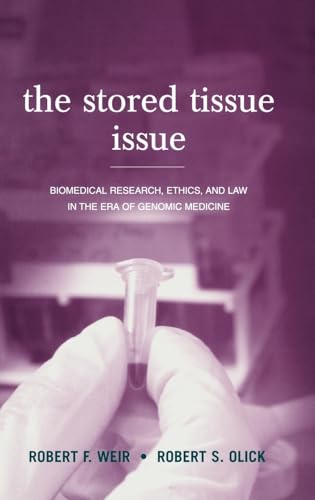
The Stored Tissue Issue: Biomedical Research, Ethics, and Law in the Era of Genomic Medicine - Hardcover
Synopsis
Genetics research with stored human tissues provides many benefits and holds much promise. Yet how this critical research is conducted sometimes raises serious ethical, legal, and social concerns, and it is difficult to balance the promise of biomedical research with our time-honored commitments to individual choice in such fundamental matters as control over personal health information and the disposition of our bodily tissues.
Weir and Olick provide a thorough analysis of this critical phase in the era of genomic medicine. While strongly supportive of the biomedical research enterprise, they develop a critique of many common research practices with banked tissues, DNA, and genetic data. Noting numerous examples of beneficial human tissue research, they focus on problematic research practices, controversial cases, and federal and institutional policies that limit the informed choices of patients and research participants. The authors offer a series of recommendations intended to limit the risks of inadequate informed consent to research for individuals, families, and groups, and to strengthen the bonds of trust between the research enterprise and the public upon which biomedical progress depends.
This book offers a wealth of information plus well-reasoned recommendations that will be of keen interest to geneticists, other biomedical scientists, research institutions, policymakers, students and others. It will serve as a clarion call to move beyond traditional policies and practices toward a richer understanding of partnership between patients and research participants and the biomedical research enterprise - a partnership for the benefit of all.
"synopsis" may belong to another edition of this title.
About the Author
Robert F. Weir is at University of Iowa. Robert S. Olick is at SUNY Upstate Medical University.
Reviews
During the past decade, national, regional, and international organizations and advisory bodies, bioethicists, patient advocates, and biomedical researchers have examined the legal, ethical, and social implications of collecting, storing, and conducting research with human-tissue samples. In The Stored Tissue Issue, Weir and Olick assess the ongoing debates about and controversy over the need for and specificity of informed consent; the privacy, confidentiality, and ownership issues related to samples and the genetic information derived from them; and the extent to which commercial profits should be shared with persons and communities that give their genetic material to researchers. Although Weir and Olick cover familiar terrain, a key feature of the book is their critical analysis of the recommendations by the National Bioethics Advisory Commission (NBAC) in its report, "Research Involving Human Biological Materials: Ethical Issues and Policy Guidance." Weir and Olick contend that the NBAC failed to achieve "the right balance" between the desire to protect persons who give researchers their tissue and genetic material and the goal of promoting biomedical research. For instance, the authors note that when the interests of persons are in conflict with the interests of researchers on matters of informed consent, the NBAC consistently offers policy recommendations that favor the interests of biomedical researchers. The authors assert that such recommendations underplay the mutual interests that both parties have in controlling the conditions of tissue research, as well as the importance of individual choice as a key feature of the principle of informed consent. Indeed, Weir and Olick point out that surveys of public opinion indicate that people want information about how researchers propose to use their genetic samples, and they want control over the uses to which their samples will be put. Weir and Olick also show that the recommendations of the NBAC do not reflect some of the common themes found in several international policy statements. Among these are the notion of human dignity, the right of people to control how their samples are used, and the commercial aspects of research that involves the use of genetic samples. Drawing from these themes, the authors issue a list of recommendations that differ from the NBAC approach, particularly with regard to informed consent. They recommend that researchers and institutions disclose detailed information about policies that concern the collection, storage, use, privacy, and commercial benefit of genetic samples; that institutional review boards have a more active role in overseeing research that involves stored samples; and that institutions provide institutional review boards with the resources they need to do a thorough and responsible job. Weir and Olick recommend that U.S. regulations on human research require disclosure by researchers about financial conflicts of interest and commercial gain, strengthen the requirements for informed consent in tissue research, state explicitly that persons have a right to self-determination over the use of their samples, require community consultation as well as community approval and individual consent for the collection of genetic samples from identifiable groups, and redefine the standard for minimal risk of harm so that potential psychosocial injuries and adverse effects on groups as a result of research with genetic samples are included in the definition. The authors say that their recommendations are "intended to be reasonable, realistic, and productive of significant change" toward improving the practices used in the collection and storage of tissue samples and the research that involves them. What Weir and Olick do not say is whether the growing list of conflicting recommendations can be brought into harmony at the national and international levels and how such harmony can be accomplished. Nonetheless, as research with banked tissues and genetic material and data continues to increase, all who hold a stake in this area should give careful attention to the authors' assessment of the problematic ethical issues and their call for greater collaboration among researchers, institutions, and persons who participate in tissue research. Karen J. Maschke, Ph.D.
Copyright © 2004 Massachusetts Medical Society. All rights reserved. The New England Journal of Medicine is a registered trademark of the MMS.
"About this title" may belong to another edition of this title.
Search results for The Stored Tissue Issue: Biomedical Research, Ethics,...

Stock Image
The Stored Tissue Issue : Biomedical Research, Ethics, and Law in the Era of Genomic Medicine
Published by
Oxford University Press, Incorporated, 2004
ISBN 10: 0195123689
ISBN 13: 9780195123685
Used
Hardcover
First Edition
Seller: Better World Books, Mishawaka, IN, U.S.A.
Seller rating 5 out of 5 stars

Condition: Good. 1st Edition. Pages intact with minimal writing/highlighting. The binding may be loose and creased. Dust jackets/supplements are not included. Stock photo provided. Product includes identifying sticker. Better World Books: Buy Books. Do Good. Seller Inventory # 55073134-6
Stock Image
The Stored Tissue Issue : Biomedical Research, Ethics, and Law in the Era of Genomic Medicine
Published by
Oxford University Press, Incorporated, 2004
ISBN 10: 0195123689
ISBN 13: 9780195123685
Used
Hardcover
First Edition
Seller: Better World Books, Mishawaka, IN, U.S.A.
Seller rating 5 out of 5 stars
Condition: Good. 1st Edition. Former library copy. Pages intact with minimal writing/highlighting. The binding may be loose and creased. Dust jackets/supplements are not included. Includes library markings. Stock photo provided. Product includes identifying sticker. Better World Books: Buy Books. Do Good. Seller Inventory # 11705044-6
Stock Image
The Stored Tissue Issue: Biomedical Research, Ethics, and Law in the Era of Genomic Medicine
Published by
Oxford University Press, 2004
ISBN 10: 0195123689
ISBN 13: 9780195123685
Used
Hardcover
Seller: ThriftBooks-Dallas, Dallas, TX, U.S.A.
Seller rating 5 out of 5 stars
Hardcover. Condition: Good. No Jacket. Missing dust jacket; Pages can have notes/highlighting. Spine may show signs of wear. ~ ThriftBooks: Read More, Spend Less. Seller Inventory # G0195123689I3N01
Stock Image
The Stored Tissue Issue: Biomedical Research, Ethics, and Law in the Era of Genomic Medicine
Published by
Oxford University Press, 2004
ISBN 10: 0195123689
ISBN 13: 9780195123685
New
Hardcover
First Edition
Seller: BOOKWEST, Phoenix, AZ, U.S.A.
Seller rating 3 out of 5 stars

Hardcover. Condition: New. 1st Edition. SHRINK-WRAPPED: US SELLER SHIPS FROM USA. Seller Inventory # TLR-BX-16-111-E4-HC-0195123689-1P5-'04
Stock Image
The Stored Tissue Issue: Biomedical Research, Ethics, and Law in the Era of Genomic Medicine
Published by
Oxford University Press, 2004
ISBN 10: 0195123689
ISBN 13: 9780195123685
New
Hardcover
First Edition
Seller: BOOKWEST, Phoenix, AZ, U.S.A.
Seller rating 3 out of 5 stars
Hardcover. Condition: New. 1st Edition. US SELLER SHIPS FAST FROM USA. Seller Inventory # 111E6-119E3-PX-813-SBX-174-211-218-1P5
Stock Image
The Stored Tissue Issue
Seller: Basi6 International, Irving, TX, U.S.A.
Seller rating 5 out of 5 stars
Condition: Brand New. New. US edition. Expediting shipping for all USA and Europe orders excluding PO Box. Excellent Customer Service. Seller Inventory # ABEOCT25-62220
Seller Image
Stored Tissue Issue : Biomedical Research, Ethics, and Law in the Era of Genomic Medicine
Seller: GreatBookPrices, Columbia, MD, U.S.A.
Seller rating 5 out of 5 stars
Condition: New. Seller Inventory # 2325593-n
Stock Image
The Stored Tissue Issue: Biomedical research, ethics and law in the era of genomic medicine (eng)
Print on DemandSeller: Brook Bookstore On Demand, Napoli, NA, Italy
Seller rating 5 out of 5 stars
Condition: new. Questo è un articolo print on demand. Seller Inventory # ba1b28c24547d0db3b06579a6a368df4
Buy New
US$ 74.13
US$ 7.61 shipping
Ships from Italy to U.S.A.
Ships from Italy to U.S.A.
Quantity: Over 20 available
Stock Image
The Stored Tissue Issue: Biomedical Research, Ethics, and Law in the Era of Genomic Medicine
Published by
Oxford University Press, 2004
ISBN 10: 0195123689
ISBN 13: 9780195123685
Used
Hardcover
Seller: Anybook.com, Lincoln, United Kingdom
Seller rating 5 out of 5 stars
Condition: Good. This is an ex-library book and may have the usual library/used-book markings inside.This book has hardback covers. In good all round condition. No dust jacket. Please note the Image in this listing is a stock photo and may not match the covers of the actual item,700grams, ISBN:0195123689. Seller Inventory # 8766977
Buy Used
US$ 64.91
US$ 17.73 shipping
Ships from United Kingdom to U.S.A.
Ships from United Kingdom to U.S.A.
Quantity: 1 available
Stock Image
The Stored Tissue Issue: Biomedical Research, Ethics, and Law in the Era of Genomic Medicine
Published by
Oxford University Press, 2004
ISBN 10: 0195123689
ISBN 13: 9780195123685
Used
Hardcover
Seller: Anybook.com, Lincoln, United Kingdom
Seller rating 5 out of 5 stars
Condition: Good. This is an ex-library book and may have the usual library/used-book markings inside.This book has hardback covers. In good all round condition. No dust jacket. Please note the Image in this listing is a stock photo and may not match the covers of the actual item,700grams, ISBN:0195123689. Seller Inventory # 8766976
Buy Used
US$ 64.91
US$ 17.73 shipping
Ships from United Kingdom to U.S.A.
Ships from United Kingdom to U.S.A.
Quantity: 1 available