
Items related to Oh, Play That Thing
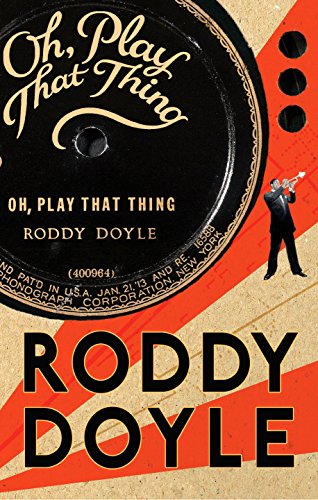
Synopsis
On the last page of A Star Called Henry, the first volume of the The Last Roundup trilogy, we left Henry Smart on the run from his Republican paymasters, the men for whom he had perpetrated murder and mayhem. He flees from Dublin to Liverpool and from thence to Ellis Island, New York, America. And this is where Oh, Play That Thing begins...It's 1924, and New York is the centre of the universe. Henry falls on his feet, as a handsome man with a sandwich board, and - this being Prohibition - behind his sandwich board a stash of hooch for the speakeasies of the Lower East Side. When he starts hiring kids to carry boards for him, he catches the attention of the mobsters who run the district and soon there are eyes on his back and men in the shadows. It is time to leave, for another Chicago.In Chicago there is no past waiting to jump on Henry. The place is wild, as new as he is, and newest of all is the music. Furious, wild, happy music played by a man with a trumpet and bleeding lips called Louis Armstrong. His music is everywhere, coming from every open door, every phonograph. But Armstrong is a prisoner of his colour; there are places a black man cannot go, things he cannot do. And the mob is in Chicago they own every stage - and they own the man up on the stage. Armstrong needs a man, a white man, and the man he chooses is Henry Smart.This is a novel of prodigious energy and invention. Its language and its rhythms are as breathtaking as the music it celebrates. It shows yet again that as a writer Roddy Doyle is unequalled in his vision, his ambition, his ability to surprise us with each new novel. It is nothing less than a triumph.
"synopsis" may belong to another edition of this title.
From the Inside Flap
Roddy Doyle's last novel, A Star Called Henry," was chosen by the "The New York Times Book Review as one of the eleven Best Books of the Year; "The Washington Post said it was "not only Doyle's best novel yet; it is a masterpiece, an extraordinarily entertaining epic." Now Doyle, author of six bestselling novels, twice nominated for the Booker Prize and once a winner, turns his protagonist Henry Smart's rich observation and linguistic acrobatics loose on America, in an energetic saga full of epic adventures, breathless escapes, and star-crossed love. "Publishers Weekly says "Doyle just gets better and better."
Our Irish hero arrives in New York in 1924 to bury himself in the teeming city and start a new life; having escaped Dublin after the 1916 Rebellion, Henry Smart is on the run from the Republicans for whom he committed murder and mayhem. Lying to the immigration officer, avoiding Irish eyes that might recognise him, hiding the photograph of himself with his wife because it shows a gun across his lap, he throws his passport into the river and tries to forge a new identity. He charms his way into the noisy, tough Lower East Side, reads to Puerto Rican cigar makers, hauls bottles for a bootlegger and composes ads on sandwich boards, finally setting up his own business with the intention of making his fortune. But he makes enemies along the way among mobsters such as Johnny No and Fast Olaf. Henry hightails it out of Manhattan with a gun at his back and Fast Olaf's hustler of a half-sister on his arm.
This was a time when America was ripe for the picking, however, and a pair of good, strong con artists could have the world at their fingertips. The Depression was sending folksto ride the rails in search of a new life and new hope, and all trains led to Chicago. As Henry's past tries to catch up with him, he takes off on a journey to the great port, where music is everywhere: wild, happy music played by a man with a trumpet called Louis Armstrong. Armstrong needs a white man, and the man he chooses is Henry Smart.
The bestselling A Star Called Henry followed Henry Smart from his birth in 1902 until the age of twenty, by which time he had already had a lifetime's worth of adventures in his native Ireland. With these books, Doyle was trying in some ways to write a story like Charles Dickens' David Copperfield, starting at the beginning of his life and following him through many years of adventures. To write the new book, he had to research the vanished world of pre-war America.
"I went to Chicago, on the south side, to see if any of the old jazz clubs were still around. I was very keen to see what Henry would have seen as he'd stood outside, under the awnings. But all the jazz clubs that were along State Street, they're all gone; every one of them's gone. There's one that's still standing - it was, originally, The Sunset Cafe, where Louis Armstrong played, but now it's a hardware store. The Vendome Cinema, where he used to play during the intermissions, is now a parking lot for the local college. That I found upsetting. But on the other hand it was very liberating because in its absence I can invent."
Music, often American soul or blues, is always important in Roddy Doyle's work, often as escapism for the working-class Dubliners in the Barrytown books. Doyle grew up listening to American music and likes to write while listening to music. For Henryin America, Doyle says, "when he hears this music, he feels he's being baptized. He's new. He feels he's gotten away from Ireland. He's gotten away from the misery of it all and he's listening to this glorious celebration."
"From the Hardcover edition.
From the Back Cover
"Together, [A Star Called Henry and Oh, Play That Thing] constitute one of the most remarkable achievements in recent Irish and American literature. And we’re left with the tantalizing possibility of a third novel to follow." -Atlanta Journal- Constitution
"Oh, Play That Thing chronicles the birth of the American century, from the shores of Ellis Island through the Jazz Age and into the Great Depression.... Doyle’s characters are too lively-too full-blooded and lusty-to be mere ciphers, and the Booker Prize-winning author gets the feel of things-jazz, regret, memory-right." -Boston Phoenix
"Written in a combo jazzed-up sassy poetry-rhythms part Irish, part New York street, part Chicago South Side blues... This is Doyle’s rambunctious tale of the 20th century’s immigrant America." -Chicago Sun-Times
"Vibrant, punchy images come in quick succession, evoking city streets teeming with life and possibility like the gritty poetics of John Dos Passos." -Philadelphia Weekly
"Doyle can make music come alive like no one else. His prose will bop and bang its head to punk or bump and grind to the blues.... [And he] understands that becoming an American-whether you’re black or Irish-is a game of improvisation, just like jazz." - New York Daily News
"A sprawling tale steeped in the grit, lawlessness and hardships of the early 1900s...it all unfolds in Doyle’s bold, vivid writing that, at its best, echoes the adventure and rhythm of jazz.... By the end, he has us hooked, racing for the finish to a book we wish wouldn’t end and eager for the final installment." -Rocky Mountain News
"About this title" may belong to another edition of this title.
Search results for Oh, Play That Thing

Stock Image
Oh, Play That Thing
Published by
Penguin Random House, 2004
ISBN 10: 0224074369
ISBN 13: 9780224074360
Used
Hardcover
First Edition
Seller: Better World Books, Mishawaka, IN, U.S.A.
Seller rating 5 out of 5 stars

Condition: Good. Not Stated (illustrator). First Edition. Pages intact with minimal writing/highlighting. The binding may be loose and creased. Dust jackets/supplements are not included. Stock photo provided. Product includes identifying sticker. Better World Books: Buy Books. Do Good. Seller Inventory # GRP102298100
Stock Image
Oh, Play That Thing
Seller: SatelliteBooks, Burlington, VT, U.S.A.
Seller rating 5 out of 5 stars
Hardcover. Condition: As New. Not Stated (illustrator). First edition Hardcover near fine/near fine DJ Free of any markings and no writing. Minor shelf-wear. For Additional Information or pictures, Please Inquire. Seller Inventory # SKU02498
Seller Image
Oh, Play That Thing
Seller: MusicMagpie, Stockport, United Kingdom
Seller rating 5 out of 5 stars
Condition: Very Good. Not Stated (illustrator). 1791539132. 10/9/2026 9:45:32 AM. Seller Inventory # U9780224074360
Buy Used
US$ 5.05
US$ 7.36 shipping
Ships from United Kingdom to U.S.A.
Ships from United Kingdom to U.S.A.
Quantity: 1 available
Stock Image
Oh, Play That Thing
Published by
Penguin Random House, 2004
ISBN 10: 0224074369
ISBN 13: 9780224074360
Used
Hardcover
First Edition
Seller: Better World Books Ltd, Dunfermline, United Kingdom
Seller rating 5 out of 5 stars
Condition: Very Good. Not Stated (illustrator). First Edition. Former library copy. Pages intact with possible writing/highlighting. Binding strong with minor wear. Dust jackets/supplements may not be included. Includes library markings. Stock photo provided. Product includes identifying sticker. Better World Books: Buy Books. Do Good. Seller Inventory # 51731147-20
Buy Used
US$ 6.22
US$ 6.70 shipping
Ships from United Kingdom to U.S.A.
Ships from United Kingdom to U.S.A.
Quantity: 2 available
Stock Image
Oh, Play That Thing
Seller: WorldofBooks, Goring-By-Sea, WS, United Kingdom
Seller rating 5 out of 5 stars
Hardback. Condition: Very Good. Not Stated (illustrator). The book has been read, but is in excellent condition. Pages are intact and not marred by notes or highlighting. The spine remains undamaged. Seller Inventory # GOR001486862
Buy Used
US$ 7.12
US$ 7.51 shipping
Ships from United Kingdom to U.S.A.
Ships from United Kingdom to U.S.A.
Quantity: 6 available
Stock Image
Oh, Play That Thing
Seller: Wonder Book, Frederick, MD, U.S.A.
Seller rating 5 out of 5 stars
Condition: Very Good. Not Stated (illustrator). First edition copy. . Like New dust jacket. First printing. In protective mylar cover. (fiction, historical fiction, ireland, new york, chicago). Seller Inventory # NC02B-00310
Stock Image
Oh, Play That Thing
Seller: medimops, Berlin, Germany
Seller rating 5 out of 5 stars
Condition: good. Not Stated (illustrator). Befriedigend/Good: Durchschnittlich erhaltenes Buch bzw. Schutzumschlag mit Gebrauchsspuren, aber vollständigen Seiten. / Describes the average WORN book or dust jacket that has all the pages present. Seller Inventory # M00224074369-G
Buy Used
US$ 6.58
US$ 11.22 shipping
Ships from Germany to U.S.A.
Ships from Germany to U.S.A.
Quantity: 1 available
Stock Image
Oh, Play That Thing
Seller: Kennys Bookstore, Olney, MD, U.S.A.
Seller rating 5 out of 5 stars
Condition: Very Good. Not Stated (illustrator). It's 1924, and New York is the centre of the universe. Henry falls on his feet, as a handsome man with a sandwich board, and behind his sandwich board a stash of hooch for the speakeasies of the Lower East Side. When he starts hiring kids to carry boards for him, he catches the attention of the mobsters who run the district. Num Pages: 384 pages. BIC Classification: FA. Category: (G) General (US: Trade). Dimension: 236 x 161 x 30. Weight in Grams: 700. Good clean copy. Fine in fine dustjacket. 2004. Hardcover. . . . . Books ship from the US and Ireland. Seller Inventory # KOC0002218
Stock Image
Oh, Play That Thing
Seller: Kennys Bookshop and Art Galleries Ltd., Galway, GY, Ireland
Seller rating 5 out of 5 stars
Condition: Very Good. Not Stated (illustrator). It's 1924, and New York is the centre of the universe. Henry falls on his feet, as a handsome man with a sandwich board, and behind his sandwich board a stash of hooch for the speakeasies of the Lower East Side. When he starts hiring kids to carry boards for him, he catches the attention of the mobsters who run the district. Num Pages: 384 pages. BIC Classification: FA. Category: (G) General (US: Trade). Dimension: 236 x 161 x 30. Weight in Grams: 700. Good clean copy. Fine in fine dustjacket. 2004. Hardcover. . . . . Seller Inventory # KOC0002218
Buy Used
US$ 8.54
US$ 10.66 shipping
Ships from Ireland to U.S.A.
Ships from Ireland to U.S.A.
Quantity: 1 available
Stock Image
Oh, Play That Thing
Published by
Jonathan Cape, London, U.K., 2004
ISBN 10: 0224074369
ISBN 13: 9780224074360
Used
Hardcover
Seller: PsychoBabel & Skoob Books, Didcot, United Kingdom
Seller rating 5 out of 5 stars
hardcover. Condition: Good. Dust Jacket Condition: Acceptable. Not Stated (illustrator). Hardcover. Very edge-worn jacket with considerable wear to leading corners and spine ends. Small nick along lower edge of front jacket. Several nicks across spine ends. Small tear to left side of spine head. Jacket is rather scuffed. Spine ends bumped. Spine is a little cocked. Stamp on half-title. Pages sunned but clean. Contents sound. AF. Used. Seller Inventory # 265929
Buy Used
US$ 3.53
US$ 16.75 shipping
Ships from United Kingdom to U.S.A.
Ships from United Kingdom to U.S.A.
Quantity: 1 available