
Items related to Tricks of the Trade: How to Think about Your Research...
Tricks of the Trade: How to Think about Your Research While You're Doing It (Chicago Guides to Writing, Editing, and Publishing) - Softcover
Book 82 of 95: Chicago Guides to Writing, Editing, and Publishing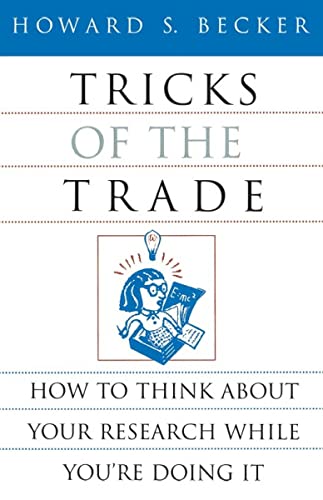
Synopsis
A classic guidebook from a master teacher and landmark researcher
Drawing on decades of experience as a researcher and teacher, Howard Becker brings to students and researchers the many valuable techniques for conducting research that he learned and taught. Tricks of the Trade will help students learn how to think about research projects. Assisted by Becker's sage advice, students can make better sense of their research and simultaneously generate fresh ideas on where to look next for new data. The tricks cover four broad areas of social science: the creation of the "imagery" to guide research; methods of "sampling" to generate maximum variety in the data; the development of "concepts" to organize findings; and the use of "logical" methods to explore systematically the implications of what is found. Becker's advice ranges from simple tricks such as changing an interview question from "Why?" to "How?" (as a way of getting people to talk without asking for a justification) to more technical tricks such as how to manipulate truth tables.
Becker has extracted these tricks from a variety of fields such as art history, anthropology, sociology, literature, and philosophy; and his dazzling variety of references ranges from James Agee to Ludwig Wittgenstein. Becker finds the common principles that lie behind good social science work, principles that apply to both quantitative and qualitative research. He offers practical advice, ideas students can apply to their data with the confidence that they will return with something they hadn't thought of before.
"synopsis" may belong to another edition of this title.
About the Author
Howard S. Becker (1928-2023) made major contributions to the sociology of deviance, sociology of art, and sociology of music. He received a PhD from the University of Chicago, where he was also an instructor in sociology and social sciences. He was professor of sociology at Northwestern University for twenty-five years and later became a professor of sociology and an adjunct professor of music at the University of Washington. He lived and worked in San Francisco and Paris.
"About this title" may belong to another edition of this title.
Search results for Tricks of the Trade: How to Think about Your Research...

Stock Image
Tricks of the Trade: How to Think about Your Research While You're Doing It
Published by
The University of Chicago Press, 1998
ISBN 10: 0226041247
ISBN 13: 9780226041247
Used
Paperback
Seller: World of Books (was SecondSale), Montgomery, IL, U.S.A.
Seller rating 5 out of 5 stars

Paperback. Condition: Good. Designed to help students learn how to think about research projects, this guide offers suggestions which cover four broad areas of social science: the creation of the "imagery" to guide research; methods of "sampling" to generate maximum variety in the data; the development of "concepts" to organize findings; and the use of "logical" methods to explore systematically the implications of what is found. The advice ranges from simple tricks such as changing an interview question from "Why?" to "How?" (as a way of getting people to talk without asking for a justification) to more technical tricks such as how to manipulate truth tables. Drawing from a variety of fields such as art history, anthropology, sociology, literature and philosophy, the author ranges from James Agee to Ludwig Wittgenstein, to find the common principles which lie behind good social science work, principles that apply to both quantitative and qualitative research. Seller Inventory # 00096743082
Seller Image
Tricks of the Trade: How to Think about Your Research While You're Doing It (Chicago Guides to Writing, Editing, and Publishing)
Published by
University of Chicago Press, 1998
ISBN 10: 0226041247
ISBN 13: 9780226041247
Used
Softcover
Seller: Zoom Books East, Glendale Heights, IL, U.S.A.
Seller rating 5 out of 5 stars
Condition: good. Book is in good condition and may include underlining highlighting and minimal wear. The book can also include "From the library of" labels. May not contain miscellaneous items toys, dvds, etc. . We offer 100% money back guarantee and 24 7 customer service. Seller Inventory # ZEV.0226041247.G
Seller Image
Tricks of the Trade: How to Think about Your Research While You're Doing It (Chicago Guides to Writing, Editing, and Publishing)
Published by
University of Chicago Press, 1998
ISBN 10: 0226041247
ISBN 13: 9780226041247
Used
Softcover
Seller: Zoom Books Company, Lynden, WA, U.S.A.
Seller rating 5 out of 5 stars
Condition: very_good. Book is in very good condition and may include minimal underlining highlighting. The book can also include "From the library of" labels. May not contain miscellaneous items toys, dvds, etc. . We offer 100% money back guarantee and 24 7 customer service. Seller Inventory # ZBV.0226041247.VG
Seller Image
Tricks of the Trade: How to Think about Your Research While You're Doing It (Chicago Guides to Writing, Editing, and Publishing)
Published by
University of Chicago Press, 1998
ISBN 10: 0226041247
ISBN 13: 9780226041247
Used
Softcover
Seller: Zoom Books East, Glendale Heights, IL, U.S.A.
Seller rating 5 out of 5 stars
Condition: very_good. Book is in very good condition and may include minimal underlining highlighting. The book can also include "From the library of" labels. May not contain miscellaneous items toys, dvds, etc. . We offer 100% money back guarantee and 24 7 customer service. Seller Inventory # ZEV.0226041247.VG
Seller Image
Tricks of the Trade: How to Think about Your Research While You're Doing It (Chicago Guides to Writing, Editing, and Publishing)
Published by
University of Chicago Press, 1998
ISBN 10: 0226041247
ISBN 13: 9780226041247
Used
Softcover
Seller: Books for Life, LAUREL, MD, U.S.A.
Seller rating 5 out of 5 stars
Condition: good. Book is in good condition. Minimal signs of wear. It May have markings or highlights, but kept to only a few pages. May not come with supplemental materials if applicable. Seller Inventory # LFM.83D5
Stock Image
Tricks of the Trade: How to Think about Your Research While You're Doing It (Chicago Guides to Writing, Editing, and Publishing)
Published by
University of Chicago Press (edition 1), 1998
ISBN 10: 0226041247
ISBN 13: 9780226041247
Used
Paperback
Seller: BooksRun, Philadelphia, PA, U.S.A.
Seller rating 5 out of 5 stars
Paperback. Condition: Very Good. 1. It's a well-cared-for item that has seen limited use. The item may show minor signs of wear. All the text is legible, with all pages included. It may have slight markings and/or highlighting. Seller Inventory # 0226041247-11-1
Stock Image
Tricks of the Trade: How to Think about Your Research While You're Doing It (Chicago Guides to Writing, Editing, and Publishing)
Published by
University of Chicago Press (edition 1), 1998
ISBN 10: 0226041247
ISBN 13: 9780226041247
Used
Paperback
Seller: BooksRun, Philadelphia, PA, U.S.A.
Seller rating 5 out of 5 stars
Paperback. Condition: Very Good. 1. It's a well-cared-for item that has seen limited use. The item may show minor signs of wear. All the text is legible, with all pages included. It may have slight markings and/or highlighting. Seller Inventory # 0226041247-8-18
Stock Image
Tricks of the Trade: How to Think about Your Research While You're Doing It (Chicago Guides to Writing, Editing, and Publishing)
Published by
University of Chicago Press, 1998
ISBN 10: 0226041247
ISBN 13: 9780226041247
Used
Softcover
Seller: More Than Words, Waltham, MA, U.S.A.
Seller rating 5 out of 5 stars
Condition: Good. A sound copy with only light wear. Overall a solid copy at a great price! Seller Inventory # BOS-G-01i-01796
Stock Image
Tricks of the Trade: How to Think about Your Research While You're Doing It
Published by
The University of Chicago Press, 1998
ISBN 10: 0226041247
ISBN 13: 9780226041247
Used
Paperback
Seller: World of Books Inc, Montgomery, IL, U.S.A.
Seller rating 4 out of 5 stars

Paperback. Condition: Good. Designed to help students learn how to think about research projects, this guide offers suggestions which cover four broad areas of social science: the creation of the "imagery" to guide research; methods of "sampling" to generate maximum variety in the data; the development of "concepts" to organize findings; and the use of "logical" methods to explore systematically the implications of what is found. The advice ranges from simple tricks such as changing an interview question from "Why?" to "How?" (as a way of getting people to talk without asking for a justification) to more technical tricks such as how to manipulate truth tables. Drawing from a variety of fields such as art history, anthropology, sociology, literature and philosophy, the author ranges from James Agee to Ludwig Wittgenstein, to find the common principles which lie behind good social science work, principles that apply to both quantitative and qualitative research. Seller Inventory # CIN0226041247G
Stock Image
Tricks of the Trade: How to Think about Your Research While You're Doing It
Published by
University of Chicago Press, 1998
ISBN 10: 0226041247
ISBN 13: 9780226041247
Used
Paperback
Seller: ThriftBooks-Atlanta, AUSTELL, GA, U.S.A.
Seller rating 5 out of 5 stars
Paperback. Condition: Good. No Jacket. Pages can have notes/highlighting. Spine may show signs of wear. ~ ThriftBooks: Read More, Spend Less. Seller Inventory # G0226041247I3N00