Items related to Difficulties of a Bridegroom
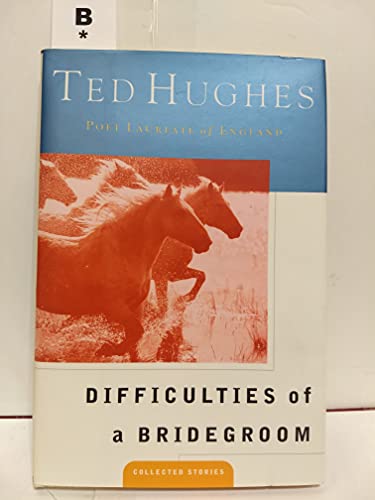

A collection of stories by the Poet Laureate of England includes among others the fable "O'Kelly's Angel," about a man who captures and cages an angel, and "The Wound," about an episode in World War II.
"synopsis" may belong to another edition of this title.
Review:
Ted Hughes is Britain's reigning poet laureate, and he confesses that most of his short fiction is merely "an accompaniment to my poems." But there are many gems here, including the affecting trilogy portraying the poet's South Yorkshire childhood. The finest tale in this collection may be "The Wound," actually a radio play about a dying soldier trekking across a pitiless desert. The death-march transforms itself into an allegory of the Buddhist path from death to rebirth. Most of these short stories date from the 1950s and 60s, before Hughes became a famous poet.
About the Author:
Ted Hughes was born on 17 August 1930 in Mytholmroyd, a small mill town in West Yorkshire. His father made portable wooden buildings. The family moved to Mexborough, a coal-mining town in South Yorkshire, when Hughes was seven. His parents took over a newsagent and tobacconist shop, and eventually he went to the local grammar school.
In 1948 Hughes won an Open Exhibition to Pembroke College, Cambridge. Before going there, he served two years National Service in the Royal Air Force. Between leaving Cambridge and becoming a teacher, he worked at various jobs, finally as a script-reader for Rank at their Pinewood Studios.
In 1956 Hughes married the American poet Sylvia Plath, who died in 1963, and they had two children. He remarried in 1970. He was awarded the OBE in 1977, created Poet Laureate in December 1984 and appointed to the Order of Merit in 1998. He died in October 1998.
Ted Hughes's first book, The Hawk in the Rain,, was published by Faber in 1957. He published poetry, fiction and prose for both adults and children, as well as acclaimed translations. He also edited a number of poetry anthologies, including (with Seamus Heaney) The Rattle Bag and The School Bag. He won many awards including First Prize in the Guinness Poetry Awards in 1958, the Queen's Gold Medal for Poetry in 1974 and the Guardian's Children's Fiction Award in 1985. In 1997 he won the Whitbread Book of the Year Award for Tales from Ovid, and repeated this success the following year with Birthday Letters, which was also awarded both the T. S. Eliot Prize and Forward Prize for Best Collection of Poetry, and named Book of the Year at the British Book Awards.
"About this title" may belong to another edition of this title.
- PublisherPicador
- Publication date1996
- ISBN 10 031214587X
- ISBN 13 9780312145873
- BindingHardcover
- Edition number1
- Number of pages159
- Rating
Buy New
Learn more about this copy
US$ 43.81
Shipping:
US$ 4.25
Within U.S.A.
Top Search Results from the AbeBooks Marketplace
Stock Image
Difficulties of a Bridegroom
Seller:
Rating

Book Description Hardcover. Condition: new. New Copy. Customer Service Guaranteed. Seller Inventory # think031214587X
Buy New
US$ 43.81
Convert currency
Seller Image
Difficulties of A Bridegroom
Published by
Picador, New York
(1995)
ISBN 10: 031214587X
ISBN 13: 9780312145873
New
Hardcover
First Edition
Quantity: 1
Seller:
Rating
Book Description HARDCOVER. Condition: New. Dust Jacket Condition: New. 1st Edition. 1st US printing. 8vo in cream cloth backed boards, 159pp CONDITION: An extremely well preserved AS NEW copy (merest hint of tanning to leaves) in an AS NEW complete Dust Jacket ] ._ ._We Ship in PROTECTIVE CARD PARCELS. Seller Inventory # T1803849
Buy New
US$ 28.17
Convert currency
Stock Image
Difficulties of a Bridegroom
Seller:
Rating
Book Description Hardcover. Condition: new. New. Seller Inventory # Wizard031214587X
Buy New
US$ 45.10
Convert currency
Stock Image
Difficulties of a Bridegroom
Seller:
Rating
Book Description Hardcover. Condition: New. Seller Inventory # Abebooks582029
Buy New
US$ 59.00
Convert currency
Stock Image
Difficulties of a Bridegroom
Seller:
Rating
Book Description Hardcover. Condition: new. New. Fast Shipping and good customer service. Seller Inventory # Holz_New_031214587X
Buy New
US$ 67.85
Convert currency
Stock Image
DIFFICULTIES OF A BRIDEGROOM
Seller:
Rating
Book Description Condition: New. New. In shrink wrap. Looks like an interesting title! 0.4. Seller Inventory # Q-031214587X
Buy New
US$ 94.41
Convert currency