Items related to The Templars: The Dramatic History of the Knights Templar,...
The Templars: The Dramatic History of the Knights Templar, the Most Powerful Military Order of the Crusades - Hardcover
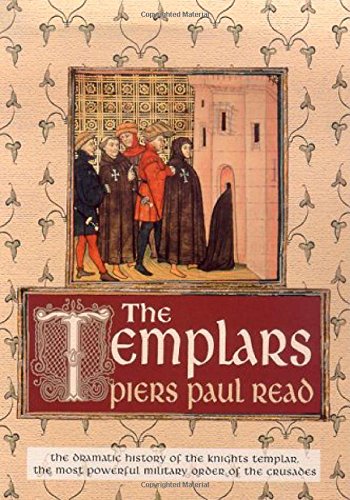

In 1099, the city of Jerusalem, a possession of the Islamic Caliphate for over four-hundred years, fell to an army of European knights intent on restoring the Cross to the Holy Lands. From the ranks of these holy warriors emerged an order of monks trained in both scripture and the military arts, an order that would protect and administer Christendom's prized conquest for almost a century: the Knights of the Temple of Solomon, or the Templars.
In this articulate and engaging history, Piers Paul Read explores the rise, the catastrophic fall, and the far-reaching legacy of these knights who took, and briefly held, the most bitterly contested citadel in the monotheistic West. Drawing on the most recent scholarship, and writing with authority and candor, Read chronicles the history of the blood-splattered monks who still infiltrate modernity in literature, as the inspiration for secret societies, and in the backyard fantasies of any child with access to a stick and a garbage can lid.
More than armed holy men, the Templars also represented the first uniformed standing army in the Western world. Sustaining their military order required vast sums of money, and, to that end, a powerful multinational corporation formed. The prosperity that European financiers enjoyed, from the efficient management of Levantine possessions and from pioneering developments in the field of international banking, would help jump-start Europe's long-slumbering Dark Age economy.
In 1307, the French king, Philip IV, expropriated Templar lands, unleashing a wave of repression that would crest five years later. After Templar leaders broke down and confessed, under torture, to blasphemy, heresy, and sodomy, Pope Clement V suppressed the Order in 1312. Was it guilty as charged? And what relevance has the story to our own times? In this remarkable history, Piers Paul Read explores the Crusades and the individual biographies of the many colorful characters that fought them.
"synopsis" may belong to another edition of this title.
Review:
Piers Paul Read studied history at Cambridge University and has authored twelve acclaimed novels and three works of non-fiction, including the international bestseller Alive. His novels have won the Hawthornden Prize and the Geoffrey Faber, Somerset Maugham, and James Tait Black Awards. He is married with four children and lives in London.
The Knights Templar remain the most glamorous, but also the most mysterious, of all religious organizations. Romanticized by Walter Scott in his novel Ivanhoe and by Wagner in his opera Parsifal, the Templars have been both celebrated as ascetic martyrs, dying for the greater good of Christianity, and condemned as deviant heretics, thieves, and sodomites who sold the Holy Land out to the Muslim Infidels. In his carefully researched study The Templars, the acclaimed novelist Piers Paul Read investigates the truth behind the myth. Placing his account of the rise of the Templars within a wider historical and political context, Read argues that "The Templars were a multinational force engaged in the defence of the Christian concept of a world order: and their demise marks the point when the pursuit of the common good within Christendom became subordinate to the interests of the nation state."
About the Author:
This approach takes Read back into the Dark Ages and the context for the first Christian Crusade, which culminated in the capture of Jerusalem in 1099. In an attempt to hold on to Jerusalem and one of the holiest sites in Christendom, the Temple of Solomon, the Templars were formed as a strict religious-military order, committed to poverty, chastity, and the protection of pilgrims en route to the Holy Land. Read charts their rise to political and financial power and influence throughout Europe and the Holy Land, and their bloody (and ultimately unsuccessful) conflict with the forces of Islam over the subsequent two centuries. Read's account is painstakingly recounted, but often lacks the verve and pace demanded by the colorful cast of characters, including Saladin and Richard the Lionheart. The best sections of the book deal with the shockingly cynical destruction of the Order by Pope Clement V and King Philip the Fair in 1312, preceded by the torture and death of hundreds of Templars who had already fought bravely for the cross in the Holy Land. The Templars are fascinating, but in his attempt to avoid the more colorful and conspiratorial stories associated with the Order, Read's book may strike some as a little turgid, despite its admirable historical detail. --Jerry Brotton, Amazon.co.uk
Piers Paul Read studied history at Cambridge University and has authored twelve acclaimed novels and three works of non-fiction, including the international bestseller Alive. His novels have won the Hawthornden Prize and the Geoffrey Faber, Somerset Maugham, and James Tait Black Awards. He is married with four children and lives in London.
"About this title" may belong to another edition of this title.
- PublisherSt. Martin's Press
- Publication date2000
- ISBN 10 0312266588
- ISBN 13 9780312266585
- BindingHardcover
- Edition number1
- Number of pages368
- Rating
Buy New
Learn more about this copy
US$ 25.34
Shipping:
FREE
Within U.S.A.
Other Popular Editions of the Same Title
Top Search Results from the AbeBooks Marketplace
Stock Image
The Templars: The Dramatic History of the Knights Templar, the Most Powerful Military Order of the Crusades
Published by
St. Martin's Press
(2000)
ISBN 10: 0312266588
ISBN 13: 9780312266585
New
Hardcover
Quantity: 1
Seller:
Rating

Book Description Condition: New. Book is in NEW condition. Seller Inventory # 0312266588-2-1
Buy New
US$ 25.34
Convert currency
Stock Image
The Templars: The Dramatic History of the Knights Templar, the Most Powerful Military Order of the Crusades
Published by
St. Martin's Press
(2000)
ISBN 10: 0312266588
ISBN 13: 9780312266585
New
Hardcover
Quantity: 1
Seller:
Rating
Book Description Hardcover. Condition: new. New. Fast Shipping and good customer service. Seller Inventory # Holz_New_0312266588
Buy New
US$ 21.58
Convert currency
Stock Image
The Templars: The Dramatic History of the Knights Templar, the Most Powerful Military Order of the Crusades
Published by
St. Martin's Press
(2000)
ISBN 10: 0312266588
ISBN 13: 9780312266585
New
Hardcover
Quantity: 1
Seller:
Rating
Book Description Hardcover. Condition: new. Buy for Great customer experience. Seller Inventory # GoldenDragon0312266588
Buy New
US$ 23.13
Convert currency
Stock Image
The Templars: The Dramatic History of the Knights Templar, the Most Powerful Military Order of the Crusades
Published by
St. Martin's Press
(2000)
ISBN 10: 0312266588
ISBN 13: 9780312266585
New
Hardcover
Quantity: 1
Seller:
Rating
Book Description Condition: New. New! This book is in the same immaculate condition as when it was published. Seller Inventory # 353-0312266588-new
Buy New
US$ 27.17
Convert currency
Stock Image
The Templars: The Dramatic History of the Knights Templar, the Most Powerful Military Order of the Crusades
Published by
St. Martin's Press
(2000)
ISBN 10: 0312266588
ISBN 13: 9780312266585
New
Hardcover
Quantity: 1
Seller:
Rating
Book Description Hardcover. Condition: new. New. Seller Inventory # Wizard0312266588
Buy New
US$ 27.08
Convert currency
Stock Image
The Templars: The Dramatic History of the Knights Templar, the Most Powerful Military Order of the Crusades
Published by
St. Martin's Press
(2000)
ISBN 10: 0312266588
ISBN 13: 9780312266585
New
Hardcover
Quantity: 1
Seller:
Rating
Book Description Hardcover. Condition: new. New Copy. Customer Service Guaranteed. Seller Inventory # think0312266588
Buy New
US$ 26.68
Convert currency
Stock Image
The Templars: The Dramatic History of the Knights Templar, the Most Powerful Military Order of the Crusades
Published by
St. Martin's Press
(2000)
ISBN 10: 0312266588
ISBN 13: 9780312266585
New
Hardcover
Quantity: 1
Seller:
Rating
Book Description Condition: new. Seller Inventory # FrontCover0312266588
Buy New
US$ 29.30
Convert currency
Stock Image
The Templars: The Dramatic History of the Knights Templar, the Most Powerful Military Order of the C
Published by
St. Martin's Press
(2000)
ISBN 10: 0312266588
ISBN 13: 9780312266585
New
Hardcover
Quantity: 2
Seller:
Rating
Book Description Hardcover. Condition: New. Brand New!. Seller Inventory # VIB0312266588
Buy New
US$ 43.85
Convert currency
Stock Image
The Templars: The Dramatic History of the Knights Templar, the Most Powerful Military Order of the Crusades
Published by
St. Martin's Press
(2000)
ISBN 10: 0312266588
ISBN 13: 9780312266585
New
Hardcover
Quantity: 1
Seller:
Rating
Book Description Hardcover. Condition: New. Seller Inventory # Abebooks85243
Buy New
US$ 59.00
Convert currency
Stock Image
THE TEMPLARS: THE DRAMATIC HISTO
Published by
St. Martin's Press
(2000)
ISBN 10: 0312266588
ISBN 13: 9780312266585
New
Hardcover
Quantity: 1
Seller:
Rating

Book Description Condition: New. New. In shrink wrap. Looks like an interesting title! 1.55. Seller Inventory # Q-0312266588
Buy New
US$ 58.14
Convert currency