
Items related to Area Code 212: New York Days, New York Nights
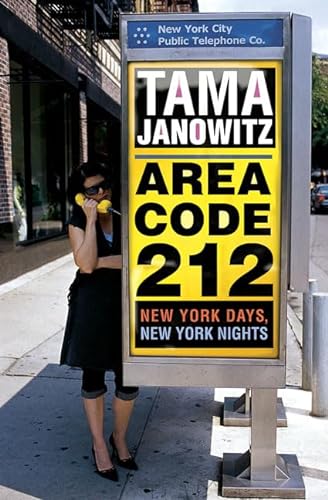
Synopsis
Welcome to the wonderful world of Tama Janowitz, one of New York's wittiest social chroniclers. Area Code 212 is filled with idiosyncratic delights and oddities, including her hilarious account of Andy Warhol's 1980s blind date club; her brief moment of celebrity as an elderly teenage extra in a ZZ Top video; the day she tested mentally retarded on an IQ test; and many other revealing tales of New York life, including its parties, its restaurants, and its fashion. Janowitz gives us her unique lowdown on her 1990s conversion from Manhattan to Brooklyn, on observing the Twin Towers come down from her apartment roof, on hairless dogs and ferrets, babies, the outer boroughs, big-hair days and bad-hair days.
Above all, the humor and insights of Area Code 212 will not only appeal to all of those who live in New York City, but also to those from around the country who have a fascination with what it is like to thrive in the urban mecca.
Self-deprecating, funny, and touching, Area Code 212 is an irresistible collection of essays.
"synopsis" may belong to another edition of this title.
About the Author
Tama Janowitz exploded onto the literary scene in 1986 with her bestselling book, Slaves of New York. Her most recent novel is Peyton Amberg. Janowitz's work has appeared in many publications, including The New Yorker, Vogue, the New York Times Op-Ed page, and elsewhere. She lives in Brooklyn with her husband and daughter.
From the Back Cover
"The other day I was walking down the street (again, fully, 100 percent clothed, and when I say 100 percent, that means practically not an inch of exposed skin) and some man on a corner yelled, "You having a bad-hair day! Whoops, I mean you having a bad-hair month! I guess you probably having a bad-hair life!"
- from Area Code 212
Praise for Tama Janowitz
"A writer of considerable talent."
- The New York Observer
"A singular talent"
- The New York Times Book Review
"A true original."
- San Francisco Chronicle
"Funny, reflective . . . wonderfully sharp."
- The Washington Post
"A penetrating eye."
- New York magazine
Reviews
While Janowitz is famous for her 1986 bestseller Slaves of New York, she's published widely since then—in everything from Vogue to Modern Ferret—and has revised many pieces for this anthology. Apart from the first selection, a horrifying description of having a miscarriage in a toilet at the Museum of Modern Art, most are in the E.B. White mode: witty vignettes on life in New York. Since adopting Chinese babies isn't uncommon in the world of modern Manhattanites, it's not surprising when Janowitz describes the trip she and her husband took to Heifei to adopt. Janowitz's description of her incompetence as a new mom has an almost Marx Brothers quality, as she details their baby fighting a diaper change "like a wounded fox in a leg-hold trap." Her essays on animals and pets are characteristically contrarian. She prefers "timid, feeble, neurotic, snappish, picky, babyish" dogs, but finds the Prospect Park Zoo's kangaroo no more interesting than a "gigantic rabbit." Apart from crotchety lapdogs, Janowitz loves food (oozing pizza, pounds of chocolate, doughnuts, steaks, etc.), although she doesn't enjoy elegant hors d'oeuvres at lavish receptions—after all, isn't eating "basically a solitary pleasure"? "The '80s died in Manhattan in 1987, along with Andy Warhol," she writes. But Janowitz herself, older and more self-critical, is still going strong.
Copyright © Reed Business Information, a division of Reed Elsevier Inc. All rights reserved.
Janowitz's caustic wit, her taste for the sordid and the absurd, and her knack for skewering the fashionable and championing the clueless are as vividly present in her pithy nonfiction as they are in her spiky novels, which include A Certain Age (1999) and Peyton Amber (2003). This robust essay collection spans the past two decades and forms a montagelike self-portrait and a sharp critique of urban life. But will the reader get past the jarring opening essay, a deadpan and graphic account of her suffering a miscarriage at the Museum of Modern Art? This rough start does establish Janowitz's sanguinary tendencies, and things get far more engaging once she offers curmudgeonly yet affectionate tales about her adopted Chinese daughter and cops to her penchant for wearing bizarre outfits and her fondness for tiny, high-strung dogs. Janowitz is at her mordant best when she chronicles the spectrum of New York life, from her crummy neighborhood grocery and the fringes of Prospect Park to decadent promotional events and her hilarious escapades with Andy Warhol and their blind date club. Never correct or polite, Janowitz is sharply observant, bracingly frank, wryly skeptical, and fully aware of the deeper issues at stake, from the devaluing of art to homelessness to the precarious state of the environment. Donna Seaman
Copyright © American Library Association. All rights reserved
Excerpt. © Reprinted by permission. All rights reserved.
Area Code 212
Part One
Family Life
Performance Art
Sometimes, living in New York, I got invited to movie premieres and screenings. There were all kinds. Usually a premiere was held in a cinema—tickets and the invitation for the party to follow came in the mail. There would be a big crowd gathered in front of the theater to watch the arrival of the celebrities, a velvet rope, security guards, Klieg lights on the streets lighting huge arcs in the sky.
After the movie there was usually a party of some sort. One I remember was held in the Plaza hotel, following a Western comedy: hamburgers and beans were served on paper plates. One was in the restaurant adjacent to the skating rink at Rockefeller Center. Another time the guests were taken in old-fashioned English double-decker buses from the movie theater to a restaurant.
I had lost the passes to get us on the bus, so I went around the line to ask the woman taking the tickets what I should do—if she would let us on the bus without them. Later, somebody wrote an angry article in a local free newspaper, about how I had thought I was so important I tried to cut to the front of the line. I kept wanting to say, That’s not why I went to the front of the line! I went to the front of the line to find out whether or not I would even be let on to the bus without a ticket or should I find a taxi. But in this situation, my own personal equivalent to a movie star’s getting a mean mention for behavior, there was nothing I could do.
Screenings were more fun; one got to see the movie in a little screening room, and some of these were incredibly fancy, with only twenty or thirty huge plush seats, high in a skyscraper, just a few of you at your own private movie in Manhattan. Sometimes after this the director might take a group out to dinner.
Of course the best premiere I ever went to was for the Merchant-Ivory film based on my book Slaves of New York in 1986. Bloomingdale’s had opened a boutique with clothing based on the fashion worn in the movie. My Grandma Anne attended and each time the photographers tried to take my picture my tiny grandmother appeared out of nowhere and sprang into the picture alongside me, shouting, “I’m the grandma!” She was so totally gleeful—at getting her picture taken—that I always felt good that I had given her that experience before her death. Then a red carpet was laid out across Third Avenue—the entire stretch, across the avenue—and traffic was stopped so that the attendees could leave Bloomingdale’s and cross the street to the movie theater.
During the movie not one person laughed. Fortunately the next night my brother and mother attended (there was a second, different premiere) and even though on this night the theater was still totally quiet, my mother and brother were sitting directly in front of me, howling, screaming with laughter. So at least at that time, for the movie, there was an audience of two.
Another time I was invited to a movie premiere which was to be followed by a dinner at the Museum of Modern Art. Tim, my husband, was out of town so I invited a friend of his—who had become my friend, too—to be my date. I was very pleased to go to a premiere and to have a friend to go with, and it seemed particularly nice in the last days of summer, first days of early fall, to be having dinner in the museum.
I didn’t feel so good, bloated and a little queasy, but I dressed carefully and put on black tights and a long flowing black skirt, with a T-shirt and a sort of long frock coat over it. I think it was an old design of Nicole Miller’s, whom I knew and who had given it to me. I liked being covered up. My idea of a bathing suit would have been one of those Victorian things down to my ankles, but even at night it seemed best to keep every inch of skin covered. That way nobody could look at me and judge me; and since I am my own harshest judge, I knew what they were thinking.
The film wasn’t particularly good but it wasn’t unbearable and later it won all kinds of prizes. Afterwards everyone walked the block or so to the museum and we showed special passes to get in.
It wasn’t the most glamorous evening, though it might have been if you had never done one of these things before, but it was entertaining in a peculiar New York sort of way, to be at a party in a museum that was closed to the general public, at night time. But neither of us really knew any of the other guests. That made things a bit awkward; it was like attending a cocktail party for a business in which you didn’t work.
Then my friend bumped into someone he knew and introduced me and the three of us stood chatting near the top of the escalator going down.
Suddenly I realized my black tights were wet. They were completely soaked. Next it occurred to me my shoes were sodden, like two sponges. It seemed very peculiar. I looked and saw the shoes were full not of water but of blood. For a moment I didn’t move. Drops of blood began to dot the floor. The floor was shiny and the dots of blood were very red.
“Excuse me,” I said and I went down the escalator toward the women’s lavatory.
By the time I got to the bottom of the escalator my shoes were almost overflowing and in the toilet I started to bleed more. There was blood everywhere. I couldn’t control it. Finally I mopped myself up a bit with toilet paper, and the floor and toilet. I went out and bought a sanitary napkin from the machine with my only dime, dripping blood everywhere.
Back in the toilet stall I bled through the sanitary napkin. There was blood on the walls, and all over the floor, it looked as if someone had been murdered. In a way it was sort of cool, I thought, even though I couldn’t figure out how this had happened. I was getting a lot weaker.
Women were going in and out and it seemed a bit peculiar that no one called, “Are you all right in there? Do you need help?”
Suddenly there was a commotion at the door; I peered out the crack in the toilet stall and saw that three men had entered with buckets and mops as well as two women, all five were in janitor uniforms. “Somebody cut themself?” one of the men was saying.
“There’s blood all over the floor,” a woman said. She sounded furious.
“Going up on the first floor, too,” another man said.
They began to mop and scrub. “Who did it?” said a woman.
“The blood led down here.”
They must have known it was I, I thought, since I saw there was a pool of blood leading directly to my toilet stall. Surely one of them might ask if I was OK. It was true I had made a mess and was very ashamed, but after all, what if I was trying to commit suicide and was bleeding to death in here, that would be a lot more work for them. It occurred to me it might be amusing to put on a couple of different voices, in a high voice I could scream, “Stop! Stop!” and in a deeper voice I would say, “I’m going to kill you!” Then I could bounce back and forth between the walls as if I was being throttled. This was a long time before the O. J. Simpson case. How surprised the cleaners would be when they finally burst open the door to my stall and found only me, covered in blood: it would be like a Sherlock. Holmes case, the attacker mysteriously vanished.
They finished mopping and left. The women’s lavatory was quiet and empty. Once in a while a woman came in to use the facilities but I guess nothing appeared amiss. I tried to wring out my stockings and clean up my shoes. Each shoe was so full I tipped out the contents into the toilet. I was still bleeding, but not as heavily, and I went out and got a lot of paper towels since I didn’t have another dime to get anything out of the machine. In the mirror my face was absolutely blanched. There was blood all over my hands and some had gotten on my face. I had never seen so much blood in my life.
“You were gone for forty minutes,” my friend said. “I thought maybe you left. Where were you?”
I don’t know why I didn’t say having a miscarriage. “I was in the lavatory,” I said. “It’s not that much fun, being female.” I was maybe three-quarters embarrassed and about one-quarter amused. I don’t know why it amused me, that I could so easily have been left for dead in the lavatory of the Museum of Modern Art, but it did. We went to the bar to get another glass of wine.
After this whenever there was some dumb girl in the newspapers who went into a bathroom and gave birth and left and then was accused of murdering her infant, I always had sympathy for the girl. I was a lot older than my teens but at that moment if a full-term baby had slipped out into the toilet and drowned, along with all the blood, I probably wouldn’t have known what was happening. If I was in my teens and nobody said, “Are you OK? Are you alive?” I don’t think I would have felt it mattered whether or not a baby was alive, if I even thought to look. And it would have served the lavatory attendants right if the next day one of them bad found a dead baby.
AREA CODE 212. Copyright © 2002, 2004 by Tama Janowitz. All rights reserved. No part of this book may be reproduced in any manner whatsoever without written permission except in the case of brief quotations embodied in critical articles or reviews. For information, address St. Martin’s Press, 175 Fifth Avenue, New York, N.Y. 10010.
"About this title" may belong to another edition of this title.
Search results for Area Code 212: New York Days, New York Nights

Seller Image
Area Code 212: New York Days, New York Nights
Seller: -OnTimeBooks-, Phoenix, AZ, U.S.A.
Seller rating 5 out of 5 stars

Condition: good. A copy that has been read, remains in good condition. All pages are intact, and the cover is intact. The spine and cover show signs of wear. Pages can include notes and highlighting and show signs of wear, and the copy can include "From the library of" labels or previous owner inscriptions. 100% GUARANTEE! Shipped with delivery confirmation, if you're not satisfied with purchase please return item! Ships via media mail. Seller Inventory # OTV.0312320620.G
Stock Image
Area Code 212: New York Days, New York Nights
Seller: ThriftBooks-Dallas, Dallas, TX, U.S.A.
Seller rating 5 out of 5 stars
Hardcover. Condition: As New. No Jacket. Pages are clean and are not marred by notes or folds of any kind. ~ ThriftBooks: Read More, Spend Less. Seller Inventory # G0312320620I2N00
Stock Image
Area Code 212 : New York Days, New York Nights
Seller: Better World Books, Mishawaka, IN, U.S.A.
Seller rating 5 out of 5 stars
Condition: Good. Former library copy. Pages intact with minimal writing/highlighting. The binding may be loose and creased. Dust jackets/supplements are not included. Includes library markings. Stock photo provided. Product includes identifying sticker. Better World Books: Buy Books. Do Good. Seller Inventory # 40988401-6
Stock Image
Area Code 212: New York Days, New York Nights
Published by
St. Martin's Press, U.S.A., 2004
ISBN 10: 0312320620
ISBN 13: 9780312320621
Used
Hardcover
First Edition
Signed
Seller: Daniel Montemarano, Newfield, NJ, U.S.A.
Seller rating 5 out of 5 stars
Hard Cover. Condition: Near Fine. Dust Jacket Condition: Fine. 1st Edition/1st Printing. SIGNED by author on a bookplate affixed to front end page (signature only with drawing of a horse). fine except for a few pages that were slightly bent at edge. $24.95 price present on DJ flap. Size: 8vo - over 7¾" - 9¾" tall. Signed by Author. Seller Inventory # 030102
Stock Image
Area Code 212 : New York Days, New York Nights
Published by
St. Martin's Press, New York, 2004
ISBN 10: 0312320620
ISBN 13: 9780312320621
Used
Hardcover
First Edition
Signed
Seller: About Books, Henderson, NV, U.S.A.
Seller rating 5 out of 5 stars
Hardcover. Condition: Fine condition. Dust Jacket Condition: Fine dust jacket. First Printing of the First Edition. New York: St. Martin's Press, 2004. INSCRIBED/SIGNED by the AUTHOR. Fine condition in a Fine dust jacket. NO chips. NO tears. NO creases. NO fading. NOT a library discard. Bright, shiny, clean, square and tight. Sharp corners. Pages are bright white and unmarked -- apparently never read. NO underlining. NO highlighting. NO margin notes. 2004. First printing with "First U.S. Edition: November 2004" so stated and complete number row (10 987654321) on the copyright page. Bound in the original black boards, stamped in hot pink on the spine. From the dust jacket: "Welcome to the wonderful world of Tama Janowitz, one of New York's wittiest social chroniclers. AREA CODE 212 is filled with idiosyncratic delights and oddities, including her hilarious account of Andy Warhol's 1980s blind date club; her brief moment of celebrity as an elderly teenage extra in a ZZ Top video; the day she tested mentally retarded on an IQ test; and many other revealing tales of New York life, including its parties, its restaurants, and its fashion. Janowitz gives us her unique lowdown on her 1990s conversion from Manhattan to Brooklyn, on observing the Twin Towers come down from her apartment roof, on hairless dogs and ferrets, babies, the outer boroughs, big-hair days and bad-hair days. Above all, the humor and insights of AREA CODE 212 will appeal not only to all of those who live in New York City, but also to those from around the country who have a fascination with what it is like to thrive in the urban mecca. Self-deprecating, funny, and touching, AREA CODE 212 is an irresistible collection of essays.". INSCRIBED/SIGNED by the AUTHOR. First Printing of the First Edition. Hardcover. Fine condition/Fine dust jacket. 8vo. xiv, 349pp. Great Packaging, Fast Shipping. Seller Inventory # 020171
Seller Image
Area Code 212: New York Days, New York Nights
Seller: WeBuyBooks, Rossendale, LANCS, United Kingdom
Seller rating 5 out of 5 stars
Hardcover. Condition: Very Good. Most items will be dispatched the same or the next working day. A copy that has been read, but is in excellent condition. Pages are intact and not marred by notes or highlighting. The spine remains undamaged. Seller Inventory # rev5838540289
Buy Used
US$ 26.98
US$ 8.82 shipping
Ships from United Kingdom to U.S.A.
Ships from United Kingdom to U.S.A.
Quantity: 1 available
Stock Image
Area Code 212: New York Days, New York Nights
Seller: DeckleEdge LLC, Albuquerque, NM, U.S.A.
Seller rating 5 out of 5 stars
hardcover. Condition: new. Seller Inventory # Shelfdream0312320620
Stock Image
Area Code 212: New York Days, New York Nights
Seller: BennettBooksLtd, Los Angeles, CA, U.S.A.
Seller rating 5 out of 5 stars
hardcover. Condition: New. In shrink wrap. Looks like an interesting title! Seller Inventory # Q-0312320620