
Items related to Twilight: Losing Sight, Gaining Insight
Synopsis
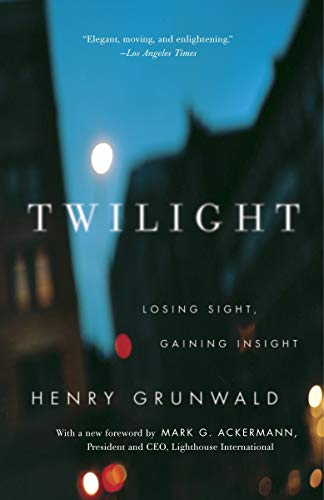
In 1992, when Henry Grunwald missed a glass into which he was pouring water, he assumed that he needed new eyeglasses, not that the incident was a harbinger of darker times. But in fact Grunwald was entering the early stages of macular degeneration -- a gradual loss of sight that affects almost 15 million Americans yet remains poorly understood and is, so far, incurable. Now, in Twilight, Grunwald chronicles his experience of disability: the clouding of his sight, and the daily struggle to overcome its physical and psychological implications; the discovery of what medicine can and cannot do to restore sight; his compulsion to understand how the eye works, its evolution, and its symbolic meaning in culture and art.
Grunwald gives us an autobiography of the eye -- his visual awakening as a child and young man, and again as an older man who, facing the loss of sight, feels a growing wonder at the most ordinary acts of seeing. This is a story not merely about seeing but about living; not merely about losing sight but about gaining insight. It is a remarkable meditation.
"synopsis" may belong to another edition of this title.
About the Author
Henry Grunwald was the editor in chief of Time Inc. publications and also served as U.S. ambassador to Austria. He is the author of One Man's America: A Journalist's Search for the Heart of His Country.
From the Back Cover
Advance praise for
Twilight
"Twilight is an elegant meditation on the very nature of eyesight, and the private struggle with its dissipation--the condition known inelegantly as macular degeneration, but in Henry Grunwald's astute and affecting prose, nothing less than a journey toward a kind of enlightenment." --Ward Just
"Henry Grunwald has more than enough vision left to give us insight into the mysteries of the human eye--and the human condition. Twilight is a clear-sighted reminder to see all there is to see."--Katharine Graham
"Twilight is wise and original, on one level a riveting, very down-to-earth account of the author's struggle with macular degeneration, on another a work of the imagination--a gifted writer flying high, letting his curiosity and artistry take him and the reader into strange and unexpected places." --Mary Ellin Barrett
"I was deeply moved by Henry Grunwald's candor and courage in dealing with macular degeneration, the diminishment of his sight, both emotionally and physically." --Dominick Dunne
"Henry Grunwald has written a beautiful, inspiring book; the real beauty of life is not seen with the eyes alone." --Beverly Sills
"This sensitive and so beautifully written book is indeed an eye-opener to the glories of the world around us."-- Barbara Walters
From the Inside Flap
In 1992, when Henry Grunwald missed a glass into which he was pouring water, he assumed that he needed new eyeglasses, not that the incident was a harbinger of darker times. But in fact Grunwald was entering the early stages of macular degeneration -- a gradual loss of sight that affects almost 15 million Americans yet remains poorly understood and is, so far, incurable. Now, in Twilight, Grunwald chronicles his experience of disability: the clouding of his sight, and the daily struggle to overcome its physical and psychological implications; the discovery of what medicine can and cannot do to restore sight; his compulsion to understand how the eye works, its evolution, and its symbolic meaning in culture and art.
Grunwald gives us an autobiography of the eye -- his visual awakening as a child and young man, and again as an older man who, facing the loss of sight, feels a growing wonder at the most ordinary acts of seeing. This is a story not merely about seeing but about living; not merely about losing sight but about gaining insight. It is a remarkable meditation.
Reviews
Described by the author as "an autobiography of my eyes," this engrossing meditationAwhich will be of particular interest to those with failing eyesightAreveals what sight means to him. Since he was diagnosed with macular degeneration in 1992, Grunwald (One Man's America), who was formerly editor-in-chief of Time magazine and the U.S. ambassador to Austria, has been learning how to live with serious visual impairment. Despite some laser surgery, the vision in both of his eyes has continued to deteriorate. Although Grunwald can still identify buildings, people and such natural events as sunrises, he now sees through a "half-veiled" haze and is no longer able to enjoy art museums or to recognize the faces of close friends. He reminisces about images that have been important to him, such as nursery wallpaper and particular colors, and the pleasure he has derived from looking at women's faces. As someone who has been a prodigious reader, Grunwald has had to make a radical readjustment: he listens to recorded books, dictates what he would have formerly written and enlists his wife to read to him on a daily basis. He has visited the Lighthouse in New York City in order to keep up with the latest visual aids and to discuss with a therapist the depression resulting from his vision loss. Although he now accepts his condition, he is not resigned to it: he has thus far refused to learn Braille even though such a skill would be useful to him, because he believes that it implies total blindness, a possibility he struggles against. (Nov.)
Copyright 1999 Reed Business Information, Inc.
A slim volume on the learned truths of living with limited vision by a man for whom the printed word has been the mainstay of both his professional and private life. Grunwald (One Man's America, 1997), former editor-in-chief of all Time, Inc., publications and under President Reagan US ambassador to his native Austria, first wrote of his fading sight in a 1996 New Yorker piece, ``Losing Vision.'' That article is the genesis of the present work. Once diagnosed with age-related macular degeneration (AMD), he began to learn everything possible not only about his condition but about the history of eye diseases and their treatment, and he shares some arcane tidbits here, describing ancient Egyptian remedies and revealing how the eye injuries of WWII fighter pilots led to refinements of cataract surgery. On a more personal note, as Grunwald's vision fades, he becomes a ``visual glutton,'' storing up precious images of beloved faces and scenes. He dredges up visual memories from his childhood and muses about the art of seeing, the remaining pleasures of museum going, the hazards and rewards of traveling, the difficulties of ordinary social intercourse when eye contact is missing, and the enormous frustration involved in reading and writing. Perhaps the most poignant sentence in the book is his quiet lament, ``My books are still more than furniture, but less than the living things they used to be.'' While the physical effects of AMD are formidable, he has found the emotional ones more troublesome. He admits to bouts of anger and depression, but tries to fight back with humor and by making a game out of the need for coping strategies. In the process, he has learned patience, humility, and, reluctantly, acceptance of membership in the society known as the ``handicapped.'' Grunwald's eyesight may have become cloudy, but the picture he creates for us is crystal clear. -- Copyright ©1999, Kirkus Associates, LP. All rights reserved.
In 1992, Grunwald, author of One Man's America, former editor-in-chief of Time, and former U.S. ambassador to Austria, went for an eye examination and learned that he was going blind. He was diagnosed with age-related macular degeneration (AMD). One of the least understood eye diseases and not reliably identified until the 1970s, AMD afflicts an estimated 15 million Americans and is the most common cause of irreversible, mostly untreatable, vision loss. As Grunwald's outward view dimmed, he looked inward, reflecting on his life and the sense of loss he experienced as his vision failed. He writes about how things will never be the same for him as when he was fully sighted, but he explains how he has learned to cope with near-blindness. Grunwald concludes that in learning to live with the afflictions that make life difficult, we are actually experiencing living. We emerge stronger for having struggled and finally overcome the obstacles life presents. Grunwald's reflective meditation may help others put their lives in perspective. For public libraries.AJames Swanton, Harlem Hosp. Lib., New York
Copyright 1999 Reed Business Information, Inc.
Grunwald's first book in retirement (One Man's America: A Journalist's Search for the Heart of His Country, 1997) surveyed the world he covered--as copyboy, reporter, editor, and editor in chief of Timeafter coming to the U.S. from Austria in 1940. Twilight is at once a smaller and a more affecting narrative: the journalist's reflections on the fading of his personal light due to macular degeneration. Grunwald grasps the irony: that he, whose life has revolved around words, should be able to read only with difficulty and high-tech assistance. Grunwald's condition was diagnosed in 1992; he's had time to accept, reluctantly, the limitations he faces and to explore his disease and a range of related topics, from the history of medical treatment of the eye to the mythology surrounding that easily taken-for-granted organ. Thus Twilight is a personal narrative of an active person forced to accommodate a disabling condition, with facts about the condition and its treatment as well as discourse on the symbolic and cultural meanings of sight and insight. Mary Carroll
Excerpt. © Reprinted by permission. All rights reserved.
In the primordial ocean, a tiny organism stirs. It is covered with a light-sensitive pigment, an eyespot, that seeks the sun and turns the organism toward it. The act is not seeing, but the precursor of seeing. It is part of the fundamental impulse in all living things to reach for light, part of the indomitable will to see.
I stand at the edge of the ocean and I think of those eyespots and of the single-cell creatures that, eons ago, began the miraculous process of sight. I, too, strain to see -- to see the waves, the sand, the shells and seaweed and debris that wash ashore. My eyes are animated by the same impulse, the same will to see. But my eyes don't work, at least not fully, because they are blocked by disease. The scene around me appears through a kind of curtain, a haze. If I bend down, I will have a hard time telling a stone apart from a shell, a coin from a piece of sea glass. If I were to pick up a discarded newspaper, I would not be able to read it. During a lifetime as a writer and editor, reading newspapers -- or news in any form -- had been a natural and indispensable part of myself. My existence seemed to be wrapped in the printed word. No longer.
Until the onset of my disease, I was literally unaware of my eyes, with the occasional trivial exception of needing new glasses or having somebody extricate a speck of dust. Now I am aware of my eyes almost constantly. I imagine them as distinct globes inside my head. I try to visualize the intricate vessels and veins and conduits in these globes. I think of their fragility but also of their power. In medicine as well as in romantic poetry, it is the heart that is the center and controlling mechanics of life. If the heart stops, life stops. The loss of sight doesn't not mean death. Yet for ages, the eyes was believed to contain a human being's vital essence -- a not wholly irrational belief. For those of us who are born with the ability to see, sight determines most of what we know about the world, what we enjoy, and what and whom we love. That is surely one reason why in the mythology of almost every culture the eve plays a dominant part.
My years with failing vision have prompted me to learn about the nature of the eye and the incredible gift of sight, which I had always taken for granted until it began to slip away. But I also leaned about living within limits and overcoming disability. This, then, is not merely a story about seeing but also about living. It is a story not merely about losing sight but about gaining insight as well.
In 1992, my wife, Louise, and I rented a villa outside Florence. The light in the house was inadequate, especially in the gloomy, rainy weather of that October; the twenty-five-watt bulbs in the pseudoelegant scones reminded me of those notoriously underlit Russian hotel rooms. One afternoon, I picked up a carafe from a side table in a particularly dark corner to pour water into a glass. I missed the glass. I inveighed against the landlord, who, I thought, was trying to save electricity with those weak lightbulbs, but I suspected that I might need new glasses. Back in New York , quite unconcerned, I dropped in on the nearest optician. In a darkened cubicle, he took me through the usual eye test. I have worn glasses ever since I was a teenager. Using both eyes, I read the chart without difficulty, but when my right eye was covered and I looked only through my left, I saw virtually nothing. My right eye, on the other hand, was close to normal and, as I realized later, saw for both. The optician seemed embarrassed, and he took me through the test again. The result was the same. "I think you had better see an eye doctor," he said.
Still not too alarmed, I did just that and was told that I was suffering from something called macular degeneration. I did not know what macular meant, but I soon learned that the word derives from macula (Latin for "spot") and refers to a tiny area in the retina. As for degeneration the term was extremely depressing, with its overtones of moral decay. I had never heard of the disease.
It is formally known as age-related macular degeneration, or AMD, because most sufferers are over fifty. It is one of the least understood eye problems, not having been reliably identified until the 1970s. To one degree or another, it afflicts an estimated 15 million Americans and will beset millions more in the future. It is the most common cause of irreversible vision loss in the world, yet its origins are unknown. . . .
We have become accustomed to medical marvels: organ transplants, heart bypass operations, hip replacement. Concerning the eye, I knew about cornea transplants, cataract removals, treatments for glaucoma and other disorders that in the past had often led to blindness. I did not yet know how serious the effect of this disease could be, and I naturally assumed that it was treatable. But I was shocked to learn that it really wasn't -- at least not with lasting effect. No comparable marvels had been devised for macular degeneration. I was outraged. Now I really started to worry.
"About this title" may belong to another edition of this title.
Search results for Twilight: Losing Sight, Gaining Insight

Stock Image
Twilight: Losing Sight, Gaining Insight
Seller: World of Books (was SecondSale), Montgomery, IL, U.S.A.
Seller rating 5 out of 5 stars

Hardback. Condition: Good. In 1992, when Henry Grunwald missed a glass into which he was pouring water, he assumed that he needed new eyeglasses, not that the incident was a harbinger of darker times. But in fact Grunwald was entering the early stages of macular degeneration--a gradual loss of sight that affects almost 15 million Americans yet remains poorly understood and is, so far, incurable. In Twilight, he chronicles his experience of disability: the discovery of what medicine can and can't do, the clouding of his sight, the daily struggle to overcome its physical and psychological implications. This is a story not merely about seeing but about living; not merely about losing sight but about gaining insight. Seller Inventory # 00046791053
Seller Image
Twilight: Losing Sight, Gaining Insight
Seller: Zoom Books East, Glendale Heights, IL, U.S.A.
Seller rating 5 out of 5 stars
Condition: good. Book is in good condition and may include underlining highlighting and minimal wear. The book can also include "From the library of" labels. May not contain miscellaneous items toys, dvds, etc. . We offer 100% money back guarantee and 24 7 customer service. Seller Inventory # ZEV.0375404228.G
Stock Image
Twilight: Losing Sight, Gaining Insight
Seller: More Than Words, Waltham, MA, U.S.A.
Seller rating 5 out of 5 stars
Condition: Good. A sound copy with only light wear. Overall a solid copy at a great price! Seller Inventory # BOS-L-03h-01884
Stock Image
Twilight: Losing Sight, Gaining Insight
Published by
Knopf (edition First Edition), 1999
ISBN 10: 0375404228
ISBN 13: 9780375404221
Used
Hardcover
First Edition
Seller: BooksRun, Philadelphia, PA, U.S.A.
Seller rating 5 out of 5 stars
Hardcover. Condition: Very Good. First Edition. It's a well-cared-for item that has seen limited use. The item may show minor signs of wear. All the text is legible, with all pages included. It may have slight markings and/or highlighting. Seller Inventory # 0375404228-8-1
Stock Image
Twilight: Losing Sight, Gaining Insight
Seller: HPB-Ruby, Dallas, TX, U.S.A.
Seller rating 5 out of 5 stars
hardcover. Condition: Very Good. Connecting readers with great books since 1972! Used books may not include companion materials, and may have some shelf wear or limited writing. We ship orders daily and Customer Service is our top priority! Seller Inventory # S_460068342
Stock Image
Twilight: Losing Sight, Gaining Insight
Seller: World of Books Inc, Montgomery, IL, U.S.A.
Seller rating 4 out of 5 stars

Hardback. Condition: Good. In 1992, when Henry Grunwald missed a glass into which he was pouring water, he assumed that he needed new eyeglasses, not that the incident was a harbinger of darker times. But in fact Grunwald was entering the early stages of macular degeneration--a gradual loss of sight that affects almost 15 million Americans yet remains poorly understood and is, so far, incurable. In Twilight, he chronicles his experience of disability: the discovery of what medicine can and can't do, the clouding of his sight, the daily struggle to overcome its physical and psychological implications. This is a story not merely about seeing but about living; not merely about losing sight but about gaining insight. Seller Inventory # CIN0375404228G
Stock Image
Twilight: Losing Sight, Gaining Insight
Seller: Half Price Books Inc., Dallas, TX, U.S.A.
Seller rating 5 out of 5 stars
hardcover. Condition: Very Good. Connecting readers with great books since 1972! Used books may not include companion materials, and may have some shelf wear or limited writing. We ship orders daily and Customer Service is our top priority! Seller Inventory # S_483895765
Stock Image
Twilight: Losing Sight, Gaining Insight
Seller: Wonder Book, Frederick, MD, U.S.A.
Seller rating 5 out of 5 stars
Condition: As New. Like New condition. Like New dust jacket. A near perfect copy that may have very minor cosmetic defects. Seller Inventory # P10A-02747
Stock Image
Twilight: Losing Sight, Gaining Insight
Seller: Wonder Book, Frederick, MD, U.S.A.
Seller rating 5 out of 5 stars
Condition: Very Good. Very Good condition. Good dust jacket. A copy that may have a few cosmetic defects. May also contain light spine creasing or a few markings such as an owner's name, short gifter's inscription or light stamp. Seller Inventory # M09E-01638
Stock Image
Twilight : Losing Sight, Gaining Insight
Published by
Knopf Doubleday Publishing Group, 1999
ISBN 10: 0375404228
ISBN 13: 9780375404221
Used
Hardcover
Seller: Better World Books: West, Reno, NV, U.S.A.
Seller rating 5 out of 5 stars
Condition: Good. Pages intact with minimal writing/highlighting. The binding may be loose and creased. Dust jackets/supplements are not included. Stock photo provided. Product includes identifying sticker. Better World Books: Buy Books. Do Good. Seller Inventory # 38319731-6