
Items related to A Spectacle of Corruption: A Novel
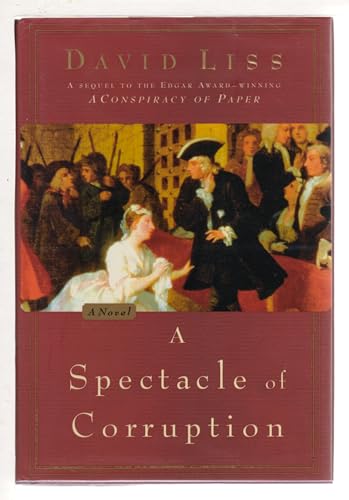
Synopsis
Benjamin Weaver, the quick-witted pugilist turned private investigator, returns in David Liss’s sequel to the Edgar Award–winning novel, A Conspiracy of Paper.
Moments after his conviction for a murder he did not commit, at a trial presided over by a judge determined to find him guilty, Benjamin Weaver is accosted by a stranger who cunningly slips a lockpick and a file into his hands. In an instant he understands two things: Someone had gone to a great deal of trouble to see him condemned to hang—and another equally mysterious agent is determined to see him free.
So begins A Spectacle of Corruption, which heralds the return of Benjamin Weaver, the hero of A Conspiracy of Paper. After a daring escape from eighteenth-century London’s most notorious prison, Weaver must face another challenge: how to prove himself innocent of a crime when the corrupt courts have already shown they want only to see him hang. To discover the truth and clear his name, he will have to understand the motivations behind a secret scheme to extort a priest, uncover double-dealings in the unrest among London’s dockworkers, and expose the conspiracy that links the plot against him to the looming national election—an election with the potential to spark a revolution and topple the monarchy.
Unable to show his face in public, Weaver pursues his inquiry in the guise of a wealthy merchant who seeks to involve himself in the political scene. But he soon finds that the world of polite society and politics is filled with schemers and plotters, men who pursue riches and power—and those who seek to return the son of the deposed king to the throne. Desperately navigating a labyrinth of politicians, crime lords, assassins, and spies, Weaver learns that, in an election year, little is what it seems and the truth comes at a staggeringly high cost.
Once again, acclaimed author David Liss combines historical erudition with mystery, complex characterization, and a captivating sense of humor. A Spectacle of Corruption offers insight into our own world of political scheming, and it firmly establishes David Liss as one of the best writers of intellectual suspense at work today.
"synopsis" may belong to another edition of this title.
About the Author
DAVID LISS is the author of The Coffee Trader and A Conspiracy of Paper, winner of the 2000 Edgar Award for Best First Novel. He lives in San Antonio with his wife and daughter, and can be reached via his website,www.davidliss.com.
From the Inside Flap
Benjamin Weaver, the quick-witted pugilist turned private investigator, returns in David Liss s sequel to the Edgar Award winning novel, A Conspiracy of Paper.
Moments after his conviction for a murder he did not commit, at a trial presided over by a judge determined to find him guilty, Benjamin Weaver is accosted by a stranger who cunningly slips a lockpick and a file into his hands. In an instant he understands two things: Someone had gone to a great deal of trouble to see him condemned to hang and another equally mysterious agent is determined to see him free.
So begins A Spectacle of Corruption, which heralds the return of Benjamin Weaver, the hero of A Conspiracy of Paper. After a daring escape from eighteenth-century London s most notorious prison, Weaver must face another challenge: how to prove himself innocent of a crime when the corrupt courts have already shown they want only to see him hang. To discover the truth and clear his name, he will have to understand the motivations behind a secret scheme to extort a priest, uncover double-dealings in the unrest among London s dockworkers, and expose the conspiracy that links the plot against him to the looming national election an election with the potential to spark a revolution and topple the monarchy.
Unable to show his face in public, Weaver pursues his inquiry in the guise of a wealthy merchant who seeks to involve himself in the political scene. But he soon finds that the world of polite society and politics is filled with schemers and plotters, men who pursue riches and power and those who seek to return the son of the deposed king to the throne. Desperately navigating a labyrinth of politicians, crime lords, assassins, and spies, Weaver learns that, in an election year, little is what it seems and the truth comes at a staggeringly high cost.
Once again, acclaimed author David Liss combines historical erudition with mystery, complex characterization, and a captivating sense of humor. A Spectacle of Corruption offers insight into our own world of political scheming, and it firmly establishes David Liss as one of the best writers of intellectual suspense at work today.
Reviews
When the Scottish writer Sir Walter Scott invented the modern historical novel in 1814, he knew what he was doing. In Waverley, which is set in the Jacobite uprising in Scotland of 1745, Scott applied to the crude manners and political antagonisms of 70 years earlier the moral insight and sentimental refinement of the Scotland of his own age. The result was unhistorical, but, in the rage for Waverley and its successors, from A Tale of Two Cities to War and Peace, who cared?
Writers of genre fiction also took to history to give novelty and prestige to literary formulas. Who has not read a police procedural at the court of Charlemagne or an erotic thriller set in Minoan Crete? Benjamin Weaver, the hero of A Spectacle of Corruption, soon turns out to be the hard-outside, soft-inside private investigator of the noir thrillers inserted into 1720s London: Philip Marlowe done up in a wig and buckles.
A Jewish ex-prizefighter turned professional "thieftaker," Weaver appeared in Liss's first novel, A Conspiracy of Paper. Liss took as his model Jonathan Wild, a Georgian gangster who worked both sides of the law until his execution in 1725, but gave him a modern mind and heart among the dead dogs and banknotes. In his next book, The Coffee Trader, Liss invented a great-uncle for Weaver among Sephardic merchants in the Amsterdam of the 1650s. He now returns to both Weaver and 1720s London.
The story unfolds during the election of 1722 in London's Westminster where, unusually for 18th-century England, the franchise was democratic. Amid the intrigues of Whigs and Tories, Hanoverians and Jacobites, the bribes and political violence, Weaver finds himself implicated for a murder he did not commit. All sorts of terrific things happen. Weaver is tried before an outrageously partisan judge, escapes from Newgate prison, holds an informer's head in a chamber pot, finds the love of his life turned Christian and married to a Tory politician, takes part in election riots. Yet few will prefer Spectacle to novels one and two.
The chief problem is that Liss is much less interested in ancient politics than in the revolutions in finance and commerce that formed the historical backdrops to the first two novels. Nothing dates like party antagonism, and to say that Liss doesn't really understand the primordial cleavage in English politics between Whig and Tory is no insult: Only a handful of today's Britishers do. As Jew and outsider, Weaver has the privilege of asking elementary political questions that Liss takes little trouble in answering.
Liss compensates not with his strengths, which are in character, especially women, and action, but as Raymond Chandler does, with yet another twist of plot. The unraveling of the plot requires a lot of talk, usually just one character to another. Many novelists can't write dialogue for more than two characters at a time, but Liss can, and it is a mystery why he doesn't.
The elaborate plot also requires acres of back story, which is not recommended in a book where the main narrative is already in the distant past. At one point, Weaver blurts out: "So the Tories kill him, and make it look like the Whigs killed him in an effort to harm the Tories. That is a mighty deep game." Not deep at all. Those are sentences of a kind every novelist knows and fears, and they mean: Your plot is out of your control. You must start again.
Even his London has lost some of its oddity. Liss has abandoned his Jewish milieux, and the beautiful Miriam has become the beautiful Mary. The social décor tends to the commonplace or anachronistic. Gin, tobacco smoking, labor combinations, prize fighting and cricket bats became widespread a generation or even two generations posterior to Weaver's story. Liss also uses words that originated long after the 18th century was over: echelon, perambulator, upcoming, attendee, visit with, communist, semantics. The effect is to break the spell of the book, like a stage actor dropping out of character. The question is whether Liss has settled into a sort of Weaver franchise, in which plots become more complex, action more brutal, language and morals less authentic and characters more simple, or whether he sets off again in search of the only thing a novel cannot do without, which is novelty.
Reviewed by James Buchan
Copyright 2004, The Washington Post Co. All Rights Reserved.
This sequel to Liss's Edgar Awardwinning A Conspiracy of Paper (2000) brings back ex-pugilist Benjamin Weaver and his 18th-century London environs in all their squalid glory. Benjamin has become a "thieftaker," a sort of bounty hunter/private eye, and is investigating the simple case of a threatening letter when he is caught up in a riot, accused of murder and sentenced to hang. After a gutsy escape, he sets about unraveling the mystery of who framed him and why. Donning the disguise of a wealthy coffee planter from Jamaica, Benjamin infiltrates the upper classes, where he encounters a plot centering on a hotly contested House of Commons election. There is much explanation (perhaps too much) of the history and philosophies of the Whig, Tory and Jacobite parties, but this is nicely balanced with Benjamin's forays into London's underbelly, where he has his way with the ladies and dodges dangerous louts looking to kill him. The real fun is the re-creation of the streets of London ("He fell into the alley's filth-the kennel of emptied chamber pots, bits of dead dogs gnawed on by hungry rats, apple cores and oyster shells") and the colorful denizens thereof. Many hours are spent in innumerable coffeehouses, with Benjamin and company imbibing coffee, chocolate, ale, wine and that great destroyer of the poor, rotgut gin, and employing such useful swear words as "shitten stick," "arse pot" and "bum firking." Mystery and mainstream readers with a taste for gritty historical fiction will relish Liss's glorious dialogue, lively rogues, fascinating setting and indomitable hero.
Copyright © Reed Business Information, a division of Reed Elsevier Inc. All rights reserved.
*Starred Review* Late-seventeenth- and early-eighteenth-century England--from Cromwell through the Jacobites--has become the richest of soil for writers of literary thrillers, the equivalent of New Orleans for contemporary hard-boiled authors. Liss makes the most of it in this sequel to the acclaimed Conspiracy of Paper (2000). Benjamin Weaver, an outsider three times over--a Jew, a former pugilist, and a "thief-taker" (one who helps victims of robbery recover their goods)--is in the soup again, framed for murder and without a clue as to who or why. He intends to answer both those questions, but first he must break out of Newgate Prison. He does so, in a marvelous set piece, and then finds himself in an even messier pickle: politics. The first English general election is in progress, with Tories and Whigs out-dirty-tricking one another while the Jacobites lurk on the outskirts, hoping to foment a revolution. To determine why he was framed, Benjamin must ingratiate himself with a leading Tory, who happens to be the husband of Benjamin's former lover, Miriam, now posing as a Gentile. Liss' elegantly constructed, multidimensional plot combines all the intrigue of the Jacobite era with a Dickensian feel for London' s lower depths and for the "spectacle of corruption" that is the city's politics. Perhaps the greatest pleasure here is the perfect melding of sharply rendered historical detail with a charismatic, fast-talking hero (an eighteenth-century version of Robert B. Parker's Spenser). This is a series to be savored. Bill Ott
Copyright © American Library Association. All rights reserved
Excerpt. © Reprinted by permission. All rights reserved.
Chapter 1
Since the publication of the first volume of my memoirs, I have found myself the subject of more notoriety than I had ever known or might have anticipated. I cannot register a complaint or a lament, for any man who chooses to place himself in public sight has no reason to regret such attentions. Rather, he must be grateful if the public chooses to cast its fickle gaze in his direction, a truth to which the countless volumes languishing in the scribbler’s perdition of obscurity can testify.
I will be frank and say that I have been gratified by the warmth with which readers responded to the accounts of my early years, yet I have been surprised too—surprised by people who read a few lines of my thoughts and consider themselves near friends, free to speak their minds to me. And while I shall not find fault with someone who has read my words so closely that he wishes to makes observations on them, I confess I have been confounded by the number of people who believe they may comment with impunity on any aspect of my life without a moment’s regard to custom or propriety.
Some months after publishing my little volume I sat at a supper gathering, speaking of a particularly noxious criminal I intended to bring to justice. A young spark, on whom I had never before set eyes, turned to me and said that this fellow had better be careful, lest he meet the same end as Walter Yate. Here he simpered, as though he and I shared a secret.
My amazement was such that I did not say a word. I had not thought about Walter Yate in some time, and I had no idea that his name had retained any currency after so many years. But I was to discover that, while I had not contemplated this poor fellow, others had. Not a fortnight later another man, also a stranger, commented on a difficulty I faced by saying I should manage that affair in the same fashion that I had managed my business with Walter Yate. He said the name with a sly nod and a wink, as though, because he had uttered this shibboleth, he and I were now jolly co-conspirators.
It does not offend me that these men chose to reference incidents from my past. It does, however, perplex me that they should feel at liberty to speak of something they do not understand. I cannot fully express my bewilderment that such people, believing what they do about this incident, should mention it to me at all, let alone with more than a dash of good cheer. Does one go to a raree show and make light with the tigers regarding their fangs?
I have therefore decided that I must pen another volume of memoirs, if for no other reason than to disabuse the world of its ideas concerning this chapter of my history. I wish no more to hear the name Walter Yate spoken in naughty and secretive tones. This man, to the best of my knowledge, did nothing to deserve becoming the subject of a private titter. Therefore, I shall say now, truthfully and definitively, that I did not act violently upon Mr. Yate—let alone with the most definitive violence—something which, I have discovered, the world generally believes. Further, if I may disabuse the public of another misconception, I did not escape the most terrible of punishments for his murder by calling upon the influence of friends in the government. Neither of those tales is true. I had never known of these rumors because no one had ever spoken them to me before. But now, having published a few words of my life, I am every man’s friend. Let me then do the friendly service of revealing the facts about the incident, if for no other reason than that it might be spoken of no more.
Walter Yate died, beaten in the head with an iron bar, only six days before the meeting of the King’s Bench, so I had mercifully little time after my arrest to reflect on my condition while awaiting trial. I will be honest: I might have put that time to better use, but not once did I believe, truly believe, that I would be convicted for a crime I had not committed—the murder of a man of whom I had scarcely heard before his death. I ought to have believed it, but I did not.
So great was my confidence that I often found myself hardly even listening to the words spoken at my own trial. Instead, I looked out at the mob packed into the open-air courtroom. It rained a fine mist that day, and there was a considerable chill in the February air, but the crowds came anyway, crammed onto the rough and splintering benches, hunched against the wet, to watch the proceedings, which had attracted some attention in the newspapers. The spectators sat eating their oranges and apples and lit- tle mutton pastries, smoking their pipes and taking snuff. They pissed in pots in the corners and threw their oyster shells at the feet of the jury. They murmured and cheered and shook their heads as though it were all an enormous puppet show staged for their amusement.
I suppose I might have been pleased to be the subject of such a broad public curiosity, but I found no gratification in notoriety. Not when she was not there, the woman I most wanted to look upon in my time of sorrows. If I were to be convicted, I thought (only in the most romantical way, since I no more anticipated a conviction than that I should be elected Lord Mayor), I should only want her to come and cry at my feet, tell me of her regrets. I wanted her teary kisses on my face. I wanted her hands, raw and coarse with wringing, to take mine as she begged my forgiveness and pleaded to hear my vows of love repeated a hundred times. These were, I knew, mere fantasies of an overwrought imagination. She would not come to my trial, and she would not come to visit me before my fanciful execution. She could not.
My cousin’s widow, Miriam, whom I had sought to marry, had wedded herself six months before to a man named Griffin Melbury, who at the moment of my trial busied himself with preparations for standing as the Tory candidate in the election soon to commence in Westminster. Now a convert to the Church of England and the wife of a man who hoped to rise as a prominent opposition politician, Miriam Melbury could ill afford to attend the trial of a Jewish ruffian-for-hire, one to whom she was no longer attached by the bonds of kinship. Kneeling at my feet or covering my face with tear-wet kisses was hardly the sort of behavior to which she was inclined under any circumstances. It would surely not happen now that she had given herself to another man.
Thus, in my hour of crisis, I dwelled less on the possibility of impending doom than I did on Miriam. I blamed her, as though she could be held accountable for this absurd trial—after all, had she married me, I might have abandoned thieftaking and would not have brought myself into the circumstances that had led to this disaster. I blamed myself for not pursuing her more vigorously—though three marriage proposals ought to meet any man’s definition of vigor.
So, while the lawyer for the Crown attempted to convince the jury to convict me, I thought of Miriam. And, because even as I dwell with longing and melancholy I remain a man, I also thought about the woman with yellow hair.
It must be seen as no surprise that my mind wandered to other women. In the half year since Miriam had married, I had distracted myself—not with the intent of forgetting, you must understand, but with the aim of making my sense of loss more exquisite—largely by indulging in vices, and those vices consisted principally of women and drink. I regretted that I was not of a gambling disposition, for most men I knew found that vice to be as distracting as the two I favored, if not more so. But in the past, having paid the high price of money lost at game, I could not quite grasp the entertainment in viewing a pair of greedy hands collecting a pile of silver that had once been my own.
Drink and women: Those were vices on which I could depend. Neither needed to be of particularly fine quality; I was of no temper to be overly choosy. Yet, here was a woman, sitting at the edge of one of the benches, who absorbed my attention as nearly as anything could in those dark times. She had pale yellow hair and eyes the color of the sun itself. She was not beautiful, but she was pretty and had a kind of pert demeanor, with her pointy nose and sharp chin. Though no great lady, she dressed like a woman of the middling ranks, neatly, but without flair or much of a nod to fashion. Rather, she let nature do what her tailor could not, and exposed to the world in a deeply cut bodice the expanse of a dazzling bosom. There was, in short, nothing that would have kept me from finding her a delight in an alehouse or tavern, but no particular reason why she should command my attention while I sat on trial for my life.
Except that she did not once take her eyes from me. Not for a moment.
Others looked at me, of course—my uncle and aunt with pity and perhaps with admonition, my friends with fear, my enemies with glee, strangers with unpitying curiosity—but this woman fixed on me a desperate, hungry gaze. When our eyes locked, she neither smiled nor frowned but only met my look as though we had shared a lifetime together and no word need be spoken between us. Anyone observing would have thought us married or sweethearts, but I had never to my recollection—none the best during those six months of hearty drinking—seen her before. The enigma of her gaze monopolized my thoughts far more than the enigma of how I came to stand trial for the death of a dockworker I’d never heard of two days before my arrest.
The rain had begun to fall harder and turn frozen when the prosecuting lawyer, an old fellow named Lionel Antsy, called Jonathan Wild to the stand. In that year, 1722, this notorious criminal was still widely believed to be the only true bulwark against the marauding armies of thieves and brigands that plagued the metropolis. He and I had long been rivals in our thieftaking efforts, for our methods were none too similar. I believ...
"About this title" may belong to another edition of this title.
Search results for A Spectacle of Corruption: A Novel

Stock Image
A Spectacle of Corruption
Seller: World of Books (was SecondSale), Montgomery, IL, U.S.A.
Seller rating 5 out of 5 stars

Hardback. Condition: Good. Benjamin Weaver, the quick-witted pugilist turned private investigator, returns in David Liss's sequel to the Edgar Award-winning novel, A Conspiracy of Paper. Moments after his conviction for a murder he did not commit, at a trial presided over by a judge determined to find him guilty, Benjamin Weaver is accosted by a stranger who cunningly slips a lockpick and a file into his hands. In an instant he understands two things: Someone had gone to a great deal of trouble to see him condemned to hang--and another equally mysterious agent is determined to see him free. So begins A Spectacle of Corruption, which heralds the return of Benjamin Weaver, the hero of A Conspiracy of Paper. After a daring escape from eighteenth-century London's most notorious prison, Weaver must face another challenge: how to prove himself innocent of a crime when the corrupt courts have already shown they want only to see him hang. To discover the truth and clear his name, he will have to understand the motivations behind a secret scheme to extort a priest, uncover double-dealings in the unrest among London's dockworkers, and expose the conspiracy that links the plot against him to the looming national election--an election with the potential to spark a revolution and topple the monarchy. Unable to show his face in public, Weaver pursues his inquiry in the guise of a wealthy merchant who seeks to involve himself in the political scene. But he soon finds that the world of polite society and politics is filled with schemers and plotters, men who pursue riches and power--and those who seek to return the son of the deposed king to the throne. Desperately navigating a labyrinth of politicians, crime lords, assassins, and spies, Weaver learns that, in an election year, little is what it seems and the truth comes at a staggeringly high cost. Once again, acclaimed author David Liss combines historical erudition with mystery, complex characterization, and a captivating sense of humor. A Spectacle of Corruption offers insight into our own world of political scheming, and it firmly establishes David Liss as one of the best writers of intellectual suspense at work today. Seller Inventory # 00095293247
Stock Image
A Spectacle of Corruption
Seller: World of Books (was SecondSale), Montgomery, IL, U.S.A.
Seller rating 5 out of 5 stars
Hardback. Condition: Fair. Benjamin Weaver, the quick-witted pugilist turned private investigator, returns in David Liss's sequel to the Edgar Award-winning novel, A Conspiracy of Paper. Moments after his conviction for a murder he did not commit, at a trial presided over by a judge determined to find him guilty, Benjamin Weaver is accosted by a stranger who cunningly slips a lockpick and a file into his hands. In an instant he understands two things: Someone had gone to a great deal of trouble to see him condemned to hang--and another equally mysterious agent is determined to see him free. So begins A Spectacle of Corruption, which heralds the return of Benjamin Weaver, the hero of A Conspiracy of Paper. After a daring escape from eighteenth-century London's most notorious prison, Weaver must face another challenge: how to prove himself innocent of a crime when the corrupt courts have already shown they want only to see him hang. To discover the truth and clear his name, he will have to understand the motivations behind a secret scheme to extort a priest, uncover double-dealings in the unrest among London's dockworkers, and expose the conspiracy that links the plot against him to the looming national election--an election with the potential to spark a revolution and topple the monarchy. Unable to show his face in public, Weaver pursues his inquiry in the guise of a wealthy merchant who seeks to involve himself in the political scene. But he soon finds that the world of polite society and politics is filled with schemers and plotters, men who pursue riches and power--and those who seek to return the son of the deposed king to the throne. Desperately navigating a labyrinth of politicians, crime lords, assassins, and spies, Weaver learns that, in an election year, little is what it seems and the truth comes at a staggeringly high cost. Once again, acclaimed author David Liss combines historical erudition with mystery, complex characterization, and a captivating sense of humor. A Spectacle of Corruption offers insight into our own world of political scheming, and it firmly establishes David Liss as one of the best writers of intellectual suspense at work today. Seller Inventory # 00066850372
Stock Image
A Spectacle of Corruption: A Novel
Seller: Gulf Coast Books, Cypress, TX, U.S.A.
Seller rating 5 out of 5 stars
Hardcover. Condition: Good. Seller Inventory # 0375508554-3-25921745
Seller Image
A Spectacle of Corruption: A Novel
Seller: Greenworld Books, Arlington, TX, U.S.A.
Seller rating 5 out of 5 stars
Condition: good. Fast Free Shipping â" Good condition. It may show normal signs of use, such as light writing, highlighting, or library markings, but all pages are intact and the book is fully readable. A solid, complete copy that's ready to enjoy. Seller Inventory # GWV.0375508554.G
Stock Image
A Spectacle of Corruption: A Novel
Seller: More Than Words, Waltham, MA, U.S.A.
Seller rating 5 out of 5 stars
Condition: Very Good. A bright, square, and overall a nice copy. Seller Inventory # WAL-I-1c-003098
Stock Image
A Spectacle of Corruption: A Novel
Published by
Random House (edition ), 2004
ISBN 10: 0375508554
ISBN 13: 9780375508554
Used
Hardcover
Seller: BooksRun, Philadelphia, PA, U.S.A.
Seller rating 5 out of 5 stars
Hardcover. Condition: Fair. With dust jacket. The item might be beaten up but readable. May contain markings or highlighting, as well as stains, bent corners, or any other major defect, but the text is not obscured in any way. Seller Inventory # 0375508554-7-1-29
Stock Image
A Spectacle of Corruption: A Novel
Seller: BookHolders, Towson, MD, U.S.A.
Seller rating 5 out of 5 stars
Condition: Good. [ No Hassle 30 Day Returns ][ Ships Daily ] [ Underlining/Highlighting: NONE ] [ Writing: NONE ] [ Edition: First ] Publisher: Random House Pub Date: 3/16/2004 Binding: Hardcover Pages: 400 First edition. Seller Inventory # 6829495
Stock Image
A Spectacle of Corruption: A Novel
Seller: ThriftBooks-Atlanta, AUSTELL, GA, U.S.A.
Seller rating 5 out of 5 stars
Hardcover. Condition: Very Good. No Jacket. Missing dust jacket; May have limited writing in cover pages. Pages are unmarked. ~ ThriftBooks: Read More, Spend Less. Seller Inventory # G0375508554I4N01
Stock Image
A Spectacle of Corruption: A Novel
Seller: ThriftBooks-Reno, Reno, NV, U.S.A.
Seller rating 5 out of 5 stars
Hardcover. Condition: Very Good. No Jacket. May have limited writing in cover pages. Pages are unmarked. ~ ThriftBooks: Read More, Spend Less. Seller Inventory # G0375508554I4N00
Stock Image
A Spectacle of Corruption: A Novel
Seller: ThriftBooks-Dallas, Dallas, TX, U.S.A.
Seller rating 5 out of 5 stars
Hardcover. Condition: Very Good. No Jacket. May have limited writing in cover pages. Pages are unmarked. ~ ThriftBooks: Read More, Spend Less. Seller Inventory # G0375508554I4N00