
Items related to The Loop
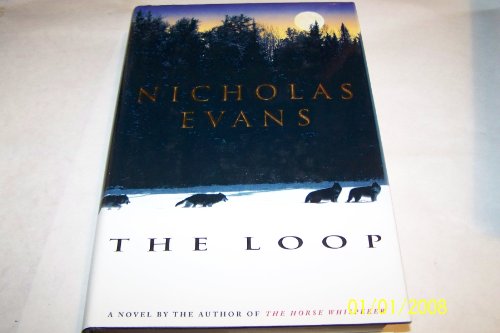
Synopsis
A pack of wolves makes a sudden savage return to the Rocky Mountain ranching town of Hope, Montana, where a century earlier they were slaughtered by the thousands. Now shielded by law as an endangered species, they reawaken an ancient hatred that will tear a family, and ultimately the town, apart.
At the center of the storm is Helen Ross, a twenty-nine-year-old wolf biologist sent alone into this remote and hostile place to protect the wolves from those who seek to destroy them. The Loop charts her struggle, and her dangerous love affair with the son of her most powerful opponent, the brutal and charismatic rancher Buck Calder.
A haunting exploration of man's conflict with nature and the wild within himself, an epic story of deadly passions and redemptive love set against the grandeur of the American West, The Loop is destined to capture the hearts and imaginations of readers everywhere.
"synopsis" may belong to another edition of this title.
About the Author
Nicholas Evans is the author of The Horse Whisperer, the #1 bestseller that has enthralled millions of readers around the world. He lives in London.
From the Inside Flap
lves makes a sudden savage return to the Rocky Mountain ranching town of Hope, Montana, where a century earlier they were slaughtered by the thousands. Now shielded by law as an endangered species, they reawaken an ancient hatred that will tear a family, and ultimately the town, apart.
At the center of the storm is Helen Ross, a twenty-nine-year-old wolf biologist sent alone into this remote and hostile place to protect the wolves from those who seek to destroy them. The Loop charts her struggle, and her dangerous love affair with the son of her most powerful opponent, the brutal and charismatic rancher Buck Calder.
A haunting exploration of man's conflict with nature and the wild within himself, an epic story of deadly passions and redemptive love set against the grandeur of the American West, The Loop is destined to capture the hearts and imaginations of readers everywhere.
Reviews
A drier version of Jaws, from the bestselling British novelist (The Horse Whisperer, 1995) whose distinctions so far are of scale rather than content. Hope, Montana, is not exactly the crossroads of a million lives. Barely more than a crossroads itself, its a quiet ranching community whose inhabitants are mostly descendants of the original white settlers who moved in a hundred years ago. But a frightening rash of brutal wolf attacksagainst both cattle and peoplemakes Hope the center of more attention than it had ever looked for. Dan Prior, the local rep of the US Wildlife Service, is an Eastern transplant whose long struggle to gain acceptance from the locals is threatened by his role as the enforcer of hated government conservation laws, and his life is suddenly made all the more difficult when the cattlemen (like ranchers Buck Calder and Abe Harding) take it upon themselves to kill the wolves in defiance of the Endangered Species Act. When the hunters are arrested and tried, a media riot puts Hope on the map and brings in its wake environmental crackpots as well as bona fide experts like biologist Helen Ross. Helen is opposed to killing the wolves, but her position is compromised by the adulation of Buck Calder's teenaged son Luke, who falls in love with her. Luke's troubled family is haunted by the death of his brother Henry some years earlier; his mother Eleanor responded to the death, and to her husband's repeated infidelities, by losing her Catholic faith and retreating into depression and despair. Meantime, Helen really just wants to get to the bottom of the wolf slayings, while Buck is looking for trouble and Dan just wants to keep the townsfolk from blowing their lids altogether. Ah, how will it all end? The same sort of sentimental pastiche, written in the same New Age Harlequin prose, that made The Horse Whisperer one of the most inexplicable success stories of the 1990s. (First printing of 650,000; Literary Guild main selection; author tour) -- Copyright ©1998, Kirkus Associates, LP. All rights reserved.
The best way to describe the writing in The Loop is to say it is Prozac Prose, the practice of which is a saccharine exercise, distinguished by the belief that the human condition can be relieved by a little sensitivity, some earnest conversations about old wounds, and the introduction of wolves into what was once their natural range.
Fans of Evans's bestselling debut, The Horse Whisperer, may find that this issue-oriented follow-up is a case of deja vu. Montana is again the setting, animals are crucial to the plot and a love story between dissimilar people is the heart-tugger. The bitter debate over the reintroduction of wolves into the American West provides the hook. After the book opens with the killing of a family dog by a stray wolf, the battle lines are quickly and clearly drawn. The wolf-hating cowboys are led by quintessential alpha male Buck Calder, the region's biggest rancher, bully and philanderer. Primary opposition comes from wolf biologist Helen Ross, a despised Easterner hired to keep the wolves safe from ranchers and more selective about their predation. She eventually teams up?professionally and romantically?with Calder's stuttering, insecure son Luke, much to his father's disgust. This underplayed romance is nicely done, as is the burgeoning revolt within the Calder household by Luke and Eleanor, Buck's surprisingly self-possessed wife. But Evans once again shows himself capable of graceless writing. As if preparing for the inevitable casting call, detailed character studies occupy large portions of the initial 100 pages, preempting later, subtler disclosures. His passages on wolf behavior read like mediocre nature film scripts. The novel is more a work of ideology than imagination. Among its overt messages: man is out of sync with nature; the New West is full of lonely, emotionally scarred people licking their wounds; and wolves make better alpha males than humans do. Literary Guild and Doubleday Book Club main selection; author tour.
Copyright 1998 Reed Business Information, Inc.
The secret to Evans' success is that there's something for everyone in his smooth-gliding novels. His first, The Horse Whisperer (1995), has pleased readers and moviegoers alike with its Big Sky country setting, mythic links between human beings and horses, and electric love story. Evans continues to mine this fertile terrain with skill and ardor in his second novel, this time spotlighting another American icon, the wolf. Our fascination with wolves is a profound one, and Evans makes good use of it, constructing dramatic confrontations between a pack of wolves, a small ranching community called Hope, Montana, and a federal biologist. Buck Clayton, a direct descendant of the so-called wolfers of a hundred years ago who massacred wolves by the thousands, is a wealthy and arrogant rancher and philanderer and Hope's most vocal advocate for wolf annihilation after a wolf kills a dog in sight of his baby grandson. To combat Clayton's threat of violence, the U.S. Fish & Wildlife Service calls in a top wolf biologist, Helen Moss, a wry young woman struggling with a broken heart. As she and Buck square off, Buck's misfit son, Luke, a handsome boy with a stutter who is already in love with the wolves, falls hard for Helen, adding fuel to the fire. Evans, bless him, has a thing for strong and tender women characters, a knack for clever dialogue, and a gift for wedding romance with suspense. And he's even handy with metaphors. The "loop" of the title refers to both a diabolical snare for killing wolf cubs and the grand circular scheme of things, as in "the living and the dead were joined in a loop as ancient and immutable as the moon that arced above them." A fine and thoughtful popular novel. Donna Seaman
In his second novel, Evans returns to Montana, the scene of his best-selling The Horse Whisperer (LJ 7/95), with a tale of conflict and love. The government's decision to introduce Canadian wolves back into the western United States disgusts powerful rancher Buck Calder, but his anger knows no bounds when a wolf wanders onto his daughter's farm and kills the family's dog. This incident, plus a series of cattle killings that Calder attributes to roving bands of wolves, leads him and his fellow ranchers to bring in a wolf killer?a man who uses the loop (a particularly inhumane method of eradicating the wolf population). Meanwhile, the government sends Helen, a beautiful young biologist, to Montana to monitor the wolves. She comes into direct conflict with Calder but wins the admiration and love of his son, Luke. This overwritten novel is about 150 pages too long. Do we really need to know that Helen's mother has a dynamite sex life with her second husband, or that her father is marrying a woman younger than Helen? For all that, this is a good story that will not disappoint Evans's many fans. Recommended for popular fiction collections everywhere.
-?Nancy Pearl, Washington Ctr. for the Book, Seattle
Copyright 1998 Reed Business Information, Inc.
Excerpt. © Reprinted by permission. All rights reserved.
The scent of slaughter, some believe, can linger in a place for years. They say it lodges in the soil and is slowly sucked through coiling roots so that in time all that grows there, from the smallest lichen to the tallest tree, bears testimony.
Perhaps, as he moved silently down through the forest on that late afternoon, his summer-sleek back brushing lower limbs of pine and fir, the wolf sensed it. And perhaps this vestige of a rumor in his nostrils, that here a hundred years ago so many of his kind were killed, should have made him turn away.
Yet on and down he went.
He had set out the previous evening, leaving the others in the high country where even now, in July, there lingered spring flowers and patches of tired snow in gullies shy of the sun. He had headed north along a high ridge then turned east, following one of the winding rocky canyons that funneled the snowmelt down from the divide to the valleys and plains below. He had kept high, shunning the trails, especially those that ran along the water, where sometimes in this season there were humans. Even through the night, wherever it was possible, he had stayed below the timberline, edging the shadows, in a trot so effortless that his paws seemed to bounce without touching the ground. It was as though his journey had some special purpose.
When the sun rose, he stopped to drink, then found a shaded nook high among the sliprock and slept through the heat of the day.
Now, in this final descent to the valley, the going was more difficult. The forest floor was steep and tangled with blowdown, like tinder in some epic fireplace, and the wolf had to weave his way carefully among it. Sometimes he would double back and find a better route so as not to puncture the silence with the telltale snap of a dead branch. Here and there, the sun broke through the trees to make pools of vivid green foliage and these the wolf would always skirt.
He was a prime four-year-old, the alpha of the pack. He was long in the leg and almost a pure black, with just the faintest haze of gray along his flanks and at his throat and muzzle. Now and again he would pause and lower his head to sniff a bush or a tuft of grass, then lift his leg and make his mark, reclaiming this long-lost place as his own. At other times he would stop and tilt his nose to the air and his eyes would narrow and shine yellow as he read the scented messages that wafted on thermals from the valley below.
Once while doing this, he smelled something closer at hand and he turned his head and saw two white-tailed deer, mother and fawn, no more than a dozen yards away, frozen in a shaft of sunlight, watching him. He stared at them, connecting in an ancient communion that even the fawn understood. And for a long moment, all that moved were the spores and insects that spiraled and glinted above the deer's heads. Then, as if deer and insect were of equal consequence to a wolf, he looked up and again assessed the air.
From a mile and a half away came the mingled smells of the valley. Of cattle, dogs, the acrid tang of man's machines. And though he must have known, without ever being taught, the peril of such things, yet on again he went and down, the deer following him with inscrutable black eyes until he was lost among the trees.
The valley which the wolf was now entering ran some ten miles due east in a widening, glacial scoop toward the town of Hope. Its sides were ridged and thick with pine and, viewed from above, seemed to reach out like yearning arms to the great sunbleached plains that stretched from the town's eastern edge to the horizon and countless more beyond.
At its widest, from ridge to ridge, the valley was almost four miles wide. It was hardly perfect grazing land, though many had made a living from it and one or two grown rich. There was too much sage and too much rock and whenever the pasture seemed about to roll, some coulee or creek, choked with scrub and boulders, would gouge through and cut it off. Halfway down the valley, several of these creeks converged and formed the river which wound its way through stands of cottonwood to Hope and on from there to the Missouri.
All of this could be surveyed from where the wolf now stood. He was on a limestone crag that jutted from the trees like the prow of a fossilized ship. Below it, the land fell away sharply in a wedge-shaped scar of tumbled rock and, below that, both mountain and forest gave way grudgingly to pasture. A straggle of black cows and calves were grazing lazily at their shadows and beyond them, at the foot of the meadow, stood a small ranch house.
It had been built on elevated ground above the bend of a creek whose banks bristled with willow and chokecherry. There were barns to one side and white-fenced corrals. The house itself was of clapboard, freshly painted a deep oxblood. Along its southern side ran a porch that now, as the sun elbowed into the mountains, was bathed in a last throw of golden light. The windows along the porch had been opened wide and net curtains stirred in what passed for a breeze.
From somewhere inside floated the babble of a radio and maybe it was this that made it hard for whoever was at home to hear the crying of the baby. The dark blue buggy on the porch rocked a little and a pair of pink arms stretched,craving for attention from its rim. But no one came. And at last, distracted by the play of sunlight on his hands and forearms, the baby gave up and began to coo instead.
The only one who heard was the wolf.
* * *
Kathy and Clyde Hicks had lived out here in the red house for nearly two years now and, if Kathy were honest with herself (which, on the whole, she preferred not to be, because mostly you couldn't do anything about it, so why give yourself a hard time?), she hated it.
Well, hate was maybe too big a word. The summers were okay. But even then, you always had the feeling that you were too far away from civilization; too exposed. The winters didn't bear thinking about.
They'd moved up here two years ago, right after they got married. Kathy had hoped having the baby might change how she felt about the place and in a way it had. At least she had someone to talk to when Clyde was out working the ranch, even though the conversation, as yet, was kind of one-way.
She was twenty-three and sometimes she wished she'd waited a few years to get married, instead of doing it straight out of college. She had a degree in agri-business management from Montana State in Bozeman and the only use she'd ever made of it was the three days a week she spent shuffling her daddy's paperwork around down at the main ranch house.
Kathy still thought of her parents' place as home and often got into trouble with Clyde for calling it that. It was only a couple of miles down the road, but whenever she'd spent the day there and got in the car to come back up here, she would feel something turn inside her that wasn't quite an ache, more a sort of dull regret. She would quickly push it aside by jabbering to the baby in the back or by finding some country music on the car radio, turning it up real loud and singing along.
She had her favorite station on now and as she stood at the sink shucking the corn and looking out at the dogs sleeping in the sun by the barns, she started to feel better. They were playing that number she liked, by the Canadian woman with the ball-breaker voice, telling her man how good it felt when he "cranked her tractor." It always made Kathy laugh.
God, really, she should count her blessings. Clyde was as fine a husband as any woman could hope for. Though not the richest (and, okay, maybe not the brightest either), he'd been, by a long way, the best-looking guy at college. When he'd proposed, on graduation day, Kathy's friends had been sick with envy. And now he'd given her a beautiful, healthy baby. And even if this place was at the back end of nowhere, it was still a place of their own. There were plenty of folk her age in Hope who'd give their right arms for it. Plus, she was tall, had great hair and even though she hadn't quite got her figure back after having the baby, she still knew her looks could crank any tractor she chose.
Self-esteem had never been a problem for Kathy. She was Buck Calder's daughter and around these parts that was about as big a thing to be as there was. Her daddy's ranch was one of the largest spreads this side of Helena and Kathy had grown up feeling like the local princess. One of the few things she didn't like about being married was giving up her name. She had even suggested to Clyde that she might do what those big-shot career women did nowadays and go double-barreled, call herself Kathy Calder Hicks. Clyde had said fine, whatever, but she could see he wasn't keen on the idea and so as not to hurt him she'd settled for plain old Kathy Hicks.
She looked up at the clock. It was getting on for six. Clyde and her daddy were down in the hay fields, fixing some irrigation, and they were all coming over for supper around seven. Her mom was due any minute with a pie she'd baked for dessert. Kathy cleared the mess out of the sink and put the corn into a pan on the stove. She wiped her hands on her apron and turned the radio down. All she had left to do was peel the potatoes and, when they were done, Buck Junior out there on the porch would no doubt be hollering for his feed and she'd do that then get him all bathed and brushed up nic...
"About this title" may belong to another edition of this title.
Search results for The Loop

Stock Image
The Loop
Seller: World of Books (was SecondSale), Montgomery, IL, U.S.A.
Seller rating 5 out of 5 stars

Condition: Good. Item in good condition. Textbooks may not include supplemental items i.e. CDs, access codes etc. Seller Inventory # 00081051115
Stock Image
The Loop
Seller: World of Books (was SecondSale), Montgomery, IL, U.S.A.
Seller rating 5 out of 5 stars
Condition: Acceptable. Item in good condition. Textbooks may not include supplemental items i.e. CDs, access codes etc. Seller Inventory # 00048568623
Seller Image
The Loop
Seller: 3Brothers Bookstore, Egg harbor township, NJ, U.S.A.
Seller rating 5 out of 5 stars
Condition: good. Missing dust jacket. Books may contain some notes and highlighting. Supplements such as Access Codes, Cd's Dust Jackets, etc. are not guaranteed with used book purchases. Seller Inventory # EVV.038531700X.G
Seller Image
The Loop
Seller: 3Brothers Bookstore, Egg harbor township, NJ, U.S.A.
Seller rating 5 out of 5 stars
Condition: very_good. Cover may have light wear, pages in very good condition and binding is sturdy; may have other light shelf wear or creases. May have notes or highlighting. Seller Inventory # EVV.038531700X.VG
Seller Image
The Loop
Seller: Zoom Books East, Glendale Heights, IL, U.S.A.
Seller rating 5 out of 5 stars
Condition: very_good. Book is in very good condition and may include minimal underlining highlighting. The book can also include "From the library of" labels. May not contain miscellaneous items toys, dvds, etc. . We offer 100% money back guarantee and 24 7 customer service. Seller Inventory # ZEV.038531700X.VG
Seller Image
The Loop
Seller: 3Brothers Bookstore, Egg harbor township, NJ, U.S.A.
Seller rating 5 out of 5 stars
Condition: acceptable. Books may contain multiple pages with notes and highlighting. Supplements such as Access Codes, Cd's, etc. are not guaranteed with used book purchases. Seller Inventory # EVV.038531700X.A
Seller Image
The Loop
Seller: Reliant Bookstore, El Dorado, KS, U.S.A.
Seller rating 5 out of 5 stars
Condition: acceptable. This book is a well used but readable copy. This is an ex-library book with stickers and markings. Integrity of the book is still intact with no missing pages. May have notes or highlighting. Cover image on the book may vary from photo. Ships out quickly in a secure plastic mailer. Seller Inventory # RDV.038531700X.A
Stock Image
The Loop
Seller: More Than Words, Waltham, MA, U.S.A.
Seller rating 5 out of 5 stars
Condition: Very Good. A bright, square, and overall a nice copy. Seller Inventory # BOS-E-08b-01654
Stock Image
The Loop
Seller: More Than Words, Waltham, MA, U.S.A.
Seller rating 5 out of 5 stars
Condition: Good. . . Before placing your order for please contact us for confirmation on the book's binding. Check out our other listings to add to your order for discounted shipping. All orders guaranteed and ship within 24 hours. Seller Inventory # BOS-S-09f-01447
Seller Image
The Loop
Seller: Greenworld Books, Arlington, TX, U.S.A.
Seller rating 5 out of 5 stars
Condition: good. Fast Free Shipping â" Good condition. It may show normal signs of use, such as light writing, highlighting, or library markings, but all pages are intact and the book is fully readable. A solid, complete copy that's ready to enjoy. Seller Inventory # GWV.038531700X.G