
Items related to Lessons from the Top: In Search of America's Best...
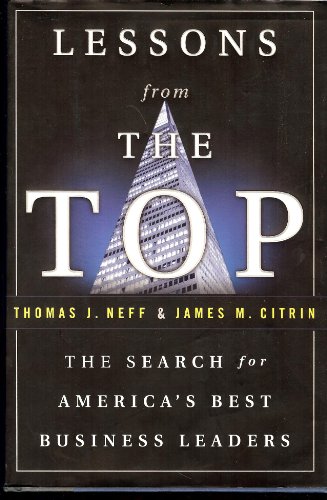
Synopsis
In the bestselling tradition of In Search of Excellence, a fascinating and authoritative selection of the most successful business leaders in America--and the strategies, methods, and motivational tools they use to help make their companies great.
"I don't expect anyone to be perfect," says Mike Armstrong, CEO of a reinvigorated AT&T. "It's not human nature. What I do expect is that they will take risks, correct mistakes, and learn from both." This is only one of the hundreds of comments and insights behind some of the most successful business minds in American industry.
In Lessons from the Top, Thomas J. Neff and James M. Citrin--the U.S. Chairman and a Managing Director of the renowned executive search firm Spencer Stuart--set out to identify the most successful business leaders in America, based on the most exacting standards imaginable. Then, in an extraordinary series of what amounts to master classes, the authors sit down with each of the fifty executives to discuss the long-term strategies, key accomplishments, guiding beliefs, and career milestones that have helped to make their organizations among the best-run companies in the world.
Lou Gerstner of IBM underscores the necessity of adapting to change. "We are constantly challenging what we do--building a culture of restless self-renewal." Ray Gilmartin of Merck discusses, among other things, the critical role of leadership. "My job is really to set the overall strategic direction of the company, to ensure that we are organized to carry out that strategy, and that we have the right management processes in place. I need to create an environment where everyone in the organization can achieve their full potential so that our company does."
What makes a business leader great? This is one of the burning questions in companies and boardrooms across America. An even more compelling question: Are there things each of us can learn from these leaders that we can apply to our own lives? Not surprisingly, there is no single answer to copy or formula to follow in order to excel in business.
In fact, the leaders selected in Lessons from the Top are wildly different in their personalities, their paths to the top, and the industries they work in. But perhaps the best way to learn how to excel is by studying the strategies and thinking of the wide range of leaders who have proved themselves the best in their industries.
Of course, any list of the best business leaders in America would include such recognizable CEOs as Jack Welch, Bill Gates, Lou Gerstner, and Andy Grove. But the list the authors have so exhaustively researched and selected--with the help of the Gallup Organization and the analytical tools of investment advisors Lazard Frères--includes many names that are far less familiar--extraordinarily successful CEOs such as pharmaceutical industry leader Bill Steere of Pfizer, advertising executive Shelly Lazarus of Ogilvy & Mather, Dennis Kozlowski of Tyco International, and Frank Raines of Fannie Mae.
In the final section of the book, the authors distill the surprising number of qualities and characteristics that these extraordinarily accomplished individuals share, to offer lessons to help us in our own lives and careers.
A groundbreaking book on business and success, Lessons from the Top should be required reading by leaders--and future leaders--everywhere.
"synopsis" may belong to another edition of this title.
About the Author
Thomas J. Neff is Chairman of Spencer Stuart U.S. Hailed by The Wall Street Journal as "The No. 1 Brand Name in CEO Searches," he has been profiled on the cover of Business Week and in the Money & Business section of The New York Times.
James M. Citrin is Managing Director of Spencer Stuart's Global Communications and Media Practice. He has authored articles in The New York Times and has appeared on CNBC and CNN.
The authors live in Connecticut.
From the Back Cover
Inside Lessons from the Top:
"I think you've got to continuously make sure [employees] understand how important they are. As a CEO, you need people more than they need you. My job is to keep our people interested in staying, and working, and growing and prospering with this company."
--Larry Bossidy, Chairman & CEO, AlliedSignal
"When I look at potential products or services, I see them through the eyes of the customer, because that is what I am, a customer. I am like a chef. I like to taste the food. If it tastes bad, I don't serve it."
--Charles Schwab, Chairman & Co-CEO, Charles Schwab
"We reward failure. I remember some guys came up with a lamp that didn't work, and we gave them all television sets. You have to do it, because otherwise people will be afraid to try things."
--Jack Welch, Chairman & CEO, General Electric
"The real trick to marketing is finding a core idea which the world can use. You find the universal, and then you make it the core of what you do."
--Shelly Lazarus, Chairman & CEO, Ogilvy & Mather Worldwide
"Customer satisfaction is the most important issue to me, and if you really believe that, then you've got to tie it to your reward system, to your management practices, and we do...We measure customer satisfaction in every way imaginable."
--John Chambers, President & CEO, Cisco Systems
"The key to building an enduring new medium is passion, people, perseverance, perspective and paranoia."
--Steve Case, Chairman & CEO, America Online
From the Inside Flap
In the bestselling tradition of In Search of Excellence, a fascinating and authoritative selection of the most successful business leaders in America--and the strategies, methods, and motivational tools they use to help make their companies great.
"I don't expect anyone to be perfect," says Mike Armstrong, CEO of a reinvigorated AT&T. "It's not human nature. What I do expect is that they will take risks, correct mistakes, and learn from both." This is only one of the hundreds of comments and insights behind some of the most successful business minds in American industry.
In Lessons from the Top, Thomas J. Neff and James M. Citrin--the U.S. Chairman and a Managing Director of the renowned executive search firm Spencer Stuart--set out to identify the most successful business leaders in America, based on the most exacting standards imaginable. Then, in an extraordinary series of what amounts to master classes, the authors sit down with each of the fifty executives to discuss the long-term strategies, key accomplishments, guiding beliefs, and career milestones that have helped to make their organizations among the best-run companies in the world.
Lou Gerstner of IBM underscores the necessity of adapting to change. "We are constantly challenging what we do--building a culture of restless self-renewal." Ray Gilmartin of Merck discusses, among other things, the critical role of leadership. "My job is really to set the overall strategic direction of the company, to ensure that we are organized to carry out that strategy, and that we have the right management processes in place. I need to create an environment where everyone in the organization can achieve their full potential so that our company does."
What makes a business leader great? This is one of the burning questions in companies and boardrooms across America. An even more compelling question: Are there things each of us can learn from these leaders that we can apply to our own lives? Not surprisingly, there is no single answer to copy or formula to follow in order to excel in business.
In fact, the leaders selected in Lessons from the Top are wildly different in their personalities, their paths to the top, and the industries they work in. But perhaps the best way to learn how to excel is by studying the strategies and thinking of the wide range of leaders who have proved themselves the best in their industries.
Of course, any list of the best business leaders in America would include such recognizable CEOs as Jack Welch, Bill Gates, Lou Gerstner, and Andy Grove. But the list the authors have so exhaustively researched and selected--with the help of the Gallup Organization and the analytical tools of investment advisors Lazard Frères--includes many names that are far less familiar--extraordinarily successful CEOs such as pharmaceutical industry leader Bill Steere of Pfizer, advertising executive Shelly Lazarus of Ogilvy & Mather, Dennis Kozlowski of Tyco International, and Frank Raines of Fannie Mae.
In the final section of the book, the authors distill the surprising number of qualities and characteristics that these extraordinarily accomplished individuals share, to offer lessons to help us in our own lives and careers.
A groundbreaking book on business and success, Lessons from the Top should be required reading by leaders--and future leaders--everywhere.
Reviews
Headhunters Neff and Citrin of Spencer Stuart U.S. set out systematically to identify, profile, interview and capture the vision of the nation's top 50 CEOs. Through their company, they commissioned Gallup polls, gathered performance data and constructed a list of intangibles ("showed the ability to overcome challenges," "demonstrated consistent strength of character," etc.). The final results don't look all that different on the surface from countless other books purporting to offer the managerial motherlode, but in this case the difference is in the details. Interviews with AT&T's Mike Armstrong, Charles Schwab, Martha Ingram (one of four women named), Louis Gerstner, Bill Gates and Bill Marriott are all illuminating, revealing complementary aspects of captaining the ship without making redundant observations. A few of the notions even seem worker-centered: Starbucks' Howard Schultz points to the decision to provide equity and stock options to employees, even part-timers, as one of the main reasons why his company's attrition rate is below 60% annually (compared with the national average of 250%). The book is filled with such ideas, presented with a minimum of self-promotion from their purveyors. A final section of "lessons learned" offers a "new definition of success" that begins "live with integrity and lead by example." As concise and clear a management guide as readers are likely to find, this is a great tip sheet on business leadership. (Aug.)
Copyright 1999 Reed Business Information, Inc.
Chair and communications director, respectively, of Spencer Stuart, a leading executive search firm, Ness and Citrin have selected 50 leaders from the private sector (e.g., Bill Gates, Jack Welch, and Charles Schwab) and the American Red Cross's Elizabeth Dole from the public sector to give us "lessons from the top." The authors interviewed each selectee, asking specific questions regarding personal triumphs; leadership strategies; methods of relating to subordinates, competitors, and shareholders; and why they think they run a solid, profitable, well-respected organization. This readable, comprehensive, and timely compilation complements many of the individual biographies already published, but the thought-provoking qualitative and quantitative analysis of the selection process sets this book apart. (Selection was based on Gallup findings, financial analysis, and references, with a detailed explanation of the methodology provided.) A good choice for business collections in academic and public libraries.ASteven J. Mayover, Free Lib. of Philadelphia
Copyright 1999 Reed Business Information, Inc.
Spencer Stuart, specialists in hiring CEOs, is one of the nation's leading executive recruiting firms. Neff is the chairman and Citrin a managing director. After several of their clients had asked them to identify the traits that make a leader successful, the firm commissioned the Gallup Organization to conduct a survey to "nominate" the best leaders in the U.S. on the basis of 10 factors, including vision, long-term performance, customer focus, and impact on business or society. In addition, Spencer Stuart utilized a model developed by the investment banking firm of Lazard Freres that measured performance based on financial results. The result was a list of 240 successful leaders, which the authors narrowed using the same proprietary criteria they use to select executives for their clients. This roster of America's 50 best is the end product. Finalists' profiles include their comments on the difficult issues, what they consider to be most important about leadership, and how those factors improve organizational performance. It is noteworthy that those at "the top" represent a wide range of leadership styles. David Rouse
Excerpt. © Reprinted by permission. All rights reserved.
What Makes Business Leaders Great
Our chief want is someone who will inspire us to be what we know we could be.
--Ralph Waldo Emerson
WHO ARE THE BEST BUSINESS LEADERS IN AMERICA? WHAT MAKES them great? What can we learn from them as we try to turn our own aspirations into reality?
These three questions have driven us from the moment that we began this project in April of 1997. They are relatively simple questions to ask. But they are extremely difficult to answer.
We had originally intended to open Lessons from the Top with an anecdote describing a real phone call we had received from a corporate board member asking us to launch an executive search for a new chief executive officer.
The board member, someone we had worked with over a period of years, wanted us to develop a list of candidates who could succeed the company's CEO, a man who had just informed the board that he intended to retire at year's end.
Up until that point, the phone call was fairly typical. Recruiting senior executives and board members to build our clients' management teams is what we do at Spencer Stuart. Each year, as one of the world's largest executive search firms, we interview over 40,000 executives around the world, in the course of more than 4,000 assignments that we conduct out of 50 offices located in 25 countries. Our recent assignments have included recruiting new CEOs to lead AT&T, Delta Airlines, Quaker Oats, Reader's Digest, J. Crew, and Weyerhaeuser.
Spencer Stuart has been recruiting such top talent for more than 40 years. So this particular phone call did not set off any unusual alarms. What was surprising, though, was his next request: Our client asked us to advise the board as well about what they should be looking for in their next CEO. Not only what industry background, company size, and geographic breadth, but the more subtle and potentially important characteristics. Who is the right kind of leader? What kind of attributes should he or she have?
The reason this brought us up short was that it was one of a number of similar requests we had recently received from our clients, firms that range from venture capital-backed start-ups, to some of America's largest companies.
Given the growing interest in this question, we decided to forgo opening the book with an elaborate story, and plunge right into the heart of the issue.
What, in fact, makes someone a great business leader? What does it really take to lead an organization successfully in today's ever more competitive and fast-moving world economy?
When we considered this carefully, we realized that it is not surprising that these questions are surfacing more frequently. They are the very things that individuals, whether given the responsibility of running an organization or managing a department, must answer and answer quickly.
As the deposed former chief executives of AT&T, Kmart, and Sunbeam can well attest, managers are being given less and less time to make a difference today.
Operating in what feels like an ever-tightening vise--being squeezed by global competition on one side and a rapidly changing, technology-driven business landscape on the other--it is only natural for managers to look for comfort in what has worked in the past. Unfortunately, as they have learned the hard way, we are no longer operating under the old rules. When a company's board loses confidence in its CEO, it often takes decisive action. And conducting a search for a new leader is often the action it takes. It is often also the point where we come in.
What Spencer Stuart Does
Executive search is a specialized form of management consulting that focuses on defining a company's leadership requirements as a function of its strategy, and then identifies, interviews, and recruits the most appropriate candidate to execute that strategy.
Developing insight into business leaders' careers and lives--what makes them "tick"--is essential for us to fulfill our mandate, as we set out to find the right executive.
To assess a candidate for a top position, we perform an in-depth appraisal of the executive's career accomplishments, management style, obstacles overcome, mistakes made and lessons learned, leadership philosophy, formative life experiences, and personal and professional ambitions. Given that executives are often competing for these high-profile appointments, it is in their interest to make certain that we understand their industries, companies, and careers as much as possible.
Meeting with all of these executives, and developing insights into their business successes and what makes leaders great, has provided us with the privilege of learning from many of the top business leaders in the world. We have grown professionally and personally as a result and wanted to share what we have learned. This was one of the principal reasons behind writing this book.
To give these lessons about success and leadership maximum impact, we decided that it was critical to hear from the very best. And rather than simply subjectively picking the "best" leaders to study, we felt compelled to apply an objective and rigorous analytical process. This decision was partially the result of the fact-based, analytical approach that was instilled in both of us earlier in our careers as management consultants at McKinsey & Company.
So we undertook to do what no one else has done before. We put together a rigorous methodology aimed at identifying the very best business leaders in America and then interviewed those leaders at length to discover why they have been so successful.
There are, of course, entire libraries of books that analyze key leadership qualities. But most are rather academic in their approach, or are limited by a single author's perspective.
And while there are scores of annual rankings of top business managers, our review suggests that these tabulations have neither the requisite analytical rigor nor the depth to elucidate the stories behind the rankings.
Neither approach seems to bring to life what it takes to be a great leader in a way that can be applied to real life.
In light of this, we set the ambitious dual goals of:
1) Being as analytically sound as possible in constructing our list of business leaders, and
2) Articulating their stories in as personal and approachable a style as possible.
Based on the methodology described below and in Chapter 3, we created the list of business leaders that is as close as we could come to answering our first question, "Who are the best business leaders in America?"
"About this title" may belong to another edition of this title.
Search results for Lessons from the Top: In Search of America's Best...

Stock Image
Lessons from the Top: In Search of America's Best Business Leaders
Seller: World of Books (was SecondSale), Montgomery, IL, U.S.A.
Seller rating 5 out of 5 stars

Condition: Good. Item in good condition. Textbooks may not include supplemental items i.e. CDs, access codes etc. Seller Inventory # 00095423215
Stock Image
Lessons from the Top: In Search of America's Best Business Leaders
Seller: World of Books (was SecondSale), Montgomery, IL, U.S.A.
Seller rating 5 out of 5 stars
Condition: Very Good. Item in very good condition! Textbooks may not include supplemental items i.e. CDs, access codes etc. Seller Inventory # 00082828552
Seller Image
Lessons from the Top: In Search of America's Best Business Leaders
Seller: Greenworld Books, Arlington, TX, U.S.A.
Seller rating 5 out of 5 stars
Condition: good. Fast Free Shipping â" Good condition. It may show normal signs of use, such as light writing, highlighting, or library markings, but all pages are intact and the book is fully readable. A solid, complete copy that's ready to enjoy. Seller Inventory # GWV.0385493436.G
Stock Image
Lessons from the Top: In Search of America's Best Business Leaders
Seller: Half Price Books Inc., Dallas, TX, U.S.A.
Seller rating 5 out of 5 stars
hardcover. Condition: Very Good. Connecting readers with great books since 1972! Used books may not include companion materials, and may have some shelf wear or limited writing. We ship orders daily and Customer Service is our top priority! Seller Inventory # S_461235462
Stock Image
Lessons from the Top: In Search of America's Best Business Leaders
Published by
Crown Business (edition 1), 1999
ISBN 10: 0385493436
ISBN 13: 9780385493437
Used
Hardcover
Seller: BooksRun, Philadelphia, PA, U.S.A.
Seller rating 5 out of 5 stars
Hardcover. Condition: Fair. 1. With dust jacket. The item might be beaten up but readable. May contain markings or highlighting, as well as stains, bent corners, or any other major defect, but the text is not obscured in any way. Seller Inventory # 0385493436-7-1-29
Stock Image
Lessons from the Top: In Search of America's Best Business Leaders
Seller: HPB-Emerald, Dallas, TX, U.S.A.
Seller rating 5 out of 5 stars
hardcover. Condition: Very Good. Connecting readers with great books since 1972! Used books may not include companion materials, and may have some shelf wear or limited writing. We ship orders daily and Customer Service is our top priority! Seller Inventory # S_481662923
Stock Image
Lessons from the Top: In Search of America's Best Business Leaders
Seller: ThriftBooks-Atlanta, AUSTELL, GA, U.S.A.
Seller rating 5 out of 5 stars
Hardcover. Condition: As New. No Jacket. Pages are clean and are not marred by notes or folds of any kind. ~ ThriftBooks: Read More, Spend Less. Seller Inventory # G0385493436I2N00
Stock Image
Lessons from the Top: The Search for America's Best Business Leaders
Published by
Bantam Doubleday Dell Publishing Group Inc, 1999
ISBN 10: 0385493436
ISBN 13: 9780385493437
Used
Hardcover
Seller: World of Books Inc, Montgomery, IL, U.S.A.
Seller rating 4 out of 5 stars

Hardback. Condition: Good. Seller Inventory # CIN0385493436G
Stock Image
Lessons from the Top: The Search for America's Best Business Leaders
Published by
Bantam Doubleday Dell Publishing Group Inc, 1999
ISBN 10: 0385493436
ISBN 13: 9780385493437
Used
Hardcover
Seller: World of Books Inc, Montgomery, IL, U.S.A.
Seller rating 4 out of 5 stars
Hardback. Condition: Very Good. Seller Inventory # CIN0385493436VG
Stock Image
Lessons from the Top : The Search of America's Best Business Leaders
Published by
Bantam Doubleday Dell Publishing Group, 1999
ISBN 10: 0385493436
ISBN 13: 9780385493437
Used
Hardcover
First Edition
Seller: Better World Books, Mishawaka, IN, U.S.A.
Seller rating 5 out of 5 stars
Condition: Good. 1st Edition. Former library copy. Pages intact with minimal writing/highlighting. The binding may be loose and creased. Dust jackets/supplements are not included. Includes library markings. Stock photo provided. Product includes identifying sticker. Better World Books: Buy Books. Do Good. Seller Inventory # GRP89565179