
Items related to Juneteenth: A Novel
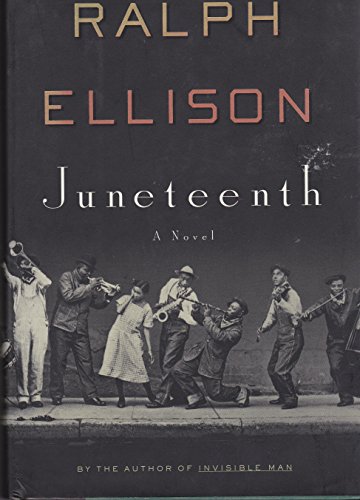
Synopsis
Juneteenth, the Senator said, closing his eyes, his bandaged head resting beneath his hands. Words of Emancipation didn't arrive until the middle of June, so they called it Juneteenth. . . .
In Washington, D.C., in the 1950s, Adam Sunraider, a race-baiting senator from a New England state, is mortally wounded by an assassin's bullet while making a speech on the Senate floor. To the shock of all who think they know him, Sunraider calls out from his deathbed for Hickman, an old black minister, to be brought to his side. The Reverend is summoned; the two are left alone. Out of their conversation, and the inner rhythms of memories whose weight has been borne in silence for many long years, a story emerges. For this United States senator, once known as Bliss, was raised by Reverend Hickman in a religion- and music-steeped black community not unlike Ralph Ellison's own childhood home. He was brought up to be a preaching prodigy in a joyful black Baptist ministry that traveled throughout the South and the Southwest. Together one last time, the two men retrace the course of their shared life in "an anguished attempt," Ellison once put it, "to arrive at the true shape and substance of a sundered past and its meaning." In the end the two men arrive at their most painful memories, memories that hold the key to understanding the mysteries of kinship and race that bind them, and to the senator's confronting how deeply estranged he has become from his true identity.
Juneteenth draws on the full richness of America's black cultural heritage, from the dazzling range of vernacular sources in its language to the way its structure echoes the call-and-response pattern of the black church and the riffs and bass lines of jazz. It offers jubilant proof that whatever else it means to be a true American, it means to be "somehow black," as Ellison once wrote. For even as Senator Sunraider was bathed from birth in the deep and nourishing waters of African-American folkways, so too are all Americans.
That idea is the cause for which Ralph Ellison gave the last full measure of his devotion. At the time of his death, he was still expanding his novel in other directions, envisioning a grand, perhaps multivolume, story cycle. Always, in Ellison's mind, the character Hickman and the story of Sunraider's life from birth to death were the dramatic heart of the narrative. And so, with the aid of Ellison's widow, Fanny, his literary executor, John Callahan, has edited this magnificent novel at the center of Ralph Ellison's forty-year work-in-progress--Juneteenth, its author's abiding testament to the country he so loved and to its many unfinished tasks.
"synopsis" may belong to another edition of this title.
About the Author
Ralph Ellison was born in Oklahoma City in 1914. He is the author of the novel Invisible Man (1952), winner of the National Book Award and one of the most important and influential American novels of the twentieth century, as well as numerous essays and short stories. He died in New York City in 1994.
John F. Callahan is Morgan S. Odell Professor of Humanities at Lewis and Clark College in Portland, Oregon. He is the editor of the Modern Library edition of The Collected Essays of Ralph Ellison and is literary executor of Ralph Ellison's estate.
From the Back Cover
"Ralph Ellison's generosity, humor, and nimble language are, of course, on display in Juneteenth, but it is his vigorous intellect that rules the novel. A majestic narrative concept."
--Toni Morrison
From the Inside Flap
the Senator said, closing his eyes, his bandaged head resting beneath his hands. Words of Emancipation didn't arrive until the middle of June, so they called it Juneteenth. . . .<br><br>In Washington, D.C., in the 1950s, Adam Sunraider, a race-baiting senator from a New England state, is mortally wounded by an assassin's bullet while making a speech on the Senate floor. To the shock of all who think they know him, Sunraider calls out from his deathbed for Hickman, an old black minister, to be brought to his side. The Reverend is summoned; the two are left alone. Out of their conversation, and the inner rhythms of memories whose weight has been borne in silence for many long years, a story emerges. For this United States senator, once known as Bliss, was raised by Reverend Hickman in a religion- and music-steeped black community not unlike Ralph Ellison's own childhood home. He was brought up to be a preaching prodigy in a joyful black Baptist ministry that traveled through
Reviews
When Ralph Ellison died in 1994, he left behind a manuscript he'd been working on since the '50s. John Callahan's introduction to this long-awaited edition explores Ellison's life and the history of this second novel (after, of course, the classic Invisible Man), cataloguing such disasters as the near-finished manuscript being destroyed in a fire in 1967. The novel turns out to have survived the many obstacles to its birth, for after a rather windy beginning, Ellison writes beautifully, in the grand, layered Southern tradition. The narrative begins in 1950s Washington, D.C., with Adam Sunraider, a race-baiting senator who is gunned down on the Senate floor while a man named Hickman watches in the gallery. Rushed to the hospital, Sunraider requests Hickman's presence, and the story of the two men's agonized relationship is told in flashbacks as Hickman attends the dying senator. Decades before, Alonzo Hickman was an ex-trombone player turned circuit preacher raising a young boy of indeterminate race named Bliss.The boy assists Hickman in his revivals, rising out of a white coffin at a certain moment in the sermon. Bliss grows up to change his name to Adam Sunraider and, having passed for white, has gone from being a flimflam artist and movie maker to the U. S. Senate Always, however, he is in flight from Hickman. These flashbacks showcase Ellison's stylized set pieces, among the best scenes he has written, especially as his incandescent images chart the mysteries and legacies of slavery. Bliss remembers his courtship of a black woman in a piercingly sweet reverie, and he revisits a revival meeting on Juneteenth (June 19), the date in 1865 on which slaves in Texas were finally informed of the Emancipation Proclamation. The sermon in this section is perhaps the highlight of the novel, sure to achieve classic status on its own merits. The revival meeting is interrupted by a white woman who claims Bliss is her son, after which Bliss begins his odyssey for an identity that takes him, by degrees, away from the black culture of his youth. Gradually, we learn of the collusion of lies and violence that brought Bliss to Hickman in the first place. Editor Callahan, in his informative afterword, describes the difficult process of editing Ellison's unfinished novel and of arranging the massive body of work into the unwieldy yet cohesive story Ellison wanted to tell. The difficulties he faced are most obvious in the ending, which is Faulknerian to a fault, even to the overuse of the word "outrage." Nonetheless, this volume is a visionary tour de force, a lyrical, necessary contribution to America's perennial racial dialogue, and a novel powerfully reinforcing Ellison's place in literary history. 100,000 first printing; BOMC double main selection.
Copyright 1999 Reed Business Information, Inc.
The late Ralph Ellison's 1952 debut, Invisible Man, remains as fine an American novel as has appeared since World War II. Afterward, he worked periodically on his "novel in progress (very long progress)" until his death in 1994. A third of that sprawling manuscript is published here, his literary executor explains in the introduction. So how are we to evaluate it, if we even should? This ambitious book (whose title refers to the 1865 day when word of Emancipation finally reached Texas slaves) certainly has the rhetorical flourishes and bluesy erudition found in Invisible Man, and its criss-crossing story is original and bold: an Oklahoma boy-preacher with racially vague features becomes a bigoted Northern Senator, Adam Sunraider, before his life intersects again with that of his estranged black mentor, Rev. Alonzo Hickman, around a 1955 assassination. The two characters are vivid, but whereas in his masterpiece the soaring language seemed an extension of the tormented narrator, too often here it clearly comes from the omniscient Ellison himself. Ellison's fans will nevertheless find much to savor and can only wonder about the unseen chapters. For all fiction collections.
-ANathan Ward, "Library Journal"
Copyright 1999 Reed Business Information, Inc.
Excerpt. © Reprinted by permission. All rights reserved.
CHAPTER 1
Two days before the shooting a chartered planeload of Southern Negroes swooped down upon the District of Columbia and attempted to see the Senator. They were all quite elderly: old ladies dressed in little white caps and white uniforms made of surplus nylon parachute material, and men dressed in neat but old-fashioned black suits, wearing wide-brimmed, deep-crowned panama hats which, in the Senator's walnut-paneled reception room now, they held with a grave ceremonial air. Solemn, uncommunicative and quietly insistent, they were led by a huge, distinguished-looking old fellow who on the day of the chaotic event was to prove himself, his age notwithstanding, an extraordinarily powerful man. Tall and broad and of an easy dignity, this was the Reverend A. Z. Hickman--better known, as one of the old ladies proudly informed the Senator's secretary, as "God's Trombone."
This, however, was about all they were willing to explain. Forty-four in number, the women with their fans and satchels and picnic baskets, and the men carrying new blue airline take-on bags, they listened intently while Reverend Hickman did their talking.
"Ma'am," Hickman said, his voice deep and resonant as he nodded toward the door of the Senator's private office, "you just tell the Senator that Hickman has arrived. When he hears who's out here he'll know that it's important and want to see us."
"But I've told you that the Senator isn't available," the secretary said. "Just what is your business? Who are you, anyway? Are you his constituents?"
"Constituents?" Suddenly the old man smiled. "No, miss," he said, "the Senator doesn't even have anybody like us in his state. We're from down where we're among the counted but not among the heard."
"Then why are you coming here?" she said. "What is your business?"
"He'll tell you, ma'am," Hickman said. "He'll know who we are; all you have to do is tell him that we have arrived. . . ."
The secretary, a young Mississippian, sighed. Obviously these were Southern Negroes of a type she had known all her life--and old ones; yet instead of being already in herdlike movement toward the door they were calmly waiting, as though she hadn't said a word. And now she had a suspicion that, for all their staring eyes, she actually didn't exist for them. They just stood there, now looking oddly like a delegation of Asians who had lost their interpreter along the way, and were trying to tell her something which she had no interest in hearing, through this old man who himself did not know the language. Suddenly they no longer seemed familiar, and a feeling of dreamlike incongruity came over her. They were so many that she could no longer see the large abstract paintings hung along the paneled wall, nor the framed facsimiles of State Documents which hung above a bust of Vice-President Calhoun. Some of the old women were calmly plying their palm-leaf fans, as though in serene defiance of the droning air conditioner. Yet she could see no trace of impertinence in their eyes, nor any of the anger which the Senator usually aroused in members of their group. Instead, they seemed resigned, like people embarked upon a difficult journey who were already far beyond the point of no return. Her uneasiness grew; then she blotted out the others by focusing her eyes narrowly upon their leader. And when she spoke again her voice took on a nervous edge.
"I've told you that the Senator isn't here," she said, "and you must realize that he is a busy man who can only see people by appointment. . . ."
"We know, ma'am," Hickman said, "but . . ."
"You don't just walk in here and expect to see him on a minute's notice."
"We understand that, ma'am," Hickman said, looking mildly into her eyes, his close-cut white head tilted to one side, "but this is something that developed of a sudden. Couldn't you reach him by long distance? We'd pay the charges. And I don't even have to talk, miss; you can do the talking. All you have to say is that we have arrived."
"I'm afraid this is impossible," she said.
The very evenness of the old man's voice made her feel uncomfortably young, and now, deciding that she had exhausted all the tried-and-true techniques her region had worked out (short of violence) for getting quickly rid of Negroes, the secretary lost her patience and telephoned for a guard.
They left as quietly as they had appeared, the old minister waiting behind until the last had stepped into the hall, then he turned, and she saw his full height, framed by the doorway, as the others arranged themselves beyond him in the hall. "You're really making a mistake, miss," he said. "The Senator knows us and--"
"Knows you," she said indignantly. "I've heard Senator Sunraider state that the only colored he knows is the boy who shines shoes at his golf club."
"Oh?" Hickman shook his head as the others exchanged knowing glances. "Very well, ma'am. We're sorry to have caused you this trouble. It's just that it's very important that the Senator know we're on the scene. So I hope you won't forget to tell him that we have arrived, because soon it might be too late."
There was no threat in it; indeed, his voice echoed the odd sadness which she thought she detected in the faces of the others just before the door blotted them from view.
In the hall they exchanged no words, moving silently behind the guard who accompanied them down to the lobby. They were about to move into the street when the security-minded chief guard observed their number, stepped up, and ordered them searched.
They submitted patiently, amused that anyone should consider them capable of harm, and for the first time an emotion broke the immobility of their faces. They chuckled and winked and smiled, fully aware of the comic aspect of the situation. Here they were, quiet, old, and obviously religious black folk who, because they had attempted to see the man who was considered the most vehement enemy of their people in either house of Congress, were being energetically searched by uniformed security police, and they knew what the absurd outcome would be. They were found to be armed with nothing more dangerous than pieces of fried chicken and ham sandwiches, chocolate cake and sweet-potato fried pies. Some obeyed the guards' commands with exaggerated sprightliness, the old ladies giving their skirts a whirl as they turned in their flat-heeled shoes. When ordered to remove his wide-brimmed hat, one old man held it for the guard to look inside; then, flipping out the sweatband, he gave the crown a tap, causing something to fall to the floor, then waited with a callused palm extended as the guard bent to retrieve it. Straightening and unfolding the object, the guard saw a worn but neatly creased fifty-dollar bill, which he dropped upon the outstretched palm as though it were hot. They watched silently as he looked at the old man and gave a dry, harsh laugh; then as he continued laughing the humor slowly receded behind their eyes. Not until they were allowed to file into the street did they give further voice to their amusement.
"These here folks don't understand nothing," one of the old ladies said. "If we had been the kind to depend on the sword instead of on the Lord, we'd been in our graves long ago--ain't that right, Sis' Arter?"
"You said it," Sister Arter said. "In the grave and done long finished mold'ing!"
"Let them worry, our conscience is clear on that. . . ."
"Amen!"
On the sidewalk now, they stood around Reverend Hickman, holding a hushed conference; then in a few minutes they disappeared in a string of taxis and the incident was thought closed.
Shortly afterwards, however, they appeared mysteriously at a hotel where the Senator leased a private suite, and tried to see him. How they knew of this secret suite they would not explain.
Next they appeared at the editorial offices of the newspaper which was most critical of the Senator's methods, but here too they were turned away. They were taken for a protest group, just one more lot of disgruntled Negroes crying for justice as though theirs were the only grievances in the world. Indeed, they received less of a hearing here than elsewhere. They weren't even questioned as to why they wished to see the Senator--which was poor newspaper work, to say the least; a failure of technical alertness, and, as events were soon to prove, a gross violation of press responsibility.
So once more they moved away.
Although the Senator returned to Washington the following day, his secretary failed to report his strange visitors. There were important interviews scheduled and she had understandably classified the old people as just another annoyance. Once the reception room was cleared of their disquieting presence they seemed no more significant than the heavy mail received from white liberals and Negroes, liberal and reactionary alike, whenever the Senator made one of his taunting remarks. She forgot them. Then at about eleven a.m. Reverend Hickman reappeared without the others and started into the building. This time, however, he was not to reach the secretary. One of the guards, the same who had picked up the fifty-dollar bill, recognized him and pushed him bodily from the building.
Indeed, the old man was handled quite roughly, his sheer weight and bulk and the slow rhythm of his normal movements infuriating the guard to that quick, heated fury which springs up in one when dealing with the unexpected recalcitrance of some inanimate object--the huge stone that resists the bulldozer's power, or the chest of drawers that refuses to budge from its spot on the floor. Nor did the old man's composure help matters. Nor did his passive resistance hide his distaste at having strange hands placed upon his person. As he was being pushed about, old Hickman looked at the guard with a...
"About this title" may belong to another edition of this title.
Search results for Juneteenth: A Novel

Stock Image
Juneteenth
Seller: World of Books (was SecondSale), Montgomery, IL, U.S.A.
Seller rating 5 out of 5 stars

Hardback. Condition: Fair. From the author of bestselling Invisible Man--the classic novel of African-American experience--this long-awaited second novel tells an evocative tale of a prodigal of the twentieth century. Brilliantly crafted, moving, and wise, Juneteenth is the work of an American master.Tell me what happened while there's still time, demands the dying Senator Adam Sunraider to the itinerate preacher whom he calls Daddy Hickman. As a young man, Sunraider was Bliss, an orphan taken in by Hickman and raised to be a preacher like himself. Bliss's history encompasses the joys of young southern boyhood; bucolic days as a filmmaker, lovemaking in a field in the Oklahoma sun. And behind it all lies a mystery: how did this chosen child become the man who would deny everything to achieve his goals? Here is the master of American vernacular at the height of his powers, evoking the rhythms of jazz and gospel and ordinary speech. An extraordinary book, a work of staggering virtuosity. With its publication, a giant world of literature has just grown twice as tall. --Newsday. Seller Inventory # 00106145188
Stock Image
Juneteenth
Seller: World of Books (was SecondSale), Montgomery, IL, U.S.A.
Seller rating 5 out of 5 stars
Hardback. Condition: Good. From the author of bestselling Invisible Man--the classic novel of African-American experience--this long-awaited second novel tells an evocative tale of a prodigal of the twentieth century. Brilliantly crafted, moving, and wise, Juneteenth is the work of an American master.Tell me what happened while there's still time, demands the dying Senator Adam Sunraider to the itinerate preacher whom he calls Daddy Hickman. As a young man, Sunraider was Bliss, an orphan taken in by Hickman and raised to be a preacher like himself. Bliss's history encompasses the joys of young southern boyhood; bucolic days as a filmmaker, lovemaking in a field in the Oklahoma sun. And behind it all lies a mystery: how did this chosen child become the man who would deny everything to achieve his goals? Here is the master of American vernacular at the height of his powers, evoking the rhythms of jazz and gospel and ordinary speech. An extraordinary book, a work of staggering virtuosity. With its publication, a giant world of literature has just grown twice as tall. --Newsday. Seller Inventory # 00101278632
Stock Image
Juneteenth
Seller: World of Books (was SecondSale), Montgomery, IL, U.S.A.
Seller rating 5 out of 5 stars
Hardback. Condition: Very Good. From the author of bestselling Invisible Man--the classic novel of African-American experience--this long-awaited second novel tells an evocative tale of a prodigal of the twentieth century. Brilliantly crafted, moving, and wise, Juneteenth is the work of an American master.Tell me what happened while there's still time, demands the dying Senator Adam Sunraider to the itinerate preacher whom he calls Daddy Hickman. As a young man, Sunraider was Bliss, an orphan taken in by Hickman and raised to be a preacher like himself. Bliss's history encompasses the joys of young southern boyhood; bucolic days as a filmmaker, lovemaking in a field in the Oklahoma sun. And behind it all lies a mystery: how did this chosen child become the man who would deny everything to achieve his goals? Here is the master of American vernacular at the height of his powers, evoking the rhythms of jazz and gospel and ordinary speech. An extraordinary book, a work of staggering virtuosity. With its publication, a giant world of literature has just grown twice as tall. --Newsday. Seller Inventory # 00107977527
Seller Image
Juneteenth: A Novel
Seller: Zoom Books Company, Lynden, WA, U.S.A.
Seller rating 5 out of 5 stars
Condition: very_good. Book is in very good condition and may include minimal underlining highlighting. The book can also include "From the library of" labels. May not contain miscellaneous items toys, dvds, etc. . We offer 100% money back guarantee and 24 7 customer service. Seller Inventory # ZBV.0394464575.VG
Seller Image
Juneteenth: A Novel
Seller: Zoom Books East, Glendale Heights, IL, U.S.A.
Seller rating 5 out of 5 stars
Condition: very_good. Book is in very good condition and may include minimal underlining highlighting. The book can also include "From the library of" labels. May not contain miscellaneous items toys, dvds, etc. . We offer 100% money back guarantee and 24 7 customer service. Seller Inventory # ZEV.0394464575.VG
Seller Image
Juneteenth: A Novel
Seller: Greenworld Books, Arlington, TX, U.S.A.
Seller rating 5 out of 5 stars
Condition: good. Fast Free Shipping â" Good condition. It may show normal signs of use, such as light writing, highlighting, or library markings, but all pages are intact and the book is fully readable. A solid, complete copy that's ready to enjoy. Seller Inventory # GWV.0394464575.G
Stock Image
Juneteenth: A Novel
Seller: Evergreen Goodwill, Seattle, WA, U.S.A.
Seller rating 5 out of 5 stars
hardcover. Condition: Good. Seller Inventory # mon0000052551
Stock Image
Juneteenth
Seller: World of Books Inc, Montgomery, IL, U.S.A.
Seller rating 4 out of 5 stars

Hardback. Condition: Very Good. From the author of bestselling Invisible Man--the classic novel of African-American experience--this long-awaited second novel tells an evocative tale of a prodigal of the twentieth century. Brilliantly crafted, moving, and wise, Juneteenth is the work of an American master.Tell me what happened while there's still time, demands the dying Senator Adam Sunraider to the itinerate preacher whom he calls Daddy Hickman. As a young man, Sunraider was Bliss, an orphan taken in by Hickman and raised to be a preacher like himself. Bliss's history encompasses the joys of young southern boyhood; bucolic days as a filmmaker, lovemaking in a field in the Oklahoma sun. And behind it all lies a mystery: how did this chosen child become the man who would deny everything to achieve his goals? Here is the master of American vernacular at the height of his powers, evoking the rhythms of jazz and gospel and ordinary speech. An extraordinary book, a work of staggering virtuosity. With its publication, a giant world of literature has just grown twice as tall. --Newsday. Seller Inventory # CIN0394464575VG
Stock Image
Juneteenth
Seller: World of Books Inc, Montgomery, IL, U.S.A.
Seller rating 4 out of 5 stars
Hardback. Condition: Good. From the author of bestselling Invisible Man--the classic novel of African-American experience--this long-awaited second novel tells an evocative tale of a prodigal of the twentieth century. Brilliantly crafted, moving, and wise, Juneteenth is the work of an American master.Tell me what happened while there's still time, demands the dying Senator Adam Sunraider to the itinerate preacher whom he calls Daddy Hickman. As a young man, Sunraider was Bliss, an orphan taken in by Hickman and raised to be a preacher like himself. Bliss's history encompasses the joys of young southern boyhood; bucolic days as a filmmaker, lovemaking in a field in the Oklahoma sun. And behind it all lies a mystery: how did this chosen child become the man who would deny everything to achieve his goals? Here is the master of American vernacular at the height of his powers, evoking the rhythms of jazz and gospel and ordinary speech. An extraordinary book, a work of staggering virtuosity. With its publication, a giant world of literature has just grown twice as tall. --Newsday. Seller Inventory # CIN0394464575G
Stock Image
Juneteenth: A Novel
Seller: ThriftBooks-Dallas, Dallas, TX, U.S.A.
Seller rating 5 out of 5 stars
Hardcover. Condition: Good. No Jacket. Pages can have notes/highlighting. Spine may show signs of wear. ~ ThriftBooks: Read More, Spend Less. Seller Inventory # G0394464575I3N00