
Items related to I Married a Communist
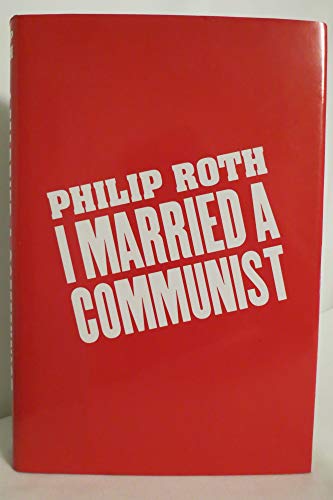
Synopsis
In an eloquent novel set against the turbulent backdrop of the McCarthy era, radio actor Iron Rinn, an idealistic Communist, marries beautiful actress Eva Frame, but their private relationship becomes a national scandal when Eva publicly betrays her husband's politics to a gossip columnist. 150,000 first printing.
"synopsis" may belong to another edition of this title.
About the Author
In 1997, Philip Roth won the Pulitzer Prize for American Pastoral. In 1998 he received the National Medal of Arts at the White House and in 2002 the highest award of the American Academy of Arts and Letters, the Gold Medal in Fiction, previously awarded to John Dos Passos, William Faulkner, and Saul Bellow, among others. He has twice won the National Book Award and the National Book Critics Circle Award. He has won the PEN/Faulkner Award three times.
In 2005 The Plot Against America received the Society of American Historians’ prize for “the outstanding historical novel on an American theme for 2003-2004.”
Recently Roth received PEN’s two most prestigious prizes: in 2006 the PEN/Nabokov Award for “a body of work…of enduring originality and consummate craftsmanship” and in 2007 the PEN/Saul Bellow Award for achievement in American Fiction, given to a writer whose “scale of achievement over a sustained career…places him or her in the highest rank of American literature.”
Roth is the only living American writer to have his work published in a comprehensive, definitive edition by the Library of America. The last of eight volumes is scheduled for publication in 2013.
In 2005 The Plot Against America received the Society of American Historians’ prize for “the outstanding historical novel on an American theme for 2003-2004.”
Recently Roth received PEN’s two most prestigious prizes: in 2006 the PEN/Nabokov Award for “a body of work…of enduring originality and consummate craftsmanship” and in 2007 the PEN/Saul Bellow Award for achievement in American Fiction, given to a writer whose “scale of achievement over a sustained career…places him or her in the highest rank of American literature.”
Roth is the only living American writer to have his work published in a comprehensive, definitive edition by the Library of America. The last of eight volumes is scheduled for publication in 2013.
Reviews
Following the spectacular success of its immediate predecessor, American Pastoral (1997), Roth's ambitious new novel is another chronicle of innocence and idealism traducedthe demolition of what one of its characters calls ``the myth of your own goodness.'' That character is Murray Ringold, a nonagenarian former schoolteacher whose meeting with his onetime student (and recurring Roth character), novelist Nathan Zuckermano, triggers a complex reconstruction of the infamous life of Murray's younger brother Ira. As Iron Rinn, a radio star. . . married to one of the country's most revered radio actresses, Ira had become a beloved public figure renowned for his impersonations of Abraham Lincoln (whom he physically resembled) and for patriotic broadcasts celebrating America's working poor. Nathan, who grew up in the 1940s as a fledgling liberal intellectual whose heroes were radio playwright Norman Corwin and left-wing novelist Howard Fast, adored the charismatic Ira, even after the latter's wife denounced him as a duplicitous ``zealot'' in her explosive memoir, I Married a Communist. The story of Ira's violent youth, spectacular career, and eventual disgrace is rather ham-fistedly assembled from Nathan's own memories (as Iron Rinn's devoted acolyte), the stories Ira told him, andmost movinglythe immensely detailed recollections poured forth by the ever-garrulous Murray Ringold (brilliantly portrayed as a bundle of fiery intellectual and moral energies undimmed by old age; a sturdy exemplar of ``the disciplined sadness of stoicism). The character of Murray is the triumph of this often inventive but gratingly discursive novel, whose dramatic content is frequently upstaged by such indulgences as Ira's lengthy political diatribes, Nathan's summaries of favorite literary works (such as Arthur Miller's Focus), and Murray's exhausting (if agreeably savage) remembrance of Richard Nixon's state funeral. Despite its superb re-creation of the conflicted 1940s and the ordeal of the American Left, along with a plethora of sharply realized ideologues at verbal war, this very talky book is an example of Roth at his most forceful and eloquent, though perhaps rather less than his best.(First printing of 150,000; $150,000 ad/promo) -- Copyright ©1998, Kirkus Associates, LP. All rights reserved.
...what is most offensive and what, to my mind, least defensible, is that Philip Roth has appropriated one of the most degraded and cruel episodes in 20th-century American history and employed it for no better purpose than to get back at his ex-wife.
Disconcerting echoes of Roth's relationship with Claire Bloom, as revealed in her memoir, Leaving the Doll's House, haunt Roth's angry but oddly inert 23rd novel. As in American Pastoral, Roth again deals with the Newark of his youth, and with the sons of Jewish immigrants to whom America has given opportunity and even riches?and how they are swept off course by the forces of history. Roth's old alter ego, Nathan Zuckerman, narrates the story of Ira Ringold, aka Iron Rinn, a supremely idealistic political radical and celebrated radio star of the 1950s who is blacklisted and brought to ruin when his wife, Eva Frame (a self-hating Jewish actress born Chava Fromkin), writes an expose called I Married A Communist. The impetus for Eva's treacherous act is Ira's insistence that she evict her 24-year-old daughter from their house; the resemblance to Bloom's revelations of Roth's similar demand is too close to miss, and Roth's shrill belaboring of the issue seems a thinly disguised vendetta. Even high-pitched scenes of family conflict don't bring the novel to life. One problem is that the flat flashback narration shared between the 64-year-old Nathan and Ira's 90-year-old brother, Murray, is stultifyingly dull. Some fine Roth touches do appear: his evocation of the Depression years through the McCarthy era has clarity and vigor. But Ira's aggressively boorish behavior as he struggles with his conscience over having abandoned his Marxist ideals to assume a bourgeois lifestyle is never credible, and his turgid ideological rants against the American government are jackhammers of repetitious invective. In addition, the depiction of an adolescent Nathan as a precocious writer and social philosopher and the saintly Murray's infallible memory of long conversations with Ira?even between Ira and Eva in bed?challenge the reader's credulity. For those who lived through the years Roth evokes, this novel will have some resonance. For others, its belligerent tone and lack of dramatic urgency will be a turn-off. 150,000 first printing; $150,000 ad/promo.
Copyright 1998 Reed Business Information, Inc.
The famous radio performer Ira Ringold was a Communist, and in the late 1940s and early 1950s, that was a hazardous card to carry, given all the Red-baiting going on in Washington. Ira's wife, a radio personality herself and a former silent-film star, revealed his sympathies in an expose , I Married a Communist, and destroyed him. Long after Ira's death, narrator Nathan Zuckerman (Roth's alter ego reprised from earlier novels) learns from his high-school teacher, Murray Ringold, Ira's brother, all the details of Ira's rise and fall. Although Nathan had been well acquainted with Ira back in his prime, and certainly had been introduced to his radical politics, Nathan was not aware of Ira's membership in the party. In fact, Nathan did not know that the real reason for the rejection of his Fulbright application was because of his friendship with Ira, then under surveillance by the FBI. Only later, in discussions with Murray, does Nathan find all this out--and, privy to Murray's and Nathan's conversations, so does the reader. Roth luxuriates in wordplay and circuitous storytelling, but his beautiful prose exquisitely achieves his purpose of illuminating every fiber of the fascinating Ira as well as of the social and political atmosphere of the post^-World War period. The result is a deft, trenchant novel. Brad Hooper
It is the McCarthy era, and Iron Rinn, star of the popular radio show The Free and the Brave, is married to glamorous film actress Eve Frame (reputedly born Chava Frumkin in Brooklyn). He's also the brother of Nathan Zuckerman's high school English teacher, Murray Ringold, and a committed Communist. Reminiscing with Murray, Nathan recalls his youthful involvement with Iron, slowly uncovering the source of Iron's beliefs, his dark rages, and the collapse of his marriage, which ends with Eve's publishing the seriously damaging expose I Married a Communist. Occasionally, Roth's tone is hectoring?we feel that we are getting a history lesson from, well, a high school teacher?but he also tells a riveting story, and the writing is more heartfelt, less guarded and cynical, than one might expect. In fact, Roth seems to have drawn on his own marital woes when writing this novel. Remember Claire Bloom complaining in Leaving a Doll's House that Roth insisted she throw her daughter out of the house? Iron asks the same of Eve, whose daughter (a monster here) wrecks their marriage. And Nathan pointedly observes, "People don't like seeing exposes on the best sellers list that falsely denounce them." The murderous secret revealed at the end comes as a good surprise. For all collections.
-?Barbara Hoffert, "Library Journal"
Copyright 1998 Reed Business Information, Inc.
Excerpt. © Reprinted by permission. All rights reserved.
Ira Ringold's brother, Murray, discusses Ira's
tortuous marriage:
"There were nights I couldn't sleep. I'd say to [my
wife] Doris, `Why doesn't he leave? Why can't he
leave?' And do you know what Doris would answer?
`Because he's like everybody--you only realize things
when they're over. Why don't you leave me? All the
human stuff that makes it hard for anybody to be with
anybody else--don't we have it? We have arguments. We
have disagreements. We have what everybody has--the
little this and the little that, the little insults
that pile up, the little temptations that pile up.
Don't you think I know that there are women who are
attracted to you? Teachers at school, women in the
union, powerfully attracted to my husband? Don't you
think I know you had a year, after you got back from
the war, when you didn't know why you were still with
me, when you asked yourself every day, "Why don't I
leave her?" But you didn't. Because by and large
people don't. Everyone's dissatisfied, but by and
large not leaving is what people do. Especially people
who've been left themselves, like you and your
brother. Come through what you two came through and
you value stability very highly. Probably overvalue
it. The hardest thing in the world is to cut the knot
of your life and leave. People make ten thousand
adjustments to even the most pathological behavior.
Why, emotionally, is a man of his type reciprocally
connected to a woman of her type? The usual reason:
their flaws fit."
Murray Ringold on betrayal:
"All those antagonisms," Murray said, "and then the
torrent of betrayal. Every soul its own betrayal
factory. For whatever reason: survival, excitement,
advancement, idealism. For the sake of the damage that
can be done, the pain that can be inflicted. For the
cruelty in it. For the pleasure in it. The pleasure of
manifesting one's latent power. The pleasure of
dominating others, of destroying people who are your
enemies. You're surprising them. Isn't that the
pleasure of betrayal? The pleasure of tricking
somebody. It's a way to pay people back for a feeling
of inferiority they arouse in you, of being put down
by them, a feeling of frustration in your relationship
with them. Their very existence may be humiliating to
you, either because you aren't what they are or
because they aren't what you are. And so you give them
their comeuppance.
"Of course there are those who betray because they
have no choice. I read a book by a Russian scientist
who, in the Stalin years, betrayed his best friend to
the secret police. He was under heavy interrogation,
terrible physical torture for six months--at which
point he said, `Look, I cannot resist any longer, so
please tell me what you want. Whatever you give me I
will sign.'
"He signed whatever they wanted him to sign. He was
himself sentenced to life in prison. Without parole.
After fourteen years, in the sixties, when things
changed, he was released and he wrote this book. He
says that he betrayed his best friend for two reasons:
because he was not able to resist the torture and
because he knew that it didn't matter, that the result
of the trial was already established. What he said or
didn't say would make no difference. If he didn't say
it, another tortured person would. He knew his friend,
whom he loved to the end, would despise him, but under
brutal torture a normal human being cannot resist.
Heroism is a human exception. A person who lives a
normal life, which is made up of twenty thousand
little compromises every day, is untrained to suddenly
not compromise at all, let alone to withstand
torture...
"Betrayal is an inescapable component of living--who
doesn't betray?--but to confuse the most heinous
public act of betrayal, treason, with every other form
of betrayal was not a good idea in 1951. Treason,
unlike adultery, is a capital offense, so reckless
exaggeration and thoughtless imprecision and false
accusation, even just the seemingly genteel game of
naming names--well, the results could be dire in those
dark days when our Soviet allies had betrayed us by
staying in Eastern Europe and exploding an atomic bomb
and our Chinese allies had betrayed us by making a
Communist revolution and throwing out Chiang Kai-shek.
Joseph Stalin and Mao Tse-tung: there was the moral
excuse for it all.
"The lying. A river of lies. Translating the truth
into a lie. Translating one lie into another lie. The
competence people display in their lying. The skill.
Carefully sizing up the situation and then, with a
calm voice and a straight face, delivering the most
productive lie. Should they speak even the partial
truth, nine times out of ten it's in behalf of a lie."
On McCarthyism and moral disgrace as public
entertainment:
"But that's what happens. Once the human tragedy has
been completed, it gets turned over to the journalists
to banalize into entertainment. Perhaps it's because
the whole irrational frenzy burst right through our
door and no newspaper's half-baked insinuating detail
passed me by that I think of the McCarthy era as
inaugurating the postwar triumph of gossip as the
unifying credo of the world's oldest democratic
republic. In Gossip We Trust. Gossip as gospel, the
national faith. McCarthyism as the beginning not just
of serious politics but of serious everything as
entertainment to amuse the mass audience. McCarthyism
as the first postwar flowering of the American
unthinking that is now everywhere.
"McCarthy was never in the Communist business; if
nobody else knew that, he did. The show-trial aspect
of McCarthy's patriotic crusade was merely its
theatrical form. Having cameras view it just gave it
the false authenticity of real life. McCarthy
understood better than any American politician before
him that people whose job was to legislate could do
far better for themselves by performing; McCarthy
understood the entertainment value of disgrace and how
to feed the pleasures of paranoia. He took us back to
our origins, back to the seventeenth century and the
stocks. That's how the country began: moral disgrace
as public entertainment. McCarthy was an impresario,
and the wilder the views, the more outrageous the
charges, the greater the disorientation and the better
the all-around fun."
Copyright (C) 1998 by Philip Roth. All rights reserved. Reprinted by
permission of Houghton Mifflin Company.
"About this title" may belong to another edition of this title.
Search results for I Married a Communist

Stock Image
I Married a Communist
Seller: World of Books (was SecondSale), Montgomery, IL, U.S.A.
Seller rating 5 out of 5 stars

Hardback. Condition: Very Good. I Married a Communist is the story of the rise and fall of Ira Ringold, a big American roughneck who begins life as a teenage ditchdigger in 1930s Newark, becomes a big-time 1940s radio star, and is destroyed, both as a performer and a man, in the McCarthy witch hunt of the 1950s.In his heyday as a star -- and as a zealous, bullying supporter of progressive political causes -- Ira marries Hollywood's beloved silent-film star, Eve Frame. Their glamorous honeymoon in her Manhattan townhouse is short-lived, however, and it is the publication of Eve's scandalous bestselling expose that identifies him as an American taking his orders from Moscow.In this story of cruelty, betrayal, and revenge spilling over into the public arena from their origins in Ira's turbulent personal life, Philip Roth -- who Commonweal calls the master chronicler of the American twentieth century -- has written a brilliant fictional portrayal of that treacherous postwar epoch when anti-Communist fever not only infected national politics but traumatized the intimate, innermost lives of friends and families, husbands and wives, parents and children. Seller Inventory # 00110637782
Stock Image
I Married a Communist
Seller: World of Books (was SecondSale), Montgomery, IL, U.S.A.
Seller rating 5 out of 5 stars
Hardback. Condition: Fair. I Married a Communist is the story of the rise and fall of Ira Ringold, a big American roughneck who begins life as a teenage ditchdigger in 1930s Newark, becomes a big-time 1940s radio star, and is destroyed, both as a performer and a man, in the McCarthy witch hunt of the 1950s.In his heyday as a star -- and as a zealous, bullying supporter of progressive political causes -- Ira marries Hollywood's beloved silent-film star, Eve Frame. Their glamorous honeymoon in her Manhattan townhouse is short-lived, however, and it is the publication of Eve's scandalous bestselling expose that identifies him as an American taking his orders from Moscow.In this story of cruelty, betrayal, and revenge spilling over into the public arena from their origins in Ira's turbulent personal life, Philip Roth -- who Commonweal calls the master chronicler of the American twentieth century -- has written a brilliant fictional portrayal of that treacherous postwar epoch when anti-Communist fever not only infected national politics but traumatized the intimate, innermost lives of friends and families, husbands and wives, parents and children. Seller Inventory # 00064983274
Stock Image
I Married a Communist
Seller: World of Books (was SecondSale), Montgomery, IL, U.S.A.
Seller rating 5 out of 5 stars
Hardback. Condition: Good. I Married a Communist is the story of the rise and fall of Ira Ringold, a big American roughneck who begins life as a teenage ditchdigger in 1930s Newark, becomes a big-time 1940s radio star, and is destroyed, both as a performer and a man, in the McCarthy witch hunt of the 1950s.In his heyday as a star -- and as a zealous, bullying supporter of progressive political causes -- Ira marries Hollywood's beloved silent-film star, Eve Frame. Their glamorous honeymoon in her Manhattan townhouse is short-lived, however, and it is the publication of Eve's scandalous bestselling expose that identifies him as an American taking his orders from Moscow.In this story of cruelty, betrayal, and revenge spilling over into the public arena from their origins in Ira's turbulent personal life, Philip Roth -- who Commonweal calls the master chronicler of the American twentieth century -- has written a brilliant fictional portrayal of that treacherous postwar epoch when anti-Communist fever not only infected national politics but traumatized the intimate, innermost lives of friends and families, husbands and wives, parents and children. Seller Inventory # 00108901500
Stock Image
I Married a Communist
Published by
Houghton Mifflin Harcourt, 1998
ISBN 10: 0395933463
ISBN 13: 9780395933466
Used
Hardcover
Seller: More Than Words, Waltham, MA, U.S.A.
Seller rating 5 out of 5 stars
Condition: Good. A sound copy with only light wear. Overall a solid copy at a great price! Seller Inventory # BOS-C-06d-02232
Stock Image
I Married a Communist
Published by
Houghton Mifflin Harcourt (edition First Edition), 1998
ISBN 10: 0395933463
ISBN 13: 9780395933466
Used
Hardcover
First Edition
Seller: BooksRun, Philadelphia, PA, U.S.A.
Seller rating 5 out of 5 stars
Hardcover. Condition: Very Good. First Edition. It's a well-cared-for item that has seen limited use. The item may show minor signs of wear. All the text is legible, with all pages included. It may have slight markings and/or highlighting. Seller Inventory # 0395933463-11-22
Stock Image
I Married a Communist
Published by
Houghton Mifflin Harcourt, 1998
ISBN 10: 0395933463
ISBN 13: 9780395933466
Used
Hardcover
Seller: HPB-Ruby, Dallas, TX, U.S.A.
Seller rating 5 out of 5 stars
Hardcover. Condition: Very Good. Connecting readers with great books since 1972! Used books may not include companion materials, and may have some shelf wear or limited writing. We ship orders daily and Customer Service is our top priority! Seller Inventory # S_420150721
Stock Image
I Married a Communist
Published by
Houghton Mifflin Harcourt, 1998
ISBN 10: 0395933463
ISBN 13: 9780395933466
Used
Hardcover
Seller: HPB-Emerald, Dallas, TX, U.S.A.
Seller rating 5 out of 5 stars
Hardcover. Condition: Very Good. Connecting readers with great books since 1972! Used books may not include companion materials, and may have some shelf wear or limited writing. We ship orders daily and Customer Service is our top priority! Seller Inventory # S_456171207
Stock Image
I Married a Communist
Published by
Houghton Mifflin Harcourt Publishing Company, 1999
ISBN 10: 0395933463
ISBN 13: 9780395933466
Used
Hardcover
Seller: Better World Books: West, Reno, NV, U.S.A.
Seller rating 5 out of 5 stars
Condition: Good. 1 Edition. Pages intact with minimal writing/highlighting. The binding may be loose and creased. Dust jackets/supplements are not included. Stock photo provided. Product includes identifying sticker. Better World Books: Buy Books. Do Good. Seller Inventory # GRP66291781
Stock Image
I Married a Communist
Published by
Houghton Mifflin Harcourt Publishing Company, 1999
ISBN 10: 0395933463
ISBN 13: 9780395933466
Used
Hardcover
Seller: Better World Books, Mishawaka, IN, U.S.A.
Seller rating 5 out of 5 stars
Condition: Good. 1 Edition. Pages intact with minimal writing/highlighting. The binding may be loose and creased. Dust jackets/supplements are not included. Stock photo provided. Product includes identifying sticker. Better World Books: Buy Books. Do Good. Seller Inventory # GRP66291781
Stock Image
I Married a Communist
Published by
Houghton Mifflin Harcourt Publishing Company, 1999
ISBN 10: 0395933463
ISBN 13: 9780395933466
Used
Hardcover
Seller: Better World Books, Mishawaka, IN, U.S.A.
Seller rating 5 out of 5 stars
Condition: Good. 1 Edition. Former library copy. Pages intact with minimal writing/highlighting. The binding may be loose and creased. Dust jackets/supplements are not included. Includes library markings. Stock photo provided. Product includes identifying sticker. Better World Books: Buy Books. Do Good. Seller Inventory # 3960101-6