
Items related to What Evolution Is
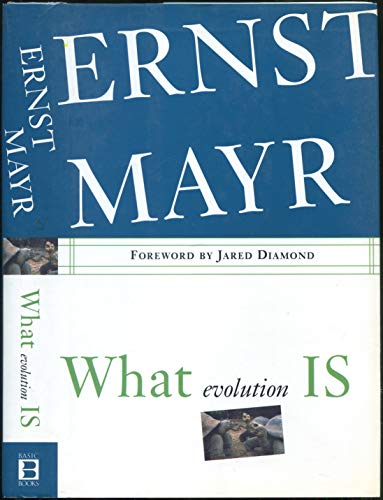
Synopsis
At once a spirited defense of Darwinian explanations of biology and an elegant primer on evolution for the general reader, What Evolution Is has several audiences in mind: those scientists and nonscientists who accept evolutionary thinking but do not know exactly how it works, and those who accept evolution but are not sure the Darwinian explanation is correct.With rare clarity, Mayr poses the questions at the heart of evolution-What is the evidence for evolution on earth? What is the origin and role of organic diversity?-and describes in refreshingly nontechnical language how the search for answers has over the years revealed solutions to the most challenging problems posed by evolutionary theory. In a provocative final section, Mayr considers how our improved understanding of evolution has affected the viewpoints and values of modern man.
"synopsis" may belong to another edition of this title.
About the Author
Ernst Mayr is largely responsible for shaping the modern synthesis of genetic and evolutionary theory. He was Curator of the Whitney-Rothschild Collection at the American Museum of Natural History for more than twenty years before joining the zoology department at Harvard University, where he is now Professor Emeritus. He lives in the Boston area.
Reviews
At age 97, Ernst Mayr is one of the most influential scientists of the 20th century, and here he delivers yet another valuable addition to the field of evolutionary theory. Mayr, who was also a curator at the American Museum of Natural History for two decades, guides lay readers through evolutionary thought from the book of Genesis and creationist theory through Darwin's theories and "soft" evolution and on to more contemporary, inclusive concepts. He takes readers on a whirlwind voyage from the scala naturae (the Great Chain of Being, in which everything in the world was accorded a position in a developmental hierarchy) to Mayr's own work, which builds on Darwinian theory and environmental factors. No one but Mayr could explain evolution so well, and though the text is peppered with many scientific terms, overall the author is triumphant in his goal to teach "first and foremost... biologist or not, [anyone] who simply wants to know more about evolution." While many authors suggest their tomes are the authoritative source, Mayr remains humble, reminding readers that "many details remain controversial." And the combination of his expertise, his elegant prose and the sheer pleasure of so many enthralling facts (the 145-million-year-old Archaeopteryx is a near perfect link between reptiles and birds, for example) means that studying the fossil record has rarely been so absorbing. Appendixes answer FAQs and respond to various objections to evolutionary theory, while a glossary offers entries from acoelomate to zygote.
Copyright 2001 Cahners Business Information, Inc.
"What I have aimed for," Mayr writes, "is an elementary volume that stresses principles and does not get lost in detail." What the reader gets from this giant in the field of evolutionary biology is a fine basic account of the developing understanding of evolution from ancient times to the present. Mayr presents a spirited defense of Darwinian explanations of biology as well as confronting the reductionist approach that tries to focus all evolutionary phenomena on the gene; he shows instead that evolution must consider two crucial units--the individual and populations. Mayr, professor emeritus of zoology at Harvard University, asserts that the term "evolutionary theory" should be abandoned. Evolution, he says, "is a fact so overwhelmingly established that it has become irrational to call it a theory."
Editors of Scientific American
*Starred Review* Almost 150 years after Origin of Species, the edifice of evolutionary science still rests securely on the foundation Darwin laid. A pioneer in using modern genetics to enlarge that science, Mayr guides his readers through the entire evolutionary structure, from paleontology to chromosomal chronology. But what will perhaps most surprise nonspecialists is not the latest research but rather the astonishing durability of Darwin's original theory. Indeed, it will come as news to most readers that Darwin's theory--actually a composite of five theories--won complete acceptance only in the second Darwinian revolution of the 1940s, when scientists finally rejected evolutionary discontinuities in favor of gradual change in biopopulations. Since that belated second revolution, biologists have acquired powerful new tools for peering into evolutionary transformations at the molecular level. Yet in Mayr's marvelously lucid explanations of these recent advances, he fits everything within the sturdy premises of the Darwinian paradigm. But for all of the enduring explanatory power of Darwinism, Mayr still confronts stubborn mysteries: Why, for instance, do living fossils (like the horseshoe crabs) not evolve? And how did high intelligence and idealistic altruism appear among those strange creatures called humans? The general reader will find no better guide to evolutionary thought. Bryce Christensen
Copyright © American Library Association. All rights reserved
Mayr (emeritus, Harvard Univ.; This Is Biology) has written a clear, comprehensive, and very informative introduction to the theory of evolution. He offers major insights into taxonomy, adaptation, common descent, biodiversity, and those mechanisms of organic evolution that result in the process of speciation. His analysis points out important contributions that molecular biology and population thinking have made to both understanding and appreciating modern Darwinism. Mayr stresses that an individual organism is the unit of natural selection, while a population is the unit of biological evolution. He rejects essentialism (typology), creationism, and teleology (orthogenesis) and gives much attention to the various aspects of macroevolution. Other topics discussed include extinction, mosaic evolution, exobiology, and the roles that both chance and necessity play in organic evolution. Of special interest is a chapter on human evolution. Mayr presents the empirical evidence substantiating hominid evolution, as well as the most recent scientific interpretation for the emergence of our species over the past five million years from an apelike ancestral group in Africa. This significant contribution to science will be of enormous value to anyone interested in evolution. Strongly recommended for all academic and public library science collections. H. James Birx, Canisius Coll., Buffalo, NY
Copyright 2001 Reed Business Information, Inc.
"About this title" may belong to another edition of this title.
Search results for What Evolution Is

Stock Image
What Evolution is
Seller: World of Books (was SecondSale), Montgomery, IL, U.S.A.
Seller rating 5 out of 5 stars

Hardback. Condition: Good. At once a spirited defense of Darwinian explanations of biology and an elegant primer on evolution for the general reader, What Evolution Is has several audiences in mind: those scientists and nonscientists who accept evolutionary thinking but do not know exactly how it works, and those who accept evolution but are not sure the Darwinian explanation is correct.With rare clarity, Mayr poses the questions at the heart of evolution-What is the evidence for evolution on earth? What is the origin and role of organic diversity?-and describes in refreshingly nontechnical language how the search for answers has over the years revealed solutions to the most challenging problems posed by evolutionary theory. In a provocative final section, Mayr considers how our improved understanding of evolution has affected the viewpoints and values of modern man. Seller Inventory # 00106323849
Seller Image
What Evolution Is (Science Masters Series)
Seller: Zoom Books East, Glendale Heights, IL, U.S.A.
Seller rating 5 out of 5 stars
Condition: very_good. Book is in very good condition and may include minimal underlining highlighting. The book can also include "From the library of" labels. May not contain miscellaneous items toys, dvds, etc. . We offer 100% money back guarantee and 24 7 customer service. Seller Inventory # ZEV.0465044255.VG
Seller Image
What Evolution Is
Seller: Greenworld Books, Arlington, TX, U.S.A.
Seller rating 5 out of 5 stars
Condition: very_good. Fast Free Shipping â" Very Good condition book with a firm cover and clean pages. Shows normal use and some light wear or limited notes markings. A solid, nice copy to enjoy. Seller Inventory # GWV.0465044255.VG
Stock Image
What Evolution is
Seller: World of Books Inc, Montgomery, IL, U.S.A.
Seller rating 4 out of 5 stars

Hardback. Condition: Good. At once a spirited defense of Darwinian explanations of biology and an elegant primer on evolution for the general reader, What Evolution Is has several audiences in mind: those scientists and nonscientists who accept evolutionary thinking but do not know exactly how it works, and those who accept evolution but are not sure the Darwinian explanation is correct.With rare clarity, Mayr poses the questions at the heart of evolution-What is the evidence for evolution on earth? What is the origin and role of organic diversity?-and describes in refreshingly nontechnical language how the search for answers has over the years revealed solutions to the most challenging problems posed by evolutionary theory. In a provocative final section, Mayr considers how our improved understanding of evolution has affected the viewpoints and values of modern man. Seller Inventory # CIN0465044255G
Stock Image
What Evolution Is
Published by
Basic Books, 2001
ISBN 10: 0465044255
ISBN 13: 9780465044252
Used
Hardcover
First Edition
Seller: Better World Books, Mishawaka, IN, U.S.A.
Seller rating 5 out of 5 stars
Condition: Very Good. First Edition. Former library copy. Pages intact with possible writing/highlighting. Binding strong with minor wear. Dust jackets/supplements may not be included. Includes library markings. Stock photo provided. Product includes identifying sticker. Better World Books: Buy Books. Do Good. Seller Inventory # 5543817-75
Stock Image
What Evolution Is
Published by
Basic Books, 2001
ISBN 10: 0465044255
ISBN 13: 9780465044252
Used
Hardcover
First Edition
Seller: Better World Books, Mishawaka, IN, U.S.A.
Seller rating 5 out of 5 stars
Condition: Good. First Edition. Pages intact with minimal writing/highlighting. The binding may be loose and creased. Dust jackets/supplements are not included. Stock photo provided. Product includes identifying sticker. Better World Books: Buy Books. Do Good. Seller Inventory # 4063173-6
Stock Image
What Evolution Is (Science Masters Series)
Seller: Wonder Book, Frederick, MD, U.S.A.
Seller rating 5 out of 5 stars
Condition: Very Good. Very Good condition. Very Good dust jacket. A copy that may have a few cosmetic defects. May also contain light spine creasing or a few markings such as an owner's name, short gifter's inscription or light stamp. Seller Inventory # B19B-03086
Stock Image
What Evolution Is (Science Masters Series)
Seller: Wonder Book, Frederick, MD, U.S.A.
Seller rating 5 out of 5 stars
Condition: Good. Good condition. Very Good dust jacket. A copy that has been read but remains intact. May contain markings such as bookplates, stamps, limited notes and highlighting, or a few light stains. Seller Inventory # D07P-01200
Stock Image
What Evolution Is
Seller: ThriftBooks-Phoenix, Phoenix, AZ, U.S.A.
Seller rating 5 out of 5 stars
Hardcover. Condition: Very Good. No Jacket. May have limited writing in cover pages. Pages are unmarked. ~ ThriftBooks: Read More, Spend Less. Seller Inventory # G0465044255I4N00
Stock Image
What Evolution Is
Seller: ThriftBooks-Reno, Reno, NV, U.S.A.
Seller rating 5 out of 5 stars
Hardcover. Condition: Good. No Jacket. Pages can have notes/highlighting. Spine may show signs of wear. ~ ThriftBooks: Read More, Spend Less. Seller Inventory # G0465044255I3N00