
Items related to Yellow Jack: How Yellow Fever Ravaged America and Walter...
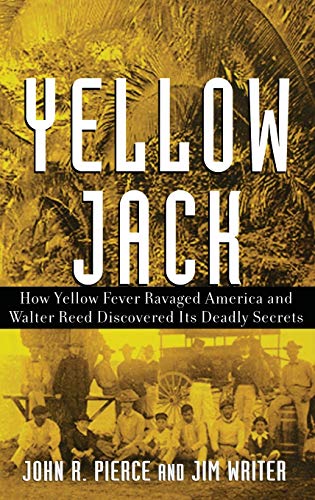
Yellow Jack: How Yellow Fever Ravaged America and Walter Reed Discovered Its Deadly Secrets - Hardcover
Synopsis
The end of a scourge
"The prayer that has been mine for twenty years, that I might be permitted in some way or some time to do something to alleviate human suffering, has been answered!"
--Major Walter Reed, writing to his wife, New Year's Eve, 1900
As he wrote to his wife of his stunning success in the mission to identify the cause of yellow fever and find a way to eradicate the disease, Walter Reed had answered the prayers of millions. For more than 250 years, the yellow jack had ravaged the Americas, bringing death to millions and striking panic in entire populations. The very mention of its presence in a city or town produced instant chaos as thousands fled in terror, leaving the frail, the weak, and the ill to fend for themselves.
Yellow Jack tracks the history of this deadly scourge from its earliest appearance in the Caribbean 350 years ago, telling the compelling story of a few extraordinarily brave souls who struggled to understand and eradicate yellow fever. Risking everything for the cause of science and humanity, Reed and his teammates on the U.S. Army Yellow Fever Board invaded the heart of enemy territory in Cuba to pursue the disease--and made one of the twentieth century's greatest medical discoveries. This thrilling adventure tells the timeless tale of their courage, ingenuity, and triumph in the face of adversity.
"synopsis" may belong to another edition of this title.
About the Author
JOHN R. PIERCE, M.D. (Col. MC, U.S. Army, Ret.), wrote the series of articles on which this book is based for Stripe, a publication for Walter Reed Army Medical Center (WRAMC) personnel and included on dcmilitary.com, a Web site for military personnel in the Washington, D.C., area. Pierce recently retired after thirty years of active duty, a significant portion of that spent at WRAMC. With Pierce, JIM WRITER coedited a supplement to the journal Military Medicine on the 1900 Yellow Fever Board.
From the Back Cover
The end of a scourge
"The prayer that has been mine for twenty years, that I might be permitted in some way or some time to do something to alleviate human suffering, has been answered!"
―Major Walter Reed, writing to his wife, New Year's Eve, 1900
As he wrote to his wife of his stunning success in the mission to identify the cause of yellow fever and find a way to eradicate the disease, Walter Reed had answered the prayers of millions. For more than 250 years, the yellow jack had ravaged the Americas, bringing death to millions and striking panic in entire populations. The very mention of its presence in a city or town produced instant chaos as thousands fled in terror, leaving the frail, the weak, and the ill to fend for themselves.
Yellow Jack tracks the history of this deadly scourge from its earliest appearance in the Caribbean 350 years ago, telling the compelling story of a few extraordinarily brave souls who struggled to understand and eradicate yellow fever. Risking everything for the cause of science and humanity, Reed and his teammates on the U.S. Army Yellow Fever Board invaded the heart of enemy territory in Cuba to pursue the disease―and made one of the twentieth century's greatest medical discoveries. This thrilling adventure tells the timeless tale of their courage, ingenuity, and triumph in the face of adversity.
From the Inside Flap
Like wars and natural disasters, epidemics tend to bring out both the best and the worst in people. Throughout most of its two-and-a-half-century killing spree across North America, yellow fever brought out only the worst. Characterized by seemingly random outbreaks that attacked people of all ages and walks of life, this excruciatingly painful and violent disease spread panic and chaos in communities that had weathered smallpox, typhoid, and other deadly epidemics with relative calm. Those who could run fled in every direction; parents abandoned infected children; friends and relatives shunned each other; businesses failed; governments collapsed; and thousands died in solitary agony with no one to care for them.
Yellow Jack tracks the history of this deadly scourge from its earliest appearance in the Caribbean 350 years ago, telling the remarkable and triumphant story of a few extraordinarily brave souls who brought their very best to the battle against yellow fever.
Based in large part on a massive body of research collected by Dr. Philip S. Hench, this thrilling medical adventure follows the exploits of the four-member U.S. Army Yellow Fever Board, led by U.S. Army major and physician Walter Reed. In the aftermath of the Spanish American War, the team assembled in Cuba long believed to be the fount of yellow fever on one of the most dangerous missions in medical history.
Risking not only their own lives, but also those of the many volunteers who agreed to be infected with the virus, the team devised a series of elegantly simple experiments to pursue the disease as far as the science and technology of the era would allow. During their short stay in Cuba, these intrepid researchers overturned the leading theories of the day on the cause, spread, and control of yellow fever; they also presented sound new theories that were proven very quickly in practical application. By the end of 1901, Havana was free of yellow fever for the first time in a hundred years. By 1905, the disease was banished from both Cuba and the United States.
Every victory has its costs as well as its triumphs. One Army Board member was killed in action by yellow fever; another was severely wounded by the disease. One was soon forgotten by history, while another became an enduring symbol of the can-do American military and medical men so revered in the early twentieth century. Yellow Jack is a testament to both their tragic sacrifices and their stunning accomplishments.
Reviews
There isn't much new in this workmanlike examination of yellow fever, which focuses on the American impact of this deadly hemorrhagic disease closely related to the West Nile virus. While mostly a tropical disease, yellow fever reached as far north as Philadelphia in 1793. But particularly in the South, deadly plagues were the norm year after year. Pierce, a physician and retired colonel with the U.S. Army, and coauthor Writer describe the debates over the cause of the disease, which many thought originated in the Caribbean, and the work to determine the mode of transmission. In 1900, after the Spanish-American War, Walter Reed headed the Yellow Fever Board sent to Havana and rather quickly confirmed earlier suspicions that mosquitoes were responsible; in remarkably short order the board rid the entire island of yellow fever. But the disease's virulence and the harsh working conditions threatened the researchers themselves. The authors explain this in their hyperbolic style: "Eight loyal and fearless soldiers in the war against an invisible foe had, in the noblest sentiments of the profession, died in hopes of saving others.... [N]o other virus in the history of laboratory research has taken away so many of those working to solve its mysteries." B&w illus. (Apr.)
Copyright © Reed Business Information, a division of Reed Elsevier Inc. All rights reserved.
From the first time an illness with symptoms like those of yellow fever was reported in the Spanish stronghold at Yucatan and spreading to Havana, Cuba, reduced its population by a third, it took nearly 300 years to pinpoint the cause of that fatal disease. The long effort suffered not from want of trying, according to U.S. Army physician Pierce. Some of the most notable medical minds of their times, including the renowned Benjamin Rush, tackled the puzzle with negligible success. Stubbornly perennial as summer heat, yellow fever continued to wreak havoc in U.S. cities from Philadelphia to New Orleans. Despite the connection French physician Louis Daniel Beauperthuy made in the mid-nineteenth century between yellow fever and mosquitoes, not until after the Spanish-American War did Major Walter Reed and his medical team make serious inroads into cause and cure. Based upon a series of articles Pierce penned for a military medical journal, this chronicle of the rise and eventual fall of yellow fever traces a substantial medical history. Donna Chavez
Copyright © American Library Association. All rights reserved
"About this title" may belong to another edition of this title.
Search results for Yellow Jack: How Yellow Fever Ravaged America and Walter...

Stock Image
Yellow Jack : How Yellow Fever Ravaged America and Walter Reed Discovered Its Deadly Secrets
Published by
Wiley & Sons, Incorporated, John, 2005
ISBN 10: 0471472611
ISBN 13: 9780471472612
Used
Hardcover
Seller: Better World Books, Mishawaka, IN, U.S.A.
Seller rating 5 out of 5 stars

Condition: Good. Former library copy. Pages intact with minimal writing/highlighting. The binding may be loose and creased. Dust jackets/supplements are not included. Includes library markings. Stock photo provided. Product includes identifying sticker. Better World Books: Buy Books. Do Good. Seller Inventory # 2351587-6
Stock Image
Yellow Jack : How Yellow Fever Ravaged America and Walter Reed Discovered Its Deadly Secrets
Published by
Wiley & Sons, Incorporated, John, 2005
ISBN 10: 0471472611
ISBN 13: 9780471472612
Used
Hardcover
Seller: Better World Books, Mishawaka, IN, U.S.A.
Seller rating 5 out of 5 stars
Condition: Very Good. Pages intact with possible writing/highlighting. Binding strong with minor wear. Dust jackets/supplements may not be included. Stock photo provided. Product includes identifying sticker. Better World Books: Buy Books. Do Good. Seller Inventory # 9799344-6
Stock Image
Yellow Jack : How Yellow Fever Ravaged America and Walter Reed Discovered Its Deadly Secrets
Published by
Wiley & Sons, Incorporated, John, 2005
ISBN 10: 0471472611
ISBN 13: 9780471472612
Used
Hardcover
Seller: Better World Books: West, Reno, NV, U.S.A.
Seller rating 5 out of 5 stars
Condition: Good. Former library copy. Pages intact with minimal writing/highlighting. The binding may be loose and creased. Dust jackets/supplements are not included. Includes library markings. Stock photo provided. Product includes identifying sticker. Better World Books: Buy Books. Do Good. Seller Inventory # 2351587-6
Stock Image
Yellow Jack: How Yellow Fever Ravaged America and Walter Reed Discovered Its Deadly Secrets
Seller: ThriftBooks-Atlanta, AUSTELL, GA, U.S.A.
Seller rating 5 out of 5 stars
Hardcover. Condition: Very Good. No Jacket. May have limited writing in cover pages. Pages are unmarked. ~ ThriftBooks: Read More, Spend Less. Seller Inventory # G0471472611I4N00
Stock Image
Yellow Jack: How Yellow Fever Ravaged America and Walter Reed Discovered Its Deadly Secrets
Seller: ThriftBooks-Atlanta, AUSTELL, GA, U.S.A.
Seller rating 5 out of 5 stars
Hardcover. Condition: Very Good. No Jacket. Former library book; May have limited writing in cover pages. Pages are unmarked. ~ ThriftBooks: Read More, Spend Less. Seller Inventory # G0471472611I4N10
Stock Image
Yellow Jack: How Yellow Fever Ravaged America and Walter Reed Discovered Its Deadly Secrets
Seller: ThriftBooks-Atlanta, AUSTELL, GA, U.S.A.
Seller rating 5 out of 5 stars
Hardcover. Condition: Fair. No Jacket. Readable copy. Pages may have considerable notes/highlighting. ~ ThriftBooks: Read More, Spend Less. Seller Inventory # G0471472611I5N00
Stock Image
Yellow Jack: How Yellow Fever Ravaged America and Walter Reed Discovered Its Deadly Secrets
Seller: Ocean Books, Dacula, GA, U.S.A.
Seller rating 5 out of 5 stars
Hardcover. Condition: Good. Good ex-library book with protective plastic cover. Stamps and stickers on inside front cover and front fly leaf. Stamps on title page, dedication page, outer page edges, and inside back cover. Sticker on spine under plastic. Seller Inventory # 052422074
Seller Image
Yellow Jack: How Yellow Fever Ravaged America and Walter Reed Discovered Its Deadly Secrets
Seller: Shakespeare Book House, Rockford, IL, U.S.A.
Seller rating 5 out of 5 stars
Condition: new. Seller Inventory # EBBV.0471472611.N
Seller Image
Yellow Jack : How Yellow Fever Ravaged America And Walter Reed Discovered Its Deadly Secrets
Seller: GreatBookPrices, Columbia, MD, U.S.A.
Seller rating 5 out of 5 stars
Condition: New. Seller Inventory # 1690856-n
Stock Image
Yellow Jack: How Yellow Fever Ravaged America and Walter Reed Discovered Its Deadly Secrets
Seller: Sequitur Books, Boonsboro, MD, U.S.A.
Seller rating 5 out of 5 stars
hardcover. Condition: New. Hardcover and dust jacket. Good binding and cover. Clean, unmarked pages. Seller Inventory # 2603300043