Synopsis
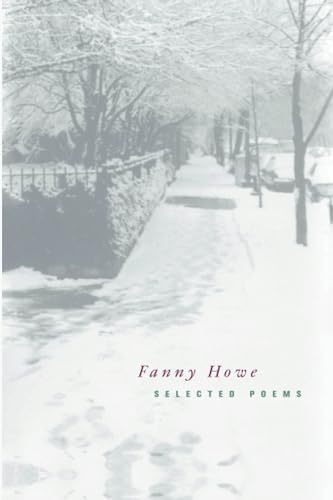
One of the best and most respected experimental poets in the United States, Fanny Howe has published more than twenty books, mostly with small presses, and this publication of her selected poems is a major event.
Howe's theme is the exile of the spirit in this world and the painfully exciting, tiny margin in which movement out of exile is imaginable and perhaps possible. Her best poems are simultaneously investigations of that possibility and protests against the difficulty of salvation.
Boston is the setting of some of the early poems, and Ireland, the birthplace of Howe's mother, is the home of O'Clock, a spiritually piquant series of short poems included in Selected Poems.
The metaphysics and the physics of this world play off each other in these poems, and there is a toughness to Howe's unique, fertile nervousness of spirit. Her spare style makes a nest for the soul:
Zero built a nest
in my navel. Incurable
Longing. Blood too―
From violent actions
It's a nest belonging to one
But zero uses it
And its pleasure is its own
―from The Quietist
"synopsis" may belong to another edition of this title.
About the Author
Fanny Howe is Professor of Writing and Literature at the University of California, San Diego. She is the author of more than twenty books of fiction and poetry (most recently, One Crossed Out, 1997).
From the Back Cover
"Fanny Howe's strangely hushed but busy landscape keeps leading us into it until we realize we're lost but wouldn't want to be anywhere else. This book is a strange joy."―John Ashbery
"This complexly articulate writer uses poetry as a final resource. All the authority of her power becomes explicit in these poems, the musing, twisting thoughts and persons woven into a meld of great force and beauty. This is life if it could speak. Here it does."―Robert Creeley
"Fanny Howe is a sly, wicked poet, always shifting between the social, the political, as well as the linguistic and literary concerns of an artist always writing from the cutting edge."―Quincy Troupe
"Fanny Howe is the closest thing to Emily Dickinson since Dickinson herself. These taut and sometimes witty poems are centripetal; they inscribe moments of a spiritual and psychological quest, word by packed word, image by edged image."―Albert Gelpi, Stanford University
"Fanny Howe writes against the grain of language and the mind. These serial works, collected from a lifetime's steady contemplation, weave piece by piece a texture of such difficulty. Most religious poetry stands on faith, emotion, or certainty; Howe's work begins and ends with questions, and immense interiority in the shape of the physical world itself."―Norman Fischer, Co-abbot, San Francisco Zen Center
"Fanny Howe employs a sometimes fierce, always passionate, spareness in her lifelong parsing of the exchange between matter and spirit. Her work displays as well a political urgency, that is to say, a profound concern for social justice and for the soundness and fate of the polis, the ‘city on a hill.’ Writes Emerson, ‘The poet is the sayer, the namer, and represents beauty.’ Here’s the luminous and incontrovertible proof." ―Michael Palmer, author of The Lion Bridge
From the Inside Flap
"Fanny Howe's strangely hushed but busy landscape keeps leading us into it until we realize we're lost but wouldn't want to be anywhere else. This book is a strange joy." John Ashbery
"This complexly articulate writer uses poetry as a final resource. All the authority of her power becomes explicit in these poems, the musing, twisting thoughts and persons woven into a meld of great force and beauty. This is life if it could speak. Here it does." Robert Creeley
"Fanny Howe is a sly, wicked poet, always shifting between the social, the political, as well as the linguistic and literary concerns of an artist always writing from the cutting edge." Quincy Troupe
"Fanny Howe is the closest thing to Emily Dickinson since Dickinson herself. These taut and sometimes witty poems are centripetal; they inscribe moments of a spiritual and psychological quest, word by packed word, image by edged image." Albert Gelpi, Stanford University
"Fanny Howe writes against the grain of language and the mind. These serial works, collected from a lifetime's steady contemplation, weave piece by piece a texture of such difficulty. Most religious poetry stands on faith, emotion, or certainty; Howe's work begins and ends with questions, and immense interiority in the shape of the physical world itself." Norman Fischer, Co-abbot, San Francisco Zen Center
"Fanny Howe employs a sometimes fierce, always passionate, spareness in her lifelong parsing of the exchange between matter and spirit. Her work displays as well a political urgency, that is to say, a profound concern for social justice and for the soundness and fate of the polis, the city on a hill. Writes Emerson, The poet is the sayer, the namer, and represents beauty. Here s the luminous and incontrovertible proof." Michael Palmer, author of The Lion Bridge
"This complexly articulate writer uses poetry as a final resource. All the authority of her power becomes explicit in these poems, the musing, twisting thoughts and persons woven into a meld of great force and beauty. This is life if it could speak. Here it does." Robert Creeley
"Fanny Howe is a sly, wicked poet, always shifting between the social, the political, as well as the linguistic and literary concerns of an artist always writing from the cutting edge." Quincy Troupe
"Fanny Howe is the closest thing to Emily Dickinson since Dickinson herself. These taut and sometimes witty poems are centripetal; they inscribe moments of a spiritual and psychological quest, word by packed word, image by edged image." Albert Gelpi, Stanford University
"Fanny Howe writes against the grain of language and the mind. These serial works, collected from a lifetime's steady contemplation, weave piece by piece a texture of such difficulty. Most religious poetry stands on faith, emotion, or certainty; Howe's work begins and ends with questions, and immense interiority in the shape of the physical world itself." Norman Fischer, Co-abbot, San Francisco Zen Center
"Fanny Howe employs a sometimes fierce, always passionate, spareness in her lifelong parsing of the exchange between matter and spirit. Her work displays as well a political urgency, that is to say, a profound concern for social justice and for the soundness and fate of the polis, the city on a hill. Writes Emerson, The poet is the sayer, the namer, and represents beauty. Here s the luminous and incontrovertible proof." Michael Palmer, author of The Lion Bridge
Reviews
The author of more than 20 books of poetry and fiction, Howe is here revealed to be working out a project of enormous consistence, clarity and grace. In 16 serial poems culled from small-press releases over the last 20-plus years, Howe (One Crossed-Out, etc.) has staked out an idiom that permits an impressive range of experience to enter the simple church-like structures of the poems, allowing them to move back and forth between a transparent self and ideas of transcendence: "Every glance works its way to infinity./ But blue eyes don't make blue sky./ Outside a grey washed world, snow all diffused into steam/ and glaucoma. My vagabondage/ is unlonelined by poems." A religious metaphor is not inapt, as several of the poems directly concern or address a God, but do so with a mix of archaism and skepticism that purposefully makes the distance too big to bridge fully, as in "The Quietist": "Mad God, mad thought/ Take me for a walk/ Stalk me. Made God,/ Wake me with your words./ Believe in what I said." A feminist thinking-through drives poems like "Conclusively" ("I was eliminated as a locus of mothering") and "The Vineyard," which contemplates indentured servitude, "a workplace torn by a union" and how "Love's body and mouth lie down together/ It's hidden parts soft inside." "The Sea-Garden" looks autobiographically back to childhood, where "hottentot figs/ Burst green water." Sensuous and intellectual pleasures commingle beautifully here, showing most recent conventional lyric to be sorely lacking in imagination. This collection should bring Howe the readership she deserves. (Apr.)
Copyright 2000 Reed Business Information, Inc.
"About this title" may belong to another edition of this title.
Other Popular Editions of the Same Title

Search results for Selected Poems of Fanny Howe (New California Poetry)...

Stock Image
Selected Poems of Fanny Howe (New California Poetry) (Volume 3)
Published by
University of California Press, 2000
ISBN 10: 0520222636
ISBN 13: 9780520222632
Used
paperback
Seller: New Legacy Books, Annandale, NJ, U.S.A.
Seller rating 5 out of 5 stars

paperback. Condition: Very Good. Fast shipping and order satisfaction guaranteed. A portion of your purchase benefits Non-Profit Organizations, First Aid and Fire Stations! Seller Inventory # 5FSZKH0018RC
Stock Image
Selected Poems (New California Poetry, 3)
Published by
University of California Press, 2000
ISBN 10: 0520222636
ISBN 13: 9780520222632
Used
Paperback
Seller: Bookmans, Tucson, AZ, U.S.A.
Seller rating 5 out of 5 stars
Paperback. Condition: Good. . Satisfaction 100% guaranteed. Seller Inventory # mon0002703313
Stock Image
Selected Poems
Published by
University of California Press, 2000
ISBN 10: 0520222636
ISBN 13: 9780520222632
Used
Paperback
Seller: ThriftBooks-Dallas, Dallas, TX, U.S.A.
Seller rating 5 out of 5 stars
Paperback. Condition: Good. No Jacket. Pages can have notes/highlighting. Spine may show signs of wear. ~ ThriftBooks: Read More, Spend Less. Seller Inventory # G0520222636I3N00
Stock Image
Selected Poems of Fanny Howe (New California Poetry) (Volume 3)
Published by
University of California Press, 2000
ISBN 10: 0520222636
ISBN 13: 9780520222632
Used
paperback
Seller: mountain, GEORGETOWN, CO, U.S.A.
Seller rating 5 out of 5 stars
paperback. Condition: Good. softcover book light wear to cover and book edges, has some light reader wear. Seller Inventory # mon0000011243
Stock Image
Selected Poems of Fanny Howe (New California Poetry) (Volume 3)
Published by
University of California Press, 2000
ISBN 10: 0520222636
ISBN 13: 9780520222632
Used
Softcover
First Edition
Seller: Ika'kimaa Books and More, Lethbridge, AB, Canada
Seller rating 4 out of 5 stars

Seller Inventory # ABE-1764208080299
Seller Image
Selected Poems of Fanny Howe
Published by
University of California Press, 2000
ISBN 10: 0520222636
ISBN 13: 9780520222632
New
Softcover
Seller: GreatBookPrices, Columbia, MD, U.S.A.
Seller rating 5 out of 5 stars
Condition: New. Seller Inventory # 435045-n
Seller Image
Selected Poems (Paperback or Softback)
Published by
University of California Press 4/11/2000, 2000
ISBN 10: 0520222636
ISBN 13: 9780520222632
New
Paperback or Softback
Seller: BargainBookStores, Grand Rapids, MI, U.S.A.
Seller rating 5 out of 5 stars
Paperback or Softback. Condition: New. Selected Poems. Book. Seller Inventory # BBS-9780520222632
Stock Image
Selected Poems of Fanny Howe (New California Poetry) (Volume 3)
Published by
University of California Press, 2000
ISBN 10: 0520222636
ISBN 13: 9780520222632
New
Softcover
Seller: Lucky's Textbooks, Dallas, TX, U.S.A.
Seller rating 5 out of 5 stars
Condition: New. Seller Inventory # ABLIING23Feb2215580232451
Stock Image
Selected Poems of Fanny Howe (New California Poetry) (Volume 3)
Published by
University of California Press, 2000
ISBN 10: 0520222636
ISBN 13: 9780520222632
New
Softcover
Seller: California Books, Miami, FL, U.S.A.
Seller rating 5 out of 5 stars
Condition: New. Seller Inventory # I-9780520222632
Seller Image
Selected Poems of Fanny Howe
Published by
University of California Press, 2000
ISBN 10: 0520222636
ISBN 13: 9780520222632
Used
Softcover
Seller: GreatBookPrices, Columbia, MD, U.S.A.
Seller rating 5 out of 5 stars
Condition: As New. Unread book in perfect condition. Seller Inventory # 435045