Items related to Peterson Reference Guide To Molt In North American...
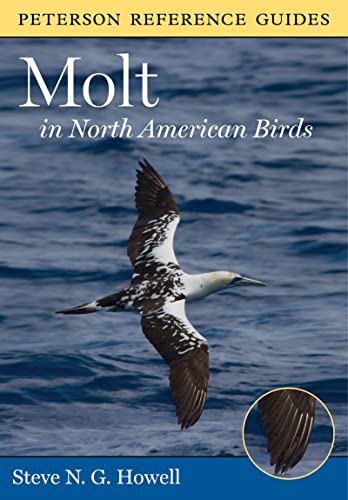

To most observers, molt seems an overwhelming subject. But birders use many aspects of molt more than they realize to distinguish juvenile birds from adults, to pick out an individual hummingbird from among dozens visiting a feeder, and much more. For those whose interest goes beyond simply identifying birds, questions such as What triggers molt to start? How fast do feathers grow? and How long do they last? offer a fascinating window into the lives of birds. Put plainly, molt relates in some way to everything a bird does, including where it lives, what it eats, and how far it migrates. Here, for the first time, molt is presented for the nonscientist. Molt is very orderly and built on only four underlying strategies: simple basic, complex basic, simple alternate, and complex alternate. This book clearly lays out these strategies, relates them to aspects of life history, such as habitat and migration, and makes this important subject accessible. 0.80 inches tall x 7.30 inches long x 10.20 inches wide
"synopsis" may belong to another edition of this title.
Review:
Product Description
To most observers,molt seems an overwhelming subject. But birders use many aspects of molt more than they realize--to distinguish juvenile birds from adults, to pick out an individual hummingbird from among dozens visiting a feeder, and much more. And for those whose interest goes beyond simply identifying birds, questions such as What triggers molt to start? How fast do feathers grow? and How long do they last? offer a fascinating window into the lives of birds. Put plainly, molt relates in some way to everything a bird does, including where it lives, what it eats, and how far it migrates. Here, for the first time, molt is presented for the nonscientist. Molt is very orderly and built on only four underlying strategies: simple basic, complex basic, simple alternate, and complex alternate. This book clearly lays out these strategies, relates them to aspects of life history, such as habitat and migration, and makes this important subject accessible.
From the Inside Flap:
To most observers,molt seems an overwhelming subject. But birders use many aspects of molt more than they realize--to distinguish juvenile birds from adults, to pick out an individual hummingbird from among dozens visiting a feeder, and much more. And for those whose interest goes beyond simply identifying birds, questions such as What triggers molt to start? How fast do feathers grow? and How long do they last? offer a fascinating window into the lives of birds. Put plainly, molt relates in some way to everything a bird does, including where it lives, what it eats, and how far it migrates. Here, for the first time, molt is presented for the nonscientist. Molt is very orderly and built on only four underlying strategies: simple basic, complex basic, simple alternate, and complex alternate. This book clearly lays out these strategies, relates them to aspects of life history, such as habitat and migration, and makes this important subject accessible.
A Look Inside Peterson Reference Guide to Molt in North American Birds
(Click on Images to Enlarge)
| Notice the long “breeding plumes” on this adult Great Egret. (Marin County, CA, 15 Mar. 2008) | The bright red epaulettes of a male Red-winged Blackbird are used for display. (Marin County, CA, 13 Mar. 2008) | A Greater Sage-Grouse male showing the limited prealternate molt of head and neck feathers. (Jackson County, CO, 26 Apr. 2008) |
| The scapulars on this first-cycle Double-crested Cormorant cover the joint between the wings and the body. (Sonoma County, CA, 23 Dec. 2008) | The wirelike tail streamers of a Red-tailed Tropicbird require almost 6 months to reach their full length. (Norfolk Island, Australia, 29 Mar. 2007) | A Snail Kite hawk showing stepwise waves of wing molt. (Nayarit, Mexico, 15 Jan. 2007) |
Feathers are an integral part of birds’ lives. They cover and protect a bird; signal a bird’s sex, age, and breeding status; and enable it to fly. But feathers don’t last forever, and they need to be replaced by a process known as molt. Molt can seem like an intimidating topic but really it isn’t. Even though birds have evolved many ways of balancing when and where to molt with other aspects of their life history, their molting patterns are actually very orderly and built upon only four underlying strategies: simple basic, complex basic, simple alternate, and complex alternate. The Peterson Reference Guide to Molt in North American Birds clearly explains the molting strategies of each family of birds, using beautiful, large photographs to illustrate and simplify this important and useful tool in bird identification. Armed with a new understanding and appreciation for molt, birders can improve their skills with any number of species. Beyond identification, birds’ molting patterns reflect factors such as their habitat, food, clutch size, migration distance, and body size, and offer a novel window through which to view the remarkable lives of birds.
"About this title" may belong to another edition of this title.
- PublisherMariner Books
- Publication date2010
- ISBN 10 0547152353
- ISBN 13 9780547152356
- BindingHardcover
- Edition number1
- Number of pages280
- Rating
Buy New
Learn more about this copy
US$ 153.49
Shipping:
US$ 4.00
Within U.S.A.
Top Search Results from the AbeBooks Marketplace
Stock Image
Peterson Reference Guide To Molt In North American Birds (Peterson Reference Guides)
Published by
Mariner Books
(2010)
ISBN 10: 0547152353
ISBN 13: 9780547152356
New
Hardcover
Quantity: 1
Seller:
Rating

Book Description Hardcover. Condition: new. New. Fast Shipping and good customer service. Seller Inventory # Holz_New_0547152353
Buy New
US$ 153.49
Convert currency
Stock Image
Peterson Reference Guide To Molt In North American Birds (Peterson Reference Guides)
Published by
Mariner Books
(2010)
ISBN 10: 0547152353
ISBN 13: 9780547152356
New
Hardcover
Quantity: 1
Seller:
Rating
Book Description Hardcover. Condition: new. New. Seller Inventory # Wizard0547152353
Buy New
US$ 154.98
Convert currency
Stock Image
Peterson Reference Guide To Molt In North American Birds (Peterson Reference Guides)
Published by
Peterson Books
(2010)
ISBN 10: 0547152353
ISBN 13: 9780547152356
New
Hardcover
Quantity: 1
Seller:
Rating
Book Description Condition: new. Seller Inventory # FrontCover0547152353
Buy New
US$ 154.24
Convert currency
Stock Image
Molt in North American Birds (Peterson Reference Guides)
Published by
Houghton Mifflin Harcourt
(2010)
ISBN 10: 0547152353
ISBN 13: 9780547152356
New
Hardcover
Quantity: 1
Seller:
Rating
Book Description Hardcover. Condition: New. Brand New!. Seller Inventory # VIB0547152353
Buy New
US$ 158.70
Convert currency
Stock Image
Peterson Reference Guide To Molt In North American Birds (Peterson Reference Guides)
Published by
Mariner Books
(2010)
ISBN 10: 0547152353
ISBN 13: 9780547152356
New
Hardcover
Quantity: 1
Seller:
Rating
Book Description Hardcover. Condition: new. New Copy. Customer Service Guaranteed. Seller Inventory # think0547152353
Buy New
US$ 165.58
Convert currency