
Items related to The Blue and the Gray
Synopsis
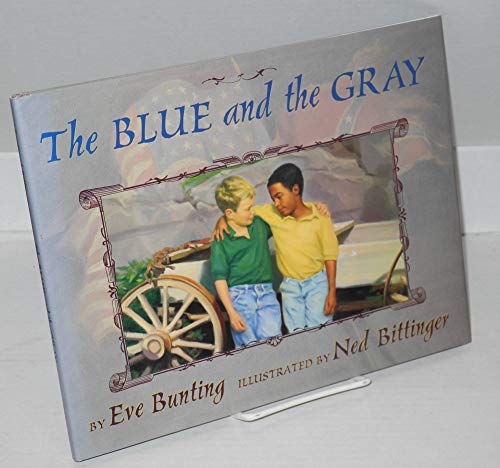
A young white boy and his African-American friend explore the grassy fields near the construction area of their new homes, which is on the site of an 1862 Civil War battleground, and one boy's father reminds them of the war's lesson of freedom.
"synopsis" may belong to another edition of this title.
Reviews
Grade 1-5-The families of two friends, one black and one white, are building new houses on a spot overlooking a field where a Civil War battle took place. The white boy's father describes the battle to the two children, and these imagined scenes are shown, juxtaposed with the everyday calm of the present. Surprised that there is no historical marker, the boys vow that they'll remember, and the father says: "We'll be a monument of sorts...a part of what they fought for long ago." Bunting uses a first-person narrative, writing in verse that is often evocative and lyrical. When the narrator finds an old bullet, he throws it "...high/across the field of bones./How silently it falls/into the tufts of grass/and flowers." The author does not always maintain an authentic child's voice, however. Bittinger's striking oil paintings are technically accomplished and suit the dramatic nature of the text. He's especially good with the contrast between the serene present, with its clear, transparent light, and the dark chaos of the fighting long ago. This well-intentioned story is not quite up to Bunting's best, but there is much potential for classroom use, and the book will make an interesting match with Patricia Polacco's Pink and Say (Philomel, 1994), right down to a painting of black hands and white hands reaching toward one another.
Lauralyn Persson, Wilmette Public Library, IL
Copyright 1996 Reed Business Information, Inc.
Luminous oil paintings carry the day for this thoughtfully conceived but unevenly executed story. Bunting's tale of two realities-houses under construction and the Civil War battlefield on which the new community lies-revolves around two boys, neighbors and friends, one black and one white. The action alternates between the present day and 1862 as one of the boys' fathers describes the long-ago battle, peeling back the layers of time to reveal the history that lies beneath the boys' feet. Bunting's (Smoky Night) verse shows glimmers of the lyricism of which she is capable ("The barrels of their muskets/ hard and black/ gave back/ the dazzle of the sun"), but it is marred by occasionally awkward phrasing ("The little puffs of smoke/ burst like gray dust/ around the barrel of each rifle gun,/ floated behind them as they'd run/ man after man"). The interracial theme seems a bit contrived, at times even self-congratulatory ("We'll be a monument of sorts," the father says, "a part of what they fought for/ long ago"). Meanwhile, Bittinger's (The Matzah That Papa Brought Home) artwork shines, capturing every nuance, whether picturing sweeping scenes of battle or the easy camaraderie between the two young friends. His evocation of the brutality and drama of war is all the more touching, standing out as it does in sharp relief against the sunny, tranquil contemporary scenes. Ages 5-7.
Copyright 1996 Reed Business Information, Inc.
Bunting adds to her series of picture books with serious themes (Smoky Night, 1994, etc.) with this account of an unnamed Civil War battle framed within a present-day story of two young boys, one black, one white, whose new homes are being constructed within view of an unmarked battlefield. As the two boys, fast friends, explore their new homesites, they learn about the tragic loss of life that happened there in that war of ``us against us . . . the saddest kind of war there is.'' Bunting's text is mostly stated in the manner of a child's brief sentences, but sprinkled with rhyming words and typographically arranged like a poem in short lines that slow the reading to a somber pace. Bittinger's oils capture both the bucolic peace of the present-day countryside and the smoke and turmoil of battle, in one case as seen from exactly the same point of view in two consecutive spreads. Particularly effective is the ghostly presence of soldiers, cannon, horses, and wagons as faint silhouettes in some scenes of the two young friends. Offering only hints of the issues over which the war was fought, this is not a book to read without preparation, but it is a worthy complement to books such as Patricia Polacco's Pink and Say (1994) and Karen Ackerman's The Tin Heart (1990). (further reading) (Picture book. 7-10) -- Copyright ©1996, Kirkus Associates, LP. All rights reserved.
Gr. 3^-5. On the cover two contemporary boys, one black, one white, stand, leaning against an old cart, their arms across each other's shoulders. The white boy is talking about the construction site where their new houses are being built. He's glad he and his friend J. J. will be neighbors there, with a wide view of a beautiful open field. But his father tells him that in 1862 that field was a Civil War battleground, and where the houses are going up, the grass was once soaked with blood. The boy's narrative is quiet, in simple free verse with an occasional rhyme. Bittinger's realistic oil paintings contrast the idyllic present--the two close friends, the narrator's father, the workmen building houses, the green spreading landscape--with the dark battle scenes, the clouds of fire and smoke, the wounded and the dead. The battleground isn't marked, but his father says their houses and their friendship are a sort of monument, "a part of what they fought for long ago." Kids will want to know more about the war, and they will also be stirred by the sense of history where they live, perhaps moved to find out what happened on their street 100 years ago. Hazel Rochman
"About this title" may belong to another edition of this title.
Search results for The Blue and the Gray

Stock Image
The Blue and the Gray
Seller: World of Books (was SecondSale), Montgomery, IL, U.S.A.
Seller rating 5 out of 5 stars

Hardback. Condition: Fair. Bittinger, Ned (illustrator). Seller Inventory # 00060326596
Stock Image
The Blue and the Gray
Seller: World of Books (was SecondSale), Montgomery, IL, U.S.A.
Seller rating 5 out of 5 stars
Hardback. Condition: Good. Bittinger, Ned (illustrator). Seller Inventory # 00103806331
Stock Image
The Blue and the Gray
Published by
Scholastic (edition First Edition), 1996
ISBN 10: 0590601970
ISBN 13: 9780590601979
Used
Hardcover
First Edition
Seller: BooksRun, Philadelphia, PA, U.S.A.
Seller rating 5 out of 5 stars
Hardcover. Condition: Very Good. Bittinger, Ned (illustrator). First Edition. With dust jacket. It's a well-cared-for item that has seen limited use. The item may show minor signs of wear. All the text is legible, with all pages included. It may have slight markings and/or highlighting. Seller Inventory # 0590601970-11-1-29
Stock Image
The Blue and the Gray
Seller: ThriftBooks-Atlanta, AUSTELL, GA, U.S.A.
Seller rating 5 out of 5 stars
Hardcover. Condition: Good. No Jacket. Bittinger, Ned (illustrator). Pages can have notes/highlighting. Spine may show signs of wear. ~ ThriftBooks: Read More, Spend Less. Seller Inventory # G0590601970I3N00
Stock Image
The Blue and the Gray
Seller: Blue Vase Books, Interlochen, MI, U.S.A.
Seller rating 5 out of 5 stars
Condition: good. Bittinger, Ned (illustrator). Former library book with the usual stamps, stickers and labels. The item shows wear from consistent use, but it remains in good condition and works perfectly. All pages and cover are intact including the dust cover, if applicable . Spine may show signs of wear. Pages may include limited notes and highlighting. May NOT include discs, access code or other supplemental materials. Seller Inventory # BVV.0590601970.G
Stock Image
The Blue and the Gray
Published by
Scholastic, Incorporated, 1996
ISBN 10: 0590601970
ISBN 13: 9780590601979
Used
Hardcover
First Edition
Seller: Better World Books, Mishawaka, IN, U.S.A.
Seller rating 5 out of 5 stars
Condition: Good. Bittinger, Ned (illustrator). First Edition. Former library copy. Pages intact with minimal writing/highlighting. The binding may be loose and creased. Dust jackets/supplements are not included. Includes library markings. Stock photo provided. Product includes identifying sticker. Better World Books: Buy Books. Do Good. Seller Inventory # 4119067-6
Stock Image
The Blue and the Gray
Seller: Once Upon A Time Books, Siloam Springs, AR, U.S.A.
Seller rating 4 out of 5 stars

hardcover. Condition: Acceptable. Bittinger, Ned (illustrator). This is a used book. It may contain highlighting/underlining and/or the book may show heavier signs of wear . It may also be ex-library or without dustjacket. This is a used book. It may contain highlighting/underlining and/or the book may show heavier signs of wear . It may also be ex-library or without dustjacket. Seller Inventory # mon0003449565
Stock Image
The Blue and the Gray
Seller: Wonder Book, Frederick, MD, U.S.A.
Seller rating 5 out of 5 stars
Condition: Good. Bittinger, Ned (illustrator). Good condition. Very Good dust jacket. A copy that has been read but remains intact. May contain markings such as bookplates, stamps, limited notes and highlighting, or a few light stains. Seller Inventory # L09D-03360
Stock Image
The Blue and the Gray
Seller: Wonder Book, Frederick, MD, U.S.A.
Seller rating 5 out of 5 stars
Condition: As New. Bittinger, Ned (illustrator). Like New condition. Like New dust jacket. A near perfect copy that may have very minor cosmetic defects. Seller Inventory # U04K-01566
Stock Image
The Blue and the Gray
Seller: HPB-Emerald, Dallas, TX, U.S.A.
Seller rating 5 out of 5 stars
hardcover. Condition: Very Good. Bittinger, Ned (illustrator). Connecting readers with great books since 1972! Used books may not include companion materials, and may have some shelf wear or limited writing. We ship orders daily and Customer Service is our top priority! Seller Inventory # S_471982922