
Items related to Questioning the Millennium: A Rationalist's Guide...
Synopsis
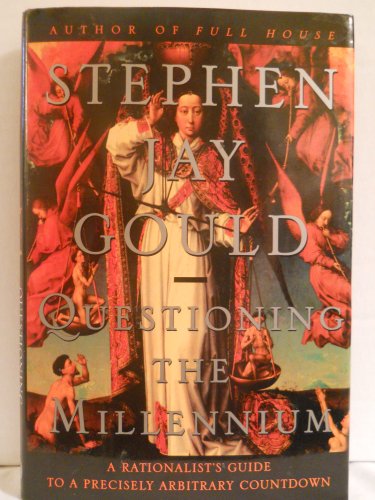
In Questioning the Millennium, Stephen Jay Gould applies his wit and erudition to one of today's most pressing subjects: the significance of the millennium.
In this beautiful inquiry into time and its milestones, he shares his interest and insights with his readers. Refreshingly reasoned, erudite, and absorbing, the book asks and answers the three major questions that define the approaching calendrical event:
First, what exactly is this concept of a millennium and how has its meaning shifted? How did the name for a future thousand year reign of Christ on earth get transferred to the passage of a secular period of a thousand years in current human history?
When does the new millennium begin: January 1, in the year 2000 or 2001?
Finally, why must our calendars be so complex, leading to our search for arbitrary regularity, including a fascination with millennia?
As always, Gould brings into his essays a wide range of compelling historical and scientific fact, including a brief history of millennia fevers, calendrical traditions and idiosyncrasies from around the world, the story of a sixth-century monk whose errors in chronology plague us even today, and the heroism of a young autistic man who has developed the extraordinary ability to calculate dates deep into the past and the future.
Ranging over a wide terrain of phenomena - from the arbitrary regularities of human calendars to the unpredictability of nature, from the vagaries of pop culture to the birth of Christ - Stephen Jay Gould holds the mirror up to our millennial passions to reveal our foibles, absurdities, and uniqueness - in other words, our humanity.
"synopsis" may belong to another edition of this title.
About the Author
Stephen Jay Gould was one of the most influential evolutionary biologists and most acclaimed science essayists of the 20th century. He died in May 2002. He was the author of numerous books, including The Lying Stones of Marrakech and Questioning the Millennium.
From the Back Cover
stioning the Millennium, Stephen Jay Gould applies his wit and erudition to one of today's most pressing subjects: the significance of the millennium.
In this beautiful inquiry into time and its milestones, he shares his interest and insights with his readers. Refreshingly reasoned, erudite, and absorbing, the book asks and answers the three major questions that define the approaching calendrical event:
First, what exactly is this concept of a millennium and how has its meaning shifted? How did the name for a future thousand year reign of Christ on earth get transferred to the passage of a secular period of a thousand years in current human history?
When does the new millennium begin: January 1, in the year 2000 or 2001?
Finally, why must our calendars be so complex, leading to our search for arbitrary regularity, including a fascination with millennia?
As always, Gould brings
From the Inside Flap
stioning the Millennium</b>, Stephen Jay Gould applies his wit and erudition to one of today's most pressing subjects: the significance of the millennium.<br><br>In this beautiful inquiry into time and its milestones, he shares his interest and insights with his readers. Refreshingly reasoned, erudite, and absorbing, the book asks and answers the three major questions that define the approaching calendrical event:<br>First, what exactly is this concept of a millennium and how has its meaning shifted? How did the name for a future thousand year reign of Christ on earth get transferred to the passage of a secular period of a thousand years in current human history? <br><br>When does the new millennium begin: January 1, in the year 2000 or 2001? <br><br>Finally, why must our calendars be so complex, leading to our search for arbitrary regularity, including a fascination with millennia?<br>As always, Gould brings
Reviews
``What?,'' ``When?,'' and ``Why?'' are the titles Gould gives to the three short essays probing humankind's fascination with thousand-year intervals. He could probably have wrapped it all up in a single essay, but the show of erudition (one can picture Gould poring over ancient texts in Harvard libraries) will please the fans and certainly speaks to a theme that is moving more and more to center stage. ``What?'' asks why we are so fascinated with numbers, the ordering of things, and dichotomies, with Gould observing that we have moved from a belief that Christ will reign over a bountiful 1,000 years following an apocalypse to the calendric concept that at some turning of the centuries there will be a thousand-year time span that may precede an apocalypse. There really are no hard answers; Gould even states that the human brain surely did not evolve to do this kind of reckoning. ``When?'' deals with whether the 21st century begins Jan. 1, 2000, or Jan. 1, 2001. The conundrum is all the fault of a sixth-century monk who started the b.c./a.d. business but omitted a year zero. To make matters worse, Herod died in 4 b.c., so if he were contemporaneous with Jesus, revision is necessary (and accounts for Archbishop James Ussher's famous start date for the universe of 4004 b.c.). Finally, ``Why?'' returns to the issue of why mankind is obsessed with order, endowing God or nature with mathematical precision. Truth is, there is no compatibility in lunar and solar cycles, and all cultures have struggled to develop calendars to make the seasons fall where they should. All this would be a romp for Gould's wit and intellect save for a final discussion on individuals classed as autistic or retarded but who can instantaneously calculate the day of the week for a given date over centuries. Readers will be moved by Gould's personal account of the process and the person involved. (16 b&w illustrations, not seen) (Author tour) -- Copyright ©1997, Kirkus Associates, LP. All rights reserved.
Gould is the latest?though certainly not the last?thinker to publish his ruminations on the coming millennium. Unlike others, he spares readers the standard litany of predictions and rallying cries to embrace the future. Instead, in three essays entitled "What?," "When?," and "Why?," Gould wryly analyzes why humans are so fascinated by the year 2000. It is no great revelation that millennial passions are fueled in part by apocalyptic yearnings as well as by an innate human compulsion to measure and organize time, but, as always, Gould puts his own clever spin on these observations. Hard-core fans may be disappointed, for this book contains more religion and numerology than science. Any book by Gould will generate demand, but while this one is witty and entertaining, it is not especially illuminating. An optional purchase.
-?Gregg Sapp, Univ. of Miami Lib., Coral Gables, Fla.
Copyright 1997 Reed Business Information, Inc.
Gould poses three questions about the millennium in this delicious science-historical jeu d'esprit: What does millennium mean? When does a millennium arrive? Why are we interested in it and other divisions of time? Millennium, he demonstrates, is a Christian concept that once meant the thousand years after the Second Coming but that, as Jesus proved indefinitely tardy, came to mean a thousand years at whose end he would finally show up and, later, any thousand years ended by a year of three zeros, such as 2000. Which broaches the second question and its cognate, Will the coming millennium begin at midnight New Year's Day 2000 or midnight New Year's Eve 2000? If the former, then the first century has only 99 years; if the latter, cancel that December 31, 1999, millennium bash you had planned. Which date one chooses, Gould discloses, involves a class-cultural decision. To address the third question, Gould examines the reasons for and the difficulties of cramming natural cycles into linear calendars and then turns to the phenomenon of day-date calculation (the ability to instantly ascertain on what day of the week a given date occurred) by an autistic young man. There is an emotional rabbit punch at the very end of the book--but don't let that warning scare you away from what may be the most enjoyable millennium book of the second millennium. Ray Olson
Excerpt. © Reprinted by permission. All rights reserved.
I have always and dearly loved calendrical questions because they display all our foibles in revealing miniature. Where else can we note, so vividly revealed, such an intimate combination of all the tricks that recalcitrant nature plays upon us, linked with all the fallacies of reason, and all the impediments of habit and emotion, that make the fulfillment of our urge to understand even more difficult - in other words, of both the external pitfalls to knowledge. Yet we press on regardless - and we do manage to get somewhere.
I think that I love humanity all the more - the scholar's hang-up, I suppose - when our urge to know transcends mere practical advantage. Societies that both fish and farm need to reconcile the incommensurate cycles of years and lunations. Since nature permits no clean and crisp correlation, people had to devise the cumbersome, baroque Metonic Cycle. And this achievement by several independent societies can only be called heroic.
I recognize this functional need to know, and I surely honor it as a driving force in human history. But when Paleolithic Og looked out of his cave and up at the heavens - and asked why the moon had phases, not because he could use the information to boost his success in gathering shellfish at the nearby shore, but because he just wanted to resolve a mystery, and because he sensed, however dimly, that something we might call recurrent order, and regard as beautiful for this reason alone, must lie behind the overt pattern - well, then calendrical questions became sublime, and so did humanity as well.
If we regard millennial passion in particular, and calendrical fascination in general, as driven by the pleasure of ordering and the joy of understanding, then this strange little subject - so often regarded as the province of drones or eccentrics, but surely not of grand or expansive thinkers - becomes a wonderful microcosm for everything that makes human beings so distinctive, so potentially noble, and often so actually funny. Socrates and Charlie Chaplin reached equal heights of sublimity.
"About this title" may belong to another edition of this title.
Search results for Questioning the Millennium: A Rationalist's Guide...

Stock Image
Questioning the Millennium: A Rationalist's Guide to a Precisely Arbitrary Countdown
Seller: World of Books (was SecondSale), Montgomery, IL, U.S.A.
Seller rating 5 out of 5 stars

Condition: Very Good. Item in very good condition! Textbooks may not include supplemental items i.e. CDs, access codes etc. Seller Inventory # 00098576630
Stock Image
Questioning the Millennium: A Rationalist's Guide to a Precisely Arbitrary Countdown
Seller: World of Books (was SecondSale), Montgomery, IL, U.S.A.
Seller rating 5 out of 5 stars
Condition: Good. Item in good condition. Textbooks may not include supplemental items i.e. CDs, access codes etc. Seller Inventory # 00097876685
Seller Image
Questioning the Millennium: A Rationalist's Guide to a Precisely Arbitrary Countdown
Seller: Greenworld Books, Arlington, TX, U.S.A.
Seller rating 5 out of 5 stars
Condition: very_good. Fast Free Shipping â" Very Good condition book with a firm cover and clean pages. Shows normal use and some light wear or limited notes markings. A solid, nice copy to enjoy. Seller Inventory # GWV.0609600761.VG
Stock Image
Questioning the Millennium: A Rationalist's Guide to a Precisely Arbitrary Countdown
Seller: More Than Words, Waltham, MA, U.S.A.
Seller rating 5 out of 5 stars
Condition: Good. A sound copy with only light wear. Overall a solid copy at a great price! Seller Inventory # BOS-I-06b-01827
Stock Image
Questioning the Millennium: A Rationalist's Guide to a Precisely Arbitrary Countdown
Seller: Once Upon A Time Books, Siloam Springs, AR, U.S.A.
Seller rating 4 out of 5 stars

Hardcover. Condition: Good. This is a used book in good condition and may show some signs of use or wear . This is a used book in good condition and may show some signs of use or wear . Seller Inventory # mon0001031889
Stock Image
Questioning the Millennium: A Rationalist's Guide to a Precisely Arbitrary Countdown
Seller: The Maryland Book Bank, Baltimore, MD, U.S.A.
Seller rating 5 out of 5 stars
hardcover. Condition: Very Good. First Edition. Used - Very Good. Seller Inventory # 9-X-1-0201
Stock Image
Questioning the Millennium : A Rationalist's Guide to a Precisely Arbitrary Countdown
Published by
Crown Publishing Group, The, 1997
ISBN 10: 0609600761
ISBN 13: 9780609600764
Used
Hardcover
First Edition
Seller: Better World Books, Mishawaka, IN, U.S.A.
Seller rating 5 out of 5 stars
Condition: Good. 1st ed. Pages intact with minimal writing/highlighting. The binding may be loose and creased. Dust jackets/supplements are not included. Stock photo provided. Product includes identifying sticker. Better World Books: Buy Books. Do Good. Seller Inventory # GRP90515397
Stock Image
Questioning the Millennium : A Rationalist's Guide to a Precisely Arbitrary Countdown
Published by
Crown Publishing Group, The, 1997
ISBN 10: 0609600761
ISBN 13: 9780609600764
Used
Hardcover
First Edition
Seller: Better World Books, Mishawaka, IN, U.S.A.
Seller rating 5 out of 5 stars
Condition: Very Good. 1st ed. Pages intact with possible writing/highlighting. Binding strong with minor wear. Dust jackets/supplements may not be included. Stock photo provided. Product includes identifying sticker. Better World Books: Buy Books. Do Good. Seller Inventory # GRP79486313
Stock Image
Questioning the Millennium: A Rationalist's Guide to a Precisely Arbitrary Countdown
Seller: World of Books Inc, Montgomery, IL, U.S.A.
Seller rating 4 out of 5 stars
Hardback. Condition: Good. In this new edition of Questioning the Millennium, best-selling author Stephen Jay Gould applies his wit and erudition to one of today's most pressing subjects: the significance of the millennium. In 1950 at age eight, prompted by an issue of Life magazine marking the century's midpoint, Stephen Jay Gould started thinking about the approaching turn of the millennium. In this beautiful inquiry into time and its milestones, he shares his interest and insights with his readers. Refreshingly reasoned and absorbing, the book asks and answers the three major questions that define the approaching calendrical event. First, what exactly is this concept of a millennium and how has its meaning shifted? How did the name for a future thousand-year reign of Jesus Christ on earth get transferred to the passage of a secular period of a thousand years in current human history? When does the new millennium really begin: January 1, 2000, or January 1, 2001? (Although seemingly trivial, the debate over this issue tells an intriguing story about the cultural history of the twentieth century.) And why must our calendars be so complex, leading to our search for arbitrary regularity, including a fascination with millennia? This revised edition begins with a new and extensive preface on a key subject not treated in the original version. As always, Gould brings into his essays a wide range of compelling historical and scientific fact, including a brief history of millennial fevers, calendrical traditions, and idiosyncrasies from around the world; the story of a sixth-century monk whose errors in chronology plague us even today; and the heroism of a young autistic man who has developed the extraordinary ability to calculate dates deep into the past and the future. Ranging over a wide terrain of phenomena--from the arbitrary regularities of human calendars to the unpredictability of nature, from the vagaries of pop culture to the birth of Christ--Stephen Jay Gould holds up the mirror to our millennial passions to reveal our foibles, absurdities, and uniqueness--in other words, our humanity. Seller Inventory # CIN0609600761G
Stock Image
Questioning the Millennium: A Rationalist's Guide to a Precisely Arbitrary Countdown
Seller: World of Books Inc, Montgomery, IL, U.S.A.
Seller rating 4 out of 5 stars
Hardback. Condition: Very Good. In this new edition of Questioning the Millennium, best-selling author Stephen Jay Gould applies his wit and erudition to one of today's most pressing subjects: the significance of the millennium. In 1950 at age eight, prompted by an issue of Life magazine marking the century's midpoint, Stephen Jay Gould started thinking about the approaching turn of the millennium. In this beautiful inquiry into time and its milestones, he shares his interest and insights with his readers. Refreshingly reasoned and absorbing, the book asks and answers the three major questions that define the approaching calendrical event. First, what exactly is this concept of a millennium and how has its meaning shifted? How did the name for a future thousand-year reign of Jesus Christ on earth get transferred to the passage of a secular period of a thousand years in current human history? When does the new millennium really begin: January 1, 2000, or January 1, 2001? (Although seemingly trivial, the debate over this issue tells an intriguing story about the cultural history of the twentieth century.) And why must our calendars be so complex, leading to our search for arbitrary regularity, including a fascination with millennia? This revised edition begins with a new and extensive preface on a key subject not treated in the original version. As always, Gould brings into his essays a wide range of compelling historical and scientific fact, including a brief history of millennial fevers, calendrical traditions, and idiosyncrasies from around the world; the story of a sixth-century monk whose errors in chronology plague us even today; and the heroism of a young autistic man who has developed the extraordinary ability to calculate dates deep into the past and the future. Ranging over a wide terrain of phenomena--from the arbitrary regularities of human calendars to the unpredictability of nature, from the vagaries of pop culture to the birth of Christ--Stephen Jay Gould holds up the mirror to our millennial passions to reveal our foibles, absurdities, and uniqueness--in other words, our humanity. Seller Inventory # CIN0609600761VG