Synopsis
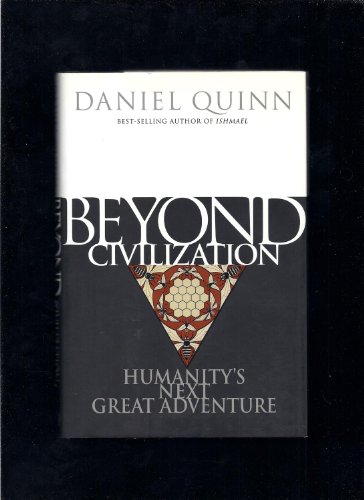
If a team of Martian anthropologists were to study our culture, their initial findings might read something like this: These people have the strange idea that the thing they call civilization is some sort of final, unsurpassable invention. Even though vast numbers of them suffer in this oppressively hierarchical system, and even though it appears to be plunging them toward a global catastrophe, they cling to it as if it were the most wonderful thing (as they quaintly say) since sliced bread. That a more agreeable (and less catastrophic) system exists BEYOND civilization, seems to be entirely unthinkable to them.
In Beyond Civilization, Daniel Quinn has made it his task to think the unthinkable. We all know there's no one right way to build a bicycle, no one right way to design an automobile, no one right way to construct a pair of shoes, but we're convinced there must be only one right way for people to live--and the one we have is it, no matter what. Even if we hate it, we must cling to it. Even if it drags us to the brink of extinction, we must not let it go.
Many other peoples have built civilizations--and then walked away from them. Quinn examines the Maya, the Olmec, the people of Teotihuacán, and others, who did just that. But they all walked away moving backward--to an earlier lifestyle. Quinn's goal in this book is to show how we can walk away moving forward, to a new lifestyle, one which encourages diversity instead of suppressing it. Not a "New World Order," but rather a New Personal Order. Not legislative change at the governmental level, but rather incremental change at the human level.
This is a guidebook for people who want to assert control over their destiny and recover the freedom to live at a scale and in a style of their own choosing--and starting now, today, not in some distant utopian future.
"synopsis" may belong to another edition of this title.
About the Author
DANIEL QUINN is the award-winning author of Ishmael, The Story of B, and My Ishmael. He lives in Houston, Texas.
From the Inside Flap
Martian anthropologists were to study our culture, their initial findings might read something like this: These people have the strange idea that the thing they call civilization is some sort of final, unsurpassable invention. Even though vast numbers of them suffer in this oppressively hierarchical system, and even though it appears to be plunging them toward a global catastrophe, they cling to it as if it were the most wonderful thing (as they quaintly say) since sliced bread. That a more agreeable (and less catastrophic) system exists BEYOND civilization, seems to be entirely unthinkable to them.<br><br>In <b>Beyond Civilization</b>, Daniel Quinn has made it his task to think the unthinkable. We all know there's no one right way to build a bicycle, no one right way to design an automobile, no one right way to construct a pair of shoes, but we're convinced there must be only one right way for people to live--and the one we have is it, no matter what. Even if we hate it, we must cling to
Reviews
With the publication of his trilogy of novels (Ishmael; The Story of B; My Ishmael), Quinn became something of a cult figure in visionary fiction. In those books, Quinn explored the self-sustaining nature of tribal societies and his belief that the current worldwide ecological and economic crises are due to the agriculture-based organization of civilized societies. He now turns his hand to nonfiction, with an appeal for universal renewal through a "New Tribal Revolution." Acknowledging that it would be impossible for most civilized humans to return to the hunting and gathering typical of tribes, Quinn argues that modern men and women need to invent a completely different mode of existence. To do this, they must question a basic assumption of all civilized societies: "Civilization must continue at any cost and must not be abandoned under any circumstances." Quinn, borrowing from Richard Dawkins, calls this assumption a "meme," the cultural equivalent of a gene. Quinn's main examples are peoples like the Maya and Anasazi, who returned to tribalism after unsuccessful attempts at other types of social organization, and the communal structure of traditional circuses. The author has a knack for stating the obvious with tremendous personal conviction. His articulation of a simpler way of life will appeal to those made frantic by globalization and all the forces conspiring to make people dance as fast as they can. (Oct.)
Copyright 1999 Reed Business Information, Inc.
Using parable and dialog, Quinn introduces the reader to some of the philosophical views that have led to our tacit assumption that civilization is the answer to humanity's problems. He offers critical reminders, without being either polemical or technical, that civilization may not be the answer. Rather, he asserts that we should move beyond hierarchy to a new form of tribal livingAnot the communal style of the 1960s but one suffused with conscious, purposeful awareness of each action's greater impact. Quinn notes, "Beyond civilization isn't a geographical space...it's a cultural space that opens up among people with new minds." As is characteristic of his philosophical novels, Ishmael, The Story of B, and My Ishmael, the prose is readable and the sociological discussion unobtrusive. Fans of Quinn's earlier works will welcome this title. Libraries seeking to provide contemporary discussion on human ecology will find this title an asset.
-ALeroy Hommerding, Citrus Cty. Lib. Syst., Inverness, FL
Copyright 1999 Reed Business Information, Inc.
Excerpt. © Reprinted by permission. All rights reserved.
From Part One: Closing In on the Problem
I heard this, naturally, from my grandfather, he from his grandfather, he from his own grandfather, and so on, back many hundreds of years. That means this tale is very old. But it won't disappear, because I offer it to my children, and my children will tell it to their children, and so on.
-- Gypsy storyteller Lazaros Harisiadis, quoted by Diane Tong in Gypsy Folk Tales
A fable to start with
Once upon a time life evolved on a certain planet, bringing forth many different social organizations--packs, pods, flocks, troops, herds, and so on. One species whose members were unusually intelligent developed a unique social organization called a tribe. Tribalism worked well for them for millions of years, but there came a time when they decided to experiment with a new social organization (called civilization) that was hierarchal rather than tribal. Before long, those at the top of the hierarchy were living in great luxury, enjoying perfect leisure and having the best of everything. A larger class of people below them lived very well and had nothing to complain about. But the masses living at the bottom of the hierarchy didn't like it at all. They worked and lived like pack animals, struggling just to stay alive.
"This isn't working," the masses said. "The tribal way was better. We should return to that way." But the ruler of the hierarchy told them, "We've put that primitive life behind us forever. We can't go back to it."
"If we can't go back," the masses said, "then let's go forward--on to something different."
"That can't be done," the ruler said, "because nothing different is possible. Nothing can be beyond civilization. Civilization is a final, unsurpassable invention."
"But no invention is ever unsurpassable. The steam engine was surpassed by the gas engine. The radio was surpassed by television. The calculator was surpassed by the computer. Why should civilization be different?"
"I don't know why it's different," the ruler said, "It just is."
But the masses didn't believe this--and neither do I.
A Manual of Change
My first concept of this book was reflected in its original title: The Manual of Change. I thought of this because there's nothing the people of our culture want more than change. They desperately want to change themselves and the world around them. The reason isn't hard to find. They know something's wrong--wrong with themselves and wrong with the world.
In Ishmael and my other books, I gave people a new way of understanding what's gone wrong here. I had the rather naive idea this would be enough. Usually it is enough. If you know what's wrong with something--your car or your computer or your refrigerator or your television set--then the rest is relatively easy. I assumed it would be the same here, but of course it isn't. Over and over again, literally thousands of times, people have said to me or written to me, "I understand what you're saying--you've changed the way I see the world and our place in it--but what are we supposed to DO about it?"
I might have said, "Isn't it obvious?" But obviously it isn't obvious--or anything remotely like obvious.
In this book I hope to make it obvious.
Humanity's future is what's at stake.
Who are the people of "our culture"?
It's easy to pick out the people who belong to "our" culture. If you go somewhere--anywhere in the world--where the food is under lock and key, you'll know you're among people of our culture. They may differ wildly in relatively superficial matters--in the way they dress, in their marriage customs, in the holidays they observe, and so on. But when it comes to the most fundamental thing of all, getting the food they need to stay alive, they're all alike. In these places, the food is all owned by someone, and if you want some, you'll have to buy it. This is expected in these places; the people of our culture know no other way.
Making food a commodity to be owned was one of the great innovations of our culture. No other culture in history has ever put food under lock and key--and putting it there is the cornerstone of our economy, for if the food wasn't under lock and key, who would work?
What does "saving the world" mean?
When we talk about saving the world, what world are we talking about? Not the globe itself, obviously. But also not the biological world--the world of life. The world of life, strangely enough, is not in danger (though thousands and perhaps even millions of species are). Even at our worst and most destructive, we would be unable to render this planet lifeless. At present it's estimated that as many as two hundred species a day are becoming extinct, thanks to us. If we continue to kill off our neighbors at this rate, there will inevitably come a day when one of those two hundred species is our own.
Saving the world also can't mean preserving the world as it is right now. That may sound like a nice idea, but it's also out of reach. Even if the entire human race vanished tomorrow, the world wouldn't stay the way it is today. We will never, under any circumstances, be able to stop change on this planet.
But if saving the world doesn't mean saving the world of life or preserving it unchanged, what are we talking about? Saving the world can only mean one thing: saving the world as a human habitat. Accomplishing this will mean (must mean) saving the world as a habitat for as many other species as possible. We can only save the world as a human habitat if we stop our catastrophic onslaught on the community of life, for we depend on that community for our very lives.
"About this title" may belong to another edition of this title.
Other Popular Editions of the Same Title

Search results for Beyond Civilization: Humanity's Next Great Adventure

Stock Image
Beyond Civilization: Humanity's Next Great Adventure
Seller: World of Books (was SecondSale), Montgomery, IL, U.S.A.
Seller rating 5 out of 5 stars

Condition: Good. Item in good condition. Textbooks may not include supplemental items i.e. CDs, access codes etc. Seller Inventory # 00094121172
Seller Image
Beyond Civilization: Humanity's Next Great Adventure
Seller: Goodwill Books, Hillsboro, OR, U.S.A.
Seller rating 5 out of 5 stars
Condition: acceptable. Fairly worn, but readable and intact. If applicable: Dust jacket, disc or access code may not be included. Seller Inventory # GICWV.0609604902.A
Seller Image
Beyond Civilization: Humanity's Next Great Adventure
Seller: Bay State Book Company, North Smithfield, RI, U.S.A.
Seller rating 5 out of 5 stars
Condition: acceptable. The book is complete and readable, with all pages and cover intact. Dust jacket, shrink wrap, or boxed set case may be missing. Pages may have light notes, highlighting, or minor water exposure, but nothing that affects readability. May be an ex-library copy and could include library markings or stickers. Seller Inventory # BSM.UCC2
Stock Image
Beyond Civilization : Humanity's Next Great Adventure
Published by
Crown Publishing Group, The, 1999
ISBN 10: 0609604902
ISBN 13: 9780609604908
Used
Hardcover
Seller: Better World Books, Mishawaka, IN, U.S.A.
Seller rating 5 out of 5 stars
Condition: Good. Used book that is in clean, average condition without any missing pages. Seller Inventory # 4477018-6
Stock Image
Beyond Civilization : Humanity's Next Great Adventure
Published by
Crown Publishing Group, The, 1999
ISBN 10: 0609604902
ISBN 13: 9780609604908
Used
Hardcover
Seller: Better World Books, Mishawaka, IN, U.S.A.
Seller rating 5 out of 5 stars
Condition: Very Good. Used book that is in excellent condition. May show signs of wear or have minor defects. Seller Inventory # GRP86865745
Stock Image
Beyond Civilization: Humanity's Next Great Adventure
Seller: Midtown Scholar Bookstore, Harrisburg, PA, U.S.A.
Seller rating 5 out of 5 stars
hardcover. Condition: Acceptable. This is a damaged book. May be ex-library, water-damaged, or spine creased/broken. Acceptable, Reading copy only, with writing/markings and heavy wear. Standard-sized. Seller Inventory # mon0000144935
Seller Image
Beyond Civilization: Humanity's Next Great Adventure
Seller: Goodwill of Silicon Valley, SAN JOSE, CA, U.S.A.
Seller rating 4 out of 5 stars

Condition: acceptable. Supports Goodwill of Silicon Valley job training programs. The cover and pages are in Acceptable condition! Any other included accessories are also in Acceptable condition showing use. Use can include some highlighting and writing, page and cover creases as well as other types visible wear such as cover tears discoloration, staining, marks, scuffs, etc. All pages intact. Seller Inventory # GWSVV.0609604902.A
Stock Image
Beyond Civilization: Humanity's Next Great Adventure
Published by
Harmony Books, New York, New York, U.S.A., 1999
ISBN 10: 0609604902
ISBN 13: 9780609604908
Used
Hardcover
First Edition
Seller: The Book House, Inc. - St. Louis, St. Louis, MO, U.S.A.
Seller rating 5 out of 5 stars
Hard Cover. Condition: Very Good. Dust Jacket Condition: Very Good. First Edition. Very Good/Very Good, Hardback. Seller Inventory # 080717-JM566
Stock Image
Beyond Civilization: Humanity's Next Great Adventure
Seller: Cheryl's Books, Vinemont, AL, U.S.A.
Seller rating 5 out of 5 stars
Hardcover. Condition: Good. Hardback with dust jacket in good condition. Some light wear on the cover, and some highlighting in the book. Seller Inventory # MAY2014D0111070
Seller Image
Beyond Civilization: Humanity's Next Great Adventure
Seller: The Book House, Inc. - St. Louis, St. Louis, MO, U.S.A.
Seller rating 5 out of 5 stars
Hardcover. Condition: Very Good. Dust Jacket Condition: Very Good. Very good hardcover with very good dust jacket. Seller Inventory # 240525-D05