
Items related to Piranha to Scurfy: And Other Stories
Synopsis
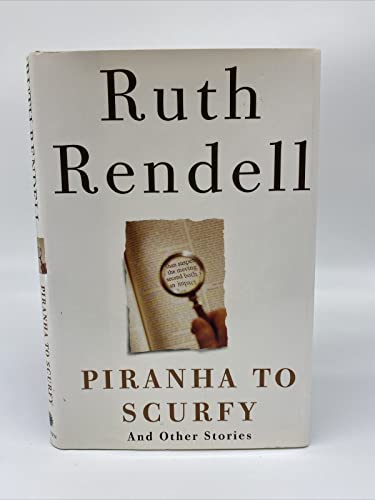
In these pages, internationally celebrated novelist Ruth Rendell, author of Harm Done, offers a collection of unforgettable stories evocative of Edgar Allan Poe, Stephen King, and other masters of the chilling touch.
"Piranha to Scurfy" tells of a lonely man who devotes his life to writing scathing letters to newly published authors, pointing out their many mistakes. He does so in memory of his mother, who lies buried in the garden, for reasons that emerge to haunting effect.
"The Wink" recounts the story of a woman, raped years ago in a small English town, whose patience is rewarded by a perfectly satisfying moment of revenge.
"Catamount," set in the Rocky Mountains, is seen through the eyes of an Englishwoman who perceives the ruthless ferocity that lurks behind the beauty of the landscape.
And bringing the collection of nine stories to an unforgettable conclusion is the novella-length "High Mysterious Union," a dark, relentless tale of erotic obsession and bloodless violence in remote, rural England.
"synopsis" may belong to another edition of this title.
About the Author
RUTH RENDELL has won three Edgar Awards from the Mystery Writers of America and one Diamond Dagger, three Gold Daggers, and one Silver Dagger from the Crime Writers Association of England. She lives in London.
From the Back Cover
Praise for Ruth Rendell
"Those who haven't read Ruth Rendell have missed something unique and wonderful."
-- Tony Hillerman
"Much honored around the world, but less well known here, Ruth Rendell is a writer whose work should be read by anyone who either enjoys brilliant mystery -- or distinguished literature."
-- Scott Turow
"Ruth Rendell is, unequivocally, the most brilliant mystery novelist of our time. Her stories are a lesson in a human nature as capable of the most exotic love as it is of the cruelest murder. She does not avert her gaze and magnificently triumphs in a style that is uniquely hers and mesmerizing."
-- Patricia Cornwell
"Ruth Rendell terrorizes with the subtle authority of a cat burglar in the night."
-- San Francisco Chronicle
From the Inside Flap
es, internationally celebrated novelist Ruth Rendell, author of Harm Done, offers a collection of unforgettable stories evocative of Edgar Allan Poe, Stephen King, and other masters of the chilling touch.
"Piranha to Scurfy" tells of a lonely man who devotes his life to writing scathing letters to newly published authors, pointing out their many mistakes. He does so in memory of his mother, who lies buried in the garden, for reasons that emerge to haunting effect.
"The Wink" recounts the story of a woman, raped years ago in a small English town, whose patience is rewarded by a perfectly satisfying moment of revenge.
"Catamount," set in the Rocky Mountains, is seen through the eyes of an Englishwoman who perceives the ruthless ferocity that lurks behind the beauty of the landscape.
And bringing the collection of nine stories to an unforgettable conclusion is the novella-length "High Mysterious Union,&quo
Reviews
Multiple Edgar and Gold Dagger award winner Rendell displays her mastery of spine-tingling suspense in her first short story collection since Blood Lines (1996). In the scary title tale, a solitary, arrogant, self-appointed fault-finder is haunted by memories of his dead mother. Although the twist is soon obvious, Rendell adds a dimension that holds the reader to the end. Mythology and fairy tales come to life in "High Mysterious Union," a novella in which a man's increasing obsession with a young woman places him under a spell that almost leads to his death. Irony plays a strong role in most of the nine tales here. In "Walter's Leg," the title character learns that people don't change, even over a lifetime. "The Professional" is about a young man who thinks he witnesses a murder, talks himself out of it, then too late realizes he was right. In "Fair Exchange," a man's doubts about a healer who helps his sick wife are his undoing. Rendell is such a good writer that all these subtle and witty stories succeed, but they are superficial compared to her far more complex and satisfying novels. (Jan. 30) Forecast: Rendell is a fine stylist with an imagination that should appeal to readers of "literary" fiction as well as to mystery fans. Although her novels far outshine these short stories in depth of plot and characterization, this collection could introduce some nongenre readers to her work, especially to the tales of psychological suspense she writes under her own name and as Barbara Vine.
Copyright 2000 Reed Business Information, Inc.
Rendell distills her special type of terror into nine new stories.
Copyright 2000 Reed Business Information, Inc.
The short-story format is ideally suited to suspense specialist Rendell (winner of three Edgars, four Golden Daggers, and the Grand Master Award). Rendell is a perplexing host, inviting the reader into a seemingly benign situation, then placing unnerving details in the way until the story's main character and the reader realize a trap has been set and sprung. This collection of eight short stories and one novella ("High Mysterious Union") showcases Rendell's twin specialties of presenting the impervious logic of the criminally insane and advancing danger from background to center stage in a few swift moves. Point of view is compelling here, whether we're overhearing a madman's rationale or recognizing ourselves in the denial and vacillation that transform Rendell's characters into villains or victims. Many of Rendell's stories hinge on the tiniest detail. "The Astronomical Scarf," for example, traces the owners of a scarf for more than 20 years, showing what fate the scarf brings each. "The Professional" centers on a shoe-shine boy who witnesses and then doubts a tiny but momentous assault. Other stories jolt us with endings that come way out of the past, as in "The Wink," in which a rape victim encounters her tormentor from 50 years ago, and "Walter's Leg," in which a grown man reconnects with his long-ago nemesis. Rendell at her unflinchingly disturbing best. Connie Fletcher
Copyright © American Library Association. All rights reserved
Excerpt. © Reprinted by permission. All rights reserved.
Chapter One
It was the first time he had been away on holiday without Mummy. The first time in his life. They had always gone to the Isle of Wight, to Ventnor or Totland Bay, so, going alone, he had chosen Cornwall for the change that people say is as good as a rest. Not that Ribbon's week in Cornwall had been entirely leisure. He had taken four books with him, read them carefully in the B and B's lounge, in his bedroom, on the beach, and sitting on the clifftop, and made meticulous notes in the looseleaf notebook he had bought in a shop in Newquay. The results had been satisfactory, more than satisfactory. Allowing for the anger and disgust making these discoveries invariably aroused, he felt he could say he had had a relaxing time. To use a horrible phrase much favored by Eric Owlberg in his literary output, he had recharged his batteries.
Coming home to an empty house would be an ordeal. He had known it would be, and it was. Instead of going out into the garden, he gave it careful scrutiny from the dining room window. Everything outside and indoors was as he had left it. The house was as he had left it, all the books in their places. Every room contained books. Ribbon was not one to make jokes, but he considered it witty to remark that while other people's walls were papered, his were booked. No one knew what he meant, for hardly anyone except himself ever entered 21 Grove Green Avenue, Leytonstone, and those to whom he uttered his little joke smiled uneasily. He had put up the shelves himself, buying them from Ikea. As they filled he bought more, adding to those already there until the shelves extended from floor to ceiling. A strange appearance was given to the house by this superfluity of books, as the shelves necessarily reduced the size of the rooms, so that the living room, originally fifteen feet by twelve, shrank to thirteen feet by ten. The hall and landing were "booked" as densely as the rooms. The place looked like a library, but one mysteriously divided into small sections. His windows appeared as alcoves set deep in the walls, affording a view at the front of the house of a rather gloomy suburban street, thickly treed. The back gave onto the yellow-brick rears of other houses and, in the foreground, his garden, which was mostly lawn, dotted about with various drab shrubs. At the far end was a wide flower bed the sun never reached and in which grew creeping ivies and dark-leaved flowerless plants that like the shade.
He had got over expecting Mummy to come downstairs or walk into a room. She had been gone four months now. He sighed, for he was a long way from recovering from his loss and his regrets. Work was in some ways easier without her and in others immeasurably harder. She had reassured him; sometimes she had made him strong. But he had to press on--there was really no choice. Tomorrow things would be back to normal.
He began by ranging before him on the desk in the study--though was not the whole house a study?--the book-review pages from the newspapers that had arrived while he was away. As he had expected, Owlberg's latest novel, Paving Hell, appeared this very day in paperback, one year after hardcover publication. It was priced at ?6.99 and by now would be in all the shops. Ribbon made a memo about it on one of the plain cards he kept for this purpose. But before continuing he let his eyes rest on the portrait of Mummy in the plain silver frame that stood on the table where used, read, and dissected books had their temporary home. It was Mummy who had first drawn his attention to Owlberg. She had borrowed one of his books from the public library and pointed out to Ribbon with indignation the mass of errors, solecisms, and abuse of the English language to be found in its pages. How he missed her! Wasn't it principally to her that he owed his choice of career, as well as the acumen and confidence to pursue it?
He sighed anew. Then he returned to his newspapers and noted down the titles of four more novels currently published in paperback, as well as the new Kingston Marle, Demogorgon, due to appear this coming Thursday in hardcover with the maximum hype and fanfares of metaphorical trumpets, but almost certainly already in the shops. A sign of the degeneracy of the times, Mummy had said, that a book whose publication was scheduled for May appeared on sale at the end of April. No one could wait these days; everyone was in a hurry. It certainly made his work harder. It increased the chances of his missing a vitally important novel that might have sold out before he knew it was in print.
Ribbon switched on his computer and checked that the printer was linked to it. It was only nine in the morning. He had at least an hour before he need make his trip to the bookshop. Where should it be today? Perhaps the City or the West End of London. It would be unwise to go back to his local shop so soon and attract too much attention to himself. Hatchard's, perhaps then, or Books Etc. or Dillon's, or even all three. He opened the notebook he had bought in Cornwall, reread what he had written, and with the paperback open on the desk, reached for the Shorter Oxford Dictionary, Brewer's Dictionary of Phrase and Fable, and Whittaker's Almanac. Referring to the first two and noting down his finds, he began his letter.
21 Grove Green Avenue London E11 4ZH
Dear Joy Anne Fortune,
I have read your new novel Dreadful Night with very little pleasure and great disappointment. Your previous work has seemed to me, while being without any literary merit whatsoever, at least to be fresh, occasionally original, and largely free from those errors of fact and slips in grammar that, I may say, characterize Dreadful Night.
Look first at page 24. Do you really believe "desiccated" has two s's and one c? And if you do, has your publisher no copy editor whose job it is to recognize and correct these errors? On page 82 you refer to the republic of Guinea as being in East Africa and as a former British possession, instead of being in West Africa and formerly French, and on page 103 to the late General Sikorski as a one-time prime minister of Czechoslovakia rather than of Poland. You describe, on page 139, "hadith" as being the Jewish prayers for the dead instead of what it correctly means, the body of tradition and legend surrounding the Prophet Muhammad and his followers, and on the following page "tabernacle" as an entrance to a temple. Its true meaning is a portable sanctuary in which the Ark of the Covenant was carried.
Need I go on? I am weary of underlining the multifarious mistakes in your book. Needless to say, I shall buy no more of your work and shall advise my highly literate and discerning friends to boycott it.
Yours sincerely, Ambrose Ribbon
The threat in the last paragraph was an empty one. Ribbon had no friends and could hardly say he missed having any. He was on excellent, at least speaking, terms with his neighbors and various managers of bookshops. There was a cousin in Gloucestershire he saw occasionally. Mummy had been his friend. There was no one he had ever met who could approach replacing her. He wished, as he did every day, she were back there beside him and able to read and appreciate his letter.
He addressed an envelope to Joy Anne Fortune care of her publisher (she was not one of "his" authors unwise enough to reply to him on headed writing paper), put the letter inside it, and sealed it up. Two more must be written before he left the house, one to Graham Prink pointing out mistakes in Dancing Partners, "lay" for "lie" in two instances and "may" for "might" in three, and the other to Jeanne Pettle to tell her that the plot and much of the dialogue in Southern Discomfort had been blatantly lifted from Gone With the Wind. He considered it the most flagrant plagiarism he had seen for a long while. In both he indicated how distasteful he found the authors' frequent use of obscenities, notably those words beginning with an f and a c, and the taking of the Deity's name in vain.
At five to ten Ribbon switched off the computer, took his letters, and closed the door behind him. Before going downstairs, he paid his second visit of the day to Mummy's room. He had been there for the first time since his return from Cornwall at seven the previous evening, again before he went to bed, and once more at seven this morning. While he was away his second greatest worry had been that something would be disturbed in there, an object removed or its position changed, for though he did his own housework, Glenys Next-door had a key and often in his absence, in her own words, "popped in to see that everything was okay."
But nothing was changed. Mummy's dressing table was exactly as she had left it, the two cut-glass scent bottles with silver stoppers set one on each side of the lace-edged mat, the silver-backed hairbrush on its glass tray alongside the hair tidy, and the pink pincushion. The wardrobe door he always left ajar so that her clothes could be seen inside, those dear garments, the afternoon dresses, the coats and skirts--Mummy had never possessed a pair of trousers--the warm winter coat, the neatly placed pairs of court shoes. Over the door, because he had seen this in an interiors magazine, he had hung, folded in two, the beautiful white and cream tapestry bedspread he had once given her but that she said was too good for daily use. On the bed lay the dear old one her own mother had worked, and on its spotless if worn bands of lace, her pink silk nightdress. He lingered, looking at it.
After a moment or two, he opened the window two inches at the top. It was a good idea to allow a little fresh air to circulate. He closed Mummy's door behind him and, carrying his letters, went downstairs. A busy day lay ahead. His tie straightened, one button only out of the three on his linen jacket done up, he set the burglar alarm. Eighteen fifty-two was the code, one eight five two, the date of the first edition of Roget's Thesaurus, a compendium Ri...
"About this title" may belong to another edition of this title.
Search results for Piranha to Scurfy: And Other Stories

Stock Image
Piranha to Scurfy: And Other Stories
Seller: World of Books (was SecondSale), Montgomery, IL, U.S.A.
Seller rating 5 out of 5 stars

Condition: Good. Item in good condition. Textbooks may not include supplemental items i.e. CDs, access codes etc. Seller Inventory # 00045939953
Stock Image
Piranha to Scurfy: And Other Stories
Seller: World of Books (was SecondSale), Montgomery, IL, U.S.A.
Seller rating 5 out of 5 stars
Condition: Very Good. Item in very good condition! Textbooks may not include supplemental items i.e. CDs, access codes etc. Seller Inventory # 00105206687
Stock Image
Piranha to Scurfy: And Other Stories
Published by
Crown (edition 1st American ed), 2001
ISBN 10: 0609608533
ISBN 13: 9780609608531
Used
Hardcover
Seller: BooksRun, Philadelphia, PA, U.S.A.
Seller rating 5 out of 5 stars
Hardcover. Condition: Fair. 1st American ed. The item might be beaten up but readable. May contain markings or highlighting, as well as stains, bent corners, or any other major defect, but the text is not obscured in any way. Seller Inventory # 0609608533-7-1
Stock Image
Piranha to Scurfy : And Other Stories
Published by
Crown Publishing Group, The, 2001
ISBN 10: 0609608533
ISBN 13: 9780609608531
Used
Hardcover
Seller: Better World Books, Mishawaka, IN, U.S.A.
Seller rating 5 out of 5 stars
Condition: Very Good. 1st American ed. Former library copy. Pages intact with possible writing/highlighting. Binding strong with minor wear. Dust jackets/supplements may not be included. Includes library markings. Stock photo provided. Product includes identifying sticker. Better World Books: Buy Books. Do Good. Seller Inventory # GRP95535746
Stock Image
Piranha to Scurfy: And Other Stories
Seller: ThriftBooks-Atlanta, AUSTELL, GA, U.S.A.
Seller rating 5 out of 5 stars
Hardcover. Condition: Very Good. No Jacket. May have limited writing in cover pages. Pages are unmarked. ~ ThriftBooks: Read More, Spend Less. Seller Inventory # G0609608533I4N00
Seller Image
Piranha to Scurfy: And Other Stories
Seller: Kayleighbug Books, IOBA, Cedar Grove, WV, U.S.A.
Seller rating 5 out of 5 stars
Hardcover. Condition: Good. Dust Jacket Condition: Very Good. First Edition. No Stock Photos! We photograph every item. ex-library with usual internal markings. light edge wear to jacket and boards; The internationally celebrated mystery novelist and author of "Harm Done" now offers a collection of deeply unsettling stories evocative of Stephen King, Edgar Allan Poe, and other masters of the chilling touch. Seller Inventory # 058884
Stock Image
Piranha to Scurfy: And Other Stories
Published by
Crown, USA, 2001
ISBN 10: 0609608533
ISBN 13: 9780609608531
Used
Hardcover
First Edition
Seller: Bramble Ridge Books, Frankewing, TN, U.S.A.
Seller rating 5 out of 5 stars
Hardcover. Condition: Good. Dust Jacket Condition: Good. 1st Edition. Seller Inventory # 004763
Stock Image
Piranha to Scurfy: And Other Stories
Seller: Half Price Books Inc., Dallas, TX, U.S.A.
Seller rating 5 out of 5 stars
hardcover. Condition: Very Good. Connecting readers with great books since 1972! Used books may not include companion materials, and may have some shelf wear or limited writing. We ship orders daily and Customer Service is our top priority! Seller Inventory # S_479409162
Stock Image
Piranha To Scurfy And Other Stories
Seller: Library House Internet Sales, Grand Rapids, OH, U.S.A.
Seller rating 5 out of 5 stars
Hardcover. Condition: Fair. Dust Jacket Condition: Fair. Front page has been cut out Moderate edgewear on the boards. Binding is so loose that the book will stay open to any given page. Please note the image in this listing is a stock photo and may not match the covers of the actual item. Book. Seller Inventory # 123640927
Stock Image
Piranha to Scurfy: And Other Stories
Seller: Tacoma Book Center, Tacoma, WA, U.S.A.
Seller rating 4 out of 5 stars

Hardcover. Condition: Very Good. First Edition. ISBN 9780609608531. Hardcover copy in Very Good condition with Very good dustjacket. Tight clean copy. PR 23 3,4. First Edition. Dustjacket included. Seller Inventory # 2001218