
Items related to Reading in the Brain: The Science and Evolution of...
Synopsis
A renowned cognitive neuroscientist?s fascinating and highly informative account of how the brain acquires reading
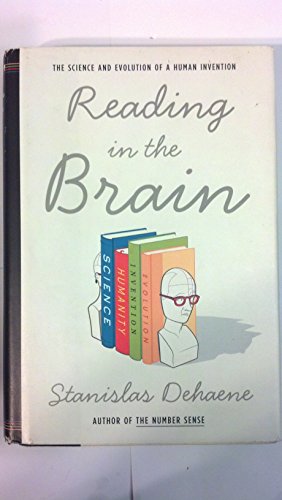
How can a few black marks on a white page evoke an entire universe of sounds and meanings? In this riveting investigation, Stanislas Dehaene provides an accessible account of the brain circuitry of reading and explores what he calls the ?reading paradox?: Our cortex is the product of millions of years of evolution in a world without writing, so how did it adapt to recognize words? Reading in the Brain describes pioneering research on how we process language, revealing the hidden logic of spelling and the existence of powerful unconscious mechanisms for decoding words of any size, case, or font.
Dehaene?s research will fascinate not only readers interested in science and culture, but also educators concerned with debates on how we learn to read, and who wrestle with pathologies such as dyslexia. Like Steven Pinker, Dehaene argues that the mind is not a blank slate: Writing systems across all cultures rely on the same brain circuits, and reading is only possible insofar as it fits within the limits of a primate brain. Setting cutting-edge science in the context of cultural debate, Reading in the Brain is an unparalleled guide to a uniquely human ability.
How can a few black marks on a white page evoke an entire universe of sounds and meanings? In this riveting investigation, Stanislas Dehaene provides an accessible account of the brain circuitry of reading and explores what he calls the ?reading paradox?: Our cortex is the product of millions of years of evolution in a world without writing, so how did it adapt to recognize words? Reading in the Brain describes pioneering research on how we process language, revealing the hidden logic of spelling and the existence of powerful unconscious mechanisms for decoding words of any size, case, or font.
Dehaene?s research will fascinate not only readers interested in science and culture, but also educators concerned with debates on how we learn to read, and who wrestle with pathologies such as dyslexia. Like Steven Pinker, Dehaene argues that the mind is not a blank slate: Writing systems across all cultures rely on the same brain circuits, and reading is only possible insofar as it fits within the limits of a primate brain. Setting cutting-edge science in the context of cultural debate, Reading in the Brain is an unparalleled guide to a uniquely human ability.
"synopsis" may belong to another edition of this title.
About the Author
STANISLAS DEHAENE is the director of the Cognitive Neuroimaging Unit in Saclay, France, and the professor of experimental cognitive psychology at the Coll���ge de France. He is the author of Reading in the Brain.
Reviews
From The Washington Post's Book World/washingtonpost.com Reviewed by Susan Okie About 5,000 years ago, societies in ancient Sumeria, China and South America invented writing, and in the millennia since, the ability to read has propelled human intellectual and cultural development, vastly expanding our capacity to learn, create, explore, and record what we think, feel and know. Reading supplies our brains with an external hard drive and gives us access to our species's past: In the words of Francisco de Quevedo, it enables us "to listen to the dead with our eyes." But how, in such a short time, did the human species evolve this unique skill, one that requires the brain to decode written words visually and process their sounds and sense rapidly? In this fascinating and scholarly book, French neuroscientist Stanislas Dehaene explains what scientists now know about how the human brain performs the feat of reading, and what made this astonishing cultural invention biologically possible. Presented with a word's image on the retina, average readers of English can, within a few 10ths of a second, match it with one of 50,000 or more words stored in their mental dictionaries, comprehend its meaning in context and proceed seamlessly to the next word. Amazingly, most children become proficient readers during elementary school (although learning to read Italian is easier, and learning to read Chinese harder, than learning to read English). In recent years, new imaging techniques have allowed researchers to watch normal brains in the act of reading, and studies have shed light on why the brains of dyslexic children, as well as those of certain stroke victims, fail to process written words successfully. "Only a stroke of good fortune allowed us to read," Dehaene writes near the end of his tour of the reading brain. It was Homo sapiens's luck that in our primate ancestors, a region of the brain's paired temporal lobes evolved over a period of 10 million years to specialize in the visual identification of objects. Experiments in monkeys show that, within this area, individual nerve cells are dedicated to respond to a specific visual stimulus: a face, a chair, a vertical line. Research suggests that, in humans, a corresponding area evolved to become what Dehaene calls the "letterbox," responsible for processing incoming written words. Located in the brain's left hemisphere near the junction of the temporal and occipital lobes, the letterbox performs identical tasks in readers of all languages and scripts. Like a switchboard, it transmits signals to multiple regions concerned with words' sound and meaning -- for example, to areas that respond to noun categories (people, animals, vegetables), to parts of the motor cortex that respond to action verbs ("kiss," "kick"), even to cells in the brain's associative cortex that home in on very specific stimuli. (In one epileptic patient, for example, a nerve cell was found that fired only in response to images or the written name of actress Jennifer Aniston.) Children learn reading in a stepwise process: first, awareness that words are made up of phonemes or speech sounds (ba, da); then the discovery that there's a correspondence between these speech sounds and pairs or groups of letters. Later the child begins to recognize entire words, and after a few years, reading speed becomes independent of word length. Dehaene deplores the whole-language approach to teaching reading, in which beginning readers are presented with entire words or phrases in the hope of fostering earlier comprehension of text. He cites research showing that children who first learn which sounds are represented by which letters, and how pairs or groups of letters correspond to speech sounds, make steadier progress and achieve better reading scores than those taught using the whole-language method. He also notes the success of teaching methods that incorporate multiple senses and motor gestures, such as those used in Montessori schools. For example, in preparation for learning to read, young Montessori students are often asked to trace with their fingers the shapes of large letters cut out of sandpaper. The exercise makes use of vision, touch and spatial orientation, as well as mimicking the gestures used to print each letter. Between 5 percent and 17 percent of U.S. children suffer from dyslexia, or severe difficulty in reading. The disorder runs in families and probably has no single cause. Several susceptibility genes have been identified, most of them influencing the migration of nerve cells within the developing brain of the fetus. Research suggests that, even as infants, many dyslexic children have trouble hearing the difference between similar-sounding consonants such as b and d; but about one in four dyslexics has primarily visual difficulties with word-processing. Although there is no prospect of a cure for dyslexia, Dehaene points to promising results with various intervention strategies aimed at strengthening awareness of speech sounds and letter differences. After dozens of hours of training using such programs, Dehaene writes, the majority of dyslexic children "end up reading adequately, even if performance continues to lag behind that of their peers." Reading, in Dehaene's words, is "by far the finest gem" in humanity's cultural storehouse, and judging by the ubiquity of electronic messages and Web surfing, it's a skill no less essential in the digital age than it was during the age of print.
Copyright 2009, The Washington Post. All Rights Reserved.
The transparent and automatic feat of reading comprehension disguises an intricate biological effort, ably analyzed in this fascinating study. Drawing on scads of brain-imaging studies, case histories of stroke victims and ingenious cognitive psychology experiments, cognitive neuroscientist Dehaene (The Number Sense) diagrams the neural machinery that translates marks on paper into language, sound and meaning. It's a complex and surprising circuitry, both specific, in that it is housed in parts of the cortex that perform specific processing tasks, and puzzlingly abstract. (The brain, Dehaene hypothesizes, registers words mainly as collections of pairs of letters.) The author proposes reading as an example of neuronal recycling—the recruitment of previously evolved neural circuits to accomplish cultural innovations—and uses this idea to explore how ancient scribes shaped writing systems around the brain's potential and limitations. (He likewise attacks modern whole language reading pedagogy as an unnatural imposition on a brain attuned to learning by phonics.) This lively, lucid treatise proves once again that Dehaene is one of our most gifted expositors of science; he makes the workings of the mind less mysterious, but no less miraculous. Illus. (Nov. 16)
Copyright © Reed Business Information, a division of Reed Elsevier Inc. All rights reserved.
"About this title" may belong to another edition of this title.
Search results for Reading in the Brain: The Science and Evolution of...

Seller Image
Reading in the Brain: The Science and Evolution of a Human Invention
Seller: Greenworld Books, Arlington, TX, U.S.A.
Seller rating 5 out of 5 stars

Condition: very_good. Fast Free Shipping â" Very Good condition book with a firm cover and clean pages. Shows normal use and some light wear or limited notes markings. A solid, nice copy to enjoy. Seller Inventory # GWV.0670021105.VG
Stock Image
Reading in the Brain: The Science and Evolution of a Human Invention
Seller: World of Books (was SecondSale), Montgomery, IL, U.S.A.
Seller rating 5 out of 5 stars
Hardback. Condition: Good. Brings together the cognitive, the cultural, and the neurological in an elegant, compelling narrative. A revelatory work.--Oliver Sacks, M.D. The act of reading is so easily taken for granted that we forget what an astounding feat it is. How can a few black marks on white paper evoke an entire universe of meanings? It's even more amazing when we consider that we read using a primate brain that evolved to serve an entirely different purpose. In this riveting investigation, Stanislas Dehaene, author of How We Learn, explores every aspect of this human invention, from its origins to its neural underpinnings. A world authority on the subject, Dehaene reveals the hidden logic of spelling, describes pioneering research on hiw we process languages, and takes us into a new appreciation of the brain and its wondrous capacity to adapt. Seller Inventory # 00102397151
Seller Image
Reading in the Brain: The Science and Evolution of a Human Invention
Seller: Zoom Books East, Glendale Heights, IL, U.S.A.
Seller rating 5 out of 5 stars
Condition: good. Book is in good condition and may include underlining highlighting and minimal wear. The book can also include "From the library of" labels. May not contain miscellaneous items toys, dvds, etc. . We offer 100% money back guarantee and 24 7 customer service. Seller Inventory # ZEV.0670021105.G
Stock Image
Reading in the Brain : The Science and Evolution of a Human Invention
Published by
Penguin Publishing Group, 2009
ISBN 10: 0670021105
ISBN 13: 9780670021109
Used
Hardcover
First Edition
Seller: Better World Books, Mishawaka, IN, U.S.A.
Seller rating 5 out of 5 stars
Condition: Good. 1st Edition. Pages intact with minimal writing/highlighting. The binding may be loose and creased. Dust jackets/supplements are not included. Stock photo provided. Product includes identifying sticker. Better World Books: Buy Books. Do Good. Seller Inventory # 4272758-6
Stock Image
Reading in the Brain : The Science and Evolution of a Human Invention
Published by
Penguin Publishing Group, 2009
ISBN 10: 0670021105
ISBN 13: 9780670021109
Used
Hardcover
First Edition
Seller: Better World Books: West, Reno, NV, U.S.A.
Seller rating 5 out of 5 stars
Condition: Good. 1st Edition. Pages intact with minimal writing/highlighting. The binding may be loose and creased. Dust jackets/supplements are not included. Stock photo provided. Product includes identifying sticker. Better World Books: Buy Books. Do Good. Seller Inventory # 4272758-6
Stock Image
Reading in the Brain : The Science and Evolution of a Human Invention
Published by
Penguin Publishing Group, 2009
ISBN 10: 0670021105
ISBN 13: 9780670021109
Used
Hardcover
First Edition
Seller: Better World Books: West, Reno, NV, U.S.A.
Seller rating 5 out of 5 stars
Condition: Good. 1st Edition. Former library copy. Pages intact with minimal writing/highlighting. The binding may be loose and creased. Dust jackets/supplements are not included. Includes library markings. Stock photo provided. Product includes identifying sticker. Better World Books: Buy Books. Do Good. Seller Inventory # 4642334-6
Stock Image
Reading in the Brain : The Science and Evolution of a Human Invention
Published by
Penguin Publishing Group, 2009
ISBN 10: 0670021105
ISBN 13: 9780670021109
Used
Hardcover
First Edition
Seller: Better World Books, Mishawaka, IN, U.S.A.
Seller rating 5 out of 5 stars
Condition: Good. 1st Edition. Former library copy. Pages intact with minimal writing/highlighting. The binding may be loose and creased. Dust jackets/supplements are not included. Includes library markings. Stock photo provided. Product includes identifying sticker. Better World Books: Buy Books. Do Good. Seller Inventory # 4642334-6
Stock Image
Reading in the Brain : The Science and Evolution of a Human Invention
Published by
Penguin Publishing Group, 2009
ISBN 10: 0670021105
ISBN 13: 9780670021109
Used
Hardcover
First Edition
Seller: Better World Books, Mishawaka, IN, U.S.A.
Seller rating 5 out of 5 stars
Condition: Very Good. 1st Edition. Pages intact with possible writing/highlighting. Binding strong with minor wear. Dust jackets/supplements may not be included. Stock photo provided. Product includes identifying sticker. Better World Books: Buy Books. Do Good. Seller Inventory # 709383-6
Seller Image
Reading in the Brain: The Science and Evolution of a Human Invention
Seller: ZBK Books, Carlstadt, NJ, U.S.A.
Seller rating 5 out of 5 stars
Condition: good. Fast & Free Shipping â" Good condition. It may show normal signs of use, such as light writing, highlighting, or library markings, but all pages are intact and the book is fully readable. A solid, complete copy that's ready to enjoy. Seller Inventory # ZWV.0670021105.G
Stock Image
Reading in the Brain: The Science and Evolution of a Human Invention
Seller: St Vincent de Paul of Lane County, Eugene, OR, U.S.A.
Seller rating 5 out of 5 stars
Condition: Acceptable. BOOK HAS SPORADIC HIGHLIGHTING AND OCCASIONAL NOTE THAT DOES NOT EFFECT READABILITY. hardcover 100% of proceeds go to charity! Acceptable reading copy with obvious signs of use, wear, and/or cosmetic issues. Item is complete and remains readable despite notable condition issues. Seller Inventory # O-02-5143