
Items related to The Difference Engine: Charles Babbage and the Quest...
Synopsis
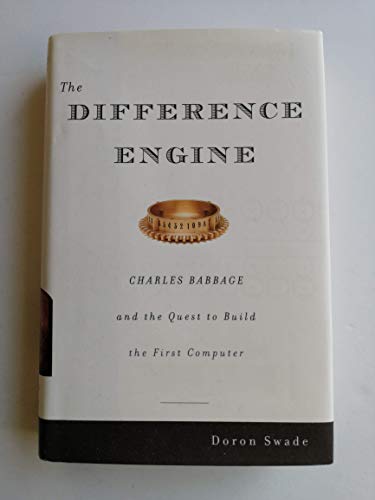
A portrait of early nineteenth-century mathematician Charles Babbage describes his efforts to construct the first computing machine more than one century before the invention of the modern computer. 22,500 first printing.
"synopsis" may belong to another edition of this title.
About the Author
Doron Swade is Assistant Director and Head of Collections at the Science Museum in London.
Reviews
Englishman Charles Babbage (1791-1871), an eccentric, ingenious mathematician, decided that existing tables of computations included far too many errors: the day's textbooks came with errata sheets appended by more errata sheets. The inventive Babbage entered completely new territory in his struggle to design an automatic computing machine that could achieve an "absolute integrity of results," and in the 1820s he completed plans for the "Difference Engine." Swade (coauthor of The Dream Machine), an assistant director at the London Science Museum, offers an engaging biography of Babbage and his milieu (buttressed by 16 pages of b&w photos and illustrations). Babbage convinced the government to invest in his invention, but the technology of the day made it prohibitively expensive to complete the machine to his satisfaction. He went on to design the "Analytical Engine," a quicker, more advanced, more broadly applicable machine that could be programmed with punch cards to do computations and store data. Unfortunately, Babbage never got to build this second machine, either. His life was full of personal tragedy, political confrontations, the personal vendettas of colleagues and the frustration of being unable to build what he designed. In the 1980s, Swade gathered a team of experts and tried to make sense of Babbage's drawings and notes in a modern quest to construct what Babbage could not. Swade's able account of this gifted scientist, his cohorts and their curious endeavors enhances and broadens the growing body of literature on computer history. (Sept. 10)Forecast: The "technological frontier" parallels between Babbage's age and our own are becoming increasingly clear, and Swade's immersion in and love for Babbage's project comes through here (beyond some British reserve). Of all the books this season whose flap copy compares them to Longitude, this title has one of the best shots at a similar breakout.
Copyright 2001 Cahners Business Information, Inc.
Babbage is regarded as a pioneer in the computing field and has already been the subject of several biographies. Any new biographer would face a challenge in finding original material, but Swade amply answers the call. Swade became involved with a project in the late 1980s to mark Babbage's two-hundredth birthday by building one of his designs, the Difference Engine No. 2. The details of this construction, bedeviled by gremlins both mechanical and financial, provide an explanation for why Babbage never fully completed any of his calculating contraptions. A partial answer lies in the experience of Swade's construction group, which contended with a maddening variety of jams in the engine. And a partial answer lies in Babbage's difficult personality, for although he was well liked by many fellow scientists, he alienated the powerful people who could have aided his projects. Despite the lack of financial backing, Babbage kept working at his designs, and Swade's exemplary mediation of them for nontechnical readers will fascinate and inform anyone interested in the history of computers. Gilbert Taylor
Copyright © American Library Association. All rights reserved
One of the first devices to be considered an automatic digital computer was conceived by the eccentric British mathematician Charles Babbage in 1822. In Babbage's time, teams of mathematicians working around the clock with primitive calculations generated complex logarithmic and trigonometric tables manually. Noting the large number of errors in these tables, Babbage proposed building an enormous mechanical calculator that he called a "Difference Engine" to calculate them automatically. Engineer and historian of technology Swade (coauthor, The Dream Machine) tells the story of Babbage's determined efforts to construct the first computing machine, which was, unfortunately, only partially completed despite financial backing from the British government. Nonetheless, Babbage's story, set against the politics and science of the early Victorian age, is fascinating. More than 150 years after its conception, one of Babbage's Difference Engines was constructed from original drawings by a team headed up by Swade at London's Science Museum. Recommended for an informed audience. Joe Accardi, William Rainey Harper Coll., Palatiane, IL
Copyright 2001 Reed Business Information, Inc.
"About this title" may belong to another edition of this title.
Search results for The Difference Engine: Charles Babbage and the Quest...

Stock Image
The Difference Engine: Charles Babbage and the Quest to Build the First Computer
Seller: World of Books (was SecondSale), Montgomery, IL, U.S.A.
Seller rating 5 out of 5 stars

Hardback. Condition: Good. Seller Inventory # 00110269591
Stock Image
The Difference Engine: Charles Babbage and the Quest to Build the First Computer
Seller: World of Books (was SecondSale), Montgomery, IL, U.S.A.
Seller rating 5 out of 5 stars
Hardback. Condition: Very Good. Seller Inventory # 00108615486
Stock Image
The Difference Engine: Charles Babbage and the Quest to Build the First Computer
Published by
Viking Adult (edition ), 2001
ISBN 10: 0670910201
ISBN 13: 9780670910205
Used
Hardcover
Seller: BooksRun, Philadelphia, PA, U.S.A.
Seller rating 5 out of 5 stars
Hardcover. Condition: Very Good. With dust jacket. It's a well-cared-for item that has seen limited use. The item may show minor signs of wear. All the text is legible, with all pages included. It may have slight markings and/or highlighting. Seller Inventory # 0670910201-11-1-29
Seller Image
The Difference Engine: Charles Babbage and the Quest to Build the First Computer
Seller: Bay State Book Company, North Smithfield, RI, U.S.A.
Seller rating 5 out of 5 stars
Condition: good. The book is in good condition with all pages and cover intact, including the dust jacket if originally issued. The spine may show light wear. Pages may contain some notes or highlighting, and there might be a "From the library of" label. Boxed set packaging, shrink wrap, or included media like CDs may be missing. Seller Inventory # BSM.1ANQX
Stock Image
The Difference Engine: Charles Babbage and the Quest to Build the First Computer
Seller: ThriftBooks-Dallas, Dallas, TX, U.S.A.
Seller rating 5 out of 5 stars
Hardcover. Condition: Good. No Jacket. Missing dust jacket; Pages can have notes/highlighting. Spine may show signs of wear. ~ ThriftBooks: Read More, Spend Less. Seller Inventory # G0670910201I3N01
Stock Image
The Difference Engine: Charles Babbage and the Quest to Build the First Computer
Seller: ThriftBooks-Dallas, Dallas, TX, U.S.A.
Seller rating 5 out of 5 stars
Hardcover. Condition: Very Good. No Jacket. Former library book; May have limited writing in cover pages. Pages are unmarked. ~ ThriftBooks: Read More, Spend Less. Seller Inventory # G0670910201I4N10
Stock Image
The Difference Engine: Charles Babbage and the Quest to Build the First Computer
Seller: ThriftBooks-Dallas, Dallas, TX, U.S.A.
Seller rating 5 out of 5 stars
Hardcover. Condition: Good. No Jacket. Pages can have notes/highlighting. Spine may show signs of wear. ~ ThriftBooks: Read More, Spend Less. Seller Inventory # G0670910201I3N00
Stock Image
The Difference Engine: Charles Babbage and the Quest to Build the First Computer
Seller: HPB-Diamond, Dallas, TX, U.S.A.
Seller rating 5 out of 5 stars
Hardcover. Condition: Very Good. Connecting readers with great books since 1972! Used books may not include companion materials, and may have some shelf wear or limited writing. We ship orders daily and Customer Service is our top priority! Seller Inventory # S_469494805
Stock Image
The Difference Engine: Charles Babbage and the Quest to Build the First Computer
Seller: HPB Inc., Dallas, TX, U.S.A.
Seller rating 5 out of 5 stars
hardcover. Condition: Very Good. Connecting readers with great books since 1972! Used books may not include companion materials, and may have some shelf wear or limited writing. We ship orders daily and Customer Service is our top priority! Seller Inventory # S_445739499
Stock Image
The Difference Engine: Charles Babbage and the Quest to Build the First Computer
Seller: HPB-Emerald, Dallas, TX, U.S.A.
Seller rating 5 out of 5 stars
hardcover. Condition: Very Good. Connecting readers with great books since 1972! Used books may not include companion materials, and may have some shelf wear or limited writing. We ship orders daily and Customer Service is our top priority! Seller Inventory # S_478696250