
Items related to Los Angeles
Synopsis
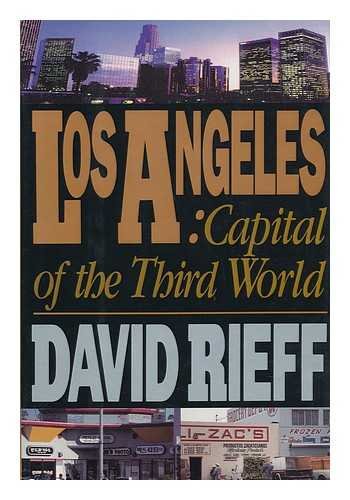
The author turns his critical eye to the City of Angels, discussing L.A.'s gridlocked freeways, immigrant neighborhoods, posh Beverly Hills, popular culture, health consciousness, and more, and speculates on the city's future
"synopsis" may belong to another edition of this title.
Reviews
Angelenos speak in catchphrases and take pride in the length of their commute. Los Angeles is a city where "people and their things are hard to tell apart," where mobile pleasure-seekers find the prospect of raising kids "just a little bit of a drag." While its middle class gets "sucked into . . . upscale consumption," its masses of largely poor Asian and Hispanic immigrants, many of them illegal, are not being assimilated, according to Rieff ( Going to Miami ). Drive-by shootings are nightly occurrences in black slums, and thousands of homeless ply the beaches of Venice and Santa Monica. A devastating, wonderful, witty send-up of L.A.--and CA--as crucibles of the 21st century, this disquieting report delineates a city with an ethos of unchecked growth, sprawl and possibility that "decontextualizes" its residents from reality. First serial to Los Angeles Times; author tour.
Copyright 1991 Reed Business Information, Inc.
Ambitious in both style and substance, Rieff's second major book on a US metropolis (Going to Miami, 1987) attempts to resolve the contradictions of L.A. by proclaiming it the Third World's capital. It's a hard sell, but Rieff does create a memorable sermon on the myopia afflicting the middle and upper classes in southern California, who seem desperately unaware of their city's decline. This is a book about gardeners, real estate, and cars: in other words, about immigration, diminishing expectations, and social and cultural gridlock. The author, a full-blown intellectual of the New York-Paris axis, has his cosmopolitan way with that most rigorous and decadent of places. He seems to mean his book to be both serious and droll, as well as a stylistic tour de force, and he comes close on all three aims. But this is also an exercise in aggravation. There's Rieff's overdependence on his ``good friend Allegra,'' a BMW-driving Everywoman, plus his unfortunate penchant of condescending to the Third World help (``...when the conversation turned, as it did so often in bourgeois America in 1989 and 1990, to the collapse of the Soviet empire, I would slip into the kitchen and talk to the maid...[where] the Rosa or Maria...in question would tell me stories about home''). Lapsing into a faux-L.A. tone, at times the author achieves the very banality he seeks to parody. Another flaw is an indistinct focus-- he makes sweeping statements about the City of Los Angeles (where ``most whites had long ago abandoned the public schools'') that simply aren't true of the much larger Los Angeles County. Yet there's much to be grateful for as well: an ambitious prose style, a thorough historical buildup that does justice to L.A.'s elusive yet crucial spirit, and a knack for the telling statistic or detail. A big book that justifies the attention Rieff has drawn, without quite earning the laurels predicted of him. -- Copyright ©1991, Kirkus Associates, LP. All rights reserved.
"About this title" may belong to another edition of this title.
Search results for Los Angeles

Stock Image
Los Angeles: Capital of the Th
Seller: World of Books (was SecondSale), Montgomery, IL, U.S.A.
Seller rating 5 out of 5 stars

Condition: Very Good. Item in very good condition! Textbooks may not include supplemental items i.e. CDs, access codes etc. Seller Inventory # 00103432875
Stock Image
Los Angeles: Capital of the Th
Seller: World of Books (was SecondSale), Montgomery, IL, U.S.A.
Seller rating 5 out of 5 stars
Condition: Good. Item in good condition. Textbooks may not include supplemental items i.e. CDs, access codes etc. Seller Inventory # 00109780068
Stock Image
Los Angeles
Published by
Simon & Schuster (edition First Edition), 1991
ISBN 10: 0671671707
ISBN 13: 9780671671709
Used
Hardcover
First Edition
Seller: BooksRun, Philadelphia, PA, U.S.A.
Seller rating 5 out of 5 stars
Hardcover. Condition: Very Good. First Edition. With dust jacket. It's a well-cared-for item that has seen limited use. The item may show minor signs of wear. All the text is legible, with all pages included. It may have slight markings and/or highlighting. Seller Inventory # 0671671707-11-1-29
Stock Image
Los Angeles
Seller: Wonder Book, Frederick, MD, U.S.A.
Seller rating 5 out of 5 stars
Condition: Very Good. Very Good condition. Very Good dust jacket. A copy that may have a few cosmetic defects. May also contain light spine creasing or a few markings such as an owner's name, short gifter's inscription or light stamp. Seller Inventory # I32K-01172
Stock Image
Los Angeles : Capital of the Third World
Published by
Simon & Schuster, 1991
ISBN 10: 0671671707
ISBN 13: 9780671671709
Used
Hardcover
First Edition
Seller: Better World Books, Mishawaka, IN, U.S.A.
Seller rating 5 out of 5 stars
Condition: Good. First Edition. Former library copy. Pages intact with minimal writing/highlighting. The binding may be loose and creased. Dust jackets/supplements are not included. Includes library markings. Stock photo provided. Product includes identifying sticker. Better World Books: Buy Books. Do Good. Seller Inventory # 8456900-6
Stock Image
Los Angeles
Seller: Once Upon A Time Books, Siloam Springs, AR, U.S.A.
Seller rating 4 out of 5 stars

hardcover. Condition: Acceptable. This is a used book. It may contain highlighting/underlining and/or the book may show heavier signs of wear . It may also be ex-library or without dustjacket. This is a used book. It may contain highlighting/underlining and/or the book may show heavier signs of wear . It may also be ex-library or without dustjacket. Seller Inventory # mon0003485539
Stock Image
Los Angeles
Seller: ThriftBooks-Dallas, Dallas, TX, U.S.A.
Seller rating 5 out of 5 stars
Hardcover. Condition: Very Good. No Jacket. Former library book; May have limited writing in cover pages. Pages are unmarked. ~ ThriftBooks: Read More, Spend Less. Seller Inventory # G0671671707I4N10
Stock Image
Los Angeles: Capital of the Third World
Seller: World of Books Inc, Montgomery, IL, U.S.A.
Seller rating 4 out of 5 stars
Hardback. Condition: Very Good. The author turns his critical eye to the City of Angels, discussing L.A.'s gridlocked freeways, immigrant neighborhoods, posh Beverly Hills, popular culture, health consciousness, and more, and speculates on the city's future. Seller Inventory # CIN0671671707VG
Stock Image
Los Angeles
Seller: HPB Inc., Dallas, TX, U.S.A.
Seller rating 5 out of 5 stars
hardcover. Condition: Very Good. Connecting readers with great books since 1972! Used books may not include companion materials, and may have some shelf wear or limited writing. We ship orders daily and Customer Service is our top priority! Seller Inventory # S_464955819
Stock Image
Los Angeles
Seller: Library House Internet Sales, Grand Rapids, OH, U.S.A.
Seller rating 5 out of 5 stars
Hardcover. Condition: Very Good. Dust Jacket Condition: Very Good. The author turns his critical eye to the City of Angels, discussing L.A.'s gridlocked freeways, immigrant neighborhoods, posh Beverly Hills, popular culture, health consciousness, and more, and speculates on the city's future Solid binding. Please note the image in this listing is a stock photo and may not match the covers of the actual item. Book. Seller Inventory # 123667933