
Items related to Many Thousands Gone: The First Two Centuries of Slavery...
Synopsis
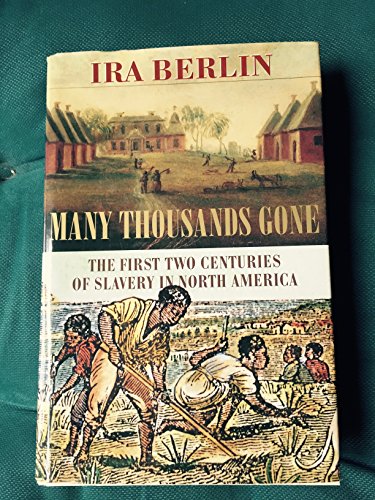
Today most Americans, black and white, identify slavery with cotton, the deep South, and the African-American church. But at the beginning of the nineteenth century, after almost two hundred years of African-American life in mainland North America, few slaves grew cotton, lived in the deep South, or embraced Christianity. Many Thousands Gone traces the evolution of black society from the first arrivals in the early seventeenth century through the Revolution. In telling their story, Ira Berlin, a leading historian of southern and African-American life, reintegrates slaves into the history of the American working class and into the tapestry of our nation.
Laboring as field hands on tobacco and rice plantations, as skilled artisans in port cities, or soldiers along the frontier, generation after generation of African Americans struggled to create a world of their own in circumstances not of their own making. In a panoramic view that stretches from the North to the Chesapeake Bay and Carolina lowcountry to the Mississippi Valley, Many Thousands Gone reveals the diverse forms that slavery and freedom assumed before cotton was king. We witness the transformation that occurred as the first generations of creole slaves―who worked alongside their owners, free blacks, and indentured whites―gave way to the plantation generations, whose back-breaking labor was the sole engine of their society and whose physical and linguistic isolation sustained African traditions on American soil.
As the nature of the slaves’ labor changed with place and time, so did the relationship between slave and master, and between slave and society. In this fresh and vivid interpretation, Berlin demonstrates that the meaning of slavery and of race itself was continually renegotiated and redefined, as the nation lurched toward political and economic independence and grappled with the Enlightenment ideals that had inspired its birth.
"synopsis" may belong to another edition of this title.
About the Author
Ira Berlin was Distinguished University Professor at the University of Maryland, College Park.
Reviews
The history of slavery in North America is not as simple, clear-cut or tidy as is often believed. That is the message of this impeccably presented history of American slavery from 1619, when John Rolfe brought "twenty Negars" to the Jamestown colony, to the 1820s, when the spirit of emancipation began to take hold in the North. Berlin, a history professor at the University of Maryland, shows how at different times and at different places, slavery was a very different thing. He makes a great distinction, for example, between slave societies such as the Carolina low country in the 17th century (in which both the economy and the social structure was built upon slavery) and societies with slaves (the lower Mississippi of the same era) where slavery was only part of a more complex structure. He shows how slavery was different for those born in the West Indies, Africa and North America, and for those serving in urban settings (which encouraged a certain entrepreneurial spirit) and in rural. These distinctions have continuing resonance, as Berlin shows that once a society with slaves became a slave society, all blacks?free or not?could come to be regarded as slaves: in short, how an economic system became racism. Although the prose is serviceable more than anything else, the book holds many surprises gleaned from the facts, whether in its portrait of New York as a major slave city or its descriptions of free enterprise at work among slaves. The economic and historical research presented here is impressive. But what gives the book an additional dimension is its deftly employed social insights.
Copyright 1998 Reed Business Information, Inc.
Recently, there has been a spate of books on the issue of slavery. Drawing on tapes made by the Federal Writers Project in the 1930s and 1940s, Remembering Slavery (LJ 9/1/98) records the history of slavery as told by ex-slaves. This powerful document was edited partly by Berlin, a prominent historian on the subject, whose Many Thousands Gone, offers "an imaginative, detailed account of American slavery from its origins at the beginning of the 17th century through the revolution" (LJ 9/15/98). Johnson and Smith's book, which accompanies a PBS series, has been marred by controversy?Smith was fired from the Boston Globe for fabricating stories. But the book remains both an "easy-to-read history of American slavery" (LJ 9/15/98) and an imaginative rethinking of history: fiction writer Johnson integrates a dozen short stories into the text.
Copyright 1998 Reed Business Information, Inc.
Rather than focus on the much studied slavery of the antebellum South, Berlin examines the earlier history of slavery throughout North America and how it affected the consequent nature and evolution of the peculiar institution. Berlin, an editor of Remembering Slavery, an absorbing collection of slave accounts (see Upfront section of this issue), examines how slave culture was shaped by economic, demographic, and topographic differences. The labor intensiveness of rice and indigo, for instance, discouraged the development of slave enterprises that were created in regions where the dominant crop was the more seasonal tobacco. Berlin explores how the need for diversified labor led to slaves developing artisan skills, and how the need for increased slave population led to encouragement of more stable family relationships. He traces the first African presence in the Americas to a "charter generation" that was multilingual and multicultural, through the "plantation generation" that adjusted its African culture to the various regions of the U.S., and, finally, the "revolutionary generation" that began to challenge U.S. ideals of liberty and freedom in the face of slavery. Throughout this fascinating book, Berlin deftly outlines the human negotiations that went on even in so unequal a relationship as master-slave. Vanessa Bush
"About this title" may belong to another edition of this title.
Search results for Many Thousands Gone: The First Two Centuries of Slavery...

Stock Image
Many Thousands Gone: The First Two Centuries of Slavery in North America
Published by
Belknap Press: An Imprint of Harvard University Press (edition ), 1998
ISBN 10: 0674810929
ISBN 13: 9780674810921
Used
Hardcover
Seller: BooksRun, Philadelphia, PA, U.S.A.
Seller rating 5 out of 5 stars

Hardcover. Condition: Fair. With dust jacket. The item might be beaten up but readable. May contain markings or highlighting, as well as stains, bent corners, or any other major defect, but the text is not obscured in any way. Seller Inventory # 0674810929-7-1-13_29
Stock Image
Many Thousands Gone: The First Two Centuries of Slavery in North America
Published by
Belknap Press: An Imprint of Harvard University Press (edition ), 1998
ISBN 10: 0674810929
ISBN 13: 9780674810921
Used
Hardcover
Seller: BooksRun, Philadelphia, PA, U.S.A.
Seller rating 5 out of 5 stars
Hardcover. Condition: Very Good. With dust jacket. It's a well-cared-for item that has seen limited use. The item may show minor signs of wear. All the text is legible, with all pages included. It may have slight markings and/or highlighting. Seller Inventory # 0674810929-11-1-29
Stock Image
Many Thousands Gone : The First Two Centuries of Slavery in North America
Published by
Harvard University Press, 1998
ISBN 10: 0674810929
ISBN 13: 9780674810921
Used
Hardcover
Seller: Better World Books, Mishawaka, IN, U.S.A.
Seller rating 5 out of 5 stars
Condition: Good. Former library copy. Pages intact with minimal writing/highlighting. The binding may be loose and creased. Dust jackets/supplements are not included. Includes library markings. Stock photo provided. Product includes identifying sticker. Better World Books: Buy Books. Do Good. Seller Inventory # 729583-6
Stock Image
Many Thousands Gone : The First Two Centuries of Slavery in North America
Published by
Harvard University Press, 1998
ISBN 10: 0674810929
ISBN 13: 9780674810921
Used
Hardcover
Seller: Better World Books, Mishawaka, IN, U.S.A.
Seller rating 5 out of 5 stars
Condition: Good. Pages intact with minimal writing/highlighting. The binding may be loose and creased. Dust jackets/supplements are not included. Stock photo provided. Product includes identifying sticker. Better World Books: Buy Books. Do Good. Seller Inventory # GRP13745895
Seller Image
Many Thousands Gone: The First Two Centuries of Slavery in North America
Published by
Belknap Press: An Imprint of Harvard University Press, 1998
ISBN 10: 0674810929
ISBN 13: 9780674810921
Used
Hardcover
Seller: Greenworld Books, Arlington, TX, U.S.A.
Seller rating 5 out of 5 stars
Condition: good. Fast Free Shipping â" Good condition. It may show normal signs of use, such as light writing, highlighting, or library markings, but all pages are intact and the book is fully readable. A solid, complete copy that's ready to enjoy. Seller Inventory # GWV.0674810929.G
Stock Image
Many Thousands Gone: The First Two Centuries of Slavery in North America
Seller: HPB-Red, Dallas, TX, U.S.A.
Seller rating 5 out of 5 stars
Hardcover. Condition: Acceptable. Connecting readers with great books since 1972. Used textbooks may not include companion materials such as access codes, etc. May have condition issues including wear and notes/highlighting. We ship orders daily and Customer Service is our top priority! Seller Inventory # S_435403452
Seller Image
Many Thousands Gone: The First Two Centuries of Slavery in North America
Published by
Belknap Press: An Imprint of Harvard University Press, 1998
ISBN 10: 0674810929
ISBN 13: 9780674810921
Used
Hardcover
Seller: Shakespeare Book House, Rockford, IL, U.S.A.
Seller rating 5 out of 5 stars
Condition: good. Used book that is clean, average condition without any missing pages. Seller Inventory # EBBV.0674810929.G
Stock Image
Many Thousands Gone: The First Two Centuries of Slavery in North America
Published by
Belknap Press: An Imprint of Harvard University Press, 1998
ISBN 10: 0674810929
ISBN 13: 9780674810921
Used
Hardcover
Seller: Wonder Book, Frederick, MD, U.S.A.
Seller rating 5 out of 5 stars
Condition: Good. Good condition. Good dust jacket. A copy that has been read but remains intact. May contain markings such as bookplates, stamps, limited notes and highlighting, or a few light stains. Seller Inventory # P16T-00567
Stock Image
Many Thousands Gone: First Two Centuries of Slavery in North America
Published by
Harvard University Press, 1998
ISBN 10: 0674810929
ISBN 13: 9780674810921
Used
Hardcover
Seller: World of Books (was SecondSale), Montgomery, IL, U.S.A.
Seller rating 5 out of 5 stars
Hardback. Condition: Fair. This text traces the evolution of black society from the first arrivals in the early-17th century through the Revolution. In telling their story, Ira Berlin reintegrates slaves into the history of the American working class and into the tapestry of the nation. Seller Inventory # 00108054755
Stock Image
Many Thousands Gone: First Two Centuries of Slavery in North America
Published by
Harvard University Press, 1998
ISBN 10: 0674810929
ISBN 13: 9780674810921
Used
Hardcover
Seller: World of Books (was SecondSale), Montgomery, IL, U.S.A.
Seller rating 5 out of 5 stars
Hardback. Condition: Good. This text traces the evolution of black society from the first arrivals in the early-17th century through the Revolution. In telling their story, Ira Berlin reintegrates slaves into the history of the American working class and into the tapestry of the nation. Seller Inventory # 00110225582