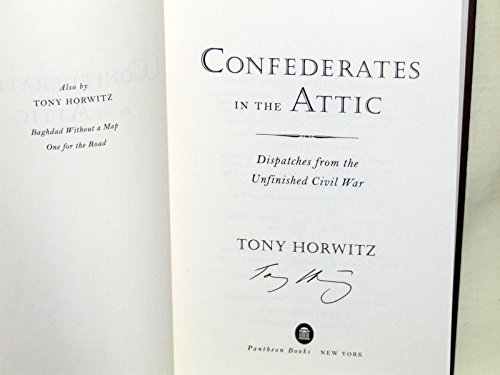
When prize-winning war correspondent Tony Horwitz leaves the battlefields of Bosnia and the Middle East for a peaceful corner of the Blue Ridge Mountains, he thinks he's put war zones behind him. But awakened one morning by the crackle of musket fire, Horwitz starts filing front-line dispatches again this time from a war close to home, and to his own heart.
Propelled by his boyhood passion for the Civil War, Horwitz embarks on a search for places and people still held in thrall by America's greatest conflict. The result is an adventure into the soul of the unvanquished South, where the ghosts of the Lost Cause are resurrected through ritual and remembrance.
In Virginia, Horwitz joins a band of 'hardcore' reenactors who crash-diet to achieve the hollow-eyed look of starved Confederates; in Kentucky, he witnesses Klan rallies and calls for race war sparked by the killing of a white man who brandishes a rebel flag; at Andersonville, he finds that the prison's commander, executed as a war criminal, is now exalted as a martyr and hero; and in the book's climax, Horwitz takes a marathon trek from Antietam to Gettysburg to Appomattox in the company of Robert Lee Hodge, an eccentric pilgrim who dubs their odyssey the 'Civil Wargasm.'
Written with Horwitz's signature blend of humor, history, and hard-nosed journalism, Confederates in the Attic brings alive old battlefields and new ones 'classrooms, courts, country bars' where the past and the present collide, often in explosive ways. Poignant and picaresque, haunting and hilarious, it speaks to anyone who has ever felt drawn to the mythic South and to the dark romance of the Civil War.
"synopsis" may belong to another edition of this title.
Tony Horwitz is the author of One for the Road and of the best-selling Baghdad Without a Map. A senior writer for The Wall Street Journal and winner of the 1995 Pulitzer Prize for national reporting, he has also written for The New Yorker and Harper's, among other publications. He lives with his wife and son in Virginia.
"The freshest book about divisiveness in America that I have read in some time. This splendid commemoration of the war and its legacy . . . is an eyes-open, humorously no-nonsense survey of complicated Americans."
--Roy Blount Jr., New York Times Book Review
"In this sparkling book Horwitz explores some of our culture's myths with the irreverent glee of a small boy hurling snowballs at a beaver hat. . . . An important contribution to understanding how echoes of the Civil War have never stopped."
--USA Today
Horwitz's chronicle of his odyssey through the nether and ethereal worlds of Confederatemania is by turns amusing, chilling, poignant, and always fascinating. He has found the Lost Cause and lived to tell the tale a wonderfully piquant tale of hardcore reenactors, Scarlett O'Hara look-alikes, and people who reshape Civil War history to suit the way they wish it had come out. If you want to know why the war isn't over yet in the South, read Confederates in the Attic to find out.
--James McPherson, author of Battle Cry of Freedom
The enthusiasm, opinions, and beliefs of latter-day Confederates don't get much mainstream exposure these days, but Tony Horwitz portrays them with accuracy, humor, and respect. This is a serious book on a serious subject, but it often made me laugh out loud. Like some characters from a Walker Percy novel, Horwitz keeps finding himself in utterly absurd settings, with colorful, even bizarre, companions.
--John Shelton Reed, author of Whistling Dixie: Dispatches from the South
inning war correspondent Tony Horwitz leaves the battlefields of Bosnia and the Middle East for a peaceful corner of the Blue Ridge Mountains, he thinks he's put war zones behind him. But awakened one morning by the crackle of musket fire, Horwitz starts filing front-line dispatches again this time from a war close to home, and to his own heart.
Propelled by his boyhood passion for the Civil War, Horwitz embarks on a search for places and people still held in thrall by America's greatest conflict. The result is an adventure into the soul of the unvanquished South, where the ghosts of the Lost Cause are resurrected through ritual and remembrance.
In Virginia, Horwitz joins a band of 'hardcore' reenactors who crash-diet to achieve the hollow-eyed look of starved Confederates; in Kentucky, he witnesses Klan rallies and calls for race war sparked by the killing of a white man who brandishes a rebel
Pulitzer Prizewinning journalist Horwitz (Baghdad Without a Map, 1991, etc.) takes an eye-opening turn in the South, where his childhood obsession with the Confederacy collides with hard adult realities about race and culture in America. Growing up in Virginia, Horwitz painted rebel heroes on the walls of his attic bedroom. Returning home after a decade spent covering foreign wars, he launches a year-long ramble through the landscape of the Civil War, traveling from Virginia to Alabama in search of explanations for his (and America's) continuing interest in the conflict. Horwitz accompanies a hard-core reenactor obsessed with authenticity (and whose gruesome specialty--``bloating'' in imitation of a corpse--puts him in demand with artists and filmmakers) on ``the Civil Wargasm,'' a whirlwind seven-day tour of battlegrounds. He visits Shelby Foote and lesser known historians like Jimmy Olgers, an eccentric storekeeper whose folk museum sports a life-size statue of Robert E. Lee made from sheetrock. Trading notes with park rangers, Horwitz discovers that much of what he knows is more myth than fact and that historical misrepresentation at federally maintained battlefields is frequently abetted by local boosterism. Nowhere is the tension between past and present more raw and divisive than in Richmond, where proposals to honor Arthur Ashe on Monument Avenue, the city's cavalcade of Confederate heroes, spur protests from whites and blacks alike. It's remarkable how much strong emotion the war still evokes (especially in the local taverns and gunshops Horwitz wisely seeks out) and how stubbornly it divides the country along racial lines--a division summed up bluntly by a redneck T-shirt that challenges blacks with a rebel battle flag over the caption ``You wear your X, I'll wear mine.'' Horwitz's reflective odyssey uncovers a profoundly disaffected nation, where battles over the Confederate flag, virulent antigovernment sentiment, and enduring ignorance and bigotry invite some dispiriting conclusions about the prospects for black/white rapprochement. (Author tour) -- Copyright ©1998, Kirkus Associates, LP. All rights reserved.
YA-Fascination with the Civil War runs in Horwitz's family. His Russian immigrant great-grandfather continued to pore over books on the subject at age 101 and his father read to the author each night from a 10-volume photographic history. Years later, the author and his wife awoke one morning to the sounds of a mock Civil War battle being filmed in front of their Virginia home. Subsequent conversations with the participants rekindled this enthusiasm and launched Horwitz on a year-long quest to determine why the Civil War continues to enthrall so many Americans. He journeyed throughout the Old South, visiting battlefields and museums. He joined "super hardcores" such as Robert Lee Hodge, learning about "farbs," "spooning," and "period rushes." He conversed with the only living Confederate widow and witnessed both the "Catechism" taught to Children of Confederate Veterans and the attitudes of black teens in Selma, AL. While his encounters ran the gamut from amusing to infuriating to positively frightening, this Pulitzer Prize-winning reporter relates them all with clarity and honesty. Read Confederates simply for the engrossing, well-written account of contemporary American culture that it is or choose any chapter to spark or enliven class discussion. Don't miss this one.
Dori DeSpain, Herndon Fortnightly Library, Fairfax County, VA
Copyright 1998 Reed Business Information, Inc.
Hilariously funny.
The first book the author's Russian grandfather bought on emigrating to the U.S., though he neither read nor spoke English, was about the Civil War, a book he still pored over into his 90s. And when Horwitz was a child, his father read him tales of the Civil War instead of fairy tales and children's literature. The powerful hold of that conflict on a diverse assortment of Americans translates into more than 60,000 books on the subject, according to the author; for some Civil War buffs it is an obsession that generates a startling number of clubs whose members regularly reenact the battles, playing out once again the logistics, problems, hardships, leading characters, losses and victories. Horwitz (Baghdad Without a Map), on a year-long exploration of these groups throughout the South, participated in some of their activities and came to know the lives and personalities of several of their members. His vivid, personal account is a mesmerizing review of history from a novel and entertaining angle.
Copyright 1998 Reed Business Information, Inc.
One of the prerequisites for a harmonious nation is the capacity to forget the pain of the past. Britons never seriously declare their personal resentment over the ill treatment of Saxons after the Norman Conquest. According to Horwitz's delightful but unsettling chronicle of his tour of the Old South, many people have yet to make peace with the past. In a South Carolina town, whites relate to Horwitz their pride in the "lost cause," even equating southern valor with the courage of Martin Luther King; a black preacher explains that affection for the "cause" strikes him as an endorsement of slavery. Esteemed Civil War scholar Shelby Foote strives to explain the origins of the Klan as the reaction to a perceived foreign occupation. In Baghdad without A Map, Horwitz displayed the gift of revealing the humanity of ordinary people that lies beneath the turbulence of the Middle East. This outstanding work shows his gift is still intact. It also shows that this nation still hasn't learned to cherish the past while forgetting the pain. Jay Freeman
From the first chapter?in which Horwitz details how he was recruited into the world of Civil War reenactors, or "living historians," as they prefer it?the reader is likewise drawn in. But this is not an outsider's tale of strange men and their silly games. It is the work of a skilled journalist looking at how?and why?the War Between the States continues to live in so many issues still with us.
Copyright 1999 Reed Business Information, Inc.
From Chapter One
There never will be anything more interesting in America than that Civil War never.
--Gertrude Stein
In 1965, a century after Appomattox, the Civil War began for me at a musty apartment in New Haven, Connecticut. My great-grandfather held a magnifying glass to his spectacles and studied an enormous book spread open on the rug. Peering over his shoulder, I saw pen-and-ink soldiers hurtling up at me with bayonets.
I was six, Poppa Isaac 101. Egg-bald, barely five feet tall, Poppa Isaac lived so frugally that he sliced cigarettes in half before smoking them. An elderly relative later told me that Poppa Isaac bought the book of Civil War sketches soon after emigrating to America in 1882. He often shared it with his children and grandchildren before I came along.
Years later, I realized what was odd about this one vivid memory of my great-grandfather. Isaac Moses Perski fled Czarist Russia as a teenaged draft dodger--in Yiddish, a shirker--and arrived at Ellis Island without money or English or family. He worked at a Lower East Side sweatshop and lived literally on peanuts, which were cheap, filling and nutritious. Why, I wondered, had this thrifty refugee chosen as one of his first purchases in America a book written in a language he could barely understand, about a war in a land he barely knew, a book that he kept poring over until his death at 102?
By the time Poppa Isaac died, my father had begun reading aloud to me each night from a ten-volume collection called The Photo-graphic History of the Civil War. Published in 1911, the volumes' ripe prose sounded as foreign to me as the captions of my great-grandfather's book must have seemed to him. So, like Poppa Isaac, I lost myself in the pictures: sepia men leading sepia horses across cornfields and creeks; jaunty volunteers, their faces framed by squished caps and fire-hazard beards; barefoot Confederates sprawled in trench mud, eyes open, limbs twisted like licorice. For me, the fantastical creatures of Maurice Sendak held little magic compared to the man-boys of Mathew Brady who stared back across the century separating their lives from mine.
Before long, I began to read aloud with my father, chanting the strange and wondrous rivers--Shenandoah, Rappahannock, Chickahominy--and wrapping my tongue around the risible names of rebel generals: Braxton Bragg, Jubal Early, John Sappington Marmaduke, William "Extra Billy" Smith, Pierre Gustave Toutant Beauregard. I learned about palindromes from the Southern sea captain Raphael Semmes. And I began to match Brady's still-deaths with the curt stutter of farm roads and rocks that formed the photographer's backdrop: Mule Shoe, Slaughter Pen, Bloody Lane, Devil's Den.
In third grade, I penciled a highly derivative Civil War history of my own--"The war was started when after all the states had sececed," it began--and embarked on an ambitious art project, painting the walls of our attic with a lurid narrative of the conflict. Preferring underdogs, I posted a life-sized Johnny Reb by the bathroom door. A pharaonic frieze of rebel soldiers at Antietam stretched from the stairs to the attic window. Albert Sidney Johnston's death at Shiloh splashed across an entire wall. General Pickett and his men charged bravely into the eaves.
I'd reached the summer of 1863 and run out of wall. But standing in the middle of the attic, I could whirl and whirl and make myself dizzy with my own cyclorama. The attic became my bedroom and the murals inhabited my boyhood dreaming. And each morning I woke to a comforting sound: my father bounding up the attic steps, blowing a mock bugle call through his fingers and shouting, "General, the troops await your command!"
Twenty-five years later, the murals were still there and so was my boyhood obsession. I'd just returned to America after nine years abroad and moved to an old house in the foothills of the Blue Ridge Mountains. My Australian wife chose the spot; the fields and cows and crooked fences fit Geraldine's image of outback America. For me, the place stirred something else. I stared at a brick church still bullet-scarred from a Civil War skirmish. In the lumpy village graveyard, I found Confederates and Yankees buried side by side, some of them kin to each other. Within an hour of our new home lay several of the battlegrounds I'd painted as a child, and to which I now dragged Geraldine on weekend drives.
At a picnic soon after our arrival, I overheard a neighbor ask Geraldine how she liked Virginia. "Fine," she sighed. "Except that my husband's become a Civil War bore."
I'd always been one, of course, but my obsession had lain dormant for several decades. With adolescence had come other passions, and I'd stuffed my toy musket, plastic rebel soldiers and Lincoln Logs into a closet reserved for boyish things. A Day-Glo poster of Jimi Hendrix supplanted Johnny Reb. Pickett's Charge and Antietam Creek vanished behind dart boards, Star Trek posters and steep drifts of teenage clutter.
But a curious thing had happened while I'd lived abroad. Millions of Americans caught my childhood bug. Ken Burns's TV documentary on the Civil War riveted the nation for weeks. Glory and Gettysburg played to packed movie houses. The number of books on the Civil War passed 60,000; a bibliography of works on Gettysburg alone ran to 277 pages.
On the face of it, this fad seemed out of character for America. Like most returning expatriates, I found my native country new and strange, and few things felt stranger than America's amnesia about its past. During the previous decade, I'd worked as a foreign correspondent in lands where memories were elephantine: Bosnia, Iraq, Northern Ireland, Aboriginal Australia. Serbs spoke bitterly of their defeat by Muslim armies at Kosovo as though the battle had occurred yesterday, not in 1389. Protestants in Belfast referred fondly to "King Billy" as if he were a family friend rather than the English monarch who led Orangemen to victory in 1690.
Returning to America, I found the background I lacked wasn't historical, it was pop-cultural. People kept referring to TV shows I'd missed while abroad, or to athletes and music stars I'd never seen perform. In the newspaper, I read a government survey showing that 93 percent of American students couldn't identify "an important event" in Philadelphia in 1776. Most parents also flunked; 73 percent of adults didn't know what event "D-Day" referred to.
Yet Americans remained obsessed with the Civil War. Nor was this passion confined to books and movies. Fights kept erupting over displays of the rebel flag, over the relevancy of states' rights, over a statue of Arthur Ashe slated to go up beside Robert E. Lee and Stonewall Jackson in Richmond. Soon after my return, the Walt Disney Company unveiled plans for a Civil War theme park beside the Manassas battlefield. This provoked howls of protest that Disney would vulgarize history and sully the nation's "hallowed ground." It seemed as though the black-and-white photographs I'd studied as
a child had blurred together, forming a Rorschach blot in which Americans now saw all sorts of unresolved strife: over race, sovereignty, the sanctity of historic landscapes, and who should interpret the past.
Then, early one morning, the Civil War crashed into my bedroom. A loud popping noise crackled just outside our window. "Is that what I think it is?" Geraldine asked, bolting awake. We'd sometimes heard gunfire while working in the Middle East, but it was the last sound we expected here, in a hamlet of 250 where bleating sheep had been our reveille for the past six months.
I went to the window and saw men in gray uniforms firing muskets on the road in front of our house. Then a woman popped up from behind a stone wall and yelled "Cut!" The firing stopped and the Confederates collapsed in our yard. I brewed a pot of coffee, gathered some mugs and went outside. It turned out that our village had been chosen as the set for a TV documentary on Fredericksburg, an 1862 battle fought partly along eighteenth-century streets that resembled ours.
But the men weren't actors, at least not professionals, and they performed in the film shoot for little or no pay. "We do this sort of thing most weekends anyway," said a lean rebel with gunpowder smudges on his face and the felicitous name of Troy Cool.
In the local paper, I'd often read about Civil War reenactors who staged mock battles with smoke bombs and reproduction muskets. It was a popular hobby in our part of Virginia. But when I asked about this, Troy Cool frowned. "We're hardcores," he said.
Between gulps of coffee--which the men insisted on drinking from their own tin cups rather than our ceramic mugs--Cool and his comrades explained the distinction. Hardcores didn't just dress up and shoot blanks. They sought absolute fidelity to the 1860s: its homespun clothing, antique speech patterns, sparse diet and simple utensils. Adhered to properly, this fundamentalism produced a time-travel high, or what hardcores called a "period rush."
"Look at these buttons," one soldier said, fingering his gray wool jacket. "I soaked them overnight in a saucer filled with urine." Uric acid oxidized the brass, giving it the patina of buttons from the 1860s. "My wife woke up this morning, sniffed the air and said, 'Tim, you've been peeing on your buttons again.'"
In the field, hardcores ate only foods that Civil War soldiers consumed, such as hardtack and salt pork. And they limited their speech to mid-nineteenth-century dialect and topics. "You don't talk about Monday Night football," Tim explained. "You curse Abe Lincoln or say things like, 'I wonder how Becky's getting on back at the farm.'"
One hardcore took this Method acting to a bizarre extreme. His name was Robert Lee Hodge and the soldiers pointed him out as he ambled toward us. Hodge looked as though ...
"About this title" may belong to another edition of this title.
Seller: Your Online Bookstore, Houston, TX, U.S.A.
Hardcover. Condition: Fair. Seller Inventory # 0679439781-4-20760385
Seller: World of Books (was SecondSale), Montgomery, IL, U.S.A.
Condition: Good. Item in good condition. Textbooks may not include supplemental items i.e. CDs, access codes etc. Seller Inventory # 00094362359
Seller: World of Books (was SecondSale), Montgomery, IL, U.S.A.
Condition: Very Good. Item in very good condition! Textbooks may not include supplemental items i.e. CDs, access codes etc. Seller Inventory # 00094161358
Seller: Greenworld Books, Arlington, TX, U.S.A.
Condition: good. Fast Free Shipping â" Good condition book with a firm cover and clean, readable pages. Shows normal use, including some light wear or limited notes highlighting, yet remains a dependable copy overall. Supplemental items like CDs or access codes may not be included. Seller Inventory # GWV.0679439781.G
Seller: ZBK Books, Carlstadt, NJ, U.S.A.
Condition: acceptable. Fast & Free Shipping â" A well-used but reliable copy with all text fully readable. Pages and cover remain intact, though wear such as notes, highlighting, bends, or library marks may be present. Supplemental items like CDs or access codes may not be included. Seller Inventory # ZWV.0679439781.A
Seller: Greenworld Books, Arlington, TX, U.S.A.
Condition: acceptable. Fast Free Shipping â" A well-loved copy with text fully readable and cover pages intact. May display wear such as writing, highlighting, bends, folds or library marks. Still a complete and usable book. Supplemental items like CDs or access codes may not be included. Seller Inventory # GWV.0679439781.A
Seller: Zoom Books East, Glendale Heights, IL, U.S.A.
Condition: very_good. Book is in very good condition and may include minimal underlining highlighting. The book can also include "From the library of" labels. May not contain miscellaneous items toys, dvds, etc. . We offer 100% money back guarantee and 24 7 customer service. Seller Inventory # ZEV.0679439781.VG
Seller: ThriftBooks-Reno, Reno, NV, U.S.A.
Hardcover. Condition: Good. No Jacket. Former library book; Pages can have notes/highlighting. Spine may show signs of wear. ~ ThriftBooks: Read More, Spend Less. Seller Inventory # G0679439781I3N10
Seller: ThriftBooks-Phoenix, Phoenix, AZ, U.S.A.
Hardcover. Condition: Fair. No Jacket. Readable copy. Pages may have considerable notes/highlighting. ~ ThriftBooks: Read More, Spend Less. Seller Inventory # G0679439781I5N00
Seller: ThriftBooks-Reno, Reno, NV, U.S.A.
Hardcover. Condition: Very Good. No Jacket. Former library book; May have limited writing in cover pages. Pages are unmarked. ~ ThriftBooks: Read More, Spend Less. Seller Inventory # G0679439781I4N10