
Items related to Flying Home: and Other Stories
Synopsis
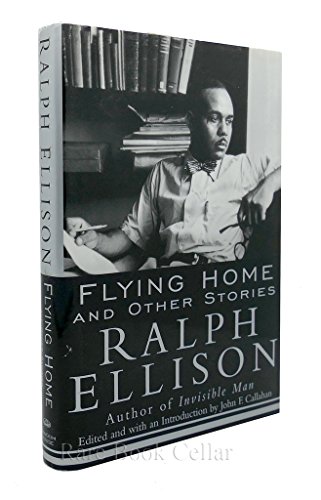
These 13 stories by the author of The Invisible Man "approach the elegance of Chekhov" (Washington Post) and provide "early explorations of (Ellison's) lifelong fascination with the 'complex fate' and 'beautiful absurdity' of American identity" (John Callahan). First serial to The New Yorker. NPR sponsorship.
"synopsis" may belong to another edition of this title.
About the Author
Ralph Ellison was born in Oklahoma City in 1914. He is the author of Invisible Man (1952), which won the National Book Award and became one of the most important and influential postwar American novels. He published two volumes of nonfiction, Shadow and Act (1964) and Going to the Territory (1986), which, together with unpublished speeches and writings, were brought together as The Collected Essays of Ralph Ellison in 1995. For more than forty years before his death in 1994, Ralph Ellison lived with his wife, Fanny McConnell, in Harlem in New York City.
From the Trade Paperback edition.
From the Inside Flap
ries by the author of The Invisible Man "approach the elegance of Chekhov" (Washington Post) and provide "early explorations of (Ellison's) lifelong fascination with the 'complex fate' and 'beautiful absurdity' of American identity" (John Callahan). First serial to The New Yorker. NPR sponsorship.
Reviews
YA. Ellison's refined style of dialogue and detailed descriptions coupled with the tradition of African-American storytelling make this a readable collection. Written between the 1930s and the 1950s, these 13 short stories, 6 of which were previously unpublished, capture a variety of moods. In "A Party Down at the Square," a white boy tells of witnessing his first lynching. Four stories introduce Buster and Riley, two preteens whose antics are laughable and conversations witty. One story deals with a four-year-old's first sense of prejudice with his father by his side. In "Flying Home," a Tuskegee Airman crashes into an Alabama field and faces, once again, the stark realities of segregation. Callahan's scholarly introduction presents a personal look at Ellison's youth. However, it is through the stories that one can begin to understand the complexities of a divided nation. YAs familiar with Invisible Man should appreciate this offering. At the same time, the mix of action and adventure will hold the attention of general readers.?Connie Freeman, Allen County Public Library, Fort Wayne, IN
Copyright 1997 Reed Business Information, Inc.
To read Ellison's early short stories after having read Invisible Man is like looking at the first sketches and blueprints of parts of the Taj Mahal after having stood in the complete palace itself. Most of these 12 early stories (written between 1937 and 1954) are clearly apprentice work in which Ellison is struggling for control of voice, timing and structure. In the earliest work (including "Hymie's Bull," his very first story), Ellison tries to shoehorn his own experience, including hoboing freight trains in the 1930s, into some boxed-in notion of literary form. But Ellison was a fast learner. While the four stories featuring the antics of Buster and Riley, two smart-mouthed African American boys, owe more than a bit to Mark Twain's Huck and Tom, they also show Ellison developing more supple language and a comic touch. "A Party Down at the Square" (discovered by Callahan, his literary executor, shortly after the writer's death in 1994), is an account of a lynching breathlessly narrated by a white Cincinnati boy visiting his uncle in Alabama. In the dramatic title story, Todd, a black pilot, a northerner trained at Tuskegee, crash-lands in rural Alabama and is rescued from redneck medics by Jefferson, an old black man exuding rustic ways and folksy tall tales. Though Jefferson represents everything Todd is trying to escape, the old man's wisdom and quick thinking ultimately lead the pilot to a reaffirmation of his roots. In these later stories, the moral core of Ellison's great novel is apparent: the passion for simultaneously exploring black identity and American identity, the determination to write deeply about race without writing only about race. His stories display, individually, the commitment to craft and, collectively, the acquired range that later enabled him to assemble, block by block, one of the great monuments of American literature.
Copyright 1996 Reed Business Information, Inc.
This marvelous collection of 13 stories, six of which were never published during Ellison's lifetime, partly explains the phenomenon of Invisible Man, itself no ordinary first book. Had Ellison published this volume first (all of these narratives were written before his landmark novel), it would have been the debut of a voice to reckon with, if not the heavenly choir of Invisible Man. This early work improvises on some of Ellison's great themes: the way in which stereotypes obscure and deform our common humanity; the quest for a distinctly American identity; and the promise of democratic culture. A quartet of stories about youngbloods Buster and Riley--an embryonic novel of sorts--shows the fully absorbed influence of Twain. Ellison's Huck and Tom, full of innocent devilment, laze away the days signifying, doing the dozens, and just getting into trouble. In a brilliant down-home retelling of the Toussaint L'Ouverture story ``Mister Toussan,'' Ellison's charming miscreants find precedent for their own rebellious desire to snatch cherries from a white man's yard. Three railroad tales document the plight of ``black bums'' who are treated with particular harshness by the guards. ``I Did Not Learn Their Names'' recalls a kind, elderly couple riding the rails to visit their son--a hard-luck story that suggests the happiness sometimes found in adversity. The struggling black railroad workers in ``A Hard Time Keeping Up'' finally give in to hilarity, a kind of release, at a late-night joint. While one young man finds momentary power onstage at a matinee bingo game, another is profoundly mortified when he crashes his plane during training as a military pilot. ``In a Strange Country'' is pure Ellison: A black sailor, fresh from a racial incident with a countryman, discovers in a local Welsh singing club the sense of transcendent national pride and unity he longs for back home. Glorious, preInvisible Man riffs--and another fine addition to the Ellison oeuvre. -- Copyright ©1996, Kirkus Associates, LP. All rights reserved.
This posthumous collection features 13 of Ellison's short stories, written when the young musician first tried his hand at fiction at the suggestion of Richard Wright. Opening with "Hymie's Bull," written in 1937, the stories describe a lynching ("A Party Down at the Square"), the adventures of preteens Buster and Riley ("Mister Toussan," "Afternoon," and "That I Had the Wings"), and a sojourner's tale ("In a Strange Country"). Humor is at the heart of the Buster and Riley stories, while sorrow rings though "Boy on a Train." Fine examples of work by a literary artist, these stories present an array of writing modes that effectively captures Ellison's talents. It is not The Invisible Man, but it stands on its own literary merit and will be a positive addition to fiction collections, especially those in African American literature.?Fannette H. Thomas, Essex Community Coll., Baltimore, Md.
Copyright 1996 Reed Business Information, Inc.
Callahan reveals in the introduction that Ellison toyed with the idea of collecting his short stories in 1994, and he alluded to early unpublished stories that might be included. Before the year ended, he died. Although Ellison's short fiction has never been collected, Callahan recounts that he hesitated to finish the project because there was nothing new. Then, in February 1996, while looking for a piece of Ellison's novel-in-progress amongst his papers, Callahan stumbled upon a file marked "Early Stories," and this collection of 13 stories became viable. From the cache of unpublished material, six stories were selected, two of which, "I Did Not Learn Their Names" and "Boy on a Train," appeared in the New Yorker earlier this year. Some critics will promote the idea that this collection shows an untutored black writer finding his voice and then rising above it to become the artist-writer of Invisible Man. The collection begins with the early story "A Party down at the Square," about a lynching narrated by a Cincinnati white boy visiting his uncle in Alabama, and ends with the poignant "Flying Home," whose narrator, indeed, foreshadows the invisible man. Yet one wonders what more Ellison could have added to any one of these stories. One thing is certain: with this work, it becomes clear how Richard Wright's worldview clung to the frightening nature of the black experience and Ellison's embraced the horrors of the human condition. Bonnie Smothers
"About this title" may belong to another edition of this title.
Search results for Flying Home: and Other Stories

Stock Image
Flying Home: And Other Stories
Seller: World of Books (was SecondSale), Montgomery, IL, U.S.A.
Seller rating 5 out of 5 stars

Hardback. Condition: Good. Written between 1937 and 1954 and now available in paperback for the first time, these thirteen stories are a potent distillation of the genius of Ralph Ellison. Six of them remained unpublished during Ellison's lifetime and were discovered among the author's effects in a folder labeled Early Stories. But they all bear the hallmarks--the thematic reach, musically layered voices, and sheer ebullience--that Ellison would bring to his classic Invisible Man. The tales in Flying Home range in setting from the Jim Crow South to a Harlem bingo parlor, from the hobo jungles of the Great Depression to Wales during the Second World War. By turns lyrical, scathing, touching, and transcendently wise, Flying Home and Other Stories is a historic volume, an extravagant last bequest from a giant of our literature. Seller Inventory # 00106449207
Seller Image
Flying Home: and Other Stories
Seller: Bay State Book Company, North Smithfield, RI, U.S.A.
Seller rating 5 out of 5 stars
Condition: good. The book is in good condition with all pages and cover intact, including the dust jacket if originally issued. The spine may show light wear. Pages may contain some notes or highlighting, and there might be a "From the library of" label. Boxed set packaging, shrink wrap, or included media like CDs may be missing. Seller Inventory # BSM.19DFE
Seller Image
Flying Home: and Other Stories
Seller: Bay State Book Company, North Smithfield, RI, U.S.A.
Seller rating 5 out of 5 stars
Condition: good. The book is in good condition with all pages and cover intact, including the dust jacket if originally issued. The spine may show light wear. Pages may contain some notes or highlighting, and there might be a "From the library of" label. Boxed set packaging, shrink wrap, or included media like CDs may be missing. Seller Inventory # BSM.1D1M8
Stock Image
Flying Home: And Other Stories
Seller: World of Books Inc, Montgomery, IL, U.S.A.
Seller rating 4 out of 5 stars

Hardback. Condition: Good. Written between 1937 and 1954 and now available in paperback for the first time, these thirteen stories are a potent distillation of the genius of Ralph Ellison. Six of them remained unpublished during Ellison's lifetime and were discovered among the author's effects in a folder labeled Early Stories. But they all bear the hallmarks--the thematic reach, musically layered voices, and sheer ebullience--that Ellison would bring to his classic Invisible Man. The tales in Flying Home range in setting from the Jim Crow South to a Harlem bingo parlor, from the hobo jungles of the Great Depression to Wales during the Second World War. By turns lyrical, scathing, touching, and transcendently wise, Flying Home and Other Stories is a historic volume, an extravagant last bequest from a giant of our literature. Seller Inventory # CIN0679457046G
Stock Image
Flying Home: and Other Stories
Seller: ThriftBooks-Atlanta, AUSTELL, GA, U.S.A.
Seller rating 5 out of 5 stars
Hardcover. Condition: Very Good. No Jacket. Former library book; May have limited writing in cover pages. Pages are unmarked. ~ ThriftBooks: Read More, Spend Less. Seller Inventory # G0679457046I4N10
Stock Image
Flying Home: and Other Stories
Seller: ThriftBooks-Dallas, Dallas, TX, U.S.A.
Seller rating 5 out of 5 stars
Hardcover. Condition: Very Good. No Jacket. May have limited writing in cover pages. Pages are unmarked. ~ ThriftBooks: Read More, Spend Less. Seller Inventory # G0679457046I4N00
Stock Image
Flying Home: and Other Stories
Seller: ThriftBooks-Dallas, Dallas, TX, U.S.A.
Seller rating 5 out of 5 stars
Hardcover. Condition: Good. No Jacket. Former library book; Missing dust jacket; Pages can have notes/highlighting. Spine may show signs of wear. ~ ThriftBooks: Read More, Spend Less. Seller Inventory # G0679457046I3N11
Stock Image
Flying Home: and Other Stories
Seller: ThriftBooks-Atlanta, AUSTELL, GA, U.S.A.
Seller rating 5 out of 5 stars
Hardcover. Condition: Good. No Jacket. Former library book; Pages can have notes/highlighting. Spine may show signs of wear. ~ ThriftBooks: Read More, Spend Less. Seller Inventory # G0679457046I3N10
Stock Image
Flying Home : And Other Stories
Published by
Random House Publishing Group, 1996
ISBN 10: 0679457046
ISBN 13: 9780679457046
Used
Hardcover
Seller: Better World Books, Mishawaka, IN, U.S.A.
Seller rating 5 out of 5 stars
Condition: Good. Former library copy. Pages intact with minimal writing/highlighting. The binding may be loose and creased. Dust jackets/supplements are not included. Includes library markings. Stock photo provided. Product includes identifying sticker. Better World Books: Buy Books. Do Good. Seller Inventory # GRP67749861
Stock Image
Flying Home : And Other Stories
Published by
Random House Publishing Group, 1996
ISBN 10: 0679457046
ISBN 13: 9780679457046
Used
Hardcover
Seller: Better World Books, Mishawaka, IN, U.S.A.
Seller rating 5 out of 5 stars
Condition: Good. Pages intact with minimal writing/highlighting. The binding may be loose and creased. Dust jackets/supplements are not included. Stock photo provided. Product includes identifying sticker. Better World Books: Buy Books. Do Good. Seller Inventory # 2415820-6