
Items related to You Mean I Don't Have to Feel This Way? New Help...
Synopsis
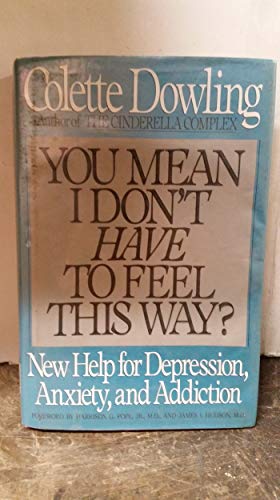
Argues that there is a biological basis for depression and addictive disorders and discusses advances in psychopharmacology
"synopsis" may belong to another edition of this title.
Reviews
Dowling ( The Cinderella Complex) here challenges the popular belief that depression, panic disorder, addictions and a host of other psychiatric problems result from events in childhood psychologi cal influences or moral weakness. Witness to both her daughter's and husband's severe depression, the author became convinced that biochemical--not psychological--difficulties were the cause. She presents the latest research in brain chemistry and argues that a lack of serotonin--a natural "feel-good" chemical--is responsible for an array of mental and mood disorders. Alcoholics, for example, are attempting to replace the missing chemical and may be better helped through drug therapy than by 12-step and other nonmedical treatment programs. Similarly, people who suffer from chronic depression or anxiety attacks may be cured by taking antidepressives. Although well-written and carefully researched, the book oversimplifies a serious issue and, in effect, claims that all problems can be eradicated by taking a "magic" pill, while dismissing the role of traditional psychotherapy. Literary Guild and Doubleday Book Club alternates.
Copyright 1991 Reed Business Information, Inc.
Again, Dowling (Perfect Woman, 1988, etc.) uses personal experience--her daughter's depression--as the springboard for her writing, this time arguing for the primary role of brain biochemistry in a large number of illnesses frequently considered biological in origin. Dowling believes, along with Hudson and Pope (Harvard psychiatrists who identified affective spectrum disorder) that the level of serotonin, a brain hormone, has as much to do with mental status as do environmental influences, and she urges medication for depressed patients to restore and regulate equilibrium. Having seen her daughter successfully treated with an antidepressant, she eagerly encourages others to seek similar relief for mood disorders, and goes on to examine the broad range of diagnoses- -bulimia, PMS, obsessive-compulsive disorder, addictions, kleptomania--that respond to these medications. Psychiatrists, she finds, often take incomplete family histories, miss cases of depression, undermedicate, or fail to recognize and treat dual illnesses (e.g., depression and addiction). Also, most people see mood as a matter of personal control and resist professional intervention. Dowling realizes that many will resist this point of view (``Life is flattened, we feel, by a one-dimensional, chemical approach to the brain''), and she tries to persuade with anecdotal case histories, always recommending psychotherapy as part of the process, not merely to monitor dosages and possible side effects but also, as one psychiatrist sees it, to learn ``to unravel what is normal personality from what the illness has superimposed upon it.'' No researcher, Dowling admits, has established a cause-and- effect relationship between serotonin and these mood disorders, just an association, so she does not insist that her argument is more than plausible. She does insist, though, some antidepressant will always relieve these conditions, a certainty many psychiatrists will dispute. As in Dowling's previous books, readers will recognize themselves, welcome the accessible vocabulary, and appreciate the balanced presentation of related issues (will people use PMS as evidence of inferiority or reason for discrimination?). Expect the warmest response from a nonprofessional audience. -- Copyright ©1991, Kirkus Associates, LP. All rights reserved.
Serotonin is a brain hormone, one of several neurotransmitters that influence the way we feel and the way we think. In this book, Dowling, author of The Cinderella Complex ( LJ 6/15/81) and Perfect Women ( LJ 10/1/88), reports on the work of biopsychiatrists who are exploring the relationships between various disorders, including bulimia and compulsive gambling, and an underlying link to low levels of serotonin, for which there may be a genetic tendency. Dowling offers understanding and encouragement to those who have tried medication without results. She does not reject psychotherapy. She discusses the pros and cons of medical intervention and offers case histories, including personal experience. Recommended for self-help collections. Literary Guild and Doubleday Book Club alternates; previewed in Prepub Alert, LJ 9/1/91.--Ed.
- Marlene Charnizon, C.S.W, formerly with "Library Journal"
Copyright 1992 Reed Business Information, Inc.
"About this title" may belong to another edition of this title.
Search results for You Mean I Don't Have to Feel This Way? New Help...

Stock Image
You Mean I Don't Have to Feel This Way? New Help for Depression, Anxiety, and Addiction
Seller: World of Books (was SecondSale), Montgomery, IL, U.S.A.
Seller rating 5 out of 5 stars

Condition: Good. Item in good condition. Textbooks may not include supplemental items i.e. CDs, access codes etc. Seller Inventory # 00090026758
Seller Image
You Mean I Don't Have to Feel This Way? New Help for Depression, Anxiety, and Addiction
Seller: ZBK Books, Carlstadt, NJ, U.S.A.
Seller rating 5 out of 5 stars
Condition: very_good. Fast & Free Shipping â" Very Good condition book with a firm cover and clean pages. Shows normal use and some light wear or limited notes markings. A solid, nice copy to enjoy. Seller Inventory # ZWV.0684192578.VG
Seller Image
You Mean I Don't Have to Feel This Way? New Help for Depression, Anxiety, and Addiction
Seller: Greenworld Books, Arlington, TX, U.S.A.
Seller rating 5 out of 5 stars
Condition: very_good. Fast Free Shipping â" Very Good condition book with a firm cover and clean pages. Shows normal use and some light wear or limited notes markings. A solid, nice copy to enjoy. Seller Inventory # GWV.0684192578.VG
Stock Image
You Mean I Don't Have to Feel This Way? New Help for Depression, Anxiety, and Addiction
Published by
Scribner \ Manmillan (edition ), 1992
ISBN 10: 0684192578
ISBN 13: 9780684192574
Used
Hardcover
Seller: BooksRun, Philadelphia, PA, U.S.A.
Seller rating 5 out of 5 stars
Hardcover. Condition: Very Good. With dust jacket. It's a well-cared-for item that has seen limited use. The item may show minor signs of wear. All the text is legible, with all pages included. It may have slight markings and/or highlighting. Seller Inventory # 0684192578-11-1-29
Stock Image
You Mean I Don't Have to Feel This Way? : New Help for Depression, Anxiety, and Addiction
Seller: Better World Books, Mishawaka, IN, U.S.A.
Seller rating 5 out of 5 stars
Condition: Fine. 1st Edition, 1st Printing. Used book that is in almost brand-new condition. May contain a remainder mark. Better World Books: Buy Books. Do Good. Seller Inventory # 53768453-6
Stock Image
You Mean I Don't Have to Feel This Way? : New Help for Depression, Anxiety, and Addiction
Seller: Better World Books: West, Reno, NV, U.S.A.
Seller rating 5 out of 5 stars
Condition: Very Good. 1st Edition, 1st Printing. Pages intact with possible writing/highlighting. Binding strong with minor wear. Dust jackets/supplements may not be included. Stock photo provided. Product includes identifying sticker. Better World Books: Buy Books. Do Good. Seller Inventory # 3390775-6
Stock Image
You Mean I Don't Have to Feel This Way? New Help for Depression, Anxiety, and Addiction
Seller: ThriftBooks-Dallas, Dallas, TX, U.S.A.
Seller rating 5 out of 5 stars
Hardcover. Condition: Very Good. No Jacket. May have limited writing in cover pages. Pages are unmarked. ~ ThriftBooks: Read More, Spend Less. Seller Inventory # G0684192578I4N00
Stock Image
You Mean I Don't Have to Feel This Way? New Help for Depression, Anxiety, and Addiction
Seller: ThriftBooks-Atlanta, AUSTELL, GA, U.S.A.
Seller rating 5 out of 5 stars
Hardcover. Condition: As New. No Jacket. Pages are clean and are not marred by notes or folds of any kind. ~ ThriftBooks: Read More, Spend Less. Seller Inventory # G0684192578I2N00
Stock Image
You Mean i Don't Have to Feel This Way: New Help for Depression, Anxiety, and Addiction
Published by
Prentice Hall (a Pearson Education company), 1992
ISBN 10: 0684192578
ISBN 13: 9780684192574
Used
Hardcover
Seller: World of Books Inc, Montgomery, IL, U.S.A.
Seller rating 4 out of 5 stars

Hardback. Condition: Good. A down-to-earth, hopeful, useful--and, from the point of view of this 'recovered' depressive--accurate account of how to treat depression.--Mike Wallace, 60 Minutes. Colette Dowling watched depression destroy her husband's life and leap to the next generation to nearly destroy her daughter's--until dramatic help was found. Now her ground-breaking book offer the same lifesaving help to the millions who still suffer depression and related disorders--which include panic, anxiety, phobias, PMS, alcohol and drug abuse, bulimia, migraine, and obesity. You Mean I Don't Have To Feel This Way? documents the latest research that links depression and related disorders to a physical cause and shows why willpower, understanding, and psychotherapy so often fail to work. It explains the state-of-the-art medical treatments that can bring about dramatic improvement--and often full recovery--within weeks. This important book includes: startling new links between eating disorders, addiction, and depression. How to recognize the symptoms of depression and anxiety disorders. Vital information about new treatments for depressed children and adolescents. A guide to breakthrough drugs for treating mood, anxiety, and eating disorders. The newest research on the use of antidepressants to prevent substance-abuse relapse. How to find expert help and evaluate the treatment you are given. Upbeat, filled with hope and warmth, Colette Dowling's book will change minds and save lives. Seller Inventory # CIN0684192578G
Stock Image
You Mean I Don't Have to Feel This Way? New Help for Depression, Anxiety, and Addiction
Seller: Redux Books, Grand Rapids, MI, U.S.A.
Seller rating 5 out of 5 stars
Hardcover. Condition: Very Good. Hardcover with dust jacket. Pages are clean and unmarked. Covers show very minor shelf wear. Dust jacket shows light edge wear. Binding is tight, hinges strong.; 100% Satisfaction Guaranteed! Ships same or next business day! Seller Inventory # 142607080007