
Items related to The DREAMS OUR STUFF IS MADE OF: HOW SCIENCE FICTION...
Synopsis
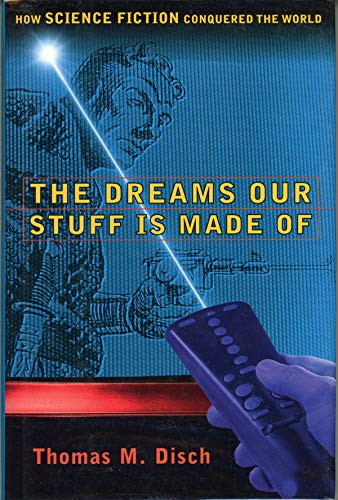
From acclaimed science fiction writer Thomas M. Disch comes The Dreams Our Stuff Is Made Of, a keenly perceptive account of the impact science fiction has had on American culture. As only a consummate insider could, Disch provides a fascinating view of this world and its inhabitants, tracing science fiction's phenomenal growth into the multibillion-dollar global entertainment industry it is today. If America is a "nation of liars," as Disch asserts in this dazzling and provocative cultural history, then science fiction is the most American of literary genres. American SF writers have seen their wishes, dreams, and lies accorded the same respect as facts. From the protoscience-fiction tales of Edgar Allen Poe, to the utopian dreams and technological nightmares of European writers H. G. Wells, Jules Verne, and J. G. Ballard, to American conservatives Robert Heinlein and Jerry Pournelle, liberals Joe Haldemann and Ursula le Guin, flakes William Burroughs and Philip K. Dick, and outright charlatans Ignatius Donnelly and various UFO "witnesses," Disch emphasizes science fiction's cultural role as both a lens and a medium for the very rapid changes driven by modern technology, highlighting its powers of prediction and prevarication. Much more than a history of the genre, The Dreams Our Stuff Is Made Of is an in-depth study of its ever-growing interaction with all aspects of culture -- politics, religion, and the fabric of our daily lives -- showing how it has become a cultural battlefield while helping us to adjust to new social realities, in everything from Star Trek's model of a multicultural workplace to Reagan's Strategic Defense Initiative. Disch is full of high praise and trenchant criticism of the genre, but sees its darker expression in the appearance of suicidal and homicidal UFO cults that blur science-fiction-fueled fantasies with reality. Behind the spaceships and aliens Disch reveals the blueprints of the dizzying postmodern future we have already begun to inhabit.
"synopsis" may belong to another edition of this title.
About the Author
Thomas M. Disch is the author of such classic works of science fiction as Camp Concentration, 334, Brave Little Toaster and On Wings Of Song, all of which are cited in David Pringle's Science Fiction: 100 Best Novels. His criticism appeared in The Atlantic, The Nation, The Times Literary Supplement, and the country's leading newspapers. The Castle of Indolence was a nominee in 1996 for the National Book Critic Circle's Award in Criticism.
Reviews
With pungency and wit, Disch (The Castle of Indolence) explores the enormous cultural impact that SF has had over the past century, placing it in the tradition of tall tales and lying, arguing that SF "has a special claim to be our national literature, as the art form best adapted to telling the lies we like to hear and to pretend we believe." He argues for Edgar Allan Poe as the father of SF and devotes a chapter to what he calls "our embarrassing ancestor," whose many stories anticipate themes common in later SF. Space travel, nuclear holocausts, Star Trek, drugs, sex and feminism, religion, politics, imperialism in space, and race relations are among the topics Disch trenchantly investigates in stories by many of the field's best-known figures, past and present. Their admirers are likely to be uncomfortable or enraged by some of his comments, which reflect a thorough knowledge of SF both as an insider and an outsider (Disch largely ceased writing SF two decades ago) and of the wider world in which it developed. His concluding chapter, "The Future of an Illusion?SF Beyond the Year 2000," offers a bleak perspective. More than half the top 10 grossing films of all time have been SF, but the economics of filmmaking dictate action-adventure and dumb plots, contends Disch. Similarly, the economics of book publishing favor undemanding series. Retailers should encourage SF buffs to buy this provocative account but should also encourage them to supplement it with two valuable companions: Brian Aldiss's Trillion Year Spree (1986) and Edward James's Science Fiction in the Twentieth Century (1996).
Copyright 1998 Reed Business Information, Inc.
A gifted writer casts a critical eye on the genre that gave him birth. Disch, a novelist, poet, and critic, first became known for his science fiction, including such classic novels as Camp Concentration (1969). He turns in this new work to an examination of the literature he fell in love with as a boy, and then worked to alter and expand as an adult. His thesis is that science fiction has pervaded American life, politics, and culture to such a degree that we are no longer even aware of it. In a series of linked but essentially discrete chapters, he discusses such topics as: how science fiction of the '50s affected our attitudes toward the atomic bomb; science fiction as a religion (notably in the life of failed SF writer L. Ron Hubbard and his creation of Scientology); and the manner in which conservative SF writers such as Jerry Pournelle and William R. Fortschen directly altered our military policies, leading to President Reagan's ``Star Wars'' program. Predominantly liberal but hardly PC, Disch is most controversial in his chapter on ``feminizing science fiction, in which he makes the case that the feminist-driven works of SF icon Ursula Le Guin can be just as limited as those of macho right-winger Robert A. Heinlein (Disch uncharacteristically avoids comparing their literary abilities). As these topics suggest, Disch tends to focus on the negative impact of the genre, and many in the field may feel battered by this book. But he writes with such keen insight and compulsive readability that only the most blinkered SF fan will be able to reject his ideas outright. Disch's provocative, engrossing book may fan the flames of a number of simmering arguments in the SF community, but when the smoke clears we may all, as a result of this tonic work, see more clearly. -- Copyright ©1998, Kirkus Associates, LP. All rights reserved.
Although Disch hasn't published science fiction in ages, this nonpareil work of cultural more than literary criticism shows he hasn't stopped thinking about it. He is interested in how this pop literature that revels in calling itself visionary has affected the real world. Sf, he says, helped us put a man on the moon, stop worrying and love the bomb, live in the future, get religion (New Age variety), aggrandize the military-industrial complex, and prepare for first contact (armed, of course) with aliens from across the galaxy (or, actually, the border). And while realizing those dreams, sf feminized its own house, long a boys-only club. All those developments in sf and sf-inspired concepts occurred, Disch says, because "America is a nation of liars" and also a nation that wants to believe the really bold lies of sf so passionately that they come true. Not all the effects of lies-come-true are good, though, and so, for instance, we blow billions on bilge like Reagan's strategic defense initiative ("Star Wars"), and the sf religionists of the Heaven's Gate community believe in space aliens and different "planes" of existence so deeply that they commit suicide to encounter them. But that's showbiz, sf style. A rollicking thought provoker of a book. Ray Olson
Get ready for a rip-roaring ride as noted sf writer Disch (The Castle of Indolence, LJ 9/1/95) takes you through the world of science fiction. Beginning with the supernatural tales of Edgar Allan Poe, through the works of Jules Verne and H.G. Wells, to today's multibillion-dollar sf business, Disch examines the evolution of the genre. He is most adept at tracing sf's effects on our culture, including politics, religion, and the fine points of our lives. But Disch is also critical of the genre. He raises serious alarms about cults that have confused science fiction fantasies with reality in recent years. He is also critical of what he sees as a bleak state of affairs in the industry at the present time. Disch's account is sure to raise the hackles of many while providing an insightful study. Recommended for all libraries.?Ronald Ratliff, Chapman H.S. Lib, Chapman, KS
Copyright 1998 Reed Business Information, Inc.
Excerpt. © Reprinted by permission. All rights reserved.
Chapter 1
THE RIGHT TO LIE
America is a nation of liars, and for that reason science fiction has a special claim to be our national literature, as the art form best adapted to telling the lies we like to hear and to pretend we believe.
It has been said of Cretans that they were all liars, and we can assume, from its proscription in the Decalogue, that lying was not unknown in Mosaic times. What distinguishes American liars from those of earlier times and other nations is that the perfected American liar does not feel himself to be disgraced by his lies, even when he is caught in them. Indeed, the bolder the lie and the more brazenly imposed on the public, the more admiration the liar is accorded.
The first American hero to be celebrated for his wily ways is a folk spirit native to the continent, Coyote. Among his lineal descendants in the realm of fiction one may number Joel Chandler Harris's Br'er Rabbit, Herman Melville's Confidence Man, Mark Twain's Tom Sawyer, and Abigail Williams in Arthur Miller's The Crucible, the Puritain maiden whose lies give rise to the Salem witch trials. What sets such American tricksters apart from those of other cultures is the degree to which they solicit our admiration. I can remember my father's reading aloud the opening chapters of The Adventures of Tom Sawyer and the delight we shared at the way Tom hustles his friends into whitewashing a thirty-yard-long, nine-foot-high board fence.
Before addressing the SF component of this issue, let me offer a short anthology of righteous lies from the past forty years of American history by way of suggesting the dimensions of the nation's Great White Fence. The first great lie of the post-World War II era, and the foundational whopper of the Cold War, was President Eisenhower's scout's-honor insistence, in 1960, that the U-2 shot down over the Soviet Union was not on a spying mission. That pro forma diplomatic fiction became a booby trap when the pilot, Francis Gary Powers, whom Eisenhower had presumed dead, was produced alive and stood trial for spying. Sisela Bok declares that "this lie was one of the crucial turning points in the spiraling loss of confidence by U.S. citizens in the word of their leaders."
The Vietnam War offered Americans a more extensive lesson in their government's complacent disregard for inconvenient truths. In The First Casualty, his history of war reporting, Phillip Knightley writes, concerning Vietnam:
In the early years of the American involvement, the administration misled Washington correspondents to such an extent that many an editor, unable to reconcile what his man in Saigon was reporting with what his man in Washington told him, preferred to use the official version. John Shaw, a Time correspondent in Vietnam...says, "for years the press corps in Vietnam was undermined by the White House and the Pentagon....Yet the Pentagon Papers proved to the hilt that what the correspondents in Saigon had been sending was true.
Knightley contends that compared to earlier wars of the modern era, the press (though not the government) had a good track record for honesty. "But," he admits, "this is not saying a lot....With a million-dollar corps of correspondents in Vietnam the war in Cambodia was kept hidden for a year."
But it was Watergate that made clear even to the most trusting and credulous of citizens that Presidents, their advisers, and anyone within distance of a bribe have as little regard for the truth as Richard III. Nixon had lied so successfully for so long about matters of such consequence that for the entire first year of the scandal, he refused to believe his robes of office would not protect him. In his steadfast denials, which he persisted in even after resigning in disgrace, he set an example of the Liarly Sublime that has never since been bettered for sheer brass.
The final establishment of lying as a right -- a right that is specifically God given -- was the work of Marine Corps paragon, presidential adviser, and 1994 Republican candidate for the U.S. Senate, Oliver North. In July 1987, North had been called to testify before the Senate concerning the White House's involvement in trading arms to Iran in exchange for the release of American hostages, the diversion of those illegal funds to assist (in defiance of Congress) the contras in Nicaragua, and his own perjuries with respect to these operations, which he had superintended. North's biographer, Ben Bradlee, Jr., begins his summing up of all the lies that were Oliver North's life:
Aside from North's admitted lying to Congress about the Contras, his admitted lying to the Iranians, his admitted falsifying of the Iran initiative chronology, his admitted shredding of documents and his admitted lying to various Administration officials as the Iran-Contra affair unraveled in November of 1986, there are stories, statements or claims that he has made to various people while at the NSC [National Security Council] that are either untrue strongly denied, or unconfirmable and thought to be untrue.
Bradlee recounts a round dozen of North's wilder whoppers, which include: a variety of self-promoting tales about confidences and private prayer meetings shared with the President; a tale of derring-do concerning his rescue of wounded contra soldiers (who later died, alas) as he piloted a plane through enemy machine-gun fire; his service in Angola and in Argentina during the Falklands War, and strategic tête-à-têtes with Israel Defense Minister Ariel Sharon just before the Israeli invasion of Lebanon (all three stories pure fabulation); and his dog's death by poisoning -- "presumably by those whom he said had been threatening his life." (A neighbor insisted that the dog died of cancer and old age.) The list is extensive enough to suggest that North's penchant for lying exceeded the merely strategic and expedient and amounted to pathology, and this is confirmed by the testimony of even reputed friends.
So artful was North's performance before the Senate that soon a good deal of the country had adopted the same attitude. "No one has captured the American public like Ollie North," opined a Chicago restaurateur. "Even when he's not telling the truth he's beautiful. The guy is so charming." Then columnist and future presidential candidate Patrick Buchanan lauded North as "a patriotic son of the republic who, confronted with a grave moral dilemma -- whether to betray his comrades and cause, or to deceive members of Congress -- chose the lesser of two evils, the path of honor. It was magnificent."
There must be two parties to a successful lie: the one who tells it and the one taken in. The motive of the teller is seldom difficult to discern, though it may be complex. In North's case one can scent self-advantage, a desire for applause, a certain amount of rational fear, and, not least, an inveterate delight in his own con-artistry. Surely a good deal of North's success was due to the TV audience's collusive admiration for the man's brass. Like Buchanan, they knew he was lying, but he lied so well; it was magnificent. This was the era, after all, of a President who had been caught again and again in evasions and fabulations. But people didn't care. Indeed, they applauded both men's acting skills -- the catch in the throat, the twinkle in the eye, the scout's-honor sincerity. TV critic Tom Shales favorably compared North's debut at the Senate hearings to Burt Lancaster's performance in Seven Days in May, in which Lancaster plays a general planning a military coup d'état.
I've said America is a nation of liars. A politer way of putting it is that we are a nation of would-be actors. No other culture has ever been so drenched in make-believe. Children spend more time watching television than going t
"About this title" may belong to another edition of this title.
Search results for The DREAMS OUR STUFF IS MADE OF: HOW SCIENCE FICTION...

Stock Image
The Dreams Our Stuff is Made of: How Science Fiction Conquered the World
Seller: World of Books (was SecondSale), Montgomery, IL, U.S.A.
Seller rating 5 out of 5 stars

Hardback. Condition: Good. This text traces Sci-Fi's phenomenal growth from the supernatural tales of Edgar Allan Poe to the utopian dreams and technological nightmares of H.G. Wells and Jules Verne, to the end of the 20th century when it has become a multi-billion dollar global entertainment industry. Seller Inventory # 00109831019
Stock Image
The Dreams Our Stuff Is Made Of : How Science Fiction Conquered the World
Seller: Better World Books, Mishawaka, IN, U.S.A.
Seller rating 5 out of 5 stars
Condition: Good. Pages intact with minimal writing/highlighting. The binding may be loose and creased. Dust jackets/supplements are not included. Stock photo provided. Product includes identifying sticker. Better World Books: Buy Books. Do Good. Seller Inventory # 3966575-6
Stock Image
The Dreams Our Stuff Is Made Of : How Science Fiction Conquered the World
Seller: Better World Books, Mishawaka, IN, U.S.A.
Seller rating 5 out of 5 stars
Condition: Very Good. Former library copy. Pages intact with possible writing/highlighting. Binding strong with minor wear. Dust jackets/supplements may not be included. Includes library markings. Stock photo provided. Product includes identifying sticker. Better World Books: Buy Books. Do Good. Seller Inventory # GRP28224235
Stock Image
The Dreams Our Stuff Is Made Of : How Science Fiction Conquered the World
Seller: Better World Books, Mishawaka, IN, U.S.A.
Seller rating 5 out of 5 stars
Condition: Good. Former library copy. Pages intact with minimal writing/highlighting. The binding may be loose and creased. Dust jackets/supplements are not included. Includes library markings. Stock photo provided. Product includes identifying sticker. Better World Books: Buy Books. Do Good. Seller Inventory # GRP17862648
Stock Image
The Dreams Our Stuff is Made of: How Science Fiction Conquered the World
Seller: World of Books Inc, Montgomery, IL, U.S.A.
Seller rating 4 out of 5 stars

Hardback. Condition: Good. This text traces Sci-Fi's phenomenal growth from the supernatural tales of Edgar Allan Poe to the utopian dreams and technological nightmares of H.G. Wells and Jules Verne, to the end of the 20th century when it has become a multi-billion dollar global entertainment industry. Seller Inventory # CIN0684824051G
Stock Image
The DREAMS OUR STUFF IS MADE OF: HOW SCIENCE FICTION CONQUERED THE WORLD
Seller: HPB-Diamond, Dallas, TX, U.S.A.
Seller rating 5 out of 5 stars
hardcover. Condition: Very Good. Connecting readers with great books since 1972! Used books may not include companion materials, and may have some shelf wear or limited writing. We ship orders daily and Customer Service is our top priority! Seller Inventory # S_461528828
Stock Image
The DREAMS OUR STUFF IS MADE OF: HOW SCIENCE FICTION CONQUERED THE WORLD
Seller: ThriftBooks-Atlanta, AUSTELL, GA, U.S.A.
Seller rating 5 out of 5 stars
Hardcover. Condition: Very Good. No Jacket. Former library book; May have limited writing in cover pages. Pages are unmarked. ~ ThriftBooks: Read More, Spend Less. Seller Inventory # G0684824051I4N10
Stock Image
The DREAMS OUR STUFF IS MADE OF: HOW SCIENCE FICTION CONQUERED THE WORLD
Seller: ThriftBooks-Atlanta, AUSTELL, GA, U.S.A.
Seller rating 5 out of 5 stars
Hardcover. Condition: Very Good. No Jacket. May have limited writing in cover pages. Pages are unmarked. ~ ThriftBooks: Read More, Spend Less. Seller Inventory # G0684824051I4N00
Stock Image
The DREAMS OUR STUFF IS MADE OF: HOW SCIENCE FICTION CONQUERED THE WORLD
Seller: ThriftBooks-Dallas, Dallas, TX, U.S.A.
Seller rating 5 out of 5 stars
Hardcover. Condition: Good. No Jacket. Former library book; Pages can have notes/highlighting. Spine may show signs of wear. ~ ThriftBooks: Read More, Spend Less. Seller Inventory # G0684824051I3N10
Stock Image
The DREAMS OUR STUFF IS MADE OF: HOW SCIENCE FICTION CONQUERED THE WORLD
Seller: ThriftBooks-Dallas, Dallas, TX, U.S.A.
Seller rating 5 out of 5 stars
Hardcover. Condition: Very Good. No Jacket. May have limited writing in cover pages. Pages are unmarked. ~ ThriftBooks: Read More, Spend Less. Seller Inventory # G0684824051I4N00