
Items related to Tragic Failure: Racial Integration in America
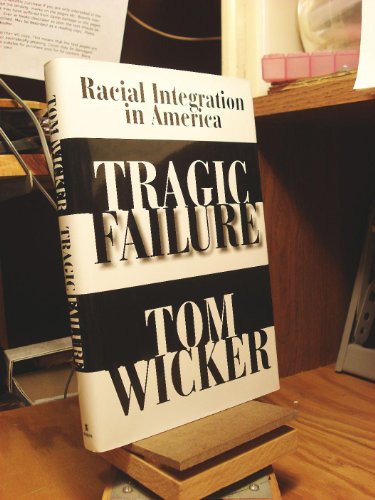
Synopsis
For twenty-five years Tom Wicker wrote for The New York Times with passion and intelligence, educating a generation of readers on important social and political issues of the day. In Tragic Failure, this keen observer assesses the failure of racial integration in America.
Thirty years after the landmark achievements of the civil rights movement in the 1960s, racial equality has made little progress and has, in fact, suffered setbacks as issues such as affirmative action, welfare reform, crime, and unemployment have made race the subtext for bitter political debate. Here, Mr. Wicker examines the current state of race relations and proposes some bold solutions-including major political realignment-to the disturbing and complex problems of race in America.
"synopsis" may belong to another edition of this title.
About the Author
Tom Wicker retired as a political columnist for The New York Times in 1991, having won numerous awards and accolades. Author of nine novels and five nonfiction books, he lives in New York City and Rochester, Vermont.
Reviews
This book, misleadingly titled, is less a study of efforts at integration than a lament-plus-prescription concerning America's racial wounds. Former New York Times columnist Wicker, a white Southern liberal, now joins a significant segment of African Americans who believe they need economic empowerment as well as political power. Thus, he proposes that blacks ditch the Democratic Party to form a new party "dedicated to economic equality." Wicker's outrage at America's deferred dreams and white backlash seems genuine, and he argues effectively that President Clinton's crime and economic policies have done little for poor blacks. His notion of integration admirably avoids melting-pot cliches; rather, he aspires to a situation of "amity," respect and equality. But Wicker's prescription founders on some practicalities. His proposed party would seek race-neutral policies to uplift the poor and expand jobs through public works programs and enhanced education. However, it's hardly clear that black Americans would unite around a class-based crusade, which more logically might be the province of America's fading left wing and fractured labor movement. Author tour.
Copyright 1996 Reed Business Information, Inc.
The former New York Times columnist builds a thorough, damning indictment of America's retreat from racial integration. It's no surprise to hear that integration has failed. High rates of poverty, incarceration, and unemployment tell the statistical tale of black disadvantage. Polarized reactions to O.J. Simpson's acquittal and the 1994 Republican ascendancy--in a campaign fought in a racial code that attacked welfare and affirmative action--dramatize the lingering depth and breadth of racial division. What is surprising is how early the retreat began. Only two years after the 1964 Civil Rights Act, Wicker argues, whites realized integration was to be a national, not merely a southern, transformation. Unwilling to sacrifice or suffer inconveniences to benefit blacks, whites spurned Democratic racial liberalism by awarding Republicans major congressional gains in 1966 and by supporting the presidential bids of racist demagogue George Wallace. Wicker astutely identifies fear as a prime motivator of white backlash and patiently attacks the cultural myths and distortions that feed it. An unabashed liberal, the veteran journalist lays blame for political foot-dragging at the doorstep of Republican presidents who've ruled all but two terms since the 1960s. But he also skewers Democrats for abandoning black interests while taking African-American support for granted. Wicker expects neither party to address ``the continuing, the cancerous, the unconfronted American dilemma'' of race. He calls for a third party dedicated to providing opportunity for the poor, contending that only economic opportunity will bring social equality. Though he underplays the considerable roadblocks to third-party participation, he cites demographic trends that suggest growing minorities could constitute a plausible political force. Wicker's historical analysis of the social cost of continuing inequality is an invaluable corrective to conservative attacks on affirmative action and a sobering condemnation of America's unwillingness to do the right thing. (Author tour) -- Copyright ©1996, Kirkus Associates, LP. All rights reserved.
A former New York Times political columnist asserts that attempts to achieve racial equality and integration in the U.S. have failed miserably. Despite the initial promise of the early civil rights movement, legislative measures have produced disappointing results. In fact, the political empowerment of black citizens never translated into the type of economic and social parity necessary to truly equalize opportunity and regard in American society. Instead, a thinly disguised backlash was fomented, prompting both Democratic and Republican politicians to adeptly exploit white disenchantment with affirmative action and racial integration. In the final analysis, Wicker argues, the formation of a new political party committed to the reality of economic growth and social inclusion for all races and classes is the only viable response to the current state of racial suspicion and unrest. An extremely thoughtful and cogent discourse on the dismal state of contemporary race relations. Margaret Flanagan
Former New York Times columnist Wicker here considers the failure of integration in America. He argues that the turning point should have been President Johnson's signing of the 1965 Civil Rights bill, but Johnson's focus on the Vietnam War obstructed Martin Luther King's vision of racial equality. Wicker observes that the freedom and equality of African Americans have always been nonnegotiable with the white power structure and the poorest whites. Republicans have held the White House for most of the past three decades and have used stereotypes of African Americans to roll back any progress made through affirmative action. The Supreme Court, which was instrumental in opening doors, has reversed many decisions on leveling the playing field. Wicker concludes this thought-provoking book by arguig that both parties have sold out African Americans and that a third party is needed. Recommended for academic and public libraries.?Kevin Whalen, Union P.L., N.J.
Copyright 1996 Reed Business Information, Inc.
"About this title" may belong to another edition of this title.
Search results for Tragic Failure: Racial Integration in America

Stock Image
Tragic Failure: Racial Integration in America
Seller: More Than Words, Waltham, MA, U.S.A.
Seller rating 5 out of 5 stars

Condition: Very Good. . . All orders guaranteed and ship within 24 hours. Before placing your order for please contact us for confirmation on the book's binding. Check out our other listings to add to your order for discounted shipping. Seller Inventory # WAL-N-5c-001996
Stock Image
Tragic Failure : Racial Integration in America
Published by
HarperCollins Publishers, 1996
ISBN 10: 0688106293
ISBN 13: 9780688106294
Used
Hardcover
Seller: Better World Books, Mishawaka, IN, U.S.A.
Seller rating 5 out of 5 stars
Condition: Good. Pages intact with minimal writing/highlighting. The binding may be loose and creased. Dust jackets/supplements are not included. Stock photo provided. Product includes identifying sticker. Better World Books: Buy Books. Do Good. Seller Inventory # 50254024-6
Stock Image
Tragic Failure: Racial Integration in America
Seller: ThriftBooks-Dallas, Dallas, TX, U.S.A.
Seller rating 5 out of 5 stars
Hardcover. Condition: As New. No Jacket. Pages are clean and are not marred by notes or folds of any kind. ~ ThriftBooks: Read More, Spend Less. Seller Inventory # G0688106293I2N00
Stock Image
Tragic Failure: Racial Integration in America
Seller: ThriftBooks-Dallas, Dallas, TX, U.S.A.
Seller rating 5 out of 5 stars
Hardcover. Condition: Very Good. No Jacket. Former library book; May have limited writing in cover pages. Pages are unmarked. ~ ThriftBooks: Read More, Spend Less. Seller Inventory # G0688106293I4N10
Stock Image
Tragic Failure: Racial Integration in America
Seller: Half Price Books Inc., Dallas, TX, U.S.A.
Seller rating 5 out of 5 stars
hardcover. Condition: Very Good. Connecting readers with great books since 1972! Used books may not include companion materials, and may have some shelf wear or limited writing. We ship orders daily and Customer Service is our top priority! Seller Inventory # S_452599506
Stock Image
Tragic Failure: Racial Integration in America
Seller: HPB-Emerald, Dallas, TX, U.S.A.
Seller rating 5 out of 5 stars
hardcover. Condition: Very Good. Connecting readers with great books since 1972! Used books may not include companion materials, and may have some shelf wear or limited writing. We ship orders daily and Customer Service is our top priority! Seller Inventory # S_426873974
Stock Image
Tragic Failure:Racial Integration in America
Seller: janet smith, Wheeling, WV, U.S.A.
Seller rating 5 out of 5 stars
Hard Cover. Condition: Very Good. Dust Jacket Condition: Good. First Edition. No markings. Dust jacket has scratches on back but no tears. Size: 8vo - over 7¾" - 9¾" tall. Seller Inventory # 013603
Stock Image
Tragic Failure: Racial Integration in America
Seller: THE OLD LIBRARY SHOP, Bethlehem, PA, U.S.A.
Seller rating 5 out of 5 stars
Hard Cover. Condition: vg+. Dust Jacket Condition: vg+. 2nd ptg. 218 pages including index; black & white dust jacket. Hardcover (dj). Seller Inventory # 166659
Stock Image
Tragic Failure: Racial Integration in America
Published by
William Morrow, New York, 1996
ISBN 10: 0688106293
ISBN 13: 9780688106294
Used
Hardcover
Seller: Pages Past--Used & Rare Books, Greensboro, NC, U.S.A.
Seller rating 4 out of 5 stars

Hardcover. Condition: Near Fine. Dust Jacket Condition: Very Good. 8vo. xiii, 218 pages, indexed. Hardcover with a white and black dust jacket. Light rubbing to the jacket. Book is sound and clean. Seller Inventory # 056118
Stock Image
Tragic Failure - Racial Integration In America
Published by
William Morrow and Compnay, New York, 1996
ISBN 10: 0688106293
ISBN 13: 9780688106294
Used
Hardcover
First Edition
Seller: RON-NAT BOOKS, Poughkeepsie, NY, U.S.A.
Seller rating 5 out of 5 stars
Hard Cover. Condition: Fine. Dust Jacket Condition: Very Good. First Edition. 218 pages including notes and index. The dust jacket has the price clipped and some shelf wear but is in overall very good condition. The book itself has minor shelf wear and slight stains on the edges but is in overall fine condition. This book is written from the point of view of an eyewitness to the history of race relations in America. It is good for students of history. Seller Inventory # 000781