
Items related to Gulag: A History
Synopsis
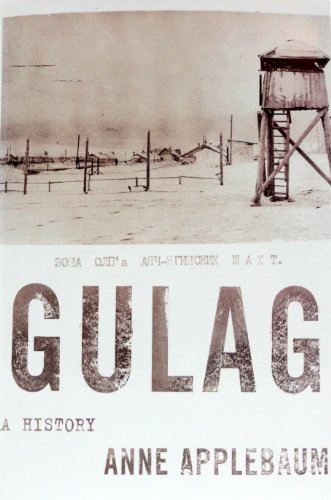
The Gulag—the vast array of Soviet concentration camps—was a system of repression and punishment whose rationalized evil and institutionalized inhumanity were rivaled only by the Holocaust.
The Gulag entered the world’s historical consciousness in 1972, with the publication of Alexander Solzhenitsyn’s epic oral history of the Soviet camps, The Gulag Archipelago. Since the collapse of the Soviet Union, dozens of memoirs and new studies covering aspects of that system have been published in Russia and the West. Using these new resources as well as her own original historical research, Anne Applebaum has now undertaken, for the first time, a fully documented history of the Soviet camp system, from its origins in the Russian Revolution to its collapse in the era of glasnost. It is an epic feat of investigation and moral reckoning that places the Gulag where it belongs: at the center of our understanding of the troubled history of the twentieth century.
Anne Applebaum first lays out the chronological history of the camps and the logic behind their creation, enlargement, and maintenance. The Gulag was first put in place in 1918 after the Russian Revolution. In 1929, Stalin personally decided to expand the camp system, both to use forced labor to accelerate Soviet industrialization and to exploit the natural resources of the country’s barely habitable far northern regions. By the end of the 1930s, labor camps could be found in all twelve of the Soviet Union’s time zones. The system continued to expand throughout the war years, reaching its height only in the early 1950s. From 1929 until the death of Stalin in 1953, some 18 million people passed through this massive system. Of these 18 million, it is estimated that 4.5 million never returned.
But the Gulag was not just an economic institution. It also became, over time, a country within a country, almost a separate civilization, with its own laws, customs, literature, folklore, slang, and morality. Topic by topic, Anne Applebaum also examines how life was lived within this shadow country: how prisoners worked, how they ate, where they lived, how they died, how they survived. She examines their guards and their jailers, the horrors of transportation in empty cattle cars, the strange nature of Soviet arrests and trials, the impact of World War II, the relations between different national and religious groups, and the escapes, as well as the extraordinary rebellions that took place in the 1950s. She concludes by examining the disturbing question why the Gulag has remained relatively obscure, in the historical memory of both the former Soviet Union and the West.
Gulag: A History will immediately be recognized as a landmark work of historical scholarship and an indelible contribution to the complex, ongoing, necessary quest for truth.
"synopsis" may belong to another edition of this title.
About the Author
ANNE APPLEBAUM was born in Washington, D.C., received a bachelor’s degree from Yale, and studied at Saint Antony’s College, Oxford, and the London School of Economics on a Marshall scholarship. In 1988, she moved to Poland to work for the Economist, and a few years later became foreign editor, then deputy editor, of the Spectator. Her work has also appeared in the New York Review of Books, the Wall Street Journal, Slate and other British and American publications. She is the author of one previous book, Between East and West: Across the Borderlands of Europe. After living for more than fifteen years in Europe, she joined the editorial board of the Washington Post in 2002 and now lives in Washington, D.C.
From the Back Cover
"GULAG is a monumental achievement, a masterpiece of Soviet history, indeed, one of the great historical epics of our time. With intense moral clarity, Anne Applebaum exposes not only the full horror of these slave labor camps -- Russia's legacy of state-sponsored genocide -- but the equally shocking, global amnesia towards the millions who died in them."
-Iris Chang, author of The Rape of Nanking: The Forgotten Holocaust of World War II
"Combining meticulous research with myriad accounts of survivors, Gulag: A History illuminates a shadowed world in which millions perished under unspeakable conditions. Any who question why we fought the Cold War will find an answer."
-Henry A. Kissinger, former U.S. Secretary of State
"As the 20th century recedes into history, with all its hideous crimes and high ideals, wars and trials, lies and revelations, we still have an uneasy feeling of some unfulfilled duty left back there, like an unpaid debt or a dead body we did not commit to the ground. This ghost's name is Gulag - and this book, a comprehensive study of a subject most people try to forget, is a first attempt at exorcism."
-Vladimir Bukovsky, former Soviet dissident
“An important and necessary book.”
-Jung Chang, author of Wild Swans: Three Daughters of China
"A monumental work that will long stand as a memorial of the countless victims of the Gulag, and also to the shame of the many erstwhile Gulag deniers."
-Zbigniew Brzezinski, Former National Security Adviser to President Jimmy Carter
“Anne Applebaum’s work is very human, very readable, both rich in detail and highly impressive as an overview of the huge and dreadful GULAG phenomenon. The astonishing story comes alive in a new way, deep feeling combining with deep understanding.”
-Robert Conquest, author of Stalin and The Great Terror
"Anne Applebaum's Gulag is the first up-to-date scholarly study of the central terror institution of the Soviet regime. It is distinguished not only by thorough research in the sources, many of them previously unknown, but by its humane treatment of the victims of this utterly inhuman institution."
-Richard Pipes, Professor of History Emeritus, Harvard University
"Anne Applebaum's Gulag is an important book. Her many years of scrupulous research have provided a wealth of fascinating detail to create a terrifying and unforgettable story."
-Antony Beevor, author of Stalingrad
From the Inside Flap
The Gulag?the vast array of Soviet concentration camps?was a system of repression and punishment whose rationalized evil and institutionalized inhumanity were rivaled only by the Holocaust.
The Gulag entered the world?s historical consciousness in 1972, with the publication of Alexander Solzhenitsyn?s epic oral history of the Soviet camps, The Gulag Archipelago. Since the collapse of the Soviet Union, dozens of memoirs and new studies covering aspects of that system have been published in Russia and the West. Using these new resources as well as her own original historical research, Anne Applebaum has now undertaken, for the first time, a fully documented history of the Soviet camp system, from its origins in the Russian Revolution to its collapse in the era of glasnost. It is an epic feat of investigation and moral reckoning that places the Gulag where it belongs: at the center of our understanding of the troubled history of the twentieth century.
Anne Applebaum first lays out the chronological history of the camps and the logic behind their creation, enlargement, and maintenance. The Gulag was first put in place in 1918 after the Russian Revolution. In 1929, Stalin personally decided to expand the camp system, both to use forced labor to accelerate Soviet industrialization and to exploit the natural resources of the country?s barely habitable far northern regions. By the end of the 1930s, labor camps could be found in all twelve of the Soviet Union?s time zones. The system continued to expand throughout the war years, reaching its height only in the early 1950s. From 1929 until the death of Stalin in 1953, some 18 million people passed through this massive system. Of these 18 million, it is estimated that 4.5 million never returned.
But the Gulag was not just an economic institution. It also became, over time, a country within a country, almost a separate civilization, with its own laws, customs, literature, folklore, slang, and morality. Topic by topic, Anne Applebaum also examines how life was lived within this shadow country: how prisoners worked, how they ate, where they lived, how they died, how they survived. She examines their guards and their jailers, the horrors of transportation in empty cattle cars, the strange nature of Soviet arrests and trials, the impact of World War II, the relations between different national and religious groups, and the escapes, as well as the extraordinary rebellions that took place in the 1950s. She concludes by examining the disturbing question why the Gulag has remained relatively obscure, in the historical memory of both the former Soviet Union and the West.
Gulag: A History will immediately be recognized as a landmark work of historical scholarship and an indelible contribution to the complex, ongoing, necessary quest for truth.
Reviews
Nearly 30 million prisoners passed through the Soviet Union's labor camps in their more than 60 years of operation. This remarkable volume, the first fully documented history of the gulag, describes how, largely under Stalin's watch, a regulated, centralized system of prison labor-unprecedented in scope-gradually arose out of the chaos of the Russian Revolution. Fueled by waves of capricious arrests, this prison labor came to underpin the Soviet economy. Applebaum, a former Warsaw correspondent for the Economist and a regular contributor to the Wall Street Journal and the Washington Post, draws on newly accessible Soviet archives as well as scores of camp memoirs and interviews with survivors to trace the gulag's origins and expansion. By the gulag's peak years in the early 1950s, there were camps in every part of the country, and slave labor was used not only for mining and heavy industries but for producing every kind of consumer product (chairs, lamps, toys, those ubiquitous fur hats) and some of the country's most important science and engineering (Sergei Korolev, the architect of the Soviet space program, began his work in a special prison laboratory). Applebaum details camp life, including strategies for survival; the experiences of women and children in the camps; sexual relationships and marriages between prisoners; and rebellions, strikes and escapes. There is almost too much dark irony to bear in this tragic, gripping account. Applebaum's lucid prose and painstaking consideration of the competing theories about aspects of camp life and policy are always compelling. She includes an appendix in which she discusses the various ways of calculating how many died in the camps, and throughout the book she thoughtfully reflects on why the gulag does not loom as large in the Western imagination as, for instance, the Holocaust.
Copyright 2003 Reed Business Information, Inc.
*Starred Review* We have massive amounts of data about the Nazi concentration and death camps, ranging from memoirs of survivors to incredibly detailed records kept by Nazi officials. The Nazi camps lasted just over a decade. On the other hand, the vast system of confinement, forced labor, and executions dubbed the "Gulag Archipelago" by Alexander Solzhenitsyn lasted almost 70 years, and we are just beginning to get a comprehensive picture of this affront to the human spirit. Applebaum is a former Marshall scholar and is now a journalist who covered the collapse of Communism in Central and Eastern Europe. With the collapse of the Soviet Union and the gradual opening of KGB archives, the full horror of the Gulag is gradually emerging, and Applebaum has done a masterful job of chronicling the origin, growth, and eventual end of this monstrous system. Contrary to the beliefs of many, the Gulag was not a product of the Stalin era. Both Lenin and Trotsky staunchly backed the creation of these camps as a useful tool in their promotion of "Red Terror." Under Stalin, of course, the camps were greatly expanded, both as a repository for the victims of his various purges and as a vital component, via slave labor, in industrialization. Like the Nazi camps, the Gulag became a virtual industrial complex. Now, we are left with the evidence, the memory of survivors, and the moral obligation to uncover the full story. This brilliant and often heartbreaking work is a giant step in the fulfillment of that obligation. Jay Freeman
Copyright © American Library Association. All rights reserved
More than a full-scale history of the Soviet Gulag, this work by the Spectator's deputy editor asks why it is so little remembered in both Russia and the West.
Copyright 2002 Reed Business Information, Inc.
Excerpt. © Reprinted by permission. All rights reserved.
Chapter 1
BOLSHEVIK BEGINNINGS
But your spine has been smashed,
My beautiful, pitiful era,
And with an inane smile
You look back, cruel and weak,
Like an animal past its prime,
At the prints of your own paws.
--osip mandelstam, "Vek"
One of my goals is to destroy the myth that the cruelest era of repression began in 1936-37. I think that in future, statistics will show that the wave of arrests, sentences and exile had already begun at the beginning of 1918, even before the official declaration, that autumn, of the "Red Terror." From that moment, the wave simply grew larger and larger, until the death of Stalin . . .
--dmitrii likhachev, Vospominaniya
In the year 1917, two waves of revolution rolled across Russia, sweeping Imperial Russian society aside as if it were destroying so many houses of cards. After Czar Nicholas II abdicated in February, events proved extremely difficult for anyone to halt or control. Alexander Kerensky, the leader of the first post-revolutionary Provisional Government, later wrote that, in the void following the collapse of the old regime, "all existing political and tactical programs, however bold and well conceived, appeared hanging aimlessly and uselessly in space."
But although the Provisional Government was weak, although popular dissatisfaction was widespread, although anger at the carnage caused by the First World War ran high, few expected power to fall into the hands of the Bolsheviks, one of several radical socialist parties agitating for even more rapid change. Abroad, the Bolsheviks were scarcely known. One apocryphal tale illustrates foreign attitudes very well: in 1917, so the story goes, a bureaucrat rushed into the office of the Austrian Foreign Minister, shouting, "Your Excellency, there has been a revolution in Russia!" The minister snorted. "Who could make a revolution in Russia? Surely not harmless Herr Trotsky, down at the Cafe Central?"
If the nature of the Bolsheviks was mysterious, their leader, Vladimir Ilyich Ulyanov--the man the world would come to know by his revolutionary pseudonym, "Lenin"--was even more so. During his many years as an emigre revolutionary, Lenin had been recognized for his brilliance, but also disliked for his intemperance and his factionalism. He picked frequent fights with other socialist leaders, and had a penchant for turning minor disagreements over seemingly irrelevant matters of dogma into major arguments.
In the first months following the February Revolution, Lenin was very far from holding a position of unchallenged authority, even within his own Party. As late as mid-October 1917, a handful of leading Bolsheviks continued to oppose his plan to carry out a coup d'etat against the Provisional Government, arguing that the Party was unprepared to take power, and that it did not yet have popular support. He won the argument, however, and on October 25 the coup took place. Under the influence of Lenin's agitation, a mob sacked the Winter Palace. The Bolsheviks arrested the ministers of the Provisional Government. Within hours, Lenin had become the leader of the country he renamed Soviet Russia.
Yet although Lenin had succeeded in taking power, his Bolshevik critics had not been entirely wrong. The Bolsheviks were indeed wildly unprepared. As a result, most of their early decisions, including the creation of the one-party state, were taken to suit the needs of the moment. Their popular support was indeed weak, and almost immediately they began to wage a bloody civil war, simply in order to stay in power. From 1918, when the White Army of the old regime regrouped to fight the new Red Army--led by Lenin's comrade, "Herr Trotsky" from the "Cafe Central"--some of the most brutal fighting ever seen in Europe raged across the Russian countryside. Nor did all of the violence take place in battlefields. The Bolsheviks went out of their way to quash intellectual and political opposition in any form it took, attacking not only the representatives of the old regime but also other socialists: Mensheviks, Anarchists, Social Revolutionaries. The new Soviet state would not know relative peace until 1921.
Against this background of improvisation and violence, the first Soviet labor camps were born. Like so many other Bolshevik institutions, they were created ad hoc, in a hurry, as an emergency measure in the heat of the civil war. This is not to say the idea had no prior appeal. Three weeks before the October Revolution, Lenin himself was already sketching out an admittedly vague plan to organize "obligatory work duty" for wealthy capitalists. By January 1918, angered by the depth of the anti-Bolshevik resistance, he was even more vehement, writing that he welcomed "the arrest of millionaire-saboteurs traveling in first- and second-class train compartments. I suggest sentencing them to half a year's forced labor in a mine."
Lenin's vision of labor camps as a special form of punishment for a particular sort of bourgeois "enemy" sat well with his other beliefs about crime and criminals. On the one hand, the first Soviet leader felt ambivalent about the jailing and punishment of traditional criminals--thieves, pickpockets, murderers--whom he perceived as potential allies. In his view, the basic cause of "social excess" (meaning crime) was "the exploitation of the masses." The removal of the cause, he believed, "will lead to the withering away of the excess." No special punishments were therefore necessary to deter criminals: in time, the Revolution itself would do away with them. Some of the language in the Bolsheviks' first criminal code would have thus warmed the hearts of the most radical, progressive criminal reformers in the West. Among other things, the code decreed that there was "no such thing as individual guilt," and that punishment "should not be seen as retribution."
On the other hand, Lenin--like the Bolshevik legal theorists who followed in his wake--also reckoned that the creation of the Soviet state would create a new kind of criminal: the "class enemy." A class enemy opposed the Revolution, and worked openly, or more often secretly, to destroy it. The class enemy was harder to identify than an ordinary criminal, and much harder to reform. Unlike an ordinary criminal, a class enemy could never be trusted to cooperate with the Soviet regime, and required harsher punishment than would an ordinary murderer or thief. Thus in May 1918, the first Bolshevik "decree on bribery" declared that: "If the person guilty of taking or offering bribes belongs to the propertied classes and is using the bribe to preserve or acquire privileges, linked to property rights, then he should be sentenced to the harshest and most unpleasant forced labor and all of his property should be confiscated."
From the very earliest days of the new Soviet state, in other words, people were to be sentenced not for what they had done, but for who they were.
Unfortunately, nobody ever provided a clear description of what, exactly, a "class enemy" was supposed to look like. As a result, arrests of all sorts increased dramatically in the wake of the Bolshevik coup. From November 1917, revolutionary tribunals, composed of random "supporters" of the Revolution, began convicting random "enemies" of the Revolution. Prison sentences, forced-labor terms, and even capital punishment were arbitrarily meted out to bankers, to merchants' wives, to "speculators"--meaning anyone engaged in independent economic activity--to former Czarist-era prison warders and to anyone else who seemed suspicious.
The definition of who was and who was not an "enemy" also varied from place to place, sometimes overlapping with the definition of "prisoner of war." Upon occupying a new city, Trotsky's Red Army frequently took bourgeois hostages, who could be shot in case the White Army returned, as it often did along the fluctuating lines of the front. In the interim they could be made to do forced labor, often digging trenches and building barricades. The distinction between political prisoners and common criminals was equally arbitrary. The uneducated members of the temporary commissions and revolutionary tribunals might, for example, suddenly decide that a man caught riding a tram without a ticket had offended society, and sentence him for political crimes. In the end, many such decisions were left up to the policeman or soldiers doing the arresting. Feliks Dzerzhinsky, founder of the Cheka--Lenin's secret police, the forerunner of the KGB--personally kept a little black notebook in which he scribbled down the names and addresses of random "enemies" he came across while doing his job.
These distinctions would remain vague right up until the collapse of the Soviet Union itself, eighty years later. Nevertheless, the existence of two categories of prisoner--"political" and "criminal"--had a profound effect on the formation of the Soviet penal system. During the first decade of Bolshevik rule, Soviet penitentiaries even split into two categories, one for each type of prisoner. The split arose spontaneously, as a reaction to the chaos of the existing prison system. In the very early days of the Revolution, all prisoners were incarcerated under the jurisdiction of the "traditional" judicial ministries, first the Commissariat of Justice, later the Commissariat of the Interior, and placed in the "ordinary" prison system. That is, they were thrown into the remnants of the Czarist system, usually into the dirty, gloomy stone prisons which occupied a central position in every major town. During the revolutionary years of 1917 to 1920, these institutions were in total disarray. Mobs had stormed the jails, self-appointed commissars had sacked the guards, prisoners had received wide-ranging amnesties or had simply walked away.
By ...
"About this title" may belong to another edition of this title.
Search results for Gulag: A History

Stock Image
Gulag: A History
Published by
Bantam Doubleday Dell Publishing Group Inc, 2003
ISBN 10: 0767900561
ISBN 13: 9780767900560
Used
Hardcover
Seller: World of Books (was SecondSale), Montgomery, IL, U.S.A.
Seller rating 5 out of 5 stars

Hardback. Condition: Fair. The Gulag a vast array of Soviet concentration camps that held millions of political and criminal prisoners was a system of repression and punishment that terrorized the entire society, embodying the worst tendencies of Soviet communism. In this magisterial and acclaimed history, Anne Applebaum offers the first fully documented portrait of the Gulag, from its origins in the Russian Revolution, through its expansion under Stalin, to its collapse in the era of glasnost. Applebaum intimately re-creates what life was like in the camps and links them to the larger history of the Soviet Union. Immediately recognized as a landmark and long-overdue work of scholarship, Gulag is an essential book for anyone who wishes to understand the history of the twentieth century. Seller Inventory # 00101661425
Stock Image
Gulag: A History
Published by
Bantam Doubleday Dell Publishing Group Inc, 2003
ISBN 10: 0767900561
ISBN 13: 9780767900560
Used
Hardcover
Seller: World of Books (was SecondSale), Montgomery, IL, U.S.A.
Seller rating 5 out of 5 stars
Hardback. Condition: Good. The Gulag a vast array of Soviet concentration camps that held millions of political and criminal prisoners was a system of repression and punishment that terrorized the entire society, embodying the worst tendencies of Soviet communism. In this magisterial and acclaimed history, Anne Applebaum offers the first fully documented portrait of the Gulag, from its origins in the Russian Revolution, through its expansion under Stalin, to its collapse in the era of glasnost. Applebaum intimately re-creates what life was like in the camps and links them to the larger history of the Soviet Union. Immediately recognized as a landmark and long-overdue work of scholarship, Gulag is an essential book for anyone who wishes to understand the history of the twentieth century. Seller Inventory # 00106680047
Stock Image
Gulag: A History
Seller: St Vincent de Paul of Lane County, Eugene, OR, U.S.A.
Seller rating 5 out of 5 stars
Condition: Good. DUST JACKET HAS SOME SHELF WEAR ON IT INCLUDING STICKER RESIDUE AND A SMALL TEAR THAT HAS BEEN TAPED BUT BOOK REMAINS IN GOOD READABLE CONDITION. hardcover 100% of proceeds go to charity! Good condition with all pages in tact. Item shows signs of use and may have cosmetic defects. Seller Inventory # F-03-6192
Stock Image
Gulag : A History
Published by
Doubleday Religious Publishing Group, The, 2003
ISBN 10: 0767900561
ISBN 13: 9780767900560
Used
Hardcover
Seller: Better World Books, Mishawaka, IN, U.S.A.
Seller rating 5 out of 5 stars
Condition: Good. Former library copy. Pages intact with minimal writing/highlighting. The binding may be loose and creased. Dust jackets/supplements are not included. Includes library markings. Stock photo provided. Product includes identifying sticker. Better World Books: Buy Books. Do Good. Seller Inventory # 4245353-6
Stock Image
Gulag : A History
Published by
Doubleday Religious Publishing Group, The, 2003
ISBN 10: 0767900561
ISBN 13: 9780767900560
Used
Hardcover
Seller: Better World Books, Mishawaka, IN, U.S.A.
Seller rating 5 out of 5 stars
Condition: Good. Pages intact with minimal writing/highlighting. The binding may be loose and creased. Dust jackets/supplements are not included. Stock photo provided. Product includes identifying sticker. Better World Books: Buy Books. Do Good. Seller Inventory # 4277211-6
Stock Image
Gulag : A History
Published by
Doubleday Religious Publishing Group, The, 2003
ISBN 10: 0767900561
ISBN 13: 9780767900560
Used
Hardcover
Seller: Better World Books, Mishawaka, IN, U.S.A.
Seller rating 5 out of 5 stars
Condition: Very Good. Former library copy. Pages intact with possible writing/highlighting. Binding strong with minor wear. Dust jackets/supplements may not be included. Includes library markings. Stock photo provided. Product includes identifying sticker. Better World Books: Buy Books. Do Good. Seller Inventory # 6462713-6
Stock Image
Gulag: A History
Seller: BooksRun, Philadelphia, PA, U.S.A.
Seller rating 5 out of 5 stars
Hardcover. Condition: Very Good. 1. With dust jacket. It's a well-cared-for item that has seen limited use. The item may show minor signs of wear. All the text is legible, with all pages included. It may have slight markings and/or highlighting. Seller Inventory # 0767900561-11-1-29
Stock Image
Gulag: A History
Published by
Bantam Doubleday Dell Publishing Group Inc, 2003
ISBN 10: 0767900561
ISBN 13: 9780767900560
Used
Hardcover
Seller: World of Books Inc, Montgomery, IL, U.S.A.
Seller rating 4 out of 5 stars

Hardback. Condition: Fair. The Gulag a vast array of Soviet concentration camps that held millions of political and criminal prisoners was a system of repression and punishment that terrorized the entire society, embodying the worst tendencies of Soviet communism. In this magisterial and acclaimed history, Anne Applebaum offers the first fully documented portrait of the Gulag, from its origins in the Russian Revolution, through its expansion under Stalin, to its collapse in the era of glasnost. Applebaum intimately re-creates what life was like in the camps and links them to the larger history of the Soviet Union. Immediately recognized as a landmark and long-overdue work of scholarship, Gulag is an essential book for anyone who wishes to understand the history of the twentieth century. Seller Inventory # CIN0767900561A
Stock Image
Gulag: A History
Published by
Bantam Doubleday Dell Publishing Group Inc, 2003
ISBN 10: 0767900561
ISBN 13: 9780767900560
Used
Hardcover
Seller: World of Books Inc, Montgomery, IL, U.S.A.
Seller rating 4 out of 5 stars
Hardback. Condition: Good. The Gulag a vast array of Soviet concentration camps that held millions of political and criminal prisoners was a system of repression and punishment that terrorized the entire society, embodying the worst tendencies of Soviet communism. In this magisterial and acclaimed history, Anne Applebaum offers the first fully documented portrait of the Gulag, from its origins in the Russian Revolution, through its expansion under Stalin, to its collapse in the era of glasnost. Applebaum intimately re-creates what life was like in the camps and links them to the larger history of the Soviet Union. Immediately recognized as a landmark and long-overdue work of scholarship, Gulag is an essential book for anyone who wishes to understand the history of the twentieth century. Seller Inventory # CIN0767900561G
Stock Image
Gulag: A History
Seller: HPB-Emerald, Dallas, TX, U.S.A.
Seller rating 5 out of 5 stars
Hardcover. Condition: Very Good. Connecting readers with great books since 1972! Used books may not include companion materials, and may have some shelf wear or limited writing. We ship orders daily and Customer Service is our top priority! Seller Inventory # S_480375540