
Items related to Spanish Lessons: Beginning a New Life in Spain
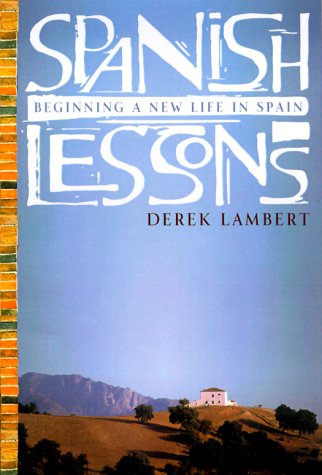
Synopsis
In the shrewd, comical spirit of Peter Mayle and Bill Bryson, Derek Lambert discovers the charms and idiosyncrasies of Spain as he experiences the rewards and frustrations of beginning a new life there.
Journalist Derek Lambert spent his career as a foreign correspondent covering conflicts around the world while living at one time or another in England, the United States, Russia, Hong Kong, Canada, Ireland, Israel, and Gibraltar. When he decided to settle down to a simpler life as a novelist, he chose Spain, the land that has inspired writers from Cervantes to Hemingway and Michener. Lambert knew Spain was a sun-splashed country with a breathtaking landscape, robust food and wine, and people who have a remarkable zest for living. What he didn't realize when he and his wife and young son arrived in a vibrant village on Spain's Mediterranean Costa Blanca was that learning to live in Spain would prove to be an adventure almost as challenging and eye-opening as any of his journalistic assignments.
In Spanish Lessons, Lambert recounts his first year in Spain with affection for the country and its people, an unerring eye for the distinctive traits of Spanish village life, and a wry, self-deprecating wit that lends his story frequent hilarity. After a too-friendly realtor books him into a "hotel" that turns out to be a brothel, Lambert and his wife are shown a moldering white casita in a citrus grove that wins their hearts. Taking charge of the restoration of their new home, Lambert hires a roofer with a fear of heights, a plumber who is confounded by a blocked pipe and a plasterer who can't work without a blaring boom-box. He also clashes wills with a stubborn-as-a-mule-gardener, faces the region's first snowstorm in ages, battles a lemon-grove fire, and bumbles through Spanish lessons with a mocking classmate who challenges him to a public arm-wrestling competition.
As he is drawn deeper into the rich texture and relaxed rhythm of Spanish life, Lambert uncovers a Spain separate from the the bullfights, tapas bars and flemenco of tourist brochures--a nation still grappling with its dark history, steeped in romance and festivity, where getting things done can always wait until mañana. Ultimately, Lambert's greatest lesson is that Spain derives its mystique not from the well-worn clichés, but from the bewitching character of its passionate, eccentric, often contradictory people.
Unpredictable, filled with humorous incidents, and animated by memorable characters, Spanish Lessons presents a delightful portrait of off-the-tourist-track Spain.
"synopsis" may belong to another edition of this title.
About the Author
Derek Lambert has contributed to newspapers and magazines worldwide. He is also the author of several novels. He lives in the province of Alicante, Spain with his wife and son.
From the Back Cover
"We were looking for a village so ordinary that it would bring us into contact with people remote from the clichés of Spain --flamenco, sangria, and bullfights...We found the sort of unassuming village we were looking for inland from the apartment blocks, hotels, and beaches of the Costa Blanca, the White Coast. It didn't possess any historic landmarks, unless you counted the bubble-blowing public wash house, no castanets clicking, not a pitcher of sangria in sight."
--from Spanish Lessons
From the Inside Flap
d, comical spirit of Peter Mayle and Bill Bryson, Derek Lambert discovers the charms and idiosyncrasies of Spain as he experiences the rewards and frustrations of beginning a new life there.
Journalist Derek Lambert spent his career as a foreign correspondent covering conflicts around the world while living at one time or another in England, the United States, Russia, Hong Kong, Canada, Ireland, Israel, and Gibraltar. When he decided to settle down to a simpler life as a novelist, he chose Spain, the land that has inspired writers from Cervantes to Hemingway and Michener. Lambert knew Spain was a sun-splashed country with a breathtaking landscape, robust food and wine, and people who have a remarkable zest for living. What he didn't realize when he and his wife and young son arrived in a vibrant village on Spain's Mediterranean Costa Blanca was that learning to live in Spain would prove to be an adventure almost as challenging and eye-opening as any of his journalistic assignments.
Reviews
"We were looking for a village so ordinary that it would bring us into contact with people remote from the cliches of Spain--flamenco, sangria and bullfights." British journalist Lambert and his Canadian wife, Diane, find just the right place when they visit La Jara, an unassuming Spanish village inland from the Mediterranean shore of Costa Blanca. This lively memoir recounts their adventures finding their way among the local characters. Much of the book is taken up with anecdotes about how Lambert, Diane and their four-year-old son settle into their new home (a rundown house with a citrus grove and a garden), take on the construction of a timbered dining hall with a minstrel gallery and deal with a sly carpenter, a fey young gardener who argues with his employer about everything from fences to flowers, and a roofer who is afraid of heights. What sets this book apart from others of its genre is the author's way of dealing with his new neighbors, all of whom seem to be related to one another and determined to intimidate him. Although Lambert wants to be accepted, he has a fierce temper, and he gives as good as he gets: he bests the "sewage specialist" who claims he can find a mysterious underground leak, assaults a policeman in the brothel where he and his wife unknowingly spend the night, calls the bluff of a mean debt collector who haunts one of the men working on his house and engineers a public showdown between two feuding ancients who claim to have fought on opposite sides in the Spanish Civil War. Some of Lambert's tales seem a bit tall, but he tells them amusingly in this chronicle of a newcomer's eventful year with the feisty residents of a very ordinary village in Spain. (May)
Copyright 2000 Reed Business Information, Inc.
London-born Lambert has written more than two dozen novels, many in the crime and espionage genres, and has also authored five volumes of autobiography. His latest effort seeks to re-create events that took place more than 20 years ago when he first moved to Spain. It may just be this distance in time that accounts for the book's lack of sparkle. Lambert's imagery is awkward, as if memory doesn't always serve and everything must then be embroidered with adjectives. When Lambert and his wife, vagabonds in search of the perfect place, choose a small town on Spain's Costa Blanca, their commitment to a trial year begins. They are quickly "adopted" by Emilio, a local with fingers in every pie and relatives in every profession. A suitable house is purchased, their small son arrives from Canada, animals are acquired, the addition of a dining room begins, and a gardener is hired. Despite Lambert's anecdotes, there's an aloofness to his narrative; the people are mere sketches, and the author himself remains an enigma. Jacket copy compares him with Peter Mayle and Bill Bryson, but it's unlikely many readers will agree. For larger travel collections only.
-Janet Ross, Sparks Branch Lib., NV
Copyright 2000 Reed Business Information, Inc.
In the tradition of A Year in Provence (1990) and Under the Tuscan Sun (1996), the author provides vivid descriptions of an entirely unique cultural landscape. Determined to try his hand at writing a novel, Lambert, a veteran foreign correspondent, decides to settle in a remote, picturesque village in the Costa Blanca region of Spain with his wife and young son. During the course of this delightfully wry narrative, they purchase an enchanting--if decrepit--house, undertake the arduous task of renovating and landscaping their property, and otherwise attempt to acclimate themselves to a thoroughly alien and exotic lifestyle. Charmed, frustrated, and continually astonished by their new surroundings, they bumble their way through their first year as extranjeros, eventually earning the friendship and loyalty of their initially suspicious neighbors. Chock-full of breathtaking comical escapades, and authentically colorful characters, this affectionately humorous memoir will appeal to both seasoned and armchair travelers. Margaret Flanagan
Copyright © American Library Association. All rights reserved
Excerpt. © Reprinted by permission. All rights reserved.
A Taste of Oranges
The two civil guards wore black tricorn hats, capes and olive green uniforms. And although they were mounted on angular bicycles they looked as sinister as their predecessors had in the civil war that had torn Spain apart in the 1930's.
It was late December and the citrus trees that covered most of the plain separating the Mediterranean from the mountains on the Costa Blanca of Spain were heavy with oranges, lemons and grapefruit. They looked so beguiling that Diane and I stole a couple of oranges. We were eating them, juice trickling down our chins, in our venerable, chocolate-brown Jaguar when the two Guardia Civil stopped beside us.
Maybe pinching oranges was a heinous crime in Spain. Tales were still rife after the death of the dictator General Francisco Franco of foreigners being imprisoned for years without trial for unspecified offenses. I imagined us lying on straw mattresses in fetid cells miles apart while rats snatched food from our eating bowls.
Or perhaps we would be deported and declared persona non grata, a preferable scenario but nonetheless a depressing one because it would mean that the vision we had shared when we first met in Africa would be aborted before it even got off the ground.
Diane, a Canadian air stewardess with blonde hair and eyes the color of the sea before a storm, had told me on our first date in Nairobi that, having experienced a couple of scary landings, she wanted to quit flying and start a new life. So did I. I was a journalist, in my forties, a foreign correspondent, and I wanted to become a novelist: our meeting was convened by the gods.
But supposing the gods had now turned against us, snitched on us to the Guardia...
Diane offered the two of them a brilliant please-fasten-your-seatbelt smile while I stuffed incriminating orange peel into a plastic bag. "What can we do for you?" she asked--she had been brought up in Paris and Rome, had studied Spanish and in any case picked up languages as easily as children catch measles.
One of the Guardia, young with a downy mustache, dismounted. "Are you lost?" he asked, peering into the aristocratic but doddery old Jaguar as I tried to back-heel the plastic bag under the driver's seat.
"No," Diane said, "we're just admiring the view."
It was worth admiring. Lizard gray mountains on one side of the citrus plantations, the sea beckoning in the cold sunlight on the other. Here and there a field of leafless grape vines; almond and olive trees and carobs with trunks like fairy tale witches.
The Guardia, who seemed to have exhausted his English, produced a creased booklet from beneath his cape and read from it. "I am so pleased you are admiring our territory."
Diane tried a few phrases in Valenciano, the regional language that confuses tourists who have studied orthodox Spanish, but he held up one hand and again consulted his phrase book. "Please, I do not understand, I am from the north." His colleague, a sad looking cabo, a corporal, who looked like a long ago Hollywood actor, Adolph Menjou, joined him.
"Do you have any papers?" he asked, that disturbing generalization that can embrace anything from a visa to a last will and testament.
Diane told him in English: "We might settle in the area."
True enough--we were looking for a village so ordinary that it would bring us into contact with people remote from the clichés of Spain--flamenco, sangria and bullfights--and define the changes that had taken place since Franco's death in 1975 so that I could write about them one day.
Her statement perturbed the cabo. He spoke with one hand, flapping, prodding and clenching it. Endless complications his hand said. Bureaucracy, papers...
Diane searched for some sort of ID in the chaotic contents of her purse. Ballpoint pens, lipsticks, coins, a comb, a chocolate bar...The cabo suggested that we get out of the car. A preliminary to being frisked, handcuffed?
Diane found her passport and handed it to him. Fishing rights in international waters hadn't yet exacerbated relations between the two countries and a Canadian passport still commanded respect. He flicked through it, handed it back and saluted.
He stabbed a finger towards me. "Your husband does not speak too much." Conceding that Diane was better at placating irate policemen I had kept out of it. Not only that but, she was much more fluent in Spanish than I was and although I was studying manfully I preferred to converse with any unfortunate Spaniards who spoke even "Me Tarzan, you Jane" English.
"He's very shy," Diane said and burst into helpless laughter. Reticence had never been my strong suit.
The younger officer, thinking perhaps that she was weeping, laid a hand on her shoulder. The cabo, suspecting that he was in the presence of an unstable neurotic woman and a deaf and dumb mute, took a step back.
"In the orchards," he said in English, "one person one orange is allowed. More--" He cut across his throat with one finger. "If you want to eat a good meal this place is very pleasing." He handed Diane a grubby visiting card and they both pedaled away, capes flowing behind them.
We embraced, our visions of a home here still intact: we drove to a village perched in the hills and gazed across the citrus trees to the sea, fishing boats perched on its rim.
The church clock tolled and the chimes rang through narrow streets that smelled of whitewash and grilling sardines. Hunger stirred. We each drank a glass of rough wine in a bar so dark that I couldn't tell whether I was being served by a man or a woman--at 5 pesetas a glass who cared?--and headed for the restaurant recommended by the cabo. In my experience policemen anywhere in the world knew the best establishments in which to take on ballast.
When we reached the address on the card, a shack with a cane roof beside a sandy beach ankle deep in seaweed, it was shut. We decided to hang around. After a while a door opened, a bead curtain parted and a woman in black wearing slippers, bunched cheeks squeezing her eyes, confronted us.
What did we want? She had already paid her rent and she didn't want to buy a carpet or an encyclopedia, from traveling salesmen her tone implied.
"We're very hungry," Diane said in English.
The woman's face softened. The period after the Civil War and World War II when Spain was ostracized by much of the world because it was ruled by Fascists was known as the Years of Hunger.
"Are you American?" she asked Diane. So many families had fled to the US and Britain after the Civil War ended in 1939 that, happily for me, a grasp of English was not uncommon.
"Canadian."
She shrugged. What mattered was that we were foreigners and we could not be turned away. "The restaurant is closed for the winter," she said. "But I can give you lamb chops and rice." My stomach whined.
"About this title" may belong to another edition of this title.
Search results for Spanish Lessons: Beginning a New Life in Spain

Stock Image
Spanish Lessons: Beginning a New Life in Spain
Published by
Broadway Books (A Division of Bantam Doubleday Dell Publishing Group Inc), 2000
ISBN 10: 076790415X
ISBN 13: 9780767904155
Used
Hardcover
Seller: World of Books (was SecondSale), Montgomery, IL, U.S.A.
Seller rating 5 out of 5 stars

Hardback. Condition: Very Good. In the shrewd, comical spirit of Peter Mayle and Bill Bryson, Derek Lambert discovers the charms and idiosyncrasies of Spain as he experiences the rewards and frustrations of beginning a new life there. [set as a headline]As Lambert and his wife set about restoring their moldering casita on Spain's Mediterranean Costa Blanca and learning to live the life of Spanish villagers, he introduces us to a nation far removed from the matadors, tapas bars, and sangria swillers. He uncovers the real Spain-a nation of passionate, eccentric, often contradictory, but always enchanting people. Unpredictable, often hilarious, and animated by colorful characters, Spanish Lessons presents an intimate and delightful portrait of off-the-tourist-track Spain. Seller Inventory # 00097478297
Stock Image
Spanish Lessons: Beginning a New Life in Spain
Published by
Broadway Books (A Division of Bantam Doubleday Dell Publishing Group Inc), 2000
ISBN 10: 076790415X
ISBN 13: 9780767904155
Used
Hardcover
Seller: World of Books (was SecondSale), Montgomery, IL, U.S.A.
Seller rating 5 out of 5 stars
Hardback. Condition: Good. In the shrewd, comical spirit of Peter Mayle and Bill Bryson, Derek Lambert discovers the charms and idiosyncrasies of Spain as he experiences the rewards and frustrations of beginning a new life there. [set as a headline]As Lambert and his wife set about restoring their moldering casita on Spain's Mediterranean Costa Blanca and learning to live the life of Spanish villagers, he introduces us to a nation far removed from the matadors, tapas bars, and sangria swillers. He uncovers the real Spain-a nation of passionate, eccentric, often contradictory, but always enchanting people. Unpredictable, often hilarious, and animated by colorful characters, Spanish Lessons presents an intimate and delightful portrait of off-the-tourist-track Spain. Seller Inventory # 00096931503
Stock Image
Spanish Lessons: Beginning a New Life in Spain
Seller: Wonder Book, Frederick, MD, U.S.A.
Seller rating 5 out of 5 stars
Condition: Very Good. Very Good condition. Very Good dust jacket. A copy that may have a few cosmetic defects. May also contain light spine creasing or a few markings such as an owner's name, short gifter's inscription or light stamp. Seller Inventory # N17O-00323
Stock Image
Spanish Lessons : Beginning a New Life in Spain
Published by
Broadway Books, 2000
ISBN 10: 076790415X
ISBN 13: 9780767904155
Used
Hardcover
First Edition
Seller: Better World Books, Mishawaka, IN, U.S.A.
Seller rating 5 out of 5 stars
Condition: Good. 1st. Former library copy. Pages intact with minimal writing/highlighting. The binding may be loose and creased. Dust jackets/supplements are not included. Includes library markings. Stock photo provided. Product includes identifying sticker. Better World Books: Buy Books. Do Good. Seller Inventory # 3460065-6
Stock Image
Spanish Lessons : Beginning a New Life in Spain
Published by
Broadway Books, 2000
ISBN 10: 076790415X
ISBN 13: 9780767904155
Used
Hardcover
First Edition
Seller: Better World Books: West, Reno, NV, U.S.A.
Seller rating 5 out of 5 stars
Condition: Very Good. 1st. Pages intact with possible writing/highlighting. Binding strong with minor wear. Dust jackets/supplements may not be included. Stock photo provided. Product includes identifying sticker. Better World Books: Buy Books. Do Good. Seller Inventory # 3460066-6
Stock Image
Spanish Lessons: Beginning a New Life in Spain
Seller: ThriftBooks-Dallas, Dallas, TX, U.S.A.
Seller rating 5 out of 5 stars
Hardcover. Condition: As New. No Jacket. Pages are clean and are not marred by notes or folds of any kind. ~ ThriftBooks: Read More, Spend Less. Seller Inventory # G076790415XI2N00
Stock Image
Spanish Lessons: Beginning a New Life in Spain
Seller: Half Price Books Inc., Dallas, TX, U.S.A.
Seller rating 5 out of 5 stars
hardcover. Condition: Very Good. Connecting readers with great books since 1972! Used books may not include companion materials, and may have some shelf wear or limited writing. We ship orders daily and Customer Service is our top priority! Seller Inventory # S_420028765
Stock Image
Spanish Lessons: Beginning a New Life in Spain
Seller: GoldBooks, Denver, CO, U.S.A.
Seller rating 5 out of 5 stars
Hardcover. Condition: new. New Copy. Customer Service Guaranteed. Seller Inventory # 16G14_12_076790415X
Stock Image
Spanish Lessons: Beginning a New Life in Spain
Seller: 2Vbooks, Derwood, MD, U.S.A.
Seller rating 5 out of 5 stars
Hard cover. Condition: Fine in fine dust jacket. Sewn binding. Cloth over boards. 272 p. Audience: General/trade. No previous owner's name HC 187. Seller Inventory # Alibris.0024834
Stock Image
Spanish Lessons: Beginning a New Life in Spain
Published by
Broadway Books (A Division of Bantam Doubleday Dell Publishing Group Inc), 2000
ISBN 10: 076790415X
ISBN 13: 9780767904155
Used
Hardcover
Seller: World of Books Inc, Montgomery, IL, U.S.A.
Seller rating 4 out of 5 stars

Hardback. Condition: Very Good. In the shrewd, comical spirit of Peter Mayle and Bill Bryson, Derek Lambert discovers the charms and idiosyncrasies of Spain as he experiences the rewards and frustrations of beginning a new life there. [set as a headline]As Lambert and his wife set about restoring their moldering casita on Spain's Mediterranean Costa Blanca and learning to live the life of Spanish villagers, he introduces us to a nation far removed from the matadors, tapas bars, and sangria swillers. He uncovers the real Spain-a nation of passionate, eccentric, often contradictory, but always enchanting people. Unpredictable, often hilarious, and animated by colorful characters, Spanish Lessons presents an intimate and delightful portrait of off-the-tourist-track Spain. Seller Inventory # CIN076790415XVG