
Items related to Hunting Humans: The Rise of the Modern Multiple Murderer
Synopsis
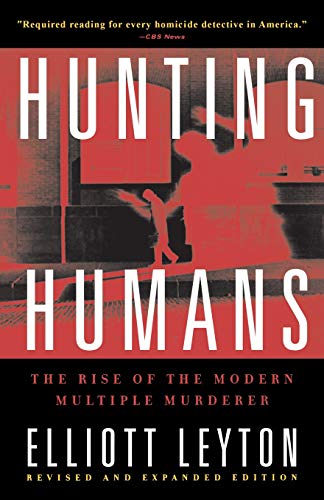
In this new edition of his landmark 1986 study, pioneering anthropologist Elliott Leyton examines the psyche and motivations of his six original multiple-murderer subjects and now takes stock of how far we've come since then in our understanding of why people commit gruesome assaults on innocent strangers. This case-study approach -- based on years of immersion in the killers' diaries, confessions, psychiatric interviews, statements to the press, videotapes, and photographs -- led the way in defining serial and mass murders not as the acts of alien creatures with deranged minds but rather as personalized protests by alienated men against the society that they believe has excluded them. Leyton also provides an analysis of the Washington, D.C. sniper case. While uncovering the central themes of modern culture that motivated their deeds, Leyton provides vivid and chilling portraits of Edmund Kemper, Ted Bundy, Albert DeSalvo, and David Berkowitz, serial murderers whose prolonged killing campaigns provided them revenge against the world and celebrity careers; and other mass murderers whose brief but horrific murder sprees constituted their own enigmatic suicide notes. The author shows that the motives of multiple murderers are not simply sexual or psychotic; but rise from the very core of American mass culture.
"synopsis" may belong to another edition of this title.
About the Author
Elliott Leyton is a professor of anthropology at Memorial University in St. Johns, Newfoundland. He has delivered lectures throughout the world, and is a past president of the Canadian Sociology and Anthropology Association. Because of his recognized expertise in the psychology of the multiple killer, he has established close links with police forces world-wide.
Reviews
Originally published in 1984, Leyton's pioneering work on the psychology of mass murderers has been updated and revised for this second edition. Clearly written, thoroughly readable and deliberately free of sociological jargon, it is an important contribution to its field and to the public at large, for whom it clarifies a dark and nightmarish phenomenon of our time. Analyzing case histories from Bundy to Berkowitz, Leyton demystifies the mass murderer. He begins with a brilliant description of the foremost serial killer of fiction, Hannibal Lecter, and demonstrates how little he resembles his real-life counterparts. To begin with, there has not been an aristocratic serial killer in centuries; most, says Leyton, are from the working classes. Nor are they diabolical geniuses; rather, they tend to be surprisingly dull-witted. Leyton's contention is that serial killers are not insane, but a product of their environment. They have been with us for centuries, he argues, and tend to come and go cyclically. (Recent research claims that 15% of them are female.) According Leyton, the serial killer sees his act as a form of revenge upon a specific social class that has denied him the social acceptance that he craves. The elements of sadism and sexual pervasion are his means of punishing his supposed persecutors. A professor of anthropology at Memorial University in St. Johns, Newfoundland, Leyton has written a number of books on psychology, and this volume in particular is a most enlightening work.
Copyright © Reed Business Information, a division of Reed Elsevier Inc. All rights reserved.
"About this title" may belong to another edition of this title.
Search results for Hunting Humans: The Rise of the Modern Multiple Murderer

Seller Image
Hunting Humans: The Rise of the Modern Multiple Murderer
Seller: Zoom Books Company, Lynden, WA, U.S.A.
Seller rating 5 out of 5 stars

Condition: like_new. Seller Inventory # ZBV.0786712287.LN
Stock Image
Hunting Humans: The Rise of the Modern Multiple Murderer
Seller: World of Books (was SecondSale), Montgomery, IL, U.S.A.
Seller rating 5 out of 5 stars
Condition: Good. Item in good condition. Textbooks may not include supplemental items i.e. CDs, access codes etc. Seller Inventory # 00106411174
Seller Image
Hunting Humans: The Rise of the Modern Multiple Murderer
Seller: Books for Life, LAUREL, MD, U.S.A.
Seller rating 5 out of 5 stars
Condition: good. Book is in good condition. Minimal signs of wear. It May have markings or highlights, but kept to only a few pages. May not come with supplemental materials if applicable. Seller Inventory # LFM.984M
Stock Image
Hunting Humans: The Rise of the Modern Multiple Murderer
Seller: ThriftBooks-Atlanta, AUSTELL, GA, U.S.A.
Seller rating 5 out of 5 stars
Paperback. Condition: Good. No Jacket. Pages can have notes/highlighting. Spine may show signs of wear. ~ ThriftBooks: Read More, Spend Less. Seller Inventory # G0786712287I3N00
Stock Image
Hunting Humans: The Rise of the Modern Multiple Murderer
Seller: ThriftBooks-Atlanta, AUSTELL, GA, U.S.A.
Seller rating 5 out of 5 stars
Paperback. Condition: Fair. No Jacket. Readable copy. Pages may have considerable notes/highlighting. ~ ThriftBooks: Read More, Spend Less. Seller Inventory # G0786712287I5N00
Stock Image
Hunting Humans: The Rise of the Modern Multiple Murderer
Seller: ThriftBooks-Dallas, Dallas, TX, U.S.A.
Seller rating 5 out of 5 stars
Paperback. Condition: Fair. No Jacket. Readable copy. Pages may have considerable notes/highlighting. ~ ThriftBooks: Read More, Spend Less. Seller Inventory # G0786712287I5N00
Stock Image
Hunting Humans: The Rise of the Modern Multiple Murderer
Seller: POQUETTE'S BOOKS, DEWITT, MI, U.S.A.
Seller rating 4 out of 5 stars

paperback. Condition: Good. EX LIBRARY BOOK. Seller Inventory # mon0000202577
Stock Image
Hunting Humans: The Rise of the Modern Multiple Murderer
Seller: Crotchety Rancher's Books, Dalton Gardens, ID, U.S.A.
Seller rating 4 out of 5 stars
Soft cover. Condition: Fine. No Jacket. 2nd Edition. Tight and square trade paperback. Pictorial wraps. A red marker line on bottom outer page edges. Pages within are clean and bright. The revised and expanded 2nd edition of the author's landmark 1968 study. A re-examination of the psyche and motivations of his six original multiple murderer subjects to see how far we've progressed over the past two decades in our understanding of why people commit gruesome assaults on innocent strangers. Seller Inventory # 002331np
Stock Image
Hunting Humans : The Rise of the Modern Multiple Murderer
Seller: Better World Books Ltd, Dunfermline, United Kingdom
Seller rating 5 out of 5 stars
Condition: Very Good. Former library copy. Pages intact with possible writing/highlighting. Binding strong with minor wear. Dust jackets/supplements may not be included. Includes library markings. Stock photo provided. Product includes identifying sticker. Better World Books: Buy Books. Do Good. Seller Inventory # GRP97846033
Buy Used
US$ 10.16
US$ 6.61 shipping
Ships from United Kingdom to U.S.A.
Ships from United Kingdom to U.S.A.
Quantity: 1 available
Stock Image
Hunting Humans: The Rise of the Modern Multiple Murderer
Published by
Carroll & Graf (edition 2nd Revised), 2003
ISBN 10: 0786712287
ISBN 13: 9780786712281
Used
Paperback
Seller: BooksRun, Philadelphia, PA, U.S.A.
Seller rating 5 out of 5 stars
Paperback. Condition: Very Good. 2nd Revised. It's a well-cared-for item that has seen limited use. The item may show minor signs of wear. All the text is legible, with all pages included. It may have slight markings and/or highlighting. Seller Inventory # 0786712287-11-1