
Items related to Boy on a String: From Cast-Off Kid to Filmmaker Through...
Synopsis
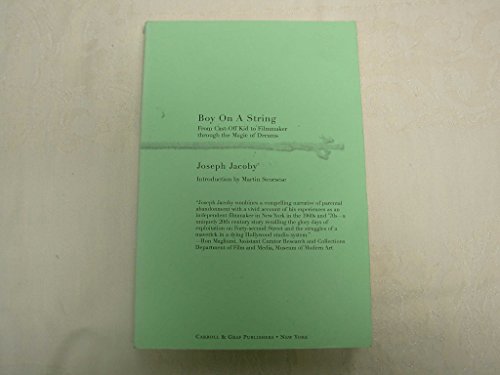
Boy on a String is the inspirational memoir of Joe Jacoby who worked in the early days of live TV and went on to become a pioneering filmmaker. Jacoby has never before revealed that his childhood was spent in foster homes and institutions. A New York University film school colleague of Martin Scorsese, Jacoby survived a childhood wrought with abuse and neglect. His mother's unpredictable and sometimes dangerous behavior forced friends to commit her, which then led Jacoby to grow up in seven foster homes in Brooklyn, and two institutions (one for emotionally disturbed children). Yet, propelled by the power of his dreams, Jacoby came to realize his passion for puppetry and movies and made his first feature at the age of twenty-seven (now in the Museum of Modern Art's permanent archives). He also recounts, often with hilarity, his dealings with the last of the movie moguls, Joseph E. Levine.
"synopsis" may belong to another edition of this title.
About the Author
Mr. Jacoby is the author of some half-dozen theatrical screenplays.
Joseph Jacoby has been a contributing essayist to New York Woman Magazine and is a subject of biographical record in Marquis' WHO'S WHO IN ENTERTAINMENT.
EDUCATION: B.A. New York University, Washington Square College of Arts & Science.
(Major: Television/Motion Pictures.) AWARDS/HONORS: Dean's List; Griffith Hughes Award
From the Back Cover
"Joe was the kind of friend you could count on he knew the score, and you knew that he would always be straight with you . As I read this frank, touching book, I was astonished to learn that Joe was in and out of foster homes and various institutions from the time he was seven until his eighteenth birthday. That experience that range of experience must have played a big part in his solitude, and in his worldliness." from the Introduction by Martin Scorsese
"Joseph Jacoby combines a compelling narrative of parental abandonment with a vivid account of his experiences as an independent filmmaker in New York in the 1960s and 70s a uniquely 20th century story recalling the glory days of exploitation on 42nd street and the struggles of a maverick in a dying Hollywood studio system." Ron Magliozzi, Assistant Curator Research and Collections Department of Film and Media, Museum of Modern Art
Reviews
Throughout a childhood spent being shuttled among foster homes and a "school for wayward boys," filmmaker Jacoby was buoyed by a passion for entertainment that grabbed hold of him at age seven when he first saw a television set. Witnessing his mother being taken to an institution marked the beginning of Jacoby's "childhood of perpetual loss" that caused him to behave like "a kid throwing jabs in anticipation of being knocked out," never feeling deserving of any praise or affection. This defensiveness proved useful during his nearly three-year stay at a home for troubled adolescents that Jacoby resented because it "simply straitjacketed the underlying causes" of his emotionally disturbed state "and directed them inward." He then went on to a successful career as a puppeteer, screenwriter, director and producer, but he dwells on and analyzes everything, writes in psych-speak and invokes childhood memories so frequently the book feels like a therapy session. Readers interested in foster children's stories might find Jacoby's experiences interesting, but his unfiltered reminiscing about his therapy progress, lists of his favorite childhood TV shows and the observation during a visit to one of his foster homes that "I remembered the front door being a bit wider" are superfluous at best. Jacoby clearly found revisiting his past therapeutic, and his success is impressive given the neglect he suffered in his youth; unfortunately, his insights on his upbringing and his noteworthy experiences in the entertainment business take a backseat to excessive introspection.
Copyright © Reed Business Information, a division of Reed Elsevier Inc. All rights reserved.
"About this title" may belong to another edition of this title.
Search results for Boy on a String: From Cast-Off Kid to Filmmaker Through...

Seller Image
Boy on a String: From Cast-Off Kid to Filmmaker Through the Magic of Dreams
Seller: BRT Resales, DeLand, FL, U.S.A.
Seller rating 5 out of 5 stars

Hardcover. Condition: Very Good. Exactly as shown in pics. Very Good hardcover 0786717114. Seller Inventory # ABE-1787194425678
Stock Image
Boy on a String: From Cast-Off Kid to Filmmaker Through the Magic of Dreams
Published by
Da Capo Press (edition ), 2006
ISBN 10: 0786717114
ISBN 13: 9780786717118
Used
Hardcover
Seller: BooksRun, Philadelphia, PA, U.S.A.
Seller rating 5 out of 5 stars
Hardcover. Condition: Very Good. With dust jacket. It's a well-cared-for item that has seen limited use. The item may show minor signs of wear. All the text is legible, with all pages included. It may have slight markings and/or highlighting. Seller Inventory # 0786717114-11-1-29
Stock Image
Boy on a String: From Cast-Off Kid to Filmmaker Through the Magic of Dreams
Seller: ThriftBooks-Atlanta, AUSTELL, GA, U.S.A.
Seller rating 5 out of 5 stars
Hardcover. Condition: Good. No Jacket. Former library book; Pages can have notes/highlighting. Spine may show signs of wear. ~ ThriftBooks: Read More, Spend Less. Seller Inventory # G0786717114I3N10
Stock Image
Boy on a String: From Cast-Off Kid to Filmmaker Through the Magic of Dreams
Published by
Da Capo Press February 2006, 2006
ISBN 10: 0786717114
ISBN 13: 9780786717118
Used
Hardcover
Seller: Montclair Book Center, Montclair, NJ, U.S.A.
Seller rating 4 out of 5 stars

Hardcover. Condition: USED Very Good. Seller Inventory # 256785
Seller Image
Boy on a String: From Cast-Off Kid to Filmmaker Through the Magic of Dreams
Published by
Carroll & Graf Publishers, 2006
ISBN 10: 0786717114
ISBN 13: 9780786717118
Used
Hardcover
First Edition
Seller: Southampton Books, Sag Harbor, NY, U.S.A.
Seller rating 5 out of 5 stars
Hardcover. Condition: Like New. First Edition. First Edition, First Printing. Not price-clipped. Published by Carroll & Graf Publishers, 2006. Octavo. Hardcover. Book is like new. Dust jacket is like new with light shelf wear.100% positive feedback. 30 day money back guarantee. NEXT DAY SHIPPING! Excellent customer service. Please email with any questions. All books packed carefully and ship with free delivery confirmation/tracking. All books come with free bookmarks. Ships from Sag Harbor, New York. Seller Inventory # 315392
Stock Image
Boy on a String
Published by
Carroll & Graf Publishers Inc, 2006
ISBN 10: 0786717114
ISBN 13: 9780786717118
Used
Hardcover
Seller: Sigrun Wuertele buchgenie_de, Altenburg, Germany
Seller rating 5 out of 5 stars
Condition: Sehr gut - gebraucht. Gebundene Ausgabe Sehr guter Zustand, ohne Namenseintrag, Original-Schutzumschlag Zustand: 2, Sehr gut - gebraucht, Gebundene Ausgabe Carroll & Graf Publishers Inc , 2006 , Boy on a String, Joseph Jacoby, Martin Scorsese. Seller Inventory # BU340439
Buy Used
US$ 25.20
US$ 41.68 shipping
Ships from Germany to U.S.A.
Ships from Germany to U.S.A.
Quantity: 1 available
Seller Image
Boy on a String From Cast-Off Kid to Filmmaker through the Magic of Dreams
Published by
Da Capo Press, 2006
ISBN 10: 0786717114
ISBN 13: 9780786717118
Used
Hardcover
First Edition
Signed
Seller: curtis paul books, inc., Crestline, CA, U.S.A.
Seller rating 5 out of 5 stars
Hardcover. Condition: Near Fine. Dust Jacket Condition: Near Fine. First Edition. Hardcover first edition is near fine in near fine jacket. Inscribed by Jacoby to ffep. ; 6.25 X 1 X 9 inches; 304 pages; Signed by Author. Seller Inventory # 44974