
Items related to The Beast God Forgot to Invent
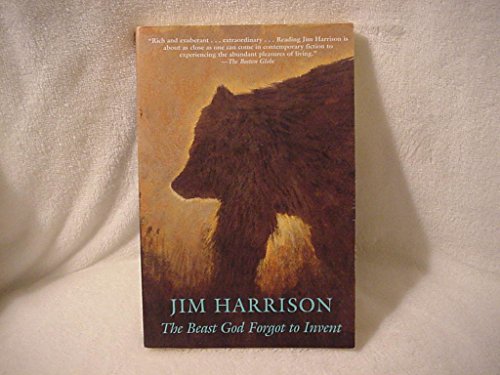
Synopsis
An unforgettable collection of novellas from the author of Legends of the Fall explores the line between civilization and the "wild men."
Jim Harrison is an American master. The Beast God Forgot to Invent offers stories of culture and wildness, of men and beasts and where they overlap. A wealthy man retired to the Michigan woods narrates the tale of a younger man decivilized by brain damage. A Michigan Indian wanders Los Angeles, hobnobbing with starlets and screenwriters while he tracks an ersatz Native-American activist who stole his bearskin. An aging alpha canine, the author of three dozen throwaway biographies, eats dinner with the ex-wife of his overheated youth, and must confront the man he used to be.
"Harrison's intricate symbolism and scathing observations of urban foibles, his sly humor and vibrant language remind readers that he is one of our most talented chroniclers of the masculine psyche, intellectual or not." —Publishers Weekly
"synopsis" may belong to another edition of this title.
About the Author
Jim Harrison was born in 1937, in Grayling, Michigan. His writing has appeared in The New Yorker, Esquire, Sports Illustrated, Playboy, and The New York Times.
Harrison was also the author of over thirty books of fiction, nonfiction, and poetry, including seven volumes of novellas, Legends of the Fall (1979), The Woman Lit by Fireflies (1990), Julip (1994), The Beast God Forgot to Invent (2000), The Summer He Didn’t Die (2005), The Farmer’s Daughter (2010), and The River Swimmer (2013); eleven novels, Wolf (1971), A Good Day to Die (1973), Farmer (1976), Warlock (1981), Sundog (1984), Dalva (1988), The Road Home (1998), True North (2004), Returning to Earth (2007), The English Major (2008), and The Great Leader (2011); thirteen collections of poetry, including most recently Songs of Unreason (2011), In Search of Small Gods (2009), and Saving Daylight (2006); and three works of nonfiction, the memoir Off to the Side (2001) and the collections Just Before Dark (1991) and The Raw and the Cooked: Adventures of a Roving Gourmand (2001).
The winner of a National Endowment for the Arts grant, a Guggenheim Fellowship, and the Spirit of the West Award from the Mountains & Plains Booksellers Association, he was inducted into the American Academy of Arts & Letters (2007) and was named Officier des Arts et Lettres (2012) by the French Ministry of Culture for his “significant contribution to the enrichment of the French cultural inheritance.” His work has been published in twenty-seven languages.
Harrison lived in Montana and Arizona before his death in 2016 at the age of seventy-eight.
"About this title" may belong to another edition of this title.
Search results for The Beast God Forgot to Invent

Stock Image
The Beast God Forgot to Invent
Published by
Grove Press / Atlantic Monthly Press, 2001
ISBN 10: 0802138365
ISBN 13: 9780802138361
Used
Paperback
Seller: World of Books (was SecondSale), Montgomery, IL, U.S.A.
Seller rating 5 out of 5 stars

Paperback. Condition: Good. An unforgettable collection of novellas from the author of Legends of the Fall explores the line between civilization and the "wild men." Jim Harrison is an American master. The Beast God Forgot to Invent offers stories of culture and wildness, of men and beasts and where they overlap. A wealthy man retired to the Michigan woods narrates the tale of a younger man decivilized by brain damage. A Michigan Indian wanders Los Angeles, hobnobbing with starlets and screenwriters while he tracks an ersatz Native-American activist who stole his bearskin. An aging alpha canine, the author of three dozen throwaway biographies, eats dinner with the ex-wife of his overheated youth, and must confront the man he used to be. "Harrison's intricate symbolism and scathing observations of urban foibles, his sly humor and vibrant language remind readers that he is one of our most talented chroniclers of the masculine psyche, intellectual or not." --Publishers Weekly. Seller Inventory # 00100515609
Stock Image
The Beast God Forgot to Invent
Seller: Orion Tech, Kingwood, TX, U.S.A.
Seller rating 5 out of 5 stars
paperback. Condition: Very Good. Seller Inventory # 0802138365-2-37902055
Seller Image
The Beast God Forgot to Invent
Seller: Dream Books Co., Denver, CO, U.S.A.
Seller rating 5 out of 5 stars
Condition: good. Gently used with minimal wear on the corners and cover. A few pages may contain light highlighting or writing, but the text remains fully legible. Dust jacket may be missing, and supplemental materials like CDs or codes may not be included. May be ex-library with library markings. Ships promptly! Seller Inventory # DBV.0802138365.G
Stock Image
The Beast God Forgot to Invent
Seller: BooksRun, Philadelphia, PA, U.S.A.
Seller rating 5 out of 5 stars
Paperback. Condition: Very Good. It's a well-cared-for item that has seen limited use. The item may show minor signs of wear. All the text is legible, with all pages included. It may have slight markings and/or highlighting. Seller Inventory # 0802138365-8-1
Stock Image
The Beast God Forgot to Invent: Novellas
Seller: More Than Words, Waltham, MA, U.S.A.
Seller rating 5 out of 5 stars
Condition: Good. A sound copy with only light wear. Overall a solid copy at a great price! Seller Inventory # BOS-D-03e-02310
Stock Image
The Beast God Forgot to Invent
Seller: Evergreen Goodwill, Seattle, WA, U.S.A.
Seller rating 5 out of 5 stars
paperback. Condition: Good. Seller Inventory # mon0000809038
Seller Image
The Beast God Forgot to Invent
Seller: ZBK Books, Carlstadt, NJ, U.S.A.
Seller rating 5 out of 5 stars
Condition: very_good. Fast & Free Shipping â" Very Good condition book with a firm cover and clean pages. Shows normal use and some light wear or limited notes markings. A solid, nice copy to enjoy. Seller Inventory # ZWV.0802138365.VG
Stock Image
The Beast God Forgot to Invent
Published by
Grove Press / Atlantic Monthly Press, 2001
ISBN 10: 0802138365
ISBN 13: 9780802138361
Used
Paperback
Seller: World of Books Inc, Montgomery, IL, U.S.A.
Seller rating 4 out of 5 stars

Paperback. Condition: Good. An unforgettable collection of novellas from the author of Legends of the Fall explores the line between civilization and the "wild men." Jim Harrison is an American master. The Beast God Forgot to Invent offers stories of culture and wildness, of men and beasts and where they overlap. A wealthy man retired to the Michigan woods narrates the tale of a younger man decivilized by brain damage. A Michigan Indian wanders Los Angeles, hobnobbing with starlets and screenwriters while he tracks an ersatz Native-American activist who stole his bearskin. An aging alpha canine, the author of three dozen throwaway biographies, eats dinner with the ex-wife of his overheated youth, and must confront the man he used to be. "Harrison's intricate symbolism and scathing observations of urban foibles, his sly humor and vibrant language remind readers that he is one of our most talented chroniclers of the masculine psyche, intellectual or not." --Publishers Weekly. Seller Inventory # CIN0802138365G
Seller Image
The Beast God Forgot to Invent
Seller: Dream Books Co., Denver, CO, U.S.A.
Seller rating 5 out of 5 stars
Condition: acceptable. This copy has clearly been enjoyedâ"expect noticeable shelf wear and some minor creases to the cover. Binding is strong, and all pages are legible. May contain previous library markings or stamps. Seller Inventory # DBV.0802138365.A
Stock Image
The Beast God Forgot to Invent
Seller: ThriftBooks-Reno, Reno, NV, U.S.A.
Seller rating 5 out of 5 stars
Paperback. Condition: Good. No Jacket. Pages can have notes/highlighting. Spine may show signs of wear. ~ ThriftBooks: Read More, Spend Less. Seller Inventory # G0802138365I3N00