
Items related to The Right's First Amendment: The Politics of Free Speech...
The Right's First Amendment: The Politics of Free Speech & the Return of Conservative Libertarianism (Stanford Studies in Law and Politics) - Softcover
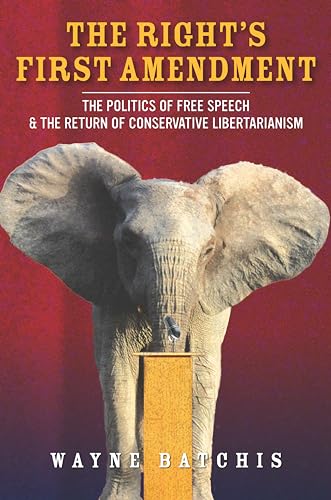
Synopsis
Not so long ago, being aggressively "pro–free speech" was as closely associated with American political liberalism as being pro-choice, pro–affirmative action, or pro–gun control. With little notice, this political dynamic has been shaken to the core. The Right's First Amendment examines how conservatives came to adopt and co-opt constitutional free speech rights.
In the 1960s, free speech on college campuses was seen as a guarantee for social agitators, hippies, and peaceniks. Today, for many conservatives, it represents instead a crucial shield that protects traditionalists from a perceived scourge of political correctness and liberal oversensitivity. Over a similar period, free market conservatives have risen up to embrace a once unknown, but now cherished, liberty: freedom of commercial expression. What do these changes mean for the future of First Amendment interpretation?
Wayne Batchis offers a fresh entry point into these issues by grounding his study in both political and legal scholarship. Surveying six decades of writings from the preeminent conservative publication National Review alongside the evolving constitutional law and ideological predispositions of Supreme Court justices deciding these issues, Batchis asks the conservative political movement to answer to its judicial logic, revealing how this keystone of our civic American beliefs now carries a much more complex and nuanced political identity.
"synopsis" may belong to another edition of this title.
About the Author
Wayne Batchis is Associate Professor of Political Science at the University of Delaware.
Excerpt. © Reprinted by permission. All rights reserved.
The Right's First Amendment
The Politics of Free Speech & the Return of Conservative Libertarianism
By Wayne BatchisSTANFORD UNIVERSITY PRESS
Copyright © 2016 Board of Trustees of the Leland Stanford Junior University
All rights reserved.
ISBN: 978-0-8047-9800-6All rights reserved.
Contents
Preface,
Acknowledgments,
Introduction: The Right's First Amendment,
1. Conservatism, the First Amendment, and National Review,
2. The Political Science of Judicial Decision Making,
3. Political Correctness and the Rise of the Conservative Victim,
4. The Courts and the Political Correctness Indictment,
5. The Rise of Free-Market Conservatism,
6. Commercial Speech in the Modern Era,
7. Citizens United and the Paradox of Associational Speech,
Conclusion,
Notes,
Index,
CHAPTER 1
Conservatism, the First Amendment, and National Review
What is "conservatism?" As foundational components of the contemporary political lexicon, the word "conservative" and its purported polar opposite "liberal" are bandied about with reckless abandon. In the rough and tumble of everyday American politics, these terms may be used to validate one's policy preferences, to denigrate another's, or merely to represent one's preferred political team. In the United States, there is, of course, no mainstream political party that adopts these words as their own — there is no Liberal Party or Conservative Party per se as in many countries throughout the world — but there might as well be. For even as the two major parties continue to evolve and adapt to their changing constituencies, today the Democratic Party is generally characterized as liberal and the Republican Party is understood to be conservative. By extension, many members of the judiciary, appointed by these very party politicians, must endure these labels as well, even when such labels are unwelcome.
The word "conservative" does, of course, have a core meaning. The American Heritage Dictionary defines conservative as "favoring traditional views and values; tending to oppose change. Traditional or restrained in style. Moderate; cautious." However, it also offers these definitions: "Of or relating to the political philosophy of conservatism. Belonging to a conservative party, group, or movement." Thus, when a judge is identified as conservative, it may suggest that her decisions convey a greater degree of respect for tradition, restraint, and caution than is the norm for judges in her class — the median judge. However, use of the identifier "conservative" might also merely indicate that that particular judge is aligned with the Republican Party, that she was nominated by a Republican president, or that her judicial decision making is perceived to be tainted by an ideological bias.
One thing is clear: Conservatism is not monolithic. Political conservatives, just like liberals, do not always see eye-to-eye. As already alluded to, there are readily identifiable tensions that exist among conservatives, the most familiar being the sometimes-contradictory emphasis on economic freedom lauded by free-market conservatives and deeply rooted tradition celebrated by moralistic conservatives. These two ideological camps largely defined the conservative landscape in the years following World War II, a period that marked the emergence of a coherent conservative movement in America. These two strains of conservative thinking do not necessarily conflict — and may indeed be complementary. David Brooks recounted how when he joined the staff of National Review in 1984, "the magazine,
"About this title" may belong to another edition of this title.
Search results for The Right's First Amendment: The Politics of Free Speech...

Stock Image
The Right's First Amendment: The Politics of Free Speech & the Return of Conservative Libertarianism
Seller: ThriftBooks-Dallas, Dallas, TX, U.S.A.
Seller rating 5 out of 5 stars

Paperback. Condition: Very Good. No Jacket. May have limited writing in cover pages. Pages are unmarked. ~ ThriftBooks: Read More, Spend Less. Seller Inventory # G0804798001I4N00
Stock Image
The Right's First Amendment: The Politics of Free Speech & the Return of Conservative Libertarianism (Stanford Studies in Law and Politics)
Published by
Stanford University Press, 2016
ISBN 10: 0804798001
ISBN 13: 9780804798006
Used
Softcover
First Edition
Seller: Project HOME Books, Philadelphia, PA, U.S.A.
Seller rating 5 out of 5 stars
Condition: Good. shelf wear, paperback Used - Good 2016 1st Edition All purchases support Project HOME - ending homelessness in Philadelphia. Seller Inventory # HZ07-000089
Stock Image
The Right's First Amendment: The Politics of Free Speech & the Return of Conservative Libertarianism (Stanford Studies in Law and Politics)
Published by
Stanford University Press, 2016
ISBN 10: 0804798001
ISBN 13: 9780804798006
Used
Paperback
Seller: Midtown Scholar Bookstore, Harrisburg, PA, U.S.A.
Seller rating 5 out of 5 stars
Paperback. Condition: Very Good. Very Good paperback with light shelfwear - NICE! Standard-sized. Seller Inventory # mon0000262235
Stock Image
Right's First Amendment : The Politics of Free Speech & the Return of Conservative Libertarianism
Published by
Stanford University Press, 2016
ISBN 10: 0804798001
ISBN 13: 9780804798006
New
Softcover
Seller: GreatBookPrices, Columbia, MD, U.S.A.
Seller rating 5 out of 5 stars
Condition: New. Seller Inventory # 25707141-n
Seller Image
The Right's First Amendment
Published by
Stanford University Press, US, 2016
ISBN 10: 0804798001
ISBN 13: 9780804798006
New
Paperback
Seller: Rarewaves USA, HEBRON, KY, U.S.A.
Seller rating 5 out of 5 stars
Paperback. Condition: New. Not so long ago, being aggressively "pro-free speech" was as closely associated with American political liberalism as being pro-choice, pro-affirmative action, or pro-gun control. With little notice, this political dynamic has been shaken to the core. The Right's First Amendment examines how conservatives came to adopt and co-opt constitutional free speech rights. In the 1960s, free speech on college campuses was seen as a guarantee for social agitators, hippies, and peaceniks. Today, for many conservatives, it represents instead a crucial shield that protects traditionalists from a perceived scourge of political correctness and liberal oversensitivity. Over a similar period, free market conservatives have risen up to embrace a once unknown, but now cherished, liberty: freedom of commercial expression. What do these changes mean for the future of First Amendment interpretation? Wayne Batchis offers a fresh entry point into these issues by grounding his study in both political and legal scholarship. Surveying six decades of writings from the preeminent conservative publication National Review alongside the evolving constitutional law and ideological predispositions of Supreme Court justices deciding these issues, Batchis asks the conservative political movement to answer to its judicial logic, revealing how this keystone of our civic American beliefs now carries a much more complex and nuanced political identity. Seller Inventory # LU-9780804798006
Seller Image
Right's First Amendment : The Politics of Free Speech & the Return of Conservative Libertarianism
Published by
Stanford University Press, 2016
ISBN 10: 0804798001
ISBN 13: 9780804798006
Used
Softcover
Seller: GreatBookPrices, Columbia, MD, U.S.A.
Seller rating 5 out of 5 stars
Condition: As New. Unread book in perfect condition. Seller Inventory # 25707141
Stock Image
The Right's First Amendment: The Politics of Free Speech & the Return of Conservative Libertarianism (Stanford Studies in Law and Politics)
Published by
Stanford University Press, 2016
ISBN 10: 0804798001
ISBN 13: 9780804798006
New
Softcover
Seller: California Books, Miami, FL, U.S.A.
Seller rating 5 out of 5 stars
Condition: New. Seller Inventory # I-9780804798006
Stock Image
The Right's First Amendment
Seller: PBShop.store UK, Fairford, GLOS, United Kingdom
Seller rating 5 out of 5 stars
PAP. Condition: New. New Book. Shipped from UK. Established seller since 2000. Seller Inventory # FW-9780804798006
Buy New
US$ 35.57
US$ 6.72 shipping
Ships from United Kingdom to U.S.A.
Ships from United Kingdom to U.S.A.
Quantity: 15 available
Stock Image
The Right?s First Amendment: The Politics of Free Speech & the Return of Conservative Libertarianism (eng)
Published by
Stanford University Press, 2016
ISBN 10: 0804798001
ISBN 13: 9780804798006
New
Softcover
Seller: Brook Bookstore On Demand, Napoli, NA, Italy
Seller rating 5 out of 5 stars
Condition: new. Seller Inventory # 36bae4d31d86669fdb6dffc87f7b2b9b
Buy New
US$ 36.59
US$ 6.17 shipping
Ships from Italy to U.S.A.
Ships from Italy to U.S.A.
Quantity: Over 20 available
Stock Image
THE RIGHT'S FIRST AMENDMENT: THE POLITICS OF FREE SPEECH & THE RETURN OF C
Published by
Stanford University Press, 2016
ISBN 10: 0804798001
ISBN 13: 9780804798006
New
Softcover
Seller: Basi6 International, Irving, TX, U.S.A.
Seller rating 5 out of 5 stars
Condition: Brand New. New. US edition. Expediting shipping for all USA and Europe orders excluding PO Box. Excellent Customer Service. Seller Inventory # ABEOCT25-374971