
Items related to Hope Against History: The Course of Conflict in Northern...
Synopsis
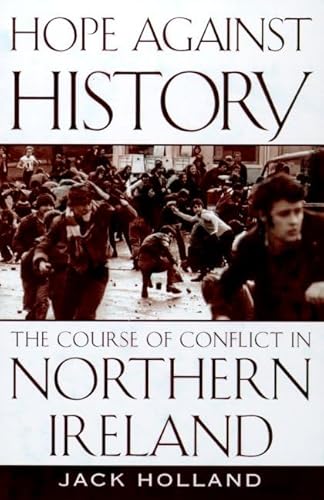
In Northern Ireland, the conflicting claims and aspirations of Catholic and Protestant, nationalist and unionist, republican and loyalist grate against each other, at each turn escalating the potential for renewed death and destruction. Hope for a peaceful future is not enough to cont with history. In Ulster, history has vanquished hope so often that it seems an act of folly to expect it to be otherwise. Until recently, the crisis in Northern Ireland was deemed a problem without a solution. Now that the major antagonists have agreed to work for peace and democracy, it is time for an authoritative assessment of "the troubles" that have plagued Ulster for more than a quarter century.
A Belfast product of mixed Catholic and Protestant heritage, Jack Holland is both of and above the fray; he is the writer who has stayed close to the terrorists and antiterrorists of every persuasion since 1966. In this cogent and balanced history, he unravels the complex and often misunderstood story of "the troubles," offering an insightful look at the past, a thorough vision of the present, and a glimpse of what the future may hold.
"synopsis" may belong to another edition of this title.
About the Author
Jack Holland writes for the Irish Echo and teaches journalism at NYU. A poet and novelist, he is a frequent contributor to The New York Times and co-wrote the 1998 PBS documentary Daughters of the Troubles; his last book, Phoenix: Policing the Shadows, about counterintelligence activities in Ulster, was a best-seller in Britain and Ireland.
Reviews
August 1999 marks the 30th anniversary of the introduction of British troops onto the streets of Northern Ireland in response to widespread civil disturbancesAthe watershed event that marked the start of the Troubles. Holland, a journalist, writer (The American Connection, etc.) and Belfast native of both Protestant and Catholic descent, provides a broad analysis of the history of the conflict. Drawing on his contacts among all parties (in Republican and Loyalist paramilitary organizations and in the British security forces), he guides readers through what he describes as the Twilight WarAthe shadowy realm in which the IRA, the loyalist paramilitary groups and the British security forces conducted their low-intensity, but often brutal, war. His claim that, before the Good Friday Agreement of 1998, the IRA was losing the armed struggle and had been effectively neutralized by the Royal Ulster Constabulatory in many areas of Northern Ireland will be hotly disputed. He also downplays the impact of the IRA's bombing campaign in England in the early 1990sAa campaign that, in the opinion of many observers, compelled the British government to launch secret talks with the IRA. While the book will profit those with little knowledge of Northern Ireland, it is not an ideal introductory text. For more knowledgeable readers, however, this volume will be invaluable. Few other works, if any, provide as many insights into the strategies, tactics and operations of the paramilitaries and the British security forces. (Aug.)
Copyright 1999 Reed Business Information, Inc.
An excellent, concise historical overview of ``the Troubles'' of Northern Ireland, especially well suited for the general reader. Holland (The American Connection: US Guns, Money, and Influence in Northern Ireland, 1987) explores the roots of sectarian conflict in Northern Ireland. He begins in the late 1960s, when John Hume organized a Catholic civil rights movement based on the nonviolent tactics of Martin Luther King. Just as in the American South, nonviolent tactics soon triggered a bloody backlash. Protestant mobs invaded Catholic areas of Belfast, burning houses and looting stores. The Provisional Irish Republican Army (IRA) was established to protect Catholic areas from Protestant invasion. When the British army arrived to ``restore order,'' all the ingredients for a civil war were in place. The IRA began a longstanding policy of attacking British soldiers, who were viewed as imperialist occupiers. Loyalist paramilitaries struck back by murdering Catholics and IRA members. A covert, dirty war of sectarian tit for tat ensued, leaving thousands dead. The intransigence of Margaret Thatcher provided a propaganda coup for the IRA: in 1981, IRA prisoners began a hunger strike demanding ``political prisoner'' status. With the world watching, Thatcher allowed the strikers to die. The hunger strikes benefited Sinn Fein, the IRAs political wing, which began having electoral success. While continuing its armed struggle, the IRA entered the 1980s with an often contradictory policy of bombs in one hand and ballots in the other. Increasingly, British intelligence, the Northern Ireland police, and Loyalist paramilitary groups were making the IRAs armed struggle unsustainable. With the departure of Thatcher, the concept of all-party negotiations gained momentum. In 1998, under intense pressure from President Clinton and Britains prime minister Tony Blair, Loyalists and republicans signed the historic Good Friday Peace Agreement, promising to share power through a new Northern Ireland Assembly. Holland is an articulate, knowledgeable guide through the labyrinth of Northern Irelands sad history. -- Copyright ©1999, Kirkus Associates, LP. All rights reserved.
Holland, a native of Belfast with both Catholic and Protestant roots, provides a lucid and insightful analysis of the "Troubles" that have plagued Northern Ireland since 1966. Dividing the contemporary Troubles into three distinct phases, the author offers a historical, economic, social, and cultural overview of each individual era. Dubbing the extraordinarily bloody years between 1966 and 1977 as the "classic" period, he describes how the incessant IRA and UDA violence initially evolved and eventually escalated to obscene proportions. Though the violence never ceased, it became increasingly staged between 1977 and 1993, when a new type of covert terrorism inextricably linked to increasingly sophisticated political organizations emerged. Though an apparently successful peace process was initiated in 1993, the underlying historical conflicts and tensions still remain, and the future of Ulster continues to be uncertain. A digestible chronicle of a costly and complex civil war. Margaret Flanagan
For over a century, the "Irish Question" has loomed on the American political horizonAsometimes large, sometimes less soAowing in large part to the passionate interests of many Irish Americans. This past generation of "troubles," coming after a period of relative quiet, has been particularly controversial and violent, taking place as it has in the modern media age. Yet somehow the unexpected has taken place, and there are genuine prospects for peace in Northern Ireland. Journalist Holland, a native of Belfast, has long been regarded as one of the most pragmatic and sensible interpreters of events there. In this book, he has put together a carefully crafted, intelligible, and fair presentation of the major phases and developments in Northern Ireland over the last 30 years, leading up to the Good Friday accord of 1998 and its immediate aftermath. Other books deal with particulars of these often gloomy years, focusing on the IRA or other aspects, but this work is highly recommended as an excellent general account of these events for both public and academic libraries.ACharles V. Cowling, Drake Memorial Lib., SUNY at Brockport
Copyright 1999 Reed Business Information, Inc.
"About this title" may belong to another edition of this title.
Search results for Hope Against History: The Course of Conflict in Northern...

Stock Image
Hope against History: The Course of Conflict in Northern Ireland
Published by
Henry Holt & Company Inc, 2001
ISBN 10: 0805060871
ISBN 13: 9780805060874
Used
Hardcover
Seller: World of Books (was SecondSale), Montgomery, IL, U.S.A.
Seller rating 5 out of 5 stars

Hardback. Condition: Good. Seller Inventory # 00105053750
Stock Image
Hope Against History: The Course of Conflict in Northern Ireland
Published by
Henry Holt and Co. (edition 1), 1999
ISBN 10: 0805060871
ISBN 13: 9780805060874
Used
Hardcover
Seller: BooksRun, Philadelphia, PA, U.S.A.
Seller rating 5 out of 5 stars
Hardcover. Condition: Very Good. 1. With dust jacket. It's a well-cared-for item that has seen limited use. The item may show minor signs of wear. All the text is legible, with all pages included. It may have slight markings and/or highlighting. Seller Inventory # 0805060871-11-1-29
Stock Image
Hope Against History: The Course of Conflict in Northern Ireland
Seller: HPB-Ruby, Dallas, TX, U.S.A.
Seller rating 5 out of 5 stars
hardcover. Condition: Very Good. Connecting readers with great books since 1972! Used books may not include companion materials, and may have some shelf wear or limited writing. We ship orders daily and Customer Service is our top priority! Seller Inventory # S_460625730
Stock Image
Hope against History: The Course of Conflict in Northern Ireland
Published by
Henry Holt & Company Inc, 2001
ISBN 10: 0805060871
ISBN 13: 9780805060874
Used
Hardcover
Seller: World of Books Inc, Montgomery, IL, U.S.A.
Seller rating 4 out of 5 stars

Hardback. Condition: Good. Seller Inventory # CIN0805060871G
Stock Image
Hope Against History: The Course of Conflict in Northern Ireland
Seller: ThriftBooks-Atlanta, AUSTELL, GA, U.S.A.
Seller rating 5 out of 5 stars
Hardcover. Condition: Good. No Jacket. Pages can have notes/highlighting. Spine may show signs of wear. ~ ThriftBooks: Read More, Spend Less. Seller Inventory # G0805060871I3N00
Stock Image
Hope Against History : The Course of Conflict in Northern Ireland
Published by
Holt & Company, Henry, 1999
ISBN 10: 0805060871
ISBN 13: 9780805060874
Used
Hardcover
First Edition
Seller: Better World Books, Mishawaka, IN, U.S.A.
Seller rating 5 out of 5 stars
Condition: Good. 1st. Former library copy. Pages intact with minimal writing/highlighting. The binding may be loose and creased. Dust jackets/supplements are not included. Includes library markings. Stock photo provided. Product includes identifying sticker. Better World Books: Buy Books. Do Good. Seller Inventory # 3504043-6
Stock Image
Hope Against History: The Course of Conflict in Northern Ireland
Seller: Half Price Books Inc., Dallas, TX, U.S.A.
Seller rating 5 out of 5 stars
hardcover. Condition: Very Good. Connecting readers with great books since 1972! Used books may not include companion materials, and may have some shelf wear or limited writing. We ship orders daily and Customer Service is our top priority! Seller Inventory # S_484962273
Seller Image
Hope Against History: The Course of Conflict in Northern Ireland
Seller: MERS Goodwill, Saint Louis, MO, U.S.A.
Seller rating 5 out of 5 stars
Condition: acceptable. Used - Acceptable: All pages and the cover are intact, but shrink wrap, dust covers, or boxed set case may be missing. Pages may include limited notes, highlighting, or minor water damage but the text is readable. Pages may include limited notes and highlighting, but the text cannot be obscured or unreadable. Any access codes or passwords originally included with the book may be expired, used or no longer valid. Image is stock photo and cover art edition may be different than pictured. Seller Inventory # 4J3P5N0020MU
Stock Image
Hope Against History: The Course of Conflict in Northern Ireland
Published by
Henry Holt, New York, 1999
ISBN 10: 0805060871
ISBN 13: 9780805060874
Used
Hardcover
First Edition
Seller: Abacus Bookshop, Pittsford, NY, U.S.A.
Seller rating 5 out of 5 stars
hardcover. Condition: Fine copy in fine dust jacket. 1st. 8vo, 280 pp. Seller Inventory # 073984
Seller Image
Hope Against History: The Course of Conflict in Northern Ireland
Published by
Henry Holt & Co, 1999
ISBN 10: 0805060871
ISBN 13: 9780805060874
Used
Hardcover
First Edition
Seller: Diplomatist Books, Norwich, United Kingdom
Seller rating 5 out of 5 stars
Hardcover. Condition: Very Good. Dust Jacket Condition: Very Good. 1st Edition. hb, d/w, 280pp. Seller Inventory # 2410053
Buy Used
US$ 6.87
US$ 24.02 shipping
Ships from United Kingdom to U.S.A.
Ships from United Kingdom to U.S.A.
Quantity: 1 available