
Items related to Terrible Lizard: The First Dinosaur Hunters and the...
Synopsis
The dramatic story of the discovery that forever changed man's perception of his place in the universe.
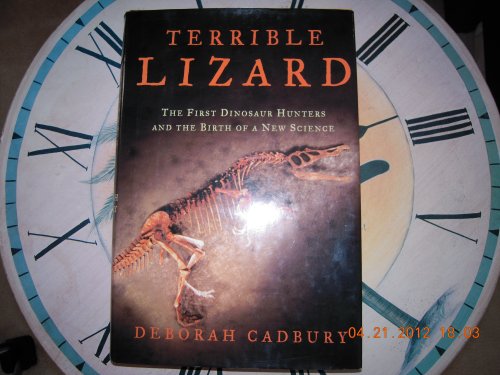
In 1812, the skeleton of a monster was discovered beneath the cliffs of Dorset, setting in motion a collision between science and religion and among scientists eager to claim supremacy in a brand-new field. For Rever William Buckland, an eccentric naturalist at Oxford University, the fossil remains of a creature that existed before Noah's flood inspired an attempt to prove the accuracy of the biblical record. Gideon Mantell, a naturalist who uncovered giant bones in a Sussex quarry, also became obsessed with the ancient past, risking everything to promote his vision of the lost world of reptiles. Soon the eminent anatomist Richard Owen entered the fray, claiming the credit for the discovery of the dinosaurs.
In a fast-paced narrative, Terrible Lizard reveals a strange, awesome prehistoric era and the struggle that set the stage for Darwin's shattering theories-and for controversies that still rage today.
In 1812, the skeleton of a monster was discovered beneath the cliffs of Dorset, setting in motion a collision between science and religion and among scientists eager to claim supremacy in a brand-new field. For Rever William Buckland, an eccentric naturalist at Oxford University, the fossil remains of a creature that existed before Noah's flood inspired an attempt to prove the accuracy of the biblical record. Gideon Mantell, a naturalist who uncovered giant bones in a Sussex quarry, also became obsessed with the ancient past, risking everything to promote his vision of the lost world of reptiles. Soon the eminent anatomist Richard Owen entered the fray, claiming the credit for the discovery of the dinosaurs.
In a fast-paced narrative, Terrible Lizard reveals a strange, awesome prehistoric era and the struggle that set the stage for Darwin's shattering theories-and for controversies that still rage today.
"synopsis" may belong to another edition of this title.
About the Author
Deborah Cadbury is an award-winning TV science producer for the BBC. She is also the author of The Feminization of Nature. She lives in London.
Reviews
In this comprehensive narrative, Cadbury (Altering Eden) tells the story of the first fossilists, whose discoveries challenged the religious convictions of their day as they struggled with the implications of new science. It begins with Mary Anning, who unearthed the skeleton of a monstrous creature beneath the cliffs of Dorset in 1812; Anning would earn the respect of her male peers, but not entry into their exclusive societies. Men like the eccentric Oxford don William Buckland sought to reconcile the biblical account of Noah's flood with the fossil record, while the brilliant Georges Cuvier posited a theory of "catastrophes" to explain the progression of life while still holding true to scripture. The ambitious Richard Owen, who coined the term dinosaur and claimed credit for the discovery of dinosaurs, used his prestige to discount early evolutionary theories in favor of his own backward-looking notions about a biblical past. Unlike his rival Gideon Mantell, whose studies in geology and paleontology laid the foundation for the new science, Owen rarely set foot in a quarry or dig, but he did, according to Cadbury, mine his share of fellow scientists' works for ideas he then claimed as his own. Cadbury makes much of the rivalry between the two men, and to good effect. Her focus on Owen's injustices against Mantell, Owen's corresponding rise to fame, and Mantell's ultimately tragic end lends momentum to her narrative, culminating in the advent of the evolutionary idea with Darwin's On the Origin of Species. This is a must-read book for dinosaur enthusiasts, and for anyone who has ever wondered about the source of our present-day assumptions and unanswered questions about human origins. (June 6)Forecast: In its inevitable sales duel with Christopher McGowan's Dragon Seekers (see review p. 231), Cadbury's more three-dimensional account is sure to win hands down.
Copyright 2001 Cahners Business Information, Inc.
Not long ago my friend George, who recently celebrated his second birthday, put some of his vocabulary on display for me. "Tee-wex," he said, and roared. "Tie-say-watops," he said, and roared again. "Apatosaw-us." Roar number three. It is a remarkable thing that children today can speak Latin, but more remarkable still that the only Latin words they speak are the names of dinosaurs. I have yet to hear George or any other child say "Hallucigenia," or "Ambulocetus," or "Acanthostega"-although they were as remarkable as any velociraptor.
Dinosaurs have such a powerful grip on the public consciousness that it is easy to forget just how recently humans became aware of them. A two-year-old boy today may be able to rattle off three dinosaur names, but in 1824 there was only one dinosaur to be named, period. The word "dinosaur" didn't even exist until 1842. Those confused early years, when the world was baffled by the discovery of absurdly enormous reptiles, represent one of the most fascinating stories in the history of science.
One reason is that its cast is so extraordinary. On the south coast of England, Mary Anning, a poor and uneducated beachcomber, spent 30 years digging up giant marine reptiles and pterosaurs. Gideon Mantell, a shoemaker's son turned doctor, discovered the first dinosaur; he thought dinosaurs would make him rich, but they ultimately destroyed his life. William Buckland, an Oxford geologist who tried to reconcile giant extinct reptiles with Genesis, had a raft of eccentricities, including a penchant for keeping live hyenas and jackals in his college rooms. The time is ripe for a book for the general public about these early paleontologists, and now we have not one but two.
The Dragon Seekers is the work of a practicing paleontologist (Christopher McGowan is a senior curator at the Royal Ontario Museum and teaches at the University of Toronto). The book is therefore filled with historical details that matter to a fossil hunter: the methods the early fossilists used to extract bones from cliffs, the squabbles over naming new species, the staffing of museums. It is brief and pleasant, but for sheer narrative pleasure, I'd have to recommend Deborah Cadbury's Terrible Lizard instead. Cadbury, a BBC television producer, turns what could have been just a string of anecdotes into high drama. Much of her success comes from her depth of research: she has scoured diaries, letters and newspaper archives and can tell her story in the words of the people who lived it.
For Cadbury, Gideon Mantell is the tragic hero of the early days of dinosaur hunting. Scrounging one quarry after another, he built up one of the finest private fossil collections in the world at the time. Even when he had just a few scraps of dinosaur bones, Mantell knew that he had found the remains of giant reptiles. He didn't back down when the leading scientists of his day told him he had found nothing but fish teeth and rhino horns. But Mantell's obsession with his fossils eventually left him bankrupt and alienated from his wife and children. And just when he began to earn scientific respect, he crossed paths with the ruthless Sir Richard Owen. Owen didn't know how to dig up fossils, but he did know how to pluck the strings of academic power. He managed to make himself England's authority on all life, both living and dead.
It was Owen, not Mantell, who in 1838 was appointed by the British Association for the Advancement of Science to survey the giant extinct reptiles of England. In his report, he gave them the name "dinosaurs" but mentioned Mantell only in scorn. The dinosaurs lifted Owen on their colossal backs to heights of fame and wealth. Mantell meanwhile faded into obscurity, his fossils dispersed and forgotten.
Owen used dinosaurs as an argument against evolution: if life progressed through time, it made no sense that the extinct dinosaurs were so much more impressive that today's reptiles. He thought that life unfolded over geologic time according to certain laws, but no one-not even himself, it seems-really understood his ideas. Then Darwin blindsided Owen with an elegant, powerful theory that encompassed all of life, dinosaurs included. Owen ultimately became irrelevant. The dinosaur sculptures that he had built for the Crystal Palace exhibition are now chipped, broken and beset with weeds.
My chief complaint with both books is that they unintentionally raise an important question that neither answers: The discovery of dinosaurs was unquestionably fascinating, but was it ultimately very important? I'm not so sure. One of the great triumphs of 19th-century paleontologists was their use of fossils as Rosetta stones to decipher the global geologic record. But dinosaurs were only one group of animals among many that they used. Darwin was certainly inspired by fossils but not by dinosaurs. Instead it was the giant ground sloths and other extinct mammals he dug up in South America that made him think about the connections between present and past life. The word "dinosaur" appears nowhere in The Origin of Species.
In the 1940s George Gaylord Simpson reinvigorated paleontology when he showed that mutations and natural selection could account for changes in the fossil record. But he used horses and other mammals as proof, not dinosaurs. Since then, paleontology has surged from the backwaters of evolutionary research to the crest of the wave. Punctuated equilibrium, the causes and effects of mass extinctions, plate tectonics' role in the origin of species, the coevolutionary arms races between predators and prey-in all these cases, it was fossils that showed how evolution works. Rarely did these fossils belong to dinosaurs; they were instead snails, plankton, pond scum and other unglamorous creatures. The fossils of dinosaurs are beautiful and spectacular, but compared with other animals, they're also very hard to find. A thousand fossil crabs can say much more about how evolution works than a single T. rex.
Only in the past couple of generations have paleontologists really started to use dinosaurs in cutting-edge research in evolution. Dinosaur paleontologists were among the first scientists to use the newest methods of classification (known as cladistics), and as a result, they've been able to explore the incremental evolution of birds from dinosaurs. Dinosaurs are becoming important sources of information about how the breakup of continents influences evolution, how changing the rules by which embryos develop shapes new anatomy and how asteroids can trigger mass extinctions. The subtitle of The Dragon Seekers claims that the study of dinosaurs paved the way for Darwin, yet the reverse may be closer to the truth.
Carl Zimmer is the author of Parasite Rex and At the Water's Edge.
From its beginnings, modern paleontology has been full of colorful characters acting out of motives base, noble, and mercenary, as this account reveals. Cadbury's richly descriptive book accents the commercial and social milieu in which the fossil hunters lived. She opens with a rarity in science--a woman, Mary Anning, first finder of such icons of Dinosauria as the plesiosaur and the pterodactyl. To her, the monstrous, petrified creatures from an antediluvian past connected her to intellectual circles beyond her hometown of Lyme Regis and were something to live on, though meagerly, through selling their remains. Another aspirant to higher social status was Gideon Mantell, who gained membership in the Royal Society and hobnobbed with such luminaries as Georges Cuvier, but whose strivings unhappily alienated his wife. Cadbury smoothly incorporates Mantell's clashes with the coiner of the word dinosaur, Richard Owen, and the support he got from the likes of geologist Charles Lyell into a humanizing book, evocative of the intellectual and social atmosphere of its setting. Gilbert Taylor
Copyright © American Library Association. All rights reserved
"About this title" may belong to another edition of this title.
Search results for Terrible Lizard: The First Dinosaur Hunters and the...

Stock Image
Terrible Lizard: The First Dinosaur Hunters and the Birth of a New Science
Seller: Gulf Coast Books, Cypress, TX, U.S.A.
Seller rating 5 out of 5 stars

hardcover. Condition: Fair. Seller Inventory # 0805067728-4-37177682
Stock Image
Terrible Lizard: The First Dinosaur Hunters and the Birth of a New Science
Seller: ThriftBooks-Dallas, Dallas, TX, U.S.A.
Seller rating 5 out of 5 stars
Hardcover. Condition: Good. No Jacket. Pages can have notes/highlighting. Spine may show signs of wear. ~ ThriftBooks: Read More, Spend Less. Seller Inventory # G0805067728I3N00
Stock Image
Terrible Lizard: The First Dinosaur Hunters and the Birth of a New Science
Seller: ThriftBooks-Atlanta, AUSTELL, GA, U.S.A.
Seller rating 5 out of 5 stars
Hardcover. Condition: Good. No Jacket. Former library book; Pages can have notes/highlighting. Spine may show signs of wear. ~ ThriftBooks: Read More, Spend Less. Seller Inventory # G0805067728I3N10
Stock Image
Terrible Lizard: The First Dinosaur Hunters and the Birth of a New Science
Seller: ThriftBooks-Dallas, Dallas, TX, U.S.A.
Seller rating 5 out of 5 stars
Hardcover. Condition: Good. No Jacket. Former library book; Pages can have notes/highlighting. Spine may show signs of wear. ~ ThriftBooks: Read More, Spend Less. Seller Inventory # G0805067728I3N10
Stock Image
Terrible Lizard: The First Dinosaur Hunters and the Birth of a New Science
Seller: HPB-Emerald, Dallas, TX, U.S.A.
Seller rating 5 out of 5 stars
Hardcover. Condition: Very Good. Connecting readers with great books since 1972! Used books may not include companion materials, and may have some shelf wear or limited writing. We ship orders daily and Customer Service is our top priority! Seller Inventory # S_470571484
Stock Image
Terrible Lizard: The First Dinosaur Hunters and the Birth of a New Science
Seller: HPB-Diamond, Dallas, TX, U.S.A.
Seller rating 5 out of 5 stars
Hardcover. Condition: Very Good. Connecting readers with great books since 1972! Used books may not include companion materials, and may have some shelf wear or limited writing. We ship orders daily and Customer Service is our top priority! Seller Inventory # S_471399919
Stock Image
Terrible Lizard: The First Dinosaur Hunters and the Birth of a Ne
Seller: Hawking Books, Edgewood, TX, U.S.A.
Seller rating 4 out of 5 stars

Condition: Good. Good Condition. Five star seller - Buy with confidence! Seller Inventory # X0805067728X3
Stock Image
Terrible Lizard : The First Dinosaur Hunters and the Birth of a New Science
Seller: Better World Books: West, Reno, NV, U.S.A.
Seller rating 5 out of 5 stars
Condition: Very Good. Pages intact with possible writing/highlighting. Binding strong with minor wear. Dust jackets/supplements may not be included. Stock photo provided. Product includes identifying sticker. Better World Books: Buy Books. Do Good. Seller Inventory # 4068045-6
Stock Image
Terrible Lizard : The First Dinosaur Hunters and the Birth of a New Science
Seller: Better World Books, Mishawaka, IN, U.S.A.
Seller rating 5 out of 5 stars
Condition: Very Good. Former library copy. Pages intact with possible writing/highlighting. Binding strong with minor wear. Dust jackets/supplements may not be included. Includes library markings. Stock photo provided. Product includes identifying sticker. Better World Books: Buy Books. Do Good. Seller Inventory # 5298828-20
Stock Image
Terrible Lizard : The First Dinosaur Hunters and the Birth of a New Science
Seller: Better World Books, Mishawaka, IN, U.S.A.
Seller rating 5 out of 5 stars
Condition: Fine. Used book that is in almost brand-new condition. May contain a remainder mark. Better World Books: Buy Books. Do Good. Seller Inventory # 14341243-6