
Items related to Infectious Greed: How Deceit and Risk Corrupted the...
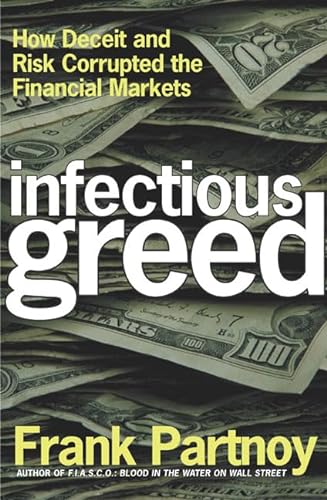
Synopsis
From the bestselling author of F.I.A.S.C.O., a
riveting chronicle of the rise of dangerous
financial instruments and the growing crisis in American business
The still-unfolding financial story is terrifying. One by one, major corporations such as Enron, Global Crossing, and Worldcom are imploding all around us, prey to a greed-driven culture and dubious or illegal corporate finance and accounting. Our financial system has suddenly reached a perilous crossroads.
In a compelling and disturbing narrative, Frank Partnoy brings to bear all of his skills and experience as a securities attorney, financial analyst, law professor, and bestselling author to tell the story of the rise of the trading instruments and corporate financial structures that now imperil the economic health of the country. Starting in the mid-1980s with the introduction of the first proto-derivatives, and taking us through such high-profile disasters as Barings Bank and Long Term Capital Management, Partnoy traces a seamless progression to today's dangerous manipulations. He documents how each new level of financial risk and complexity obscured the sickness of the company in question, and required ever more ingenious deceptions. The story becomes more alarming with each passing day, but Partnoy offers a clear vision of how we can step back from the precipice.
riveting chronicle of the rise of dangerous
financial instruments and the growing crisis in American business
The still-unfolding financial story is terrifying. One by one, major corporations such as Enron, Global Crossing, and Worldcom are imploding all around us, prey to a greed-driven culture and dubious or illegal corporate finance and accounting. Our financial system has suddenly reached a perilous crossroads.
In a compelling and disturbing narrative, Frank Partnoy brings to bear all of his skills and experience as a securities attorney, financial analyst, law professor, and bestselling author to tell the story of the rise of the trading instruments and corporate financial structures that now imperil the economic health of the country. Starting in the mid-1980s with the introduction of the first proto-derivatives, and taking us through such high-profile disasters as Barings Bank and Long Term Capital Management, Partnoy traces a seamless progression to today's dangerous manipulations. He documents how each new level of financial risk and complexity obscured the sickness of the company in question, and required ever more ingenious deceptions. The story becomes more alarming with each passing day, but Partnoy offers a clear vision of how we can step back from the precipice.
"synopsis" may belong to another edition of this title.
About the Author
Frank Partnoy is currently a professor at the University of San Diego Law School. He has worked as an investment banker, derivatives broker, and corporate securities attorney. He also consults on regulation of the markets and white-collar crime. His expert testimony before the Senate committee investigating the Enron collapse has been widely cited in the media. Partnoy is the author of F.I.A.S.C.O.: Blood in the Water on Wall Street. He lives in San Diego, California.
Reviews
Partnoy's previous book, F.I.A.S.C.O., was an inside story of a Wall Street derivatives trader. It argued that recklessness and lack of regulation made derivatives trading (trading financial instruments that have no intrinsic value) a threat to the financial system. Turning from autobiography to history, this new work makes the same points by examining financial disasters caused by derivatives of the last 15 years. "Patient Zero" is Andy Krieger, whose $80 million mismarking of currency options embarrassed Bankers Trust in 1988. Partnoy profiles other derivatives abusers, too, including Nick Leeson, who bankrupted Barings Bank; Robert Citron, who did the same for Orange County; and Joseph Jett, whose "forward recon" trades helped end the independent existence of Kidder Peabody and Long Term Capital Management. These accounts of 20th-century disasters are neither original nor deep, but readers interested in the subject will be pleased to see the links among them. Taken together, common features emerge that are hard to see in detailed accounts of individual collapses. For example, Partnoy makes a revisionist case that credit rating agencies and federal regulators, including Alan Greenspan and Arthur Levitt, bear most of the blame. The author carries his story into mid-2002, evaluating Enron, WorldCom and Global Crossing. His analysis here is more original, reversing the popular perception by claiming Enron was a profitable company that should have survived, while WorldCom and Global Crossing had no economic substance.
Copyright 2003 Reed Business Information, Inc.
An academic with a corporate resume, Partnoy tells the story of the rise of trading instruments and corporate financial structures that now imperil the economic health of the country. He contends that any appearance of control of the financial markets is an illusion and the "truth is that the markets have been, and are, spinning out of control." From actual cases culminating in scandals, such as Enron and WorldCom, we learn about three major changes in financial markets since the mid-1980s--financial instruments became increasingly complex and served as tools to manipulate earnings and avoid regulation; even sophisticated investors could not monitor increasingly aggressive managers; and with deregulated markets, financial malfeasance was rarely punished. Six recommendations to stem the tide of excess in financial markets include treating derivatives like other financial instruments; shifting from rules to standards; eliminating the domination of gatekeepers, especially credit-rating agencies; and encouraging informed investors to bet against stocks and encouraging investors to control and monitor their own investments. Mary Whaley
Copyright © American Library Association. All rights reserved
Why the economy is so unstable; from law professor Partnoy.
Copyright 2002 Reed Business Information, Inc.
Excerpt. © Reprinted by permission. All rights reserved.
From Infectious Greed:
By 2002, the closing bell of the New York Stock Exchange was barely relevant, as securities traded 24 hours a day, around the world. The largest markets were private, and didn't involve regulated exchanges at all. Financial derivatives were as prevalent as stocks and bonds, and nearly as many assets and liabilities were off balance sheets as on. Companies' reported earnings were a fiction, and financial reports were chock full of disclosures that would shock the average investor if she ever even glanced at them, not that anyone—including financial journalists and analysts—ever did. Trading volatilities were sky high, with historically unrelated markets moving in lock step, increasing the risk of systemic collapse.
In just a few years, regulators had lost what limited control they had over market intermediaries, market intermediaries had lost what limited control they had over corporate managers, and corporate managers had lost what limited control they had over employees. This loss-of-control daisy chain had led to exponential risk-taking at many companies, largely hidden from public view. Simply put, the appearance of control in financial markets was a fiction.
By 2002, the closing bell of the New York Stock Exchange was barely relevant, as securities traded 24 hours a day, around the world. The largest markets were private, and didn't involve regulated exchanges at all. Financial derivatives were as prevalent as stocks and bonds, and nearly as many assets and liabilities were off balance sheets as on. Companies' reported earnings were a fiction, and financial reports were chock full of disclosures that would shock the average investor if she ever even glanced at them, not that anyone—including financial journalists and analysts—ever did. Trading volatilities were sky high, with historically unrelated markets moving in lock step, increasing the risk of systemic collapse.
In just a few years, regulators had lost what limited control they had over market intermediaries, market intermediaries had lost what limited control they had over corporate managers, and corporate managers had lost what limited control they had over employees. This loss-of-control daisy chain had led to exponential risk-taking at many companies, largely hidden from public view. Simply put, the appearance of control in financial markets was a fiction.
"About this title" may belong to another edition of this title.
Search results for Infectious Greed: How Deceit and Risk Corrupted the...

Stock Image
Infectious Greed: How Deceit and Risk Corrupted the Financial Markets
Seller: Gulf Coast Books, Cypress, TX, U.S.A.
Seller rating 5 out of 5 stars

hardcover. Condition: Fair. Seller Inventory # 0805072675-4-37847748
Stock Image
Infectious Greed: How Deceit and Risk Corrupted the Financial Markets
Seller: World of Books (was SecondSale), Montgomery, IL, U.S.A.
Seller rating 5 out of 5 stars
Hardback. Condition: Good. Seller Inventory # 00102806960
Stock Image
Infectious Greed: How Deceit and Risk Corrupted the Financial Markets
Published by
Times Books (edition 1), 2003
ISBN 10: 0805072675
ISBN 13: 9780805072679
Used
Hardcover
Seller: BooksRun, Philadelphia, PA, U.S.A.
Seller rating 5 out of 5 stars
Hardcover. Condition: Very Good. 1. It's a well-cared-for item that has seen limited use. The item may show minor signs of wear. All the text is legible, with all pages included. It may have slight markings and/or highlighting. Seller Inventory # 0805072675-11-1
Stock Image
Infectious Greed: How Deceit and Risk Corrupted the Financial Markets
Seller: ThriftBooks-Dallas, Dallas, TX, U.S.A.
Seller rating 5 out of 5 stars
Hardcover. Condition: Good. No Jacket. Missing dust jacket; Pages can have notes/highlighting. Spine may show signs of wear. ~ ThriftBooks: Read More, Spend Less. Seller Inventory # G0805072675I3N01
Stock Image
Infectious Greed: How Deceit and Risk Corrupted the Financial Markets
Seller: ThriftBooks-Dallas, Dallas, TX, U.S.A.
Seller rating 5 out of 5 stars
Hardcover. Condition: Good. No Jacket. Former library book; Pages can have notes/highlighting. Spine may show signs of wear. ~ ThriftBooks: Read More, Spend Less. Seller Inventory # G0805072675I3N10
Stock Image
Infectious Greed: How Deceit and Risk Corrupted the Financial Markets
Seller: ThriftBooks-Atlanta, AUSTELL, GA, U.S.A.
Seller rating 5 out of 5 stars
Hardcover. Condition: Very Good. No Jacket. May have limited writing in cover pages. Pages are unmarked. ~ ThriftBooks: Read More, Spend Less. Seller Inventory # G0805072675I4N00
Stock Image
Infectious Greed: How Deceit and Risk Corrupted the Financial Markets
Seller: ThriftBooks-Atlanta, AUSTELL, GA, U.S.A.
Seller rating 5 out of 5 stars
Hardcover. Condition: Good. No Jacket. Former library book; Pages can have notes/highlighting. Spine may show signs of wear. ~ ThriftBooks: Read More, Spend Less. Seller Inventory # G0805072675I3N10
Seller Image
Infectious Greed: How Deceit and Risk Corrupted the Financial Markets
Seller: -OnTimeBooks-, Phoenix, AZ, U.S.A.
Seller rating 5 out of 5 stars
Condition: good. A copy that has been read, remains in good condition. All pages are intact, and the cover is intact. The spine and cover show signs of wear. Pages can include notes and highlighting and show signs of wear, and the copy can include "From the library of" labels or previous owner inscriptions. 100% GUARANTEE! Shipped with delivery confirmation, if you're not satisfied with purchase please return item! Ships via media mail. Seller Inventory # OTV.0805072675.G
Stock Image
Infectious Greed: How Deceit and Risk Corrupted the Financial Markets
Seller: World of Books Inc, Montgomery, IL, U.S.A.
Seller rating 4 out of 5 stars

Hardback. Condition: Good. Seller Inventory # CIN0805072675G
Seller Image
Infectious Greed: How Deceit and Risk Corrupted the Financial Markets
Seller: Blue Vase Books, Interlochen, MI, U.S.A.
Seller rating 5 out of 5 stars
Condition: good. Former library book with the usual stamps, stickers and labels. The item shows wear from consistent use, but it remains in good condition and works perfectly. All pages and cover are intact including the dust cover, if applicable . Spine may show signs of wear. Pages may include limited notes and highlighting. May NOT include discs, access code or other supplemental materials. Seller Inventory # BVV.0805072675.G