
Items related to For the Common Good: Redirecting the Economy Toward...
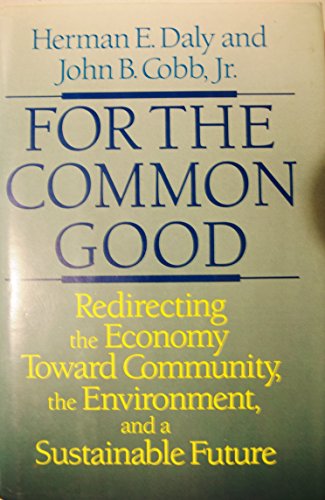
For the Common Good: Redirecting the Economy Toward Community, the Environment, and a Sustainable Future - Hardcover
Synopsis
Winner of the Grawemeyer Award for Ideas Improving World Order 1992, Named New Options Best Political Book
Economist Herman Daly and theologian John Cobb, Jr., demonstrate how conventional economics and a growth-oriented industrial economy have led us to the brink of environmental disaster, and show the possibility of a different future.
Named as one of the Top 50 Sustainability Books by University of Cambridges Programme for Sustainability Leadership and Greenleaf Publishing.
"synopsis" may belong to another edition of this title.
Reviews
Pushing for economic growth above all else, industrial nations ignore the damage done to the biosphere by the profligate use of energy and scarce resources. Daly, a World Bank economist, and Cobb, a philosopher-theologian, set forth a detailed, far-reaching blueprint for a highly decentralized economy built around small communities, scaled to human needs and stewardship of the planet. Their important, radical critique of contemporary economic thinking in the book's dry first half leads to specific proposals in the second. These include a tax on industrial polluters, worker participation in management and ownership, reduced military expenditures and a self-sufficient national economy that relies less on imports. In place of gross national product, they put forth an "index of sustainable economic welfare" as a yardstick of true growth.
Copyright 1989 Reed Business Information, Inc.
This book is a profound critique of conventional economic theories and policies. Daly (economics, Louisiana State Univ.), an economist at the World Bank, and Cobb (theology and philosophy, Claremont Graduate Sch., Cal.) provide an alternative approach to economics, one that is more humanistic and less scientific. Their criticisms are rooted in a religious/philosophical framework of stewardship and community. The idealistic policies that flow from this new approach will be controversial. This book is highly recommended, especially for college libraries. Few other volumes address these issues with such insight.
- Richard C. Schiming, Mankato State Univ., Minn.
Copyright 1990 Reed Business Information, Inc.
"About this title" may belong to another edition of this title.
Search results for For the Common Good: Redirecting the Economy Toward...

Stock Image
For the Common Good: Redirecting the Economy Toward Community, the Environment, and a Sustainable Future
Seller: More Than Words, Waltham, MA, U.S.A.
Seller rating 5 out of 5 stars

Condition: Good. . Good. All orders guaranteed and ship within 24 hours. Before placing your order for please contact us for confirmation on the book's binding. Check out our other listings to add to your order for discounted shipping. Seller Inventory # WAL-A-5h-001978
Seller Image
For the Common Good: Redirecting the Economy Toward Community, the Environment, and a Sustainable Future
Seller: Dream Books Co., Denver, CO, U.S.A.
Seller rating 5 out of 5 stars
Condition: acceptable. This copy has clearly been enjoyedâ"expect noticeable shelf wear and some minor creases to the cover. Binding is strong, and all pages are legible. May contain previous library markings or stamps. Seller Inventory # DBV.0807047023.A
Seller Image
For the Common Good: Redirecting the Economy Toward Community, the Environment, and a Sustainable Future
Seller: Bay State Book Company, North Smithfield, RI, U.S.A.
Seller rating 5 out of 5 stars
Condition: very_good. Seller Inventory # BSM.1DMAD
Seller Image
For the Common Good: Redirecting the Economy Toward Community, the Environment, and a Sustainable Future
Seller: Bay State Book Company, North Smithfield, RI, U.S.A.
Seller rating 5 out of 5 stars
Condition: good. The book is in good condition with all pages and cover intact, including the dust jacket if originally issued. The spine may show light wear. Pages may contain some notes or highlighting, and there might be a "From the library of" label. Boxed set packaging, shrink wrap, or included media like CDs may be missing. Seller Inventory # BSM.1CDC2
Stock Image
For the Common Good: Redirecting the Economy Toward Community, the Environment, and a Sustainable Future
Seller: St Vincent de Paul of Lane County, Eugene, OR, U.S.A.
Seller rating 5 out of 5 stars
Condition: Acceptable. DUST JACKET SHOWS GENERAL WEAR, SUCH AS SCRATCHES, RUBBING, STAINING, STICKER RESIDUE AND CREASES. SPINE LEANS. BOOK HAS SOME WRITING/NOTATIONS IN THE MARGINS. END PAPERS HAVE SMALL RUST STAINS FROM METAL PAPERCLIPS THAT WERE LEFT IN THE BOOK. PREVIOUS OWNER'S NAME WRITTEN IN BOOK. hardcover 100% of proceeds go to charity! Acceptable reading copy with obvious signs of use, wear, and/or cosmetic issues. Item is complete and remains readable despite notable condition issues. Seller Inventory # N-01-4182
Stock Image
For the Common Good: Redirecting the Economy Toward Community, the Environment, and a Sustainable Future
Seller: ThriftBooks-Dallas, Dallas, TX, U.S.A.
Seller rating 5 out of 5 stars
Hardcover. Condition: Good. No Jacket. Missing dust jacket; Pages can have notes/highlighting. Spine may show signs of wear. ~ ThriftBooks: Read More, Spend Less. Seller Inventory # G0807047023I3N01
Stock Image
For the Common Good: Redirecting the Economy Toward Community, the Environment, and a Sustainable Future
Seller: ThriftBooks-Dallas, Dallas, TX, U.S.A.
Seller rating 5 out of 5 stars
Hardcover. Condition: Good. No Jacket. Former library book; Missing dust jacket; Pages can have notes/highlighting. Spine may show signs of wear. ~ ThriftBooks: Read More, Spend Less. Seller Inventory # G0807047023I3N11
Stock Image
For the Common Good: Redirecting the Economy Toward Community, the Environment, and a Sustainable Future
Seller: ThriftBooks-Atlanta, AUSTELL, GA, U.S.A.
Seller rating 5 out of 5 stars
Hardcover. Condition: Good. No Jacket. Missing dust jacket; Pages can have notes/highlighting. Spine may show signs of wear. ~ ThriftBooks: Read More, Spend Less. Seller Inventory # G0807047023I3N01
Stock Image
For the Common Good: Redirecting the Economy Toward Community, the Environment, and a Sustainable Future
Seller: ThriftBooks-Atlanta, AUSTELL, GA, U.S.A.
Seller rating 5 out of 5 stars
Hardcover. Condition: Good. No Jacket. Former library book; Pages can have notes/highlighting. Spine may show signs of wear. ~ ThriftBooks: Read More, Spend Less. Seller Inventory # G0807047023I3N10
Stock Image
For the Common Good: Redirecting the Economy Toward Community, the Environment, and a Sustainable Future
Seller: ThriftBooks-Dallas, Dallas, TX, U.S.A.
Seller rating 5 out of 5 stars
Hardcover. Condition: Good. No Jacket. Pages can have notes/highlighting. Spine may show signs of wear. ~ ThriftBooks: Read More, Spend Less. Seller Inventory # G0807047023I3N00