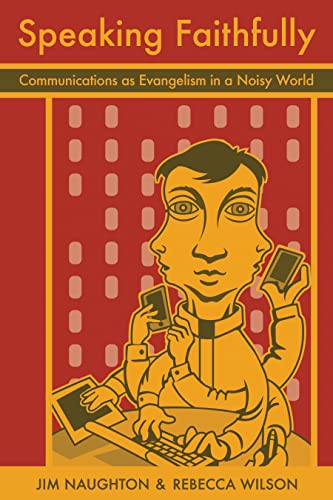
A down-to-earth guide that syncs theology with technology.
Today Sunday morning worship competes with youth soccer, Starbucks, Facebook, and the allure of being “spiritual but not religious.” To share the gospel in a world like this, Christians need to reach beyond the boundaries of concrete and virtual communities to become evangelists. That takes faith. It also requires skill with public relations, social media, traditional print materials and other techniques to increase church visibility. The authors, both recognized experts and consultants, walk readers through the theology of church communications and introduce steps to help us deliver clutter-busting messages to reach our technologically sophisticated and faith-challenged world.
"synopsis" may belong to another edition of this title.
Rebecca Wilson works at Canticle Communications, which specializes in work for church agencies, organizations, parishes and advocacy groups. A long-time communications strategist, she has spearheaded public interest initiatives, non-partisan ballot campaigns, and church programs.
Jim Naughton is a former reporter for the New York Times and the Washington Post and is the author of four books, including a novel for young adults. He has a master's degree in American history from Syracuse University and was previously the canon for communications in the Episcopal Diocese of Washington. A partner in Canticle Communications, Jim is the founder and former editor of the website Episcopal Café.
Following Jesus
Jesus, as you may be aware, was something of a storyteller, and he went to significant lengths to make himself heard. If you doubt this, try giving a sermon while standing in an open boat.
Jesus was more than just a good storyteller, of course. But not less. He had something urgent and enormously important to say, and he said it in an extremely creative way.
To use the jargon of our field for a moment, Jesus had a very definite message: The kingdom of God is at hand. He unfolded it in ever-greater depth, and developed a network of sympathetic people who could carry his message beyond the reach of his own voice. He explained complex theological truths in language that fishermen, tax collectors, and women who lived on the margins of society could understand. He understood his diverse audiences extremely well, and knew how to argue scripture and law with Pharisees and how to tell earthy parables that caught the imagination of less educated audiences. He told tales that were vivid, memorable, and open to deeper exploration. We knew a Christian education director once who said that the resurrection was all well and good, but she would have believed that Jesus was the Son of God simply because he had come up with the parable of the prodigal son.
As familiar as the teachings and stories of Jesus are, it can be helpful to people involved in communications to stop and consider them strictly in terms of literary achievement. There are thirty-five distinct parables, give or take, depending on which scholars are doing the counting. That's a lot of writing. We do not see Jesus scribbling anything down (perhaps because that would be anachronistic) or rehearsing his delivery so that he can hear how the words he had heard only in his mind sounded on his lips. But make no mistake; stories as sophisticated as the Good Samaritan seldom blossom fully formed in an author's head.
A storyteller who can convey the tenderness at the heart of the parable of the lost sheep, plumb the depths of human selfishness in the tale of Lazarus and the rich man, define the kingdom of God by speaking about seeds and birds and bushes, and cook up a parable just about every time he passes a fig tree is practicing his craft at an exalted level. Perhaps all of this came easily, Jesus being who he was. Perhaps not. The point isn't so much that Jesus worked hard at this—though we suspect that he did—but that he understood the importance of speaking in fresh and inventive ways. He knew how to use the characters, landscape, and situations of his stories to let his audience know that he knew their world, their hopes, their failings, and their fears.
Jesus' life was even more captivating than his teachings. He lived in a way that riveted attention, and reinforced the revelation that he preached. There was no discrepancy between what he said and what he did. That kind of authenticity confers credibility, which is essential when you are inviting people to make significant changes in their lives. Obviously Jesus performed certain feats that are beyond any church communications person we have encountered, but telling compelling stories, and living in ways that suggest we take those stories seriously, are not among them.
The Apostle Paul: All Things to All Audiences
St. Paul's example hits even closer to home for the contemporary communicator. He knew seemingly every port of call in the Mediterranean and preached to much more diverse audiences than those that followed Jesus. As a well-educated Jew, a Roman citizen, and a Christian theologian, he was able to speak in ways that could be understood by people of different religious, cultural, and ethnic backgrounds.
Paul was well aware of the advantage this gave him. In 1 Corinthians 9:20–22 he wrote: "To the Jews I became as a Jew, in order to win Jews. To those under the law I became as one under the law ... so that I might win those under the law. To those outside the law I became as one outside the law ... so that I might win those outside the law. To the weak I became weak, so that I might win the weak. I have become all things to all people, that I might by all means save some."
One writer has suggested that Paul's extensive, cross-cultural missionary travels and his willingness to take on the mindset of his various audiences in order to win them over made him the first Christian target marketer. We raise that notion without fully endorsing it, to make it clear that even as single- minded an evangelist as Paul understood that he could not effectively communicate with all of the members of his culturally disparate audience at the same time.
Study his missionary travels, and you encounter a man who knew where and when he was most likely to receive a favorable hearing. He sought Jews in the synagogue and Greeks in the marketplace. He spent much of his time in cities, yet he didn't simply target the biggest population center in his path. The language of his letters is often dense, clause laden, and highly qualified, suggesting it was honed in debate. But few passages ever captured on paper are more graceful and gracefilled than the beginning of the thirteenth chapter of his first letter to the Corinthians, where he writes, "Love is patient; love is kind; love is not envious or boastful or arrogant or rude.... It bears all things, believes all things, hopes all things, endures all things" (1 Corinthians 13:4, 7).
Some scholars have looked for a particular strategy in Paul's travels, but there isn't one strategy—there are many. And like modern communicators who are called upon to use new tools before they have mastered them, Paul is always adapting, finding his way, shifting his plans whether due to shipwreck or some new opportunity. And all to tell a story that changes lives, including his own life.
The Hyenas Did Not Touch Him
It is worth remembering the practices of Jesus and Paul because those of us who attempt to spread the good news today often encounter resistance—not just from secular audiences, which is to be expected, but also from church leaders who labor under the false impression that mastering the use of the tools of the communications industry and the wisdom of public relations is somehow beneath the church. These leaders seem to believe the church should grow simply because it has opened its doors and continues to conduct its well-meaning business on Sunday mornings.
Despite the examples of Jesus and Paul, or, for that matter John Wesley, Billy Sunday, or Bishop Fulton J. Sheen, the church has been agonizingly slow to realize that communications is a ministry in its own right, not simply a support for "real" ministry. When parishes, dioceses, and churches are economizing, they will often cut communications budgets first. Parishes that would never dream of having a volunteer organist are happy to turn their communications ministry over to volunteers with no background in communications, and no opportunity to receive training.
Any number of church leaders will tell you that they did not establish an online presence because they were too busy building the church or feeding the hungry or visiting the sick—as though somehow learning to speak about these things in a way that gets others involved detracts from and is less sacred than these activities. But it is not a small thing to be able to put the word of God and the activities of God's people in front of people. The printing press helped make the Reformation possible. The radio supported the growth of the vast network of nondenominational megachurches across the country. We probably don't need to tell you that certain evangelists have built careers and fortunes from broadcasting their sermons on television.
People have always been eager to tell the story of God in their own times. We see this in the ways that the image of Jesus has been placed in settings and cultures across two millennia—note how Italian Renaissance paintings set the nativity in the palaces of burghers—and in the ways prayers are written to express timeless truths to people far removed from first-century Palestine and possibly unversed in the traditions of the Western Church.
Back in the sixteenth century, having the Bible in your own language was thought to be such a dangerous thing that Thomas More wanted to kill William Tyndale for making it possible. Having the liturgy in one's own language was a cause of great celebration for Roman Catholics after the Second Vatican Council. It is easy for us to appreciate when the word of God is made accessible to a culture we consider exotic. Think of the words of the Maasai Creed:
We believe that God made good his promise by sending his son, Jesus Christ, a man in the flesh, a Jew by tribe, born poor in a little village, who left his home and was always on safari doing good, curing people by the power of God, teaching about God and man, showing that the meaning of religion is love. He was rejected by his people, tortured and nailed hands and feet to a cross, and died. He lay buried in the grave, but the hyenas did not touch him, and on the third day, he rose from the grave. He ascended to the skies. He is the Lord.
We can see that this is poetry, and that it is a skillful and devout attempt to reach new audiences and to articulate the distinctive way they understand the Christian faith. We understand the necessity of expressing Christianity in a way that speaks to the Maasai, but too often we do not grasp the importance of expressing Christianity in a way that speaks to twenty-first-century Americans.
Waiting for the Fish to Jump In
When we're speaking to groups, Jim sometimes asks people how they like his shoes, knowing full well that most of the people in the room cannot see them. You are not likely to buy a pair of shoes you can't see on the say-so of the salesman. Similarly, you are not likely to form a relationship with a church that provides you with little information about itself. Jesus said that no one lights a lamp and puts it under a bushel basket (Matthew 5:15), but Jesus had never met any Episcopalians or other mainline Christians. As a rule, we have been reluctant to call attention to ourselves. We are more comfortable being the church invisible, the church inoffensive, the church optional, and the church afraid of being associated with intolerant and heavy-handed people who are also Christian.
We need to get over this, but we won't do that by illuminating the interiors of bushel baskets. We won't do it by speaking in inoffensive generalities about kindness and politeness. Nor will we do it by announcing that we're having a potluck supper.
Rather, what is required of us are compelling accounts of what our faith means to us, clear explanations of the nature of our spiritual experiences, descriptions of our church communities as places where people are committed to working for justice and peace, and stories about the ways that God has changed our lives and the lives of people we know. These can be hard stories to tell, and hard institutional communications to produce for people who sometimes hold inoffensiveness as a high virtue. But it is possible that the future of our churches depend upon it.
Even the word "evangelism" makes some people feel uncomfortable. We have worked with church communicators who argued hard and successfully against our efforts to include information about what Episcopalians believe and how they worship on their website. They were happy to have it conveyed on parish sites, or on the website of the Episcopal Church. They just didn't want it on their site. We think this is symptomatic of the fear and unease that what people sometimes refer to as the "E word" arouses.
The Most Reverend Frank Griswold, former presiding bishop of the Episcopal Church, once said that the Episcopal Church's approach to evangelism was similar to setting an aquarium on the shore of the ocean and waiting for fish to jump in. That doesn't work in an age in which churchgoing is no longer socially normative. We live increasingly in an on-demand world where activities that once required us to be in a specific place at a specific time (television shows, movies) can be indulged on our own schedule. We live in a culture in which youth soccer and other sports compete for the affection of our children, and there is no longer a taboo against holding those activities on Sunday mornings. Fear-based motivations for attending church (to avoid going to hell or being seen as an outcast by one's neighbors) have lost their force, and people who think of themselves as "spiritual but not religious" look to Oprah as a spiritual guide, to therapists for moral direction, and to book clubs and cycling groups for their sense of community.
Churches are up against all of those competing forces. Too often we respond by retreating to the comfortable place in which we communicate primarily, even exclusively, with our own members. Take a look at a few church websites. Which ones seem more like they belong on an intranet than on the Internet? How many take a "member services" approach to communications aimed at making it convenient for those already in the church to find the information they need quickly and then be on their way? This doesn't make much sense as a web strategy. Your highly motivated regular visitors are already deeply familiar with your site. They do not need primary homepage real estate to draw them into the church, and after a visit or two they are going to know how to find what they need. Instead, the homepage of a church website is for the stranger who needs the real welcome, and who wants a deeper understanding of what the church is about.
We have not yet awakened from the dream of a time when aspiring to mainline Protestantism was part of rising into the middle class, and coffee hour was an extension of Saturday night at the club or Sunday afternoon on the golf course. We have not yet adjusted to the fact that the world, in many places, has passed us by, or that to catch up we have to tell a story that shows we have been meeting God and living lives of genuine faith all the while.
So, let us go on a safari to lift some bushels and light some lights. With any luck, the hyenas will not touch us.
Naughty Words in Church
There are words that don't go down especially well in church contexts, that make people worry that you are going to shift into Aaron Sorkin's West Wing mode and force them to engage in witty, rapid fire banter as they walk quickly from one important meeting to the next. "Messaging" is one of those words.
To many listeners, the word "messaging" speaks of either marketing or electioneering. It connotes a lack of authenticity and an effort to frame truth in a way that obscures truth. We would like to propose a different definition. A message is the thing you want to say. Messaging is the process you participate in to figure out your message.
Let's try another naughty word: "audience." Or, to make things a little more risqué, "target audience." Because the church wants to speak to as wide an audience as possible—to "go therefore and make disciples of all nations" (Matthew 28:19)—church folks resist the notion that their audience is anything less than humankind. They imagine it is sinful to be anything less than entirely inclusive. We think this constitutes a misunderstanding of our role as individual Christians or members of a particular community. Just as none of us sees the whole truth, none of us has the appeal necessary to speak to "everyone." And yet, many congregations and not a few dioceses define their target audience just that way.
Each individual and each congregation has particular gifts, opportunities, and responsibilities to speak to particular audiences. Some of these audiences are given to us because our community has demonstrated a certain ability to attract them, others because they live in our neighborhoods. But however God gives them to us, they are ours, and we need to learn how to say what we have to say in a way that they will find compelling.
In this chapter, we're going to delve into messaging and audience targeting church-style, not Washington Beltway-style. But it won't hurt you to fire up those West Wing reruns to get in the mood.
The Tragedy of the Trifold Brochure
We once knew a parish whose leaders enthusiastically told us that they needed a trifold brochure. There was a college nearby, and their plan was to induce the college students to come to their 9:00 a.m. contemporary music service and hand them a brochure with an information card inserted. The college students, they explained, would then fill out the cards with their contact information and the church would send them a welcome packet via the U.S. mail.
It's fun to hunt for as many examples of institutional church myopia as you can find in this little vignette, but for communications purposes, the point is this: If you skip the work of developing the messages that will most effectively reach your key audiences and identifying those audiences carefully, you risk having a communications plan full of mismatches between what you want to say, who you want to say it to, and what tools you need to do the job.
Worse yet for evangelism, if you skip right to deciding if you need a Twitter feed or a trifold brochure to reach the people you want to reach, you risk communicating effectively with only people who like what you like and communicate the way you communicate. If you look around most mainline churches, you will see that the church has been doing that for some time now. We think it's time to make a change.
Blessed Are the Acolytes
What can we say that might induce people to hear what the church has to say? Adult learning experts tell us that adults learn something new when they need to know it. People come to church, or come back to church, because they need to know something new.
When we give workshops, Jim sometimes asks people to think of Jesus standing up to give what Christians now refer to as the Sermon on the Mount. Imagine, he says, if instead of the Beatitudes, Jesus had addressed the crowd by saying, "The altar guild will meet on Tuesday evening, and the men's group on Thursday. I know we all like a little extra sleep, but we really need the acolytes here fifteen minutes before the service begins. Families, please see if you can get out the door a little earlier."
When people come to the church, they need to know something about hope, or God's love for them, or about the existence of a community of people living according to values that dispute the hopelessness and violence they see around them. Usually the thing they need to know is not the altar guild update or the annual meeting agenda. But too often, that's all our newsletters, Facebook pages, and websites tell them.
(Continues...)
Excerpted from Speaking Faithfullyby JIM NAUGHTON REBECCA WILSON Copyright © 2012 by Jim Naughton and Rebecca Wilson. Excerpted by permission of Morehouse Publishing. All rights reserved. No part of this excerpt may be reproduced or reprinted without permission in writing from the publisher.
Excerpts are provided by Dial-A-Book Inc. solely for the personal use of visitors to this web site.
"About this title" may belong to another edition of this title.
Seller: World of Books (was SecondSale), Montgomery, IL, U.S.A.
Condition: Good. Item in good condition. Textbooks may not include supplemental items i.e. CDs, access codes etc. Seller Inventory # 00085876478
Seller: World of Books (was SecondSale), Montgomery, IL, U.S.A.
Condition: Very Good. Item in very good condition! Textbooks may not include supplemental items i.e. CDs, access codes etc. Seller Inventory # 00075577054
Seller: BooksRun, Philadelphia, PA, U.S.A.
Paperback. Condition: Very Good. It's a well-cared-for item that has seen limited use. The item may show minor signs of wear. All the text is legible, with all pages included. It may have slight markings and/or highlighting. Seller Inventory # 0819228109-8-1
Seller: Wonder Book, Frederick, MD, U.S.A.
Condition: Very Good. Very Good condition. A copy that may have a few cosmetic defects. May also contain light spine creasing or a few markings such as an owner's name, short gifter's inscription or light stamp. Bundled media such as CDs, DVDs, floppy disks or access codes may not be included. Seller Inventory # E14I-00077
Seller: ThriftBooks-Atlanta, AUSTELL, GA, U.S.A.
Paperback. Condition: Very Good. No Jacket. May have limited writing in cover pages. Pages are unmarked. ~ ThriftBooks: Read More, Spend Less. Seller Inventory # G0819228109I4N00
Seller: ThriftBooks-Atlanta, AUSTELL, GA, U.S.A.
Paperback. Condition: Good. No Jacket. Pages can have notes/highlighting. Spine may show signs of wear. ~ ThriftBooks: Read More, Spend Less. Seller Inventory # G0819228109I3N00
Seller: Redux Books, Grand Rapids, MI, U.S.A.
Paperback. Condition: Very Good. Paperback. Pages are clean and unmarked. Covers show very minor shelving wear.; 100% Satisfaction Guaranteed! Ships same or next business day! Seller Inventory # 52404230057
Seller: Better World Books, Mishawaka, IN, U.S.A.
Condition: Very Good. Pages intact with possible writing/highlighting. Binding strong with minor wear. Dust jackets/supplements may not be included. Stock photo provided. Product includes identifying sticker. Better World Books: Buy Books. Do Good. Seller Inventory # 49449314-6
Seller: Better World Books, Mishawaka, IN, U.S.A.
Condition: Good. Former library copy. Pages intact with minimal writing/highlighting. The binding may be loose and creased. Dust jackets/supplements are not included. Includes library markings. Stock photo provided. Product includes identifying sticker. Better World Books: Buy Books. Do Good. Seller Inventory # 45875190-6
Seller: ABOXABOOKS, Bristol, VT, U.S.A.
Soft cover. Condition: Good. Moderate edge wear on covers. Otherwise in good condition. Seller Inventory # 009182