
Items related to Original Sin: Illuminating the Riddle (Volume 5) (New...
Original Sin: Illuminating the Riddle (Volume 5) (New Studies in Biblical Theology) - Softcover
Book 4 of 67: New Studies in Biblical Theology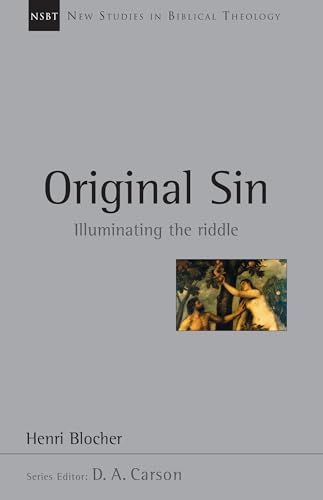
Synopsis
We live in a world shot through with evil. The twentieth century has witnessed suffering and human cruelty on a scale never before imagined. Yet, paradoxically, in recent years the doctrine of original sin has suffered neglect and ridicule. In this philosophically sophisticated treatment of the biblical evidence for original sin, Henri Blocher offers a robust response. Interacting with the best theological thinking on the subject, this New Studies in Biblical Theology volume shows that whilethe nature of original sin is a mystery―even a riddle―only belief in it makes sense of evil and wrongdoing.After a general survey of the biblical evidence, Blocher moves on to discuss the two key texts. First, he considers the relation of the Eden story of Genesis 2 and 3 to modern scientific, literary and theological thinking. Then, he offers a new and groundbreaking interpretation of Romans 5, where Paul discusses Christ and Adam. From this exegetical foundation, he goes on to show how the doctrine of original sin makes sense of the paradoxes of human existence. In the final chapter, he discusses the intellectual difficulties that some feel remain with the doctrine itself.Addressing key issues in biblical theology, the works comprising New Studies in Biblical Theology are creative attempts to help Christians better understand their Bibles. The NSBT series is edited by D. A. Carson, aiming to simultaneously instruct and to edify, to interact with current scholarship and to point the way ahead
"synopsis" may belong to another edition of this title.
About the Authors
In October 2003, Henri Blocher was appointed to the Guenther H. Knoedler Chair of Theology at Wheaton College in Wheaton, Illinois. Since 1965 he has served as professor of systematic theology at the Faculté Libre de Théologie Evangélique in Vaux-sur-Seine near Paris, France. A leading evangelical theologian and statesman, Blocher was a member of the Lausanne Committee on World Evangelization (1975-1980), served the World Evangelical Fellowship/Alliance in a number of capacities, and taught in schools in Europe, Australia, Africa, Canada and the US. He is currently president of the Fellowship of European Evangelical Theologians. Blocher studied at a number of institutions including the Sorbonne, London Bible College, Gordon Divinity School, and Faculté Libre de Théologie Protestant of Paris. He has written six books, four of which have appeared in English, and several dozen articles. His English publications include Original Sin: Illuminating the Riddle, Evil and the Cross: Christian Thought and the Problem of Evil and In the Beginning: The Opening chapters of Genesis.
D. A. Carson is research professor of New Testament at Trinity Evangelical Divinity School in Deerfield, Illinois.
Excerpt. © Reprinted by permission. All rights reserved.
Original Sin
Illuminating the RiddleBy Henri BlocherIVP Academic
Copyright © 1997 Henri BlocherAll right reserved.
ISBN: 9780830826056
Chapter One
Original sin as taught in
Holy Scripture
`Nothing is so easy to denounce, nothing is so difficult tounderstand.' So wrote Augustine on original sin.
To him the doctrine was a battlefield. The controversy hascontinued unabated through the centuries. The leaders of theReformation, with the exception of Ulrich Zwingli, renewed theemphasis on the Augustinian view. It was included in the mainconfessions of faith in the Reformation churches, such as theForty-two Articles framed by Archbishop Cranmer for theChurch of England in 1553. The arguments have not subsided;Protestant liberals carry on the various attacks against thedoctrine of original sin which the Socinians and some Anabaptistshad launched in the sixteenth century. The perpetualconflict probably witnesses both to the difficulty of thearguments and to the stakes involved.
A new stage was reached (and new heights in subtlety andsophistication) in the first half of the twentieth century with thepowerful neo-orthodox reinterpretation of the doctrine. In thewake of Kierkegaard's elusive The Concept of Anxiety (1844), KarlBarth, Emil Brunner and Reinhold Niebuhr ? who praisedKierkegaard's analysis as `the profoundest in Christian thought'(Niebuhr 1941:182 n. 2) ? again preached original sin, but notwithout making far-reaching changes in their understanding of it.
Among evangelical theologians, John Murray's series of short,sharp articles, published under the title The Imputation of Adam'sSin (1959) and G. C. Berkouwer's Sin (first Dutch edition1959-60) illustrate two contrasting kinds of original thinking withinorthodox bounds: the former with rigour and careful argument;the latter with well-informed sensitivity and openness to theconcerns of contemporary theology ? but still confessing, in asofter, more sympathetically nuanced tone, the main tenets ofReformed tradition. Both contributions still deserve our fullconsideration.
Has controversy cooled since then? After years of comparativeneglect, at least in Protestant circles, there are signs that interestin the doctrine may be awakening. Feminist process theologianMarjorie Hewitt Suchocki has set out a vigorous reply toNiebuhr on original sin (Suchocki 1994). The AmericanLutheran professor Ted Peters does theology in a lively,thought-provoking way, raising deep questions on the subject oforiginal sin (Peters 1994). Professor David L. Smith in Canada(though an heir to the US Southern Baptist tradition) hasproduced a most user-friendly presentation (Smith 1994), whichfollows in the train of Bernard Ramm's moderate synthesis ofevangelical substance and modern ideas a decade earlier(Ramm 1985) ? the first token, maybe, of attention being paidto the old doctrine again. The contributions of these competentscholars are not great in number; they are, rather, wide-ranging,and semi-popular in style. They leave enough room, therefore,for a more concentrated study, one which may also take morenotice of the work of Roman Catholic theologians fromcontinental Europe.
There is no urgent need to rehearse the history of thedoctrine. It has been covered in a number of monographs, andNorman P. William?s classic (1927), though sorely lacking insympathy for Augustine, offers sufficient resources. My aim, asmy sub-title suggests, will rather be to illuminate the riddle.Original sin is a riddle, certainly, and I dare hope that this bookwill cast some light upon it (audentes fortuna juvat!); even moreimportantly, however, the human phenomenon is a riddle, and Itrust that the doctrine of original sin will illuminate thatphenomenon.
This book will be an exercise in dogmatics, not apologetics-- in this, I agree with Kierkegaard, who insisted that original sincomes under the jurisdiction of dogmatics (1980: sub-titles 9, 23and passim). `There may be some incidental apologetic benefits,but the central question will be: what are we to believe, in theobedience of faith? Since the first concern of evangelicaldogmatics, in grateful obedience to its `external principle ofknowledge', is agreement with Scripture, I shall enquire first(chapter 1) about the general support which may be found inthe whole Bible for the church dogma, that is, the `Augustinian'doctrine, of original sin. I shall be wary of the enticements ofthose who follow Karl Barth's lead and draw their theology ofsin from Christ and the cross directly. Though apparently most`Christian', this procedure conceals a subtle snare: the selectionand abstraction of the relevant elements of Christology, acomplex field of study, is bound to be arbitrary. If one startswith the cross, the character of Christ's work as a remedy for sin,as redemption, is obscured; simply to read the meaning oforiginal sin off the Christ-event is to act as if we were masters ofrevelation. Far from it! We are mere disciples, and cannot affordnot to start with the teaching of God. Sound theological methodrequires that we listen to Scripture as a whole, according to theanalogy of faith, and only then perceive how precisely thedoctrine is proclaimed and, so to speak, reinforced in the Christ-event.
The path to be travelled by this volume is fairly easy to markout. Once the biblical survey is completed, we shall turn to the`origin' passage, Genesis 3, asking whether we should read it ashistory or as myth, saga or symbol (chapter 2). Then the otherscripture upon which the doctrine of original sin was founded,Romans 5, will engage our scrutiny (chapter 3); against all theodds, will a new proposal break through the deadlock ofinterpretations ancient and modern? In the next chapter (4),we shall observe how the doctrine of `original sin' unveilshuman experience, unlocks the enigmas of life and sets them inproper perspective. Finally, we shall confront the core difficultyof Augustine's construction: the hereditary transmission of whatis a most personal exercise of freedom, namely, sin.
First, though, we need some idea of just what it is we aretalking about. Calvin's definition offers as good a starting-pointas any. Original sin, he writes in the Institutes, is that `hereditarydepravity and corruption of our nature, diffused into all parts ofthe soul, which first makes us liable to God's wrath, then alsobrings forth in us those works which Scripture calls "works ofthe flesh" (Gal. 5:19)' (II.i.8). By way of developing andcommenting on that definition, we may note the following fourpoints. First, original sin is universal sinfulness, consisting ofattitudes, orientations, propensities and tendencies which arecontrary to God's law, incompatible with his holiness, and foundin all people, in all areas of their lives. Secondly, it belongs to thenature of human beings (it is also called peccatum naturale),`nature' being that stable complex of characteristics typical ofthe class of creatures known as `human', and present from birth(natura comes from nasci, `to be born'). Thirdly, since itbelongs to our nature, it is inherited; hence its usual name in German,Erbsünde, literally `hereditary sin'. Fourthly, it stems fromAdam, whose disobedience gave original sin a historical beginning, sothat the present sinfulness of all can be traced back through thegenerations, to the first man and progenitor of the race.
The `origin' of original sin is touched on in John 8:44, whichspeaks of the arche of the devil? murderous lie. This is the `enemy'whom Revelation calls the `original (archaios) serpent(12:9; 20:2). Augustine preferred `original' to `natural' as aqualifying term in order to stipulate that universal sinfulnesshad a historical beginning and cause. The famous Genevantheologian François Turretin, who won the title of the`Protestant Aquinas', made the perceptive remark that sin isnot radically original, since it derives not from the first origin(creation) but from a second one; yet, he maintained, the termis apt because original sin flows from the originating sin,propagates itself in each person?s origination, and becomes theorigin of actual sins (1847:569 [IX.10.4]). `Actual sins' are allother sins, though the demarcation line is hard to draw, as olderdivines recognized. In Judaism, we are told, `a distinction wasdrawn between the original stock or capital (so-called originalsin; Heb. qeren) and interest (individual sins)' (Hensel 1975:721). It is probably wise therefore to think of both in the closestpossible organic conjunction.
Actual sins incur guilt. The traditional Augustinian line is thatoriginal sin does too, and Calvin's definition, `liable to God'swrath', implies it clearly. But not all are so tough-minded. Manyhave doubted whether, in the Christian tradition, there is aconcept of true original guilt. If we speak, as Cyprian did, of analien sin, is not the phrase `alien guilt' a contradiction in terms?
The scandal seems even greater when heredity is the statedmode of transmission. Karl Barth vehemently rejects the idea,and with it the term Erbsünde.' "Hereditary sin" has a hopelesslynaturalistic, deterministic and even fatalistic ring. If both partsof the term are taken seriously, it is a contradictio in adjecto in faceof which there is no help for it but to juggle away either the onepart or the other' (1956: 501). Even those who hold to thetraditional thesis still have to think how sin and guilt can beinherited.
To the law and the testimony! Does Scripture support, at leastin broad terms, the doctrine I have just delineated?
Universal sinfulness
That a bent towards sinning does affect all humankind, and thatit cannot be isolated as belonging to any one part of the person,has been agreed on all sides, or nearly so, in the twentiethcentury. Even those who oppose the church dogma of originalsin concur in this basic assessment of our reality. It would behard to close one's eyes to the data of experience. The value ofsolidarity, highly prized in the modern scale of values, forbidsone to draw radical distinctions between individuals, and therenewed perception that the individual is a psychosomatic unitydoes not favour a division between `parts' of the person withregard to sinfulness.
The witness of Scripture fully warrants this consensus. Itmajors on sinfulness as the human problem, which alone causesseparation between the Creator and his creatures (Is. 59:2). Itstresses that none escapes the reign of sin and that no part of thehuman person is left untainted (Pr. 20:9; Ps. 14; and Paul'squotations in Rom. 3:10ff.). But it does not formally distinguishour proneness to evil from our sinful acts or failures to act. Yetthe twofold universal spread of actual sin (that is, throughoutthe whole race and within the whole individual life) couldhardly obtain without an equally universal bent, or corruption.The Bible itself explicitly follows that logic.
Illustrations abound. As early as the case of Cain, sin isdepicted as `crouching at the door', implying an impulse ordesire which Cain ought to master (Gn. 4:7). For Paul also, sin,ever ready to cause all manner of evil, is `lying there' (parakeitai,Rom. 7:21), a tyrant `indwelling' his members (v. 17); a fewverses earlier, sin resembles a snake, apparently lying deadwithin the person, which springs to life in the presence of thecommandment (w. 8-11). James's letter highlights the processthat gives birth to particular sinful acts; the source is theperson's own epithymia, `concupiscence' or inordinate desire(Jas. 1:14). Ligier (1960: 106f.) interprets the `stubbornness' ofthe heart, which Jeremiah so often denounces (3:17; 7:24; 9:14;11:8; etc.), as a passionate impulse of freedom, an anarchicunloosing which cannot but issue in disobedience. The sameidea of the existence of sin before sins are committed issuggested by the metaphors of sin written upon the heart (Je.17:1), of heart and ears uncircumcised (Je. 6:10, 9:25f.; cf. 4:4and Dt. 10:16; 30:6; Acts 7:51) and of the heart being of stone(Ezk. 11:19). Our Lord himself stressed that all the things thattruly defile people originate in their hearts (Mt. 15:19f. andpar.), and that evil words flow from what fills their hearts, andevil deeds from what is stored up within (Mt. 12:34ff.).
In somewhat analogous fashion, Judaism developed thetheme of the `evil imagination' or `impulse' in human makeup,yeser ra'. The phrase was taken from Genesis 6:5, `everyinclination [or impulse, or imagination, yeser] was only evil allthe time'. Murray's comment on that passage is worth quoting:
There is the intensity ? `The wickedness of man was great in the earth'; there is the inwardness ? `the imagination of the thoughts of his heart', an expression unsurpassed in the usage of Scripture to indicate that the most rudimentary movement of thought was evil; there is the totality ? `every imagination'; there is the constancy ? `continually'; there is the exclusiveness ? only evil'; there is the early manifestation ? `from his youth' (1962: l191f.).
The last trait comes from Genesis 8:21, a verse which shows thatthe truth of the statement in 6:5 is not restricted to the situationbefore the flood. Intertestamental literature elaborates thetheme, sometimes with a good impulse in view too. As early as thebook of Ecclesiasticus, the pathetic question is raised: `O evilimagination [enthymema], whence were you formed to cover theland with deceit?' (37:3). At the end of the first century AD, 4 Ezrauses, in the extant Latin text, the words `malignant heart' (cormalignum) as a probable equivalent: `The First Adam, bearing themalignant heart, trespassed and was defeated, and [so were] allthose who are born of him; this weakness [infirmitas] has becomepermanent ...' (3:21f.); `the malignant heart has grown withinus; it has turned us away from [your] commandments, and led usinto corruption and on the ways of death ...' (7:48). The thememay also be found in the Qumran hymns:
No-one will be justified in your judgment.
Nor be shown innocent in your trial.
A human being proceeding from a human being, can
he be righteous?
A man coming from a man, can he deal wisely?
And flesh coming from the evil inclination, can it share
in glory?
(1 QHIX. 14d-16)
In several New Testament passages, the presence of the yesermay be detected as the underlying theme. It may be the originalword behind the `evil thoughts' of Matthew 15:19; it may berepresented by `the mind of the flesh' in Romans 8:5ff. and bythe `thoughts' whose `wills' we used to fulfil as `children ofwrath' in Ephesians 2:3. Philo's somewhat different language isprobably indebted to the same concept (Williams 1927: 82f.).Rabbinical theology did not relinquish that tradition, and oftenopposed two symmetrical inclinations, evil and good; but itremained unsystematic, and was hesitant as to the neutrality orperversion of the yeser hara', and on its original implantation.
How deep and strong is the tendency? Augustinians affirmand Pelagians (or semi-Pelagians) deny that it entails an inabilityto turn to the true God. The diagnosis of a bent towards sinningis closely linked with whatever stand is taken on free will,whether it is lost or preserved. In this respect, among the Jews,the Sadducees would appear as the forerunners of Pelagius; theEssenes would be on the opposite side, and the Pharisees inbetween (the ?semi-Pelagians'), if we trust Josephus's well-balancedmodel of the three sects. We shall not settle the age-oldissue here, but only observe the remarkable force of thelanguage of Scripture. When actual sins (at least) are takentogether with the propensity to sin, the Bible speaks plainly ofbondage and of the impossibility of change. Jesus himselfaroused the anger of his hearers when he insisted that allsinners are slaves to sin (Jn. 8:34), a metaphor which Paul tookover and exploited (Rom. 6:19f.). Jeremiah warned his peoplethat they could not do good, any more than an Ethiopian couldchange his skin or a leopard his spots (Je. 13:23). Paulconfirmed that the sinful mind (flesh) does not submit toGod's law, `nor can it do so' (Rom. 8:7), and that human beingsleft to their own resources (psychikoi) cannot understand thethings of God (1 Cor. 2:14). No-one can come to the Lord Jesusunless the Father draws or drags (helkyse) him or her (Jn. 6:44;cf. 65). This suggests that the universal inclination is no superficialtrait. On the contrary, it holds a dreadful sway over human life.
Does the bent entail guilt? Since the bent is universal, it isfound in those many individuals who are ignorant, or evenunconscious, of the divine standards of the good. Do infantsdeserve condemnation for the propensity which is born inthem? Many thinkers are indignant at the mere idea, though ithas long been affirmed by the church. Williams (1927: 330) hasto invoke `the crude lights and hard shadows which the burningsun of Africa casts upon its desert sands' to account forAugustine's incredible harshness. Nearer to orthodoxy, and tous in time, David Smith emphatically, though ambiguously,denies that there can be guilt where there is no consciousness ofGod's standards:
Children are born innocent, but as they approach adolescence they are increasingly able to handle abstract ideas, and ultimately, the realisation of sin and guilt. It is the awareness of guilt that causes sin to kill spiritually ... When we couple that awareness along with Romans 5:12ff., what do we find? Sin is not imputed against innocents. Until there is awareness of guilt (i.e., of breaking the law), the penalty for sin ? eternal death ? is not imposed. It is evidently covered by the Saviour's atonement (1994: 297f.).
The ambiguity lies in the joint affirmations of innocence andof the role of atonement. If the infant is not to be charged withsin, where does the need for atonement come in? Innocencedoes not need to be `covered'. One could also question thecorrelation of awareness with the handling of abstract ideas. Butthe main concern is clear, and it finds some echoes in mostpeople's sensitivities: to avoid attaching guilt to tendencies inchildren or in other morally unconscious persons.
The burden of proof, I suggest, rests with those who wouldsever the connection between evil inclinations, sin and guilt.Nowhere in Scripture do we see the link between them broken,or even slackened. Guilt is the human correlate of the constantreaction of the absolutely Righteous One, who cannot toleratethe sight of evil. How could the righteous and holy God accept atendency in human hearts towards the things he abominates,when the first and great commandment is that we should tendtowards him with the whole of our hearts and souls and`intensities'? When James vividly describes the process oftemptation (Jas. 1:14f.), he does not deny the sinfulness andguilt of the enticing `evil desire' (epithymia); far from wishing toexonerate the propensity, he brands it as the real culprit.Formally, epithymia must be defined as sin, for it breaks the tenthcommandment, `You shall not covet ...' In Romans 7, Paul inno way suggests that dormant sin could be considered guiltlessand remain without charge. `I lived once' (v. 9) merely expresseshis unreliable feeling at the time of his ignorance, not the truthof his state, as if he had enjoyed spiritual life in God's eyes.Rather, the apostle's aim in the passage is to showy how theexpressed commandment increases what is already the case: sinbecomes superlatively sinful, kath' hyperbolen hamartolos (v. 13).
The presupposition of those who deny `original guilt' is thatguilt requires a distinct and deliberate exercise of personal will.Does Scripture concur? It seems to teach a broader, moreinclusive, view. Sins of omission are real sins (Jas. 4:17), and weusually slip into them unawares. Unconscious sins need divineforgiveness (Ps. 19:12) and may come under God's judgment (1Cor. 4:4). Unintentional sins must be atoned for, as the law ofNumbers 15:27ff. stipulates; the Septuagint used the wordakousioi here, corresponding to `unintentional', as Turretinnoticed (1847:537 [IX.2.4]). (Heb. 10:26 distinguishes deliberate[ekousios] sin as just one sort of sinning.) Turretin also refersto Romans 7:16: the fact that the man does what he does notwant to do does not excuse him; it only adds to his wretchednessunder the condemnation of the law.
The biblical witness, then, taken at face value, associatesbondage and guilt with the universal bent of humankind. Thisdeserves to be called sin with the full force of the word.
Natural sinfulness
If sinfulness is universal in humankind, and present `fromyouth', should it be predicated of human nature? The Augustiniandogma does take that apparently natural step, and notwithout predecessors. Philo frequently used cognates of theGreek word `nature' (physis) to stress the impregnation of evil;he stigmatized the `adulterous nature' and spoke of the `innate[or, co-natural] evils of our race', and of `sinning innate [or, co-natural]in everyone who is born'. Even earlier, the apocryphalbook of Wisdom refers to the Canaanites' malice asemphytos:, implanted in them, part of their nature. It speaks oftheir `genesis' as evil, and to their seed (sperma) as accursed(12:10f.).
Does canonical Scripture agree? The actual word `nature' isfound once with reference to guilt or liability to divine wrath:`We were by nature [physei] children of wrath' (Eph. 2:3).Several have attempted to loosen the Augustinian grip on thisremarkable `proof-text'. Didymus of Alexandria (c. 311-396)reduces the meaning to `really, in truth', but the antitheticalterm which one would then expect (something like `butaccording to appearances we were ...') is totally absent.Others oppose `by nature' to the phrase `by grace', severalverses later (v. 8). But that reading sounds somewhat anachronistic,betraying the influence of the later `nature-grace'conceptual scheme. By far the most attractive exegesis connectsthe word with the apostle?s theme in the whole chapter, indeedin the whole development of Ephesians 1 - 3: that of Jews andnon-Jews made one. Physei refers to ethnic origin, birth, andlineage, just as it does in a close parallel passage, Galatians 2:15.`Nature', therefore, does not bear the precise technical meaninggiven to the term by philosophers or later theologians, butthe implications are essentially the same as those of the churchdoctrine. The whole emphasis of the paragraph points to thesame interpretation, as Ramm (1985: 45f.) skilfully brings out:we were children of wrath, sons of disobedience, dead intrespasses and sins, and led by the tendencies (thelemata) of theflesh.
The use of the loaded term `flesh' provides powerful supportfor the concept of `natural' sinfulness. Indisputably, the wordfrequently approximates to `human nature', while a relatedmeaning evokes kinship or family ties. The link between `flesh'and guilty propensities to evil is significant for doctrine. Thislink is not obvious in the Old Testament, despite the term'sconnotations of frailty, transitoriness and vulnerability, andwhatever might be suggested by Genesis 6:4, `for he is flesh' ? anenigmatic text. In Qumran, the Community Rule prescribesthe striking confession, `I belong to wicked humankind, to thecommunion [sôd] of sinful flesh.' Paul's extraordinary developmentof the idea, whereby the flesh becomes the seat andpower of indwelling sin, even the hypostasis of sin's tyranny,maintains continuity with previous usage; `being fleshly'(sarkikoi) equals `walking in the human way' (kata anthropon)and `being human beings' (1 Cor. 3:3f.). This languagedescribes the fact that human nature concretely is at enmity withGod; hence the meaning attached to `flesh'. Johannine usageis not far removed from this; Jesus' word in John 3:6,contrasting flesh born of flesh with kingdom requirements,does imply a radical human inadequacy and inability inspiritual matters. Berkouwer (1971: 488) underestimates theimport of that verse, failing to notice that our Lord refers tobirth or conception (gennao) to account for the prevailing stateof affairs ? not to the event of birth as such, but as signifyingthe transmission of human nature. The mention of birth is notincidental, since the conversation with Nicodemus focuses onthat very theme.
Other passages are interested in the question of the origin ofsin in the individual. Job 14:4 does not require the amplificationof the Vulgate, `Who can make pure what was conceived ofimpure seed?', to point in a direction similar to that of thepassages just discussed (so Nicole 1986: ad loc.). Job 15:14 and25:4 echo the same thought, almost proverbial in tone. Themother's ritual impurity (Lv. 12:2ff.) may be in the background;it would then function as a symbol of that sinfulness that adheresto nature as it is transmitted.
The locus classicus is Psalm 51:6. A literal rendering couldread: `Indeed, in [or, with] iniquity was I born, and in [with]sin was my mother warm of me.' Two misguided interpretationsmay be put aside without further ado. First, virtually no-onetoday follows Augustine in viewing the procreative act assinful per se (in our fallen condition). Such a view finds nosupport anywhere else in Scripture, and the synonymousparallelism of the verse contradicts the idea, since the deliveryof the child (`I was born') could not be considered sinful evenin Augustinian eyes. Secondly, those who would charge thepsalmist's mother with a specific sin, such as adultery orpromiscuity, are on no surer ground. The only argument ofMaillot and Lelièvre (1966: 12f., 22) is based on the highlynegative connotation of the verb `being warm', perhaps `beingin heat' (yaham). But this is merely hypothetical, with only twoother occurrences (Gn. 30:41; 31:10), and is criticized by ablelinguists. There is not a shred of evidence to suggest thatDavid's mother had misbehaved, and if one doubts theauthenticity of the psalm's superscription, the fact remainsthat Israelites ascribed its language to David and recited thepsalm as a common confession. Ligier's sophisticated version,which identifies the `mother' with the generation of the exile,or even with Jehoiachin's mother (on the basis of Je. 22:26),suffers from the same deficiencies and fails to carry conviction.Luther had rightly observed that the text does not say:`My mother sinned when she conceived me' (quoted byBerkouwer 1971:535 n. 178). David is not trying to accuse hismother in order to excuse himself! Actually, mentioning themother follows the rules of Mediterranean rhetoric, whether inabuse of others or in humble reference to oneself: `Yourhandmaid's son? just means `Your servant'. David confesses hisown sinfulness, in a spirit of true repentance.
Far from attempting to downplay his guilt, David refers to hisbirth and conception in the clear realization that his very beingis shot through and through with the tendencies that producedthe fruits of adultery and murder. As far back as he can go, hesees his life as sinful. Therefore, this radical confession issues inhis request for purification in the innermost parts of his person(v. 7). Even the `man according to the Lord's heart? has toacknowledge that he is corrupt and guilty `by nature', like others-- like the wicked who are wayward `from birth', `from the womb'(Ps. 58:3).
In addition, we may recall once more Jeremiah's comparison(13:23) of his fellow countrymen's expertise in the practice ofsin with an Ethiopian's colour of skin and a leopard's spots ? both`natural' features. It is striking, too, that Jesus deliberatelyworks back from the fruits to the nature of the tree (Mt. 7:16ff.;12:33; cf. Jas. 3:12); he denounces `broods of vipers' and makes`being evil' the cause of the foul talk from which there is noescape (Mt. 12:34). Melanchthon argued forcefully that theapostolic description of actual sins as `the fruits of sin' indicatesthat original sin is what determines human nature. It would bedifficult biblically to countenance the rather bold counter-positionof Trent: `This concupiscence, which sometimes the Apostlecalls sin [Rom. 6:12ff.], the Holy Council declares that theCatholic Church has never understood to be called sin becauseit is, in the regenerate, truly and properly sin, but because it stemsfrom sin and inclines to sin.'
At the same time, Scripture can marvel at the beauty andwisdom evident in the way the human being is constituted: `Ipraise you because I am fearfully and wonderfully made; yourworks are wonderful' (Ps. 139:14, NIV). The provocative sageQohelet agrees: `God made humankind upright ...' (Ec. 7:29).Nature, in the strict sense of what makes men and womenhuman, the essence of being a particular kind of creature,cannot be termed evil. The phrase `natural sinfulness' concealsa paradox, which Tertullian (De anima 41) noticed (`Thecorruption of nature is another nature'). Calvin deliberatelydeveloped this thought: `We say, then, that man is corrupted bya natural viciousness, but not one which proceeded fromnature' (Institutes II.i.11). Sinfulness has become our quasi-naturewhile remaining truly our anti-nature.
Inherited sinfulness
Are the quasi-nature and anti-nature of sin inherited in the sameway as nature? John 3:6 (`What is born of the flesh is flesh' andcannot see the kingdom of God) and kindred passages stronglysuggest a positive answer. Flesh begets flesh. This is the law ofheredity, and one could expect it to apply when `flesh' takes on asinful aspect. Transmission from forebears is mentioned once(the futility of life being one of the faces of sin; 1 Pet. 1:18); butthe word used there (patroparadotos) may suggest social ratherthan biological modes of inheritance.
Further evidence pointing to the hereditary transmission ofsinfulness may be found in the strategy of prophetic rebuke.Indictments often follow the pattern: `You are truly the childrenof your parents ...' tracing perversity back to the ancestors ofthe accused. Hosea castigates his fellow Israelites by recallingJacob?s deviousness from his mother's womb and up to themysterious nocturnal fight at Peniel (Ho. 12:3f.; the mention ofJacob's tears, however, may suggest his conversion there, anexample for his descendants to follow). Hosea contrasts Jacob'sbehaviour with the Lord's action through his prophet Moses,which illustrated Israel's perennial opposition to God's designsand to his prophetic agents (12:12f. ? Jacob left the land, Godthrough Moses brought Israel back to the land; Jacob had to dohard service and care for sheep, Israel under Moses enjoys thebenefit of being cared for). Isaiah makes the blunt charge: `Yourfirst father sinned', a fact that shows the falsity of the people'scase (Is. 43:27); most commentators think Jacob is the father,but some see a reference to Abraham, and Alexander (1953: adloc.) to Adam, the very first patriarch? Ezekiel insists on theracial connection, reminding Jerusalem that `Your mother was aHittite and your father an Amorite', and quoting the proverb`Like mother, like daughter? (16:44ff.). Scharbert too (1968:80ff.) has noticed the phenomenon; in addition to Ezekiel 16,he quotes Hosea 9:10; 10:9; Amos 2:4, 7; Isaiah 1:4; Jeremiah2:17; 11:6ff. (9:12ff.). He also mentions the curse which rests onsome family lines, such as Eli's (see 1 Ki. 2:27, referring back to 1Sa. 2:30-35) (p. 87). One cannot miss the idea of inheritedsinfulness in the Old Testament.
At the same time, Scripture draws back from the rhetoric oftraditional theology. Nowhere does it approach such crudeexpressions as Anselm's: `Of leprous parents, lepers are born;the same of our first parents.' Nowhere does it reduce thetransmission to such narrow terms as in David Smith's boldlanguage: `We may assume, then, that each infant born intothe world possesses that gene, as it were, that predisposestoward sin' (1994: 369), comparable to genes that wouldpredispose to shyness, alcoholism, depression, or to the HIVvirus (p. 371). Writing of the so-called `Yahwist', Scharbertstresses that `the guilt of humankind is not for him a merelybiological, but even more an ethical, datum' (1968: 76).Turretin emphasized that `the mere law of nature, after which,as man begets man and the leprous begets the leprous, corruptman begets corrupt man' is not enough to safeguard the truthand justice of sin's propagation (1847:562 [IX.9.21], mytranslation). His reservations reflect the distinctive restraint ofScripture.
Adamic sinfulness
Since forebears are brought into the dock when the prophetsdenounce the people's sins, what about Adam (and Eve)? DoesScripture trace the corruption of nature back to Adam? Is hesingled out for a special role?
Two passages, Genesis 3 and Romans 5:12ff., play such animportant role in this debate that I shall devote a chapter eachto a fuller study of their logic and intention. Here, however, wemust be content, provisionally, with a quick sketch of a possibleanswer.
Several critics deny that these passages can bear the weight inbiblical thought that Augustine has placed upon them. Theyargue from the lack of echoes and references elsewhere inScripture, and try to minimize their doctrinal importance. PaulRicoeur (1967: 237f.) brilliantly summarizes this position: `Inevery way the addition [of Adam] is belated and, in certainrespects, non-essential ... The Prophets ignore him ... Jesushimself never refers to the Adamic story.' As to Romans 5, it is anartificial construction; Paul is really interested in Christ, not inAdam; he contrives a homiletical symmetry, but Adam's partconstitutes `only a flying buttress', `only a false column' (p. 239).
These arguments look formidable, but they can be unmaskedas paper tigers. Scharbert (1968:19) incisively criticizes thecurrent opinion (e.g. Lohfink's) about the `isolation' of Genesis3 in the Old Testament. With Vriezen, he maintains the validityof the traditional interpretation of the chapter. Even if theBible contained no echoes at all of that passage, frequency ofoccurrence could not be the sole measure of importance; itsplace in the canon is significant. It is obvious that the Eden storyis no peripheral anecdote or marginal addition; it belongsdecisively to the structure of Genesis and to that of the Torah. Ithas a major aetiological intention, with the following chaptersshowing the results of the inaugural tragedy, and chapter 11recounting a kind of socio-political duplication of that tragedyafter the flood (similarities in language between Genesis 3 andthe Babel story are striking). Turretin (1847: 571, [IX. 10.8])appealed to Genesis 5:3 as implying the change from divine toAdamic likeness.
Beyond Genesis, allusions to Adam's fateful action are by nomeans impossible to find. An ear finely attuned to Scripturedoes detect distinct echoes of it. Using source-critical labels (inwhich I would not follow him), Scharbert (1968: 12) seesallusions to Adam in the Yahwist, the Elohist, the PriestlyDocument, the Deuteronomist, the Chronicler and Jesus benSirach (Ecclesiasticus). We shall review other pieces of evidencein the Prophets and the Writings. Suffice it for the moment topoint to Clemens's (1994: 5ff.) recent interpretation of the bookof Ecclesiastes as almost a `commentary' on Genesis 1 - 3.
In Judaism, the Old Testament seeds of the doctrine began togerminate, although the import of the Eden story was eclipsedfor a time by explanations based on Genesis 6 (the `angelicwatcher' theory). The responsibility of Adam or Eve wasaffirmed, mostly regarding death, but also regarding the causeof corruption and `fallenness'. Among the books of theApocrypha, Wisdom and Ecclesiasticus focus on two of theGenesis 3 protagonists; Wisdom 2:23f. teaches that `it was thedevil's spite that brought death into the world' (NEB) ? andWilliams himself has to acknowledge here `an embryonicdoctrine of Original Sin' (1927: 55). Ecclesiasticus 25:24expresses the author's misogyny: `Woman is the origin of sin,and it is through her that we all die' (NEB). The Qumran hymnquoted earlier provides a remarkable reference to the `firsttransgression', pe?a' rî?ôn: `I was comforted regarding the firsttransgression.' Despite its strong and familiar emphasis on freewill and the responsibility of each individual (54:19 and, earlier,15), 2 Baruch sees our first parents as the fountain-head ofcorruption and death; Adam plunged `many' into darkness(18:2; 56:8f.) and brought death upon humankind (23:4; 54:15).There is pathos in the question put to him:
O Adam, what hast thou done to all those who are
born of thee?
And what will be said to the first Eve who hearkened to
the Serpent?
For all this multitude are going to corruption;
Nor is there any numbering of those whom the fire
devours (48:42-43).
4 Ezra (= 2 Esdras) goes even further, raising Adam'sresponsibility for human death and unrighteousness to aposition of crucial importance. `For a grain of evil seed wassown in Adam's heart from the beginning, and how muchungodliness it has produced ...' (4:30). And the lament ismore consistent than in 2 Baruch's case:
O Adam, what have you done? For though it was you who sinned, this fall was not yours alone, but ours also who are your descendants [qui ex te advenimus]. For what good is it to us, if an eternal age has been promised to us, but we have done deeds that bring death? (4 Ezra 7:118f.)
Such utterances warrant the conclusion that ideas of `originalsin' were probably not totally foreign to the New TestamentJewish context. Against the background they provide, possibleallusions in the New Testament gain probability; we may be rightto see echoes of this material in them.
There are possible allusions and echoes of the Paradise storyin the New Testament ? more than many imagine. Since thenext chapter will attempt to sift the evidence for relevant data, itwill be sufficient to state here that even the synoptic gospels arenot devoid of traces of interest in the Genesis origin ofsinfulness; Jesus' comments on divorce are impressive in thisregard. The Johannine corpus contains several major referencesto the Eden drama, although they focus on protagonists otherthan the first couple. Paul's letters reveal on many occasions (inaddition to Rom. 5) that Genesis 3 was on his mind. In hisdiscussion of the way in which Paul uses the passage, Williamsstates that it may be `safely inferred from St. Paul's confidentassumption of the Adam-doctrine ... that no other theory of theorigin of evil was in possession of the Gentile-Christian field at the timewhen he wrote'.
We may therefore confidently pass over the pessimisticevaluations of various scholars. Romans 5 is no isolatedmonument, and certainly not a `false column' in the temple ofbiblical teaching.
Yet we can readily concur that the apostle's elaboration of themagnitude of Adam's role far exceeds any other reference toGenesis 3, both within and without the Scriptures. His discernmentis a gift of divine inspiration, and it offers us an example ofrigorous, sober, responsible yet daring inventiveness in fulfillingthe theologian's calling. Anselm spoke of fides quaerens intellectum(`faith seeking understanding'); the theologian thinks throughand between revealed truths, in the service of the whole truth.We are called to emulate Paul's example, though our sketchingof truth is fallible and imperfect. But we have the graciouspromise that the Spirit who inspired him will assist us in our task.
Continues...
Excerpted from Original Sinby Henri Blocher Copyright © 1997 by Henri Blocher. Excerpted by permission.
All rights reserved. No part of this excerpt may be reproduced or reprinted without permission in writing from the publisher.
Excerpts are provided by Dial-A-Book Inc. solely for the personal use of visitors to this web site.
"About this title" may belong to another edition of this title.
Search results for Original Sin: Illuminating the Riddle (Volume 5) (New...

Stock Image
Original Sin: Illuminating the Riddle
Seller: World of Books (was SecondSale), Montgomery, IL, U.S.A.
Seller rating 5 out of 5 stars

Paperback. Condition: Good. We live in a world shot through with evil. The twentieth century has witnessed suffering and human cruelty on a scale never before imagined. Yet, paradoxically, in recent years the doctrine of original sin has suffered neglect and ridicule. In this philosophically sophisticated treatment of the biblical evidence for original sin, Henri Blocher offers a robust response. Interacting with the best theological thinking on the subject, this New Studies in Biblical Theology volume shows that while the nature of original sin is a mystery--even a riddle--only belief in it makes sense of evil and wrongdoing. After a general survey of the biblical evidence, Blocher moves on to discuss the two key texts. First, he considers the relation of the Eden story of Genesis 2 and 3 to modern scientific, literary and theological thinking. Then, he offers a new and groundbreaking interpretation of Romans 5, where Paul discusses Christ and Adam. From this exegetical foundation, he goes on to show how the doctrine of original sin makes sense of the paradoxes of human existence. In the final chapter, he discusses the intellectual difficulties that some feel remain with the doctrine itself. Addressing key issues in biblical theology, the works comprising New Studies in Biblical Theology are creative attempts to help Christians better understand their Bibles. The NSBT series is edited by D. A. Carson, aiming to simultaneously instruct and to edify, to interact with current scholarship and to point the way ahead. Seller Inventory # 00102878722
Stock Image
Original Sin: Illuminating the Riddle (New Studies in Biblical Theology, Volume 5)
Seller: HPB-Red, Dallas, TX, U.S.A.
Seller rating 5 out of 5 stars
paperback. Condition: Good. Connecting readers with great books since 1972! Used textbooks may not include companion materials such as access codes, etc. May have some wear or writing/highlighting. We ship orders daily and Customer Service is our top priority! Seller Inventory # S_468222217
Seller Image
Original Sin: Illuminating the Riddle (Volume 5) (New Studies in Biblical Theology)
Seller: clickgoodwillbooks, Indianapolis, IN, U.S.A.
Seller rating 4 out of 5 stars

Condition: acceptable. Used - Acceptable: All pages and the cover are intact, but shrink wrap, dust covers, or boxed set case may be missing. Pages may include limited notes, highlighting, or minor water damage but the text is readable. Item may be missing bundled media. Seller Inventory # CSIV.083082605X.A
Stock Image
Original Sin: Illuminating the Riddle (Volume 5) (New Studies in Biblical Theology)
Seller: Marlton Books, Bridgeton, NJ, U.S.A.
Seller rating 5 out of 5 stars
Condition: Good. Has some wear and creases. Has a remainder mark. paperback Used - Good 2000. Seller Inventory # AB-024773
Stock Image
Original Sin: Illuminating the Riddle
Seller: World of Books Inc, Montgomery, IL, U.S.A.
Seller rating 4 out of 5 stars
Paperback. Condition: Good. We live in a world shot through with evil. The twentieth century has witnessed suffering and human cruelty on a scale never before imagined. Yet, paradoxically, in recent years the doctrine of original sin has suffered neglect and ridicule. In this philosophically sophisticated treatment of the biblical evidence for original sin, Henri Blocher offers a robust response. Interacting with the best theological thinking on the subject, this New Studies in Biblical Theology volume shows that while the nature of original sin is a mystery--even a riddle--only belief in it makes sense of evil and wrongdoing. After a general survey of the biblical evidence, Blocher moves on to discuss the two key texts. First, he considers the relation of the Eden story of Genesis 2 and 3 to modern scientific, literary and theological thinking. Then, he offers a new and groundbreaking interpretation of Romans 5, where Paul discusses Christ and Adam. From this exegetical foundation, he goes on to show how the doctrine of original sin makes sense of the paradoxes of human existence. In the final chapter, he discusses the intellectual difficulties that some feel remain with the doctrine itself. Addressing key issues in biblical theology, the works comprising New Studies in Biblical Theology are creative attempts to help Christians better understand their Bibles. The NSBT series is edited by D. A. Carson, aiming to simultaneously instruct and to edify, to interact with current scholarship and to point the way ahead. Seller Inventory # CIN083082605XG
Stock Image
Original Sin: Illuminating the Riddle (New Studies in Biblical Theology, Volume 5)
Seller: HPB-Diamond, Dallas, TX, U.S.A.
Seller rating 5 out of 5 stars
Paperback. Condition: Very Good. Connecting readers with great books since 1972! Used books may not include companion materials, and may have some shelf wear or limited writing. We ship orders daily and Customer Service is our top priority! Seller Inventory # S_480918594
Stock Image
Original Sin: Illuminating the Riddle (Volume 5) (New Studies in Biblical Theology)
Seller: Books From California, Simi Valley, CA, U.S.A.
Seller rating 4 out of 5 stars
paperback. Condition: Good. Book is slightly bowing/bending. In otherwise great condition with minimal/no other wear, crisp & clean interiors showing unmarked text, and firm binding of the text block. A good reading copy! Seller Inventory # mon0004128060
Stock Image
Original Sin: Illuminating the Riddle (Volume 5) (New Studies in Biblical Theology)
Seller: Books From California, Simi Valley, CA, U.S.A.
Seller rating 4 out of 5 stars
paperback. Condition: Very Good. Seller Inventory # mon0004130658
Stock Image
Original Sin. Illuminating the Riddle [New Studies in Biblical Theology 5]
Seller: Windows Booksellers, Eugene, OR, U.S.A.
Seller rating 5 out of 5 stars
Paperback. Very good. Previous owner's stamp and label to ffep. 158 pp. Seller Inventory # 734561
Stock Image
Original Sin. Illuminating the Riddle [New Studies in Biblical Theology 5]
Seller: Windows Booksellers, Eugene, OR, U.S.A.
Seller rating 5 out of 5 stars
Paperback. Previous owner's name penned on half title page. Heavy pencil underlining. Otherwise VG 158 pp. Seller Inventory # 745866