
Items related to Developing an Outstanding Core Collection: A Guide...
Synopsis
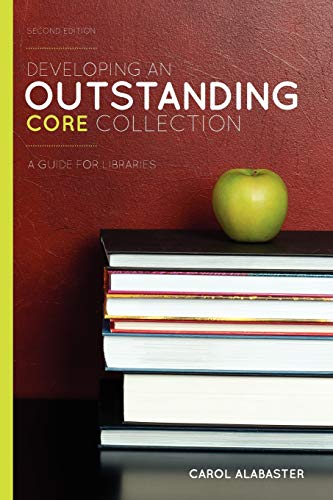
In this practical handbook, newly updated for 2010, Carol Alabaster focuses on developing a collection with high-quality materials while saving time and money. She addresses key collection development questions, including
- What criteria are used to identify a core title?
- What is the process for making selections?
- How is a collection maintained and improved?
- How are core titles tracked in the library's acquisition and circulation systems?
Packed with selection resources and sample core lists in seven subject areas, this soup-to-nuts manual will be useful whether you are starting from scratch or revitalizing an existing collection.
"synopsis" may belong to another edition of this title.
About the Author
Carol Alabaster is one of those women who love books too much, but an extremely fortunate one who has been able to indulge her passion full time as a librarian. She has more than thirty years experience working for public library systems in both New York City and Phoenix. During the thirteen years she was collection development coordinator for the Phoenix Public Library, she developed and implemented systemwide core collections. In addition to writing a weekly book review for the Arizona Republic for more than seven years, she was a National Book Award judge in 1982. She is retired from the Phoenix Public Library but continues to foster her love for books as a book club leader and a full-time reader.
Reviews
Building on the basic premises of the first edition (that the general public needs materials beyond current best-sellers and ready-reference works; that those materials should be high-quality, enduring pieces; and that librarians are the best persons to decide what constitutes appropriate core collections for their communities), Alabaster updates her previous suggestions and addresses the technological changes that drastically affect reading habits and our ability to satisfy the needs of “the people’s university.” Her updated bibliography, assessment of print and online review sources, and overview of how digitization might affect the way books are delivered make this title required reading for all those charged with the task of adult collection development—even if they have already absorbed the basic principles from the first edition. The sample collection-development policies and procedures should prove helpful to anyone responsible for dealing with the reality that no library can have everything and none can keep all they have—and then deciding which items must always be available in one form or another. --Sally Jane
"About this title" may belong to another edition of this title.
Search results for Developing an Outstanding Core Collection: A Guide...

Stock Image
Developing an Outstanding Core Collection : A Guide for Libraries
Published by
American Library Association, 2010
ISBN 10: 0838910408
ISBN 13: 9780838910405
Used
Softcover
Seller: Better World Books, Mishawaka, IN, U.S.A.
Seller rating 5 out of 5 stars

Condition: Very Good. Second. Former library copy. Pages intact with possible writing/highlighting. Binding strong with minor wear. Dust jackets/supplements may not be included. Includes library markings. Stock photo provided. Product includes identifying sticker. Better World Books: Buy Books. Do Good. Seller Inventory # 2549284-20
Stock Image
Developing an Outstanding Core Collection : A Guide for Libraries
Published by
American Library Association, 2010
ISBN 10: 0838910408
ISBN 13: 9780838910405
Used
Softcover
Seller: Better World Books, Mishawaka, IN, U.S.A.
Seller rating 5 out of 5 stars
Condition: Good. Second. Former library copy. Pages intact with minimal writing/highlighting. The binding may be loose and creased. Dust jackets/supplements are not included. Includes library markings. Stock photo provided. Product includes identifying sticker. Better World Books: Buy Books. Do Good. Seller Inventory # 2549283-75
Stock Image
Developing an Outstanding Core Collection : A Guide for Libraries
Published by
American Library Association, 2010
ISBN 10: 0838910408
ISBN 13: 9780838910405
Used
Softcover
Seller: Better World Books: West, Reno, NV, U.S.A.
Seller rating 5 out of 5 stars
Condition: Very Good. Second. Pages intact with possible writing/highlighting. Binding strong with minor wear. Dust jackets/supplements may not be included. Stock photo provided. Product includes identifying sticker. Better World Books: Buy Books. Do Good. Seller Inventory # 17932955-6
Stock Image
Developing an Outstanding Core Collection: A Guide for Libraries, Second Edition
Published by
American Library Association, 2010
ISBN 10: 0838910408
ISBN 13: 9780838910405
Used
Paperback
Seller: ThriftBooks-Atlanta, AUSTELL, GA, U.S.A.
Seller rating 5 out of 5 stars
Paperback. Condition: Very Good. No Jacket. Former library book; May have limited writing in cover pages. Pages are unmarked. ~ ThriftBooks: Read More, Spend Less. Seller Inventory # G0838910408I4N10
Stock Image
Developing an Outstanding Core Collection: A Guide for Libraries, Second Edition
Published by
American Library Association, 2010
ISBN 10: 0838910408
ISBN 13: 9780838910405
Used
Paperback
Seller: ThriftBooks-Dallas, Dallas, TX, U.S.A.
Seller rating 5 out of 5 stars
Paperback. Condition: Very Good. No Jacket. May have limited writing in cover pages. Pages are unmarked. ~ ThriftBooks: Read More, Spend Less. Seller Inventory # G0838910408I4N00
Stock Image
Developing an Outstanding Core Collection: A Guide for Libraries
Seller: GoldBooks, Denver, CO, U.S.A.
Seller rating 5 out of 5 stars
Paperback. Condition: new. New Copy. Customer Service Guaranteed. Seller Inventory # 9M74_74_0838910408
Stock Image
DevelopinganOutstandingCoreCollection Format: Paperback
Seller: INDOO, Avenel, NJ, U.S.A.
Seller rating 5 out of 5 stars
Condition: New. Brand New. Seller Inventory # 9780838910405
Stock Image
Developing an Outstanding Core Collection
Print on DemandSeller: PBShop.store UK, Fairford, GLOS, United Kingdom
Seller rating 5 out of 5 stars
PAP. Condition: New. New Book. Delivered from our UK warehouse in 4 to 14 business days. THIS BOOK IS PRINTED ON DEMAND. Established seller since 2000. Seller Inventory # IQ-9780838910405
Buy New
US$ 85.89
US$ 5.63 shipping
Ships from United Kingdom to U.S.A.
Ships from United Kingdom to U.S.A.
Quantity: 15 available
Stock Image
Developing an Outstanding Core Collection A Guide for Libraries
Published by
American Library Association, 2010
ISBN 10: 0838910408
ISBN 13: 9780838910405
New
Paperback
Seller: Revaluation Books, Exeter, United Kingdom
Seller rating 5 out of 5 stars
Paperback. Condition: Brand New. 2nd edition. 191 pages. 8.75x6.00x0.50 inches. In Stock. Seller Inventory # x-0838910408
Buy New
US$ 107.66
US$ 13.53 shipping
Ships from United Kingdom to U.S.A.
Ships from United Kingdom to U.S.A.
Quantity: 2 available
Seller Image
Developing an Outstanding Core Collection
Print on DemandSeller: moluna, Greven, Germany
Seller rating 5 out of 5 stars
Condition: New. Dieser Artikel ist ein Print on Demand Artikel und wird nach Ihrer Bestellung fuer Sie gedruckt. Updated for 2010, this focuses on developing a collection with high-quality materials while saving time and money. The author addresses key collection development questions, including: What criteria are used to identify a core title? What is the process f. Seller Inventory # 447092699
Buy New
US$ 92.40
US$ 56.80 shipping
Ships from Germany to U.S.A.
Ships from Germany to U.S.A.
Quantity: Over 20 available