
Items related to Lessons for a Long War: How America Can Win on New...
Synopsis
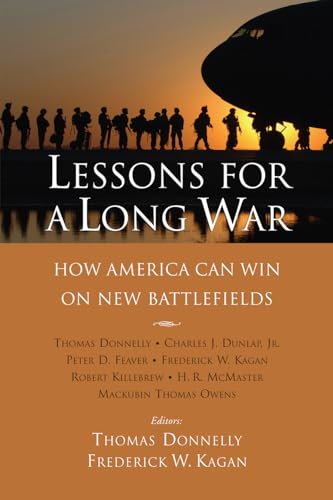
As the guarantor of international security, the United States must commit to a long-term military presence in Iraq and Afghanistan. But what are the tools necessary to succeed on the new battlefields of the Long War? In this volume, a group of the foremost U.S. military officials and national security experts analyze the American experience in Iraq and Afghanistan thus far in order to map a way forward―not only for the military, but for diplomats, elected officials, and the American public.
Thomas Donnelly, Frederick W. Kagan, and their coauthors offer several core lessons for success in The Long War. They argue that decentralizing command is the key to efficient operations on an ever-changing battlefield; that air power is the unsung hero of counterinsurgency warfare; that public opinion can influence crucial military decisions; and that the military should minimize its role in domestic affairs. Finally, although the battlefields have changed over the last fifty years, the authors contend that America's long-held counterinsurgency strategy―to foster political support at home, employ diplomacy overseas, and extend military assistance to allies―remains effective.
The Long War will not soon be over. But, in the words of retired Army special forces officer Colonel Robert Killebrew, the United States already has "the tools it needs in order to prevail in the wars of the twenty-first century."
"synopsis" may belong to another edition of this title.
About the Author
Thomas Donnelly is a resident fellow in defense and security policy studies at the American Enterprise Institute. He previously served as policy group director and professional staff member for the House Committee on Armed Services.
Frederick W. Kagan is a resident scholar at the American Enterprise Institute and director of the AEI Critical Threats Project. He was formerly associate professor of military history at the U.S. Military Academy at West Point.
Reviews
Since September 11 the phrase "the long war" has gradually emerged as a theoretical and practical alternative to "war on terrorism." "Long War" is defined, according to the editors of this new collection, as "an effort to create a new-- and by American standards better--political order across the Greater Middle East." Donnelly and Kagan, leading military analysts with the American Enterprise Institute, have assembled a distinguished team of contributors. Peter D. Feaver suggests a "Long War" model will temper current partisan divisions, as did the cold war. Mackubin Owens sees "Long War" as a paradigm for reducing civil-military tensions exacerbated by a focus on immediate solutions. A very persuasive Charles J. Dunlap Jr. calls for the air force to explain to government, the press, and the public why air power is both effective and necessary, despite civilian deaths. Robert Killibrew concludes the volume by calling for the army to prepare for "hybrid" insurgencies: complex synergies of terror, combat, and public relations. "Long War" is a comprehensive approach, as opposed to specific efforts to suppress specific groups, and it receives serious consideration in this policy-oriented book.
Copyright © Reed Business Information, a division of Reed Elsevier Inc. All rights reserved.
"About this title" may belong to another edition of this title.
Search results for Lessons for a Long War: How America Can Win on New...

Stock Image
Lessons for a Long War
Published by
American Enterprise Institute for Public Policy Research, 2010
ISBN 10: 0844743291
ISBN 13: 9780844743295
Used
Hardcover
Seller: Mobilis Books, Geneva, FL, U.S.A.
Seller rating 4 out of 5 stars

Condition: As New. Dust Jacket Condition: As New. Like new condition, like new DJ, no interior marks. As the guarantor of international security, the United States must commit to a long-term military presence in Iraq and Afghanistan. But what are the tools necessary to succeed on the new battlefields of the Long War? In this volume, a group of the foremost U. S. military officials and national security experts analyze the American experience in Iraq and Afghanistan thus far in order to map a way forward--not only for the military, but for diplomats, elected officials, and the American public. Thomas Donnelly, Frederick W. Kagan, and their coauthors offer several core lessons for success in The Long War. They argue that decentralizing command is the key to efficient operations on an ever-changing battlefield; that air power is the unsung hero of counterinsurgency warfare; that public opinion can influence crucial military decisions; and that the military should minimize its role in domestic affairs. Finally, although the battlefields have changed over the last fifty years, the authors contend that America's long-held counterinsurgency strategy--to foster political support at home, employ diplomacy overseas, and extend military assistance to allies--remains effective. The Long War will not soon be over. But, in the words of retired Army special forces officer Colonel Robert Killebrew, the United States already has "the tools it needs in order to prevail in the wars of the twenty-first century.". Seller Inventory # 1016
Stock Image
Lessons for a Long War : How America Can Win on New Battlefields
Published by
American Enterprise Institute for Public Policy Research, 2010
ISBN 10: 0844743291
ISBN 13: 9780844743295
Used
Hardcover
Seller: Better World Books, Mishawaka, IN, U.S.A.
Seller rating 5 out of 5 stars

Condition: Very Good. Former library copy. Pages intact with possible writing/highlighting. Binding strong with minor wear. Dust jackets/supplements may not be included. Includes library markings. Stock photo provided. Product includes identifying sticker. Better World Books: Buy Books. Do Good. Seller Inventory # 1056311-6
Stock Image
Lessons for a Long War: How America Can Win on New Battlefields
Seller: ThriftBooks-Dallas, Dallas, TX, U.S.A.
Seller rating 5 out of 5 stars
Hardcover. Condition: Very Good. No Jacket. May have limited writing in cover pages. Pages are unmarked. ~ ThriftBooks: Read More, Spend Less. Seller Inventory # G0844743291I4N00
Stock Image
Lessons for a Long War: How America Can Win on New Battlefields
Seller: ThriftBooks-Atlanta, AUSTELL, GA, U.S.A.
Seller rating 5 out of 5 stars
Hardcover. Condition: Very Good. No Jacket. Former library book; May have limited writing in cover pages. Pages are unmarked. ~ ThriftBooks: Read More, Spend Less. Seller Inventory # G0844743291I4N10
Stock Image
Lessons for a Long War: How America Can Win on New Battlefields
Seller: BooksRun, Philadelphia, PA, U.S.A.
Seller rating 5 out of 5 stars
Hardcover. Condition: Very Good. It's a well-cared-for item that has seen limited use. The item may show minor signs of wear. All the text is legible, with all pages included. It may have slight markings and/or highlighting. Seller Inventory # 0844743291-8-1
Seller Image
Lessons for a Long War: How America Can Win on New Battlefields
Seller: Greenworld Books, Arlington, TX, U.S.A.
Seller rating 5 out of 5 stars
Condition: like_new. Fast Free Shipping â" Excellent condition book with clean cover and pages. Barely handled, with minimal wear. An outstanding copy, close to enjoy! Seller Inventory # GWV.0844743291.LN
Stock Image
Lessons for a Long War: How America Can Win on New Battlefields
Seller: HPB-Movies, Dallas, TX, U.S.A.
Seller rating 4 out of 5 stars
hardcover. Condition: Very Good. Connecting readers with great books since 1972! Used books may not include companion materials, and may have some shelf wear or limited writing. We ship orders daily and Customer Service is our top priority! Seller Inventory # S_476217523
Stock Image
Lessons for a Long War: How America Can Win on New Battlefields
Seller: Revaluation Books, Exeter, United Kingdom
Seller rating 5 out of 5 stars
Hardcover. Condition: Brand New. 180 pages. 9.39x6.47x0.71 inches. In Stock. Seller Inventory # 0844743291
Buy New
US$ 109.30
US$ 13.40 shipping
Ships from United Kingdom to U.S.A.
Ships from United Kingdom to U.S.A.
Quantity: 1 available